Current Views: 353383
 Current Downloads: 212946
Advances in Linguistics Research
ISSN Print:2707-2622
ISSN Online:2707-2630
Contact Editorial Office



Subscribe to the latest published information from SCISCAN
Text Type and Text Structure Visualization —AI-Based Analysis and Instructional Design


-
Information:
Yangtze University, Jingzhou, China
-
Keywords:
Text Type; Discourse Structure; Generative Artificial Intelligence; Secondary School English; Instructional Design
- Abstract: Through case-based practice, this study explores the capacity of Generative Artificial Intelligence (GenAI) to analyze and visualize text types and structures, as well as its potential to empower instructional design for secondary school English. Findings indicate that GenAI can provide accurate, in-depth, and lucid analyses of discourse types and their macro- and meso-structures. Furthermore, it generates appropriate visualizations and offers creative instructional designs that align with mainstream pedagogical principles, specifically targeting text type awareness and structural competence. The study concludes that elaborated prompt design is the pivotal factor, and such prompts must embody a profound understanding of discourse types and structures, including representative exemplars.
- DOI: 10.35534/lin.0802006
- Cite: Lu, S. Y., Yang, L. B., & Xie, J. C. (2026). Text type and text structure visualization—AI-based analysis and instructional design. Advances in Linguistics Research, 8 (2), 55-68.
1 Introduction
As one of the six core elements of the English curriculum, text (or “yupian” in Chinese)—specifically its types and structures—is a critical component of both textual analysis and classroom instruction. The English Curriculum Standards for Senior High Education defines the primary requirement for receptive skills as the ability to “identify different text types and grasp their structural and linguistic features” (Ministry of Education of the People’s Republic of China, 2020, p. 32–33). This ability not only facilitates a deeper understanding of textual meaning but also enables students to communicate and express themselves effectively using diverse discourse types. However, the inherent complexity of text type and structure often leads to inaccurate text type classification by teachers, resulting in students’ lack of text type or stylistic awareness and neglect of the specific communicative purposes embedded in different text types (Zhang, 2023; Ye, 2024; Yu & Chen, 2024). Furthermore, teachers often demonstrate insufficient understanding of discourse organization at both macro-, meso-, and micro levels. Interpretations of English discourse structures tend to be superficial and fragmented, focusing on isolated information nodes and paragraph divisions rather than the holistic interconnections between paragraphs. This issue is compounded by a lack of cognitive scaffolding for structural interpretation, such as visualization instruments, necessary for decoding complex discourse structures (Lu, 2022; Li, 2023; Wang, Duan, & Liu, 2025).
With its robust comprehension and text-generation capabilities, Generative Artificial Intelligence (GenAI) can identify and analyze text types and structures while producing visual resources. These affordances serve to deepen teachers’ understanding of discourse, enhance the efficiency of text analysis, and provide new insights for instructional design and classroom practice (Zhang, 2025). Although existing research has explored AI’s application in analyzing secondary school English textbooks, studies specifically targeting AI-empowered analysis of discourse types and structures remain scarce. Through case analysis, this study investigates AI’s performance in text type identification, structural analysis, and visualization, with a particular focus on prompt design strategies and the quality of the generated outputs.
2 Literature Review
2.1 The Complexity of Discourse Types
The terminology used to refer to discourse types is multifaceted, encompassing “types of discourse” (Fang, 1998), “genre” (Liang & Kang, 2012), and “text type” (Liu, 2018). Some scholars argue that genre is primarily a dynamic social process defined by its macro-level communicative purpose; thus, the most critical criterion for distinguishing genres is the intent of communication (Swales, 1990). In contrast, text type is viewed as a static category defined by a group of texts sharing similar internal linguistic features and functional tendencies (Yu, 2003). While these two concepts are not identical, they are often complementary. In discourse analysis practice, the terms “genre” and “text type” are frequently used interchangeably, with “text type” sometimes treated as a synonym for “genre” or “style” (Yu, 2003). Among China’s various English Curriculum Standards, the term “text type” (yupian leixing) is predominantly used, with occasional references to “stylistic forms” (Ministry of Education of the People’s Republic of China, 2020; 2022). The New Curriculum Standards (NCS) categorize the text types required for secondary education, revealing a hybrid taxonomy: categories such as “narrative” and “expository” align with genre definitions, while “operational guides” and “menus”—classified by internal linguistic features—correspond more closely to text type. Rather than terminological disambiguation, this paper follows the NCS convention of using “text type” as an umbrella term for both.
The inherent complexity of these classifications stems from the fact that they are shaped by diverse criteria, including content organization, functional purpose, and modality (e.g., spoken vs. written) (Yu, 2003; Nunan, 2008). This multifaceted nature is evident in the specific discourse requirements outlined across different proficiency levels in the NCS (Ministry of Education of the People’s Republic of China, 2020; 2022), where categories such as “narrative” and “new media discourse” clearly rely on disparate classification standards. Furthermore, macro-level discourse types can be further subdivided. For instance, the new National Curriculum Standards categorize expository writing into sub-types such as introductory essays, descriptions of processes or phenomena, explanations of principles, written instructions, operation guides, and manuals. The complexity of discourse types is also reflected in the fact that a single genre may adopt different rhetorical structures, leading to distinct discourse types; for example, the expository genre can manifest as operation guides, manuals, or even menus (Yu, 2003). Consequently, genre identification requires integrated analysis of communicative function, discourse structure, and linguistic form rather than uniform application of criteria (Zhu, 2023). Additionally, text types themselves present challenges of internal complexity, extensive variation, and fuzzy boundaries, comprising both prototypical instances and less clear-cut examples.
2.2 The Complexity of Discourse Structure
Discourse structure, also referred to as textual organization, refers to the sequential arrangement of information from sentence to paragraph to entire text (Li, 2023). This structure is inherently hierarchical, often categorized into macro-, meso-, and micro-levels (He & Zhang, 2016) or dichotomized into macro- and micro-structures (Cheng, 2005; Ministry of Education of the People’s Republic of China, 2022). Given these varying perspectives, a definitive consensus on specific classification systems has yet to be reached among scholars.
A discourse possesses a single overarching logical framework to which all paragraphs are subordinate. Consequently, inter-paragraph relationships and the relation between textual segments and the global theme constitute macro-organizational structure (Ministry of Education of the People’s Republic of China, 2020). This structure manifests the overall organizational flow and structural characteristics, illustrating how the macro-layout underscores the thematic meaning (Mei & Wang, 2018). That is, macro-structure concerns the organizational patterns and semantic coherence of the text as an integral whole (Yu & Chen, 2024). Common textual patterns include the “problem-solution,” “general-specific,” and “claim-counterclaim” patterns (Liu, 1999). Existing research has also explored these macro-structures within the context of secondary school English teaching. For common text types such as narratives, scholars often apply Labov’s narrative analysis model, which divides a complete narrative into six elements: abstract, orientation, complicating action, evaluation, resolution, and coda (Wu, 2020). For argumentative essays, frameworks such as the “phenomenon-problem-argument-conclusion” model (Cao et al., 2025) and the OREO structure (Opinion, Reason, Example/Explanation, Opinion restated) (Huang & Jiang, 2017) are widely used. Furthermore, research utilizes the Toulmin Model of Argumentation, emphasizing its three core elements: claim, grounds/evidence, and warrant (Sun, 2018). For other text types, one example is the news report, which is typically analyzed through its three-part structure—headline, lead, and body—or via the “pyramid” and “inverted pyramid” models (Gu, 2024).
Viewed through the lens of paragraph functions, discourse themes often exhibit several typical macro-structural patterns. These include the General-Specific structure, characterized by an opening paragraph that establishes the theme, followed by middle paragraphs that expand upon it (Chen & Zhang, 2020). Other common formats include the three-part structure: Beginning, Body, and Ending (Tang, 2020) and the five-paragraph structure: Introduction, three body paragraphs, and a Conclusion (Chen, 2018). Furthermore, research-based discourse typically encompasses elements such as Introduction, Topic, Research Process, Findings, Explanation, Conclusion, and Significance (Zhang, 2023).
In addition, from a holistic unit perspective, secondary school English textbooks often feature “multi-texts”—composed of two or more interconnected passages—within their reading and extended reading sections. These multi-text structures typically manifest in five patterns: problem-solution, enumeration, comparison-contrast, cause-effect, and main-subordinate (Yin, 2025).
However, existing literature offers limited exploration of meso- and micro-discourse structures, and their definitions remain somewhat ambiguous. For instance, some scholars define the meso-structure1 as the substructures and components nested within the macro-structure, advocating for an analysis based on the specific functions of these elements (He & Zhang, 2016). In contrast, the micro-structure is characterized by its focus on specific grammatical constructions, lexical choices, and semantic cohesion between sentences (Cheng, 2005).
2.3 Visualization of Discourse Structure
Given the inherent complexity of discourse structure, developing a holistic understanding requires cognitive scaffolding to enhance students’ text type awareness. Visualizing thinking, for instance, effectively integrates fragmented information while foregrounding textual logic (Wang, Duan, & Liu, 2025). Consequently, discourse structure is typically schematized through graphic organizers such as mind maps, information maps, or concept maps (Xu, 2018). Yet classroom implementation reveals persistent pitfalls: superficial text analysis or limited familiarity with visualization tools often lead to arbitrary diagram selection and inadequate alignment between genre and graphic representation (Jiang, 2021).
Existing research has examined visualization methods for various discourse genres. At the macro-structural level, narrative texts may be represented through story mountains or wave diagrams to illustrate plot development, while argumentative writing commonly employs five-paragraph structure diagrams (Jiang, 2021; Pan & Guo, 2025). Regarding meso-structure, diverse visual options correspond to different logical relations, with tables being the most versatile—suitable for comparison, contrast, classification, character analysis, and enumerating advantages, disadvantages, or opposing viewpoints. Additionally, Venn diagrams and T-charts facilitate information comparison, whereas flow maps and timelines effectively sequence steps or chronological events. For non-continuous texts involving procedural steps or operational guidelines, flow maps offer a particularly intuitive structural representation. Brace maps, meanwhile, display multi-layered part-whole relationships (Jiang, 2021; Nie, 2023).
3 Case-Based Practice and Analysis
3.1 Prompt Design Strategies
Prompt design critically determines the quality of AI-generated output. Research indicates that elaborated prompts significantly enhance generation quality compared to simple ones (Weng et al., 2025). This study adopts elaborated prompts; due to space constraints, only the key elements are outlined below.
This study adopts the BRTR framework for prompt organization: Background, Role, Task, and Requirement. The Background specifies the educational stage, basic information about the target text, the instructional design context, and the student profile. The Role component positions the AI as a secondary English teaching specialist with deep knowledge of curriculum standards and classroom practice, extensive expertise in discourse and discourse pedagogy, and particular proficiency in text type and structure analysis alongside visualization tools. The Task consists of four components: 1) Identifying the text types of the uploaded text; 2) concisely justifying this classification by analyzing the core communicative function with supporting evidence; 3) Analyzing the discourse structure compatible with the identified text type, focusing first on the macro-structure (the overarching organization of the text) and then on the meso-structure (an optional task); 4) Developing a detailed instructional plan targeting text type awareness and structural competence based on the foregoing analysis.
The Requirement module constitutes the most critical component of a prompt. This study contends that this module should embody a profound understanding of text types and structures, specify detailed output expectations, and incorporate exemplary models where possible. To ensure the AI grasps the task’s full scope, the prompts integrate key theoretical foundations from the preceding sections of this paper, including definitions, the multi-dimensional classifications and inherent complexities of text types as outlined in the National Curriculum Standards, and the characteristics of text types common in secondary school English. Furthermore, the prompts cover the categorization and complexity of discourse structures (at macro and meso levels), typical macro-structural models for various text types (with examples), and common visualization techniques (also with examples).
The Requirement Module also specifies the output requirements, which are detailed as follows:
1) Language and Difficulty Requirements: All generated content must be in English, with expression that is idiomatic and calibrated to the target learners’ linguistic and cognitive levels. Specifically, texts for junior secondary students must adhere to the Compulsory Education English Curriculum Standards vocabulary threshold (1,500 words).
2) Output Sequence and Specifications: ① Text type identification: however, if the text involves multiple types, explicitly
specify primary-secondary relationships with explanatory justification. ②Classification rationale: provide justifications for the identification based on factors such as the text’s communicative functions. ③ Comparative analysis (Optional): if the text is a non-classical text type, provide an in-depth comparison with classical types. ④ Macro-structural analysis: Avoid conflating textual structure with paragraph structure or reducing it to a summary of main ideas. Even when paragraph-based, analysis should attend to how segments serve the global theme—identifying patterns such as general-specific or three-part structures. ⑤ Meso-structural Analysis (Optional): Perform this only if the text exhibits distinct meso-level organizational features. Note: All foregoing outputs should be visualized where possible, accompanied by concise explication. ⑥ Instructional design: Design teaching activities focused exclusively on the previously analyzed text types and structures (macro and meso). The teaching plan must include detailed teacher questioning, predicted student outputs, and required resources (e.g., scaffolding).
3.2 Case Analysis
For this study, we selected an atypical text, Should I Be Allowed to Make My Own Decisions? from Unit 7, Section B 2b of the Grade 9 “Go for it!” textbook (People’s Education Press). Various AI platforms were tested, all of which yielded pedagogically illuminating outputs. This study uses four mainstream GenAI tools with fixed versions: Gemini 3.1 Pro, ChatGPT 4o, DeepSeek R1 and Kimi 2.5; all prompts and outputs are recorded in full to ensure replicability, to demonstrate how generative AI, guided by elaborated prompts, can enhance instruction on text type and structure. Due to space constraints, only content directly relevant to the research theme is presented. The AI-generated content has been abridged and reformatted for concision. The analysis comprises six key components (tasks): text type identification, rationale for identification, comparative analysis with canonical text types, macro-discourse structure, meso-discourse structure, and instructional design.
Task 1: text type Conclusion
Table 1 summarizes the text type identifications generated by the four AI platforms.
Table 1 Text type identification by four AI platforms
|
AI Platforms |
text type Conclusion(Main text type) |
Supporting Text Type |
|
Gemini 3.1 Pro |
Discussion essay. |
Story |
|
ChatGPT 4o |
Argumentation in a real-life case |
Narrative |
|
DeepSeek R1 |
Discussion text |
Personal narrative |
|
KIMI 2.5 |
Discussion |
Story |
Task 2:Reasons for text type Determination (from Gemeni)
The main goal of the text is to show different opinions and persuade readers to think about the problem. (To explain why parents and teenagers have different ideas about hobbies and schoolwork.)
Text Evidence: 1) The Title: It asks a question: Should I Be Allowed to Make My Own Decisions? This shows a debate; 2) The First Paragraph: It asks the readers, Do you agree? This invites the reader to think about their own opinion; 3) Keywords: It uses words like agree, disagree,... These words show that people are sharing different points of view.
Case Commentary: All four AI platforms identified the dual characteristics of “Discussion” and “Narrative” within the text, reflecting the “hybrid text type” nature commonly found in English language teaching (ELT) materials. Except for ChatGPT 4o, all platforms categorized the text type as a “Discussion”. This classification adheres to the principle that text type identification should primarily be based on the overarching rhetorical purpose of the discourse (Swales, 1990); indeed, the subsequent rationales provided by the AI all highlighted that the text’s primary objective is to present diverse perspectives and stimulate discussion. This text type is close to the “opinion/argument texts” at Level 3+ in the Compulsory Education English Curriculum Standards (Ministry of Education of the People’s Republic of China, 2022, p. 18). Regarding sub-types, while the terminology used by the platforms varied slightly, their core assessments remained consistent. Notably, ChatGPT categorized the text as “Argumentation” yet emphasized its “discussion” function in the subsequent analysis. This internal inconsistency suggests that AI may still falter when judging complex text types. However, ChatGPT rectified its classification following a follow-up inquiry during the human-AI interaction.
Task 3: Comparison with Classic Text types (from ChatGPT)
AI-generated comparisons between the target text and classic text types were presented in tabular format across all platforms. Among them, ChatGPT offered the most comprehensive set of analytical dimensions; some dimensions are detailed in Table 2.
Table 2 Multi-dimensional Comparison with Classic Text Types
|
Comparison Area |
Discussion (this text type) |
Classic Argumentative Essay |
Classic For-and-Against Essay |
Classic Narrative |
|
Purpose |
Present a debatable issue and let readers judge |
Persuade readers to accept the writer’s position |
Present both sides and help readers weigh them (often with a final evaluation) |
Entertain, ..., or show personal growth |
|
Macro structure |
Issue→Case background →Two-sided arguments→ Open-ended conflict |
Thesis(clear stance) → reasons+ evidence→ counterargument+ refutation→ conclusion (strong closure) |
Often grouped by side (all pros, then all cons) → weighing/evaluation/possible compromise |
Beginning-middle–end plot → clearer outcome/ resolution |
|
Stance & ending |
Writer’s stance is hidden/soft; ending (no final solution) |
Stance is clear early; ending restates and strengthens the thesis |
May stay balanced but often ends with a “weighing” paragraph or suggested compromise |
Resolution is common; conflict is usually settled |
|
Evidence/ support |
One personal case as “evidence”; ... |
Broader evidence (facts, numbers,...) |
Uses reasons on both sides; ... |
Details support mood/character change... |
Note: Due to space constraints, some comparative dimensions, such as Language style, Organization of viewpoints and Reader task, have been omitted from this table.
Case Commentary: Firstly, the comparative analysis thoroughly covers a wide range of classical text types, including the Classic Argumentative Essay, Classic For-and-Against Essay, and Classic Narrative. Furthermore, the analysis employs diverse dimensions, such as communicative purpose, macro-structure, stance and conclusion, evidence types and so on, thereby encompassing the primary aspects of text type analysis. Secondly, the key points identified are concise, accurate, and highly readable. Their presentation in a tabular format facilitates quick identification of differences between textbook discourse and classical text types by both teachers and students, making this a valuable teaching reference. However, minor inaccuracies appear. For instance, the For-and-Against Essay is characterized as “often grouped by side (all pros, then all cons)”. In contrast, instruction typically emphasizes the coexistence of block and point-by-point patterns. Thus, this particular statement risks overgeneralization.
Task 4: Macro Structure
Macro structure: Issue → Case background → Two-sided arguments → Ongoing conflict (open-ended)
Part 1 sets the issue and reader task. Parts 2–5 provide a case and organize arguments in alternating voices (parents vs. teen). The ending strengthens the teen’s claim but still leaves the conflict unresolved (no final solution).
The foregoing content was generated by ChatGPT, which also provided the overall macro-structure from a functional perspective, specifically as a “discussion framework” (see Figure 1). Similarly, Kimi also illustrated the macro-discourse structure with a discussion framework (see Figure 2).
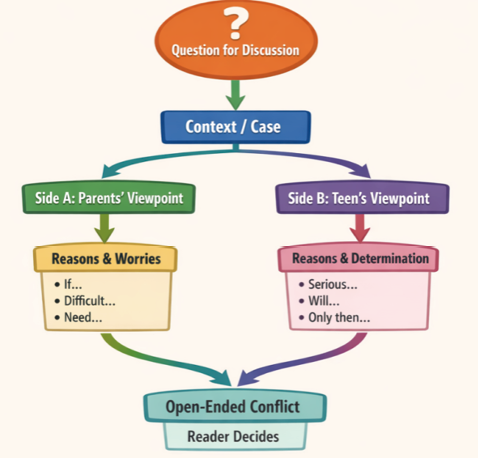
Figure 1 Macro-structure from ChatGPT
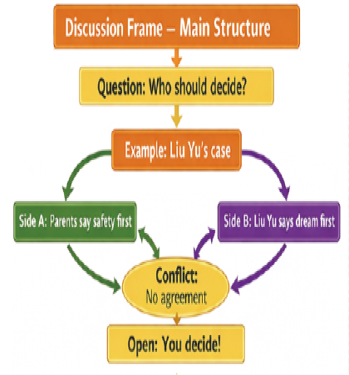
Figure 2 Macro-structure from Kimi
Note: The framework was initially in Mermaid’s Markdown code format, which was rendered into the diagram by ChatGPT-4o. The same applies to the other diagrams.
Task 5: Meso-Discourse Structure
ChatGPT analyzed the structure of the parents’ reasoning in the second paragraph, identifying a “concession + counterargument” pattern.
Concession: parents show support first (reduce conflict); Turn: “But…” introduces worry and main argument; Reasoning: future risk (“if… doesn’t end up…”)
In contrast, Kimi focused on the textual evidence of the shared reasoning patterns employed by both parties.
Both sides first show they understand the other side, then give their own view.
Parents: “Of course we want to see him achieve his dreams... BUT...”
Liu Yu: “I know my parents care about me... BUT...”
Furthermore, the AI platforms generated visualizations of these structures, such as the “Parents’ Reasoning Path” provided by ChatGPT (see Figure 3).
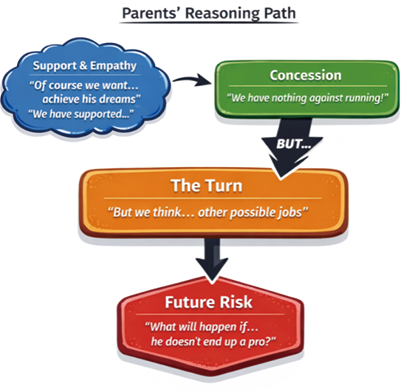
Figure 3 Meso-structure of Parents’ Reasoning Path from ChatGPT
Additionally, Kimi also analyzed the meso-structure of paragraphs 2-5, identifying a Compare-Contrast Structure, as detailed in Figure 4.
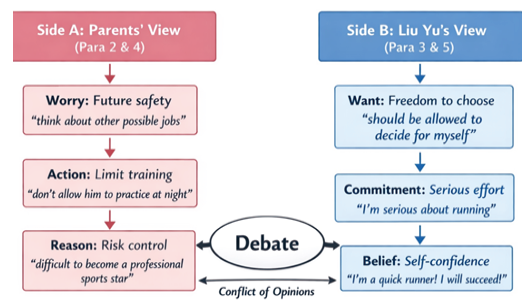
Figure 4 Meso-level Compare-Contrast Structure
Case Commentary: Both AI platforms demonstrated commendable accuracy, analytical depth, and pedagogical appropriateness in their macro- and meso-structural analyses and visualizations. Regarding the macro-structure, both accurately identified the overarching discussion framework and, by incorporating paragraph functions, effectively highlighted the text’s open-ended nature. This accuracy was further reinforced through apt visualization choices. At the meso-level, the analyses exhibited substantial depth, precisely identifying and explicating reasoning structures and compare-contrast patterns—pedagogical appropriateness manifested in multiple dimensions. The AI-generated outputs not only mapped out structures clearly—such as the three-step argumentative chain of “Concession → Turn → Reasoning”—but also provided supporting evidence from the original text. This integration provided students with observable, imitable linguistic models, forging direct connections between structural analysis and language learning. Such an evidence-based analytical approach aligns with fundamental pedagogical principles: from form to function, from language to structure. Furthermore, the clarity, precision, and accessibility of the generated language allow teachers to adapt these outputs directly for classroom instruction. Finally, this practice suggests that different AI platforms can complement one another, providing educators with a broader range of instructional options.
Task 6:Teaching Activities
The following activities are designed by Kimi.
Activity 1: Text Type Detective
Objective: Find out text type features and mixed characteristics
Materials: Text handout, Text type Feature Checklist
Step 1: Individual Scanning
Teacher says: “Read the title and first paragraph. Is this mainly a story, or mainly a discussion?”
Students do: Circle discussion words (should, allowed, agree, think) in red; circle story parts (names, places) in blue
Step 2: Feature Sorting
Teacher gives checklist:
□ Asks a question □ Shows different opinions
□ Uses examples □ No clear ending - you decide
□ People and place □ Dialogue
Students do: Check applicable features and count: Discussion features ( ); Story features ( )
Step 3: Pair Discussion
Teacher asks: “Does the story serve the discussion, or does the discussion serve the story?”
Expected student answer: (omitted)
Language help: Sentence frame “This text uses a story about ___, but its real purpose is to discuss ___.”
Step 4: Class Consensus
Teacher confirms: “This is a discussion text that uses story form. Discussion is the main type, story is the tool.”
Visual aid: Draw a box labeled “Discussion” with a smaller box inside labeled “Story Tools”.
Activity 2: Structure Mapping
Objective: Visualize the text’s problem-discussion structure
Materials: Structure template worksheet, colored pencils
Step 1: Paragraph Function Matching
Teacher says: “Each paragraph has a job in the discussion. Match the paragraph to its function.”(Use the Worksheet table below):
|
Paragraph |
Function Options |
Your Choice |
|
1 |
A. Give example B. Ask question C. Show solution |
|
|
2 |
A. Show first side B. Give example C. Ask question |
|
|
3 |
A. Parents’ view B. Liu Yu’s view C. |
|
|
4 |
A. Relax rules B. Make stricter rules C. ... |
|
|
5 |
A. Happy ending B. Strengthen Liu Yu’s side + Open C. Give answer |
Answer key: 1-B, 2-A, 3-B, 4-B, 5-B
Step 2: Visual Mapping---Discussion Frame
Teacher says: “Draw the text structure using the Question-Example-Discussion template.”
Help provided: Step 1: Raise question (Paragraph ___), Step 2: Give example (Paragraph ___), Step 3: Show Side A (Paragraphs ___), Step 4: Show Side B (Paragraphs ___), Step 5: Invite answer (Paragraph ___)
Expected completion: (omitted)
Step 3: Structure Reflection
Teacher asks: “Why does the writer use Liu Yu’s story instead of just saying ‘Some parents think... Some teenagers think...’?”
Expected answer: (omitted)
Activity 3: Perspective T-Chart
Objective: Analyze the compare-contrast structure in middle paragraphs
Materials: T-Chart template, text markers (two colors)
Step 1: Evidence Hunting
Teacher says: “Find what parents say vs. what Liu Yu says. Use red for parents, blue for Liu Yu.” using the T-Chart template below:
|
Parents’ Points (Red) |
Liu Yu’s Counterpoints (Blue) |
|
“We want to see him achieve dreams, BUT...” |
“I understand, BUT...” |
|
“He needs to think about other jobs” |
“It’s the only thing I’ve ever wanted” |
|
“He needs to spend more time on homework” |
“I should be allowed to decide” |
|
“It’s difficult to become a professional” |
“I’m a quick runner! I will succeed!” |
Step 2: Pattern Recognition
Teacher asks: “Look at the language. How do both sides show they care about each other before disagreeing?”
Guidance: (1)Parents: “Of course we want to see him achieve his dreams” (giving in before restriction); (2)Liu Yu: “I know my parents care about me” (saying yes before insistence)
Expected answer: (omitted)
Activity 4: Critical Discussion---Four Corners
Objective: Produce reasoned opinions using text structure and evidence
Materials: Discussion cards, evaluation rubric
Step 1: Position Taking---Four Corners
Teacher instructions: “Corner A (Strong Agree): Liu Yu should decide for himself”; “Corner B (Agree): Liu Yu should mostly decide, with parents’ advice”; “Corner C (Disagree): Parents should mostly decide, considering Liu Yu’s opinion”; “Corner D (Strong Disagree): Parents should decide until Liu Yu is older”
Physical movement: Students move to corners based on personal opinion
Safety reminder: “No corner is wrong. We are exploring different views.”
Step 2: Reflection & Consensus Building
Teacher asks: “Is there a solution that respects both sides? Think about the text structure—could there be a ‘Paragraph 6’?”
Expected creative answers: “Maybe Liu Yu can promise to keep grades up while training” (compromise); “Maybe parents can allow weekend training but not weekdays” (negotiation); “Maybe Liu Yu needs to show he can be responsible first” (conditional agreement)
Language output: Students write one sentence using “I think Liu Yu should be allowed to... if/when...”
Evaluation rubric: (omitted)
Activity 5: Text Type Transformation Writing---Homework
Objective: Change discussion into pure story OR into pure Argumentative essay
Materials: Writing template, type-specific checklists
Task Options (Students choose one):
Option A: Pure Argumentative Essay (Classic 5-Paragraph Structure). Change the text into a formal Argumentative essay with a clear position.
Paragraph 1 (Introduction): Hook: General statement about teenage decisions. Background: Brief mention of Liu Yu’s case as example. Thesis statement: “Teenagers should/should not be allowed to make their own decisions because...”
Paragraph 2 (Reason 1): Topic sentence; Evidence from text or personal experience; ·Explanation
Paragraph 3 (Reason 2): Topic sentence; Evidence; Explanation
Paragraph 4 (Other Side): Acknowledge opposite view (use text evidence); Answer back with evidence
Paragraph 5 (Conclusion): Restate thesis; Summarize main points; Final thought/call to action
Option B: Pure Story Completion (Classic Story Ending). Write “Paragraph 6” with a clear ending to Liu Yu’s story.
Requirements: 1) Liu Yu’s voice (passionate, determined); 2) Keep parents’ voice (caring, careful); 3) Show a specific event (talk, race, meeting with coach); 4) Provide happy ending, sad ending, or surprise twist; 5) Use dialogue format like original text; 6) Must have a clear resolution (not open ending)
Evaluation Checklist (for both options) (omitted):
Case Commentary: Overall, this instructional design establishes a clear and coherent pathway of text type-oriented teaching: text type identification as the point of departure, visualization of macro- and meso-structure as scaffolding, and value-based discussion and creative writing as culmination. This sequence forms a “recognition, exploration, internalization, transfer” trajectory centered on text type and structure. The design aligns with established principles of secondary English instruction. Firstly, the activities fully embody a learner-centered philosophy, guiding students to discover, summarize, and express themselves through various methods. Furthermore, the activities align with the “learning-understanding, application-practice, transfer-innovation” progression of the English Learning Activity View. The first three activities focus on the cognitive processing of text types and structures, falling under the “Learning & Understanding” stage. The latter two activities—the “Four Corners” discussion and a text type-switching writing task—prompt students to transfer this structured knowledge into personal expression and creative output, falling under the application-practice and transfer-innovation stages. This sequencing aligns with the cognitive trajectory from input through internalization to output. Additionally, the design integrates the four core competencies of the English subject: language competence, thinking quality, cultural awareness, and learning ability. For instance, learning ability, the use of text-type checklists, structural templates, and self-assessment rubrics, fosters metacognitive strategies and autonomous learning. Moreover, the design is fully calibrated to junior secondary English proficiency levels and uses extensive visual scaffolding to reduce cognitive load in text type and structure recognition. The design also excels at stimulating student interest through engaging topic selection. For instance, Activity 4 (the “Four Corners” discussion) translates the abstract structural analysis of the text into relatable value-judgment topics, effectively stimulating students’ motivation to express themselves. Furthermore, the pedagogical design demonstrates notable innovation. Methodologically, activities embody “inquiry-based learning”—Activity 1’s “text type detective” approach, for example, guides students to independently discover hybrid text type features rather than receive direct instruction. This aligns perfectly with the recent emphasis on “guided discovery” within text-type-based pedagogy. In terms of presentation, the design adeptly employs a diverse array of visualization tools.
4 Conclusion
This case study demonstrates that GenAI significantly empowers teachers in analyzing text types and structures, as well as in instructional design. It provides robust professional support for frontline secondary English teachers, particularly in identifying atypical text types, articulating rationales, and discourse structures. However, given that the inherent complexity of discourse can lead to variations in the quality of AI-generated output, teachers should remain critical of the results. To optimize AI empowerment, frontline English teachers are encouraged to integrate materials across different platforms, refine content through human-AI interaction, and adapt AI-generated outputs to suit their specific student profiles.
Practice also underscores the critical importance of prompt engineering. The depth and granularity of task understanding embedded within the prompt largely determine the professionalism and appropriateness of the generated outputs. Developing prompt design expertise, however, requires sustained professional development, which entails continuous updating of pedagogical beliefs, accumulating canonical exemplars, practice, reflection, and optimization. Therefore, teachers should be aware that iterative prompt refinement is, in essence, an internalization process of professional development, deepening subject-matter understanding while simultaneously enhancing AI literacy. Only through such professional growth can prompt design competence be ensured. This improvement, in turn, fosters the ability to critically evaluate and collaboratively refine AI-generated content, and ultimately enables effective human-AI collaboration.
References
[1] Cao, Y. H., Lu, M. Y., Xu, G. H., & Li, H. F. (2025). Research on teaching strategies for senior high school English argumentative reading emphasizing the cultivation of thinking quality. Foreign Language Teaching in Primary and Secondary Schools, (12), 31–37.
[2] Chen, C. H., & Zhang, J. S. (2020). Principles and practice of visualized blackboard design in junior high school English. English Teaching and Research in Primary and Secondary Schools, (6), 29–31, 46.
[3] Chen, Y. S. (2018). Application of the five-paragraph essay writing method in senior high school English writing instruction. Foreign Language Teaching in Primary and Secondary Schools (Middle School Edition), (5), 30–34.
[4] Cheng, X. T. (2005). Discourse-based approaches to language teaching. Foreign Language Teaching Abroad, (1), 8–16.
[5] Fang, Y. (1998). A brief discussion on genre. Foreign Languages (Journal of Shanghai International Studies University), (1), 18–23.
[6] Gu, W. H. (2024). Teaching practice of news report discourse in senior high school English permeated with thinking quality cultivation. English Teaching and Research in Primary and Secondary Schools, (7), 42–47.
[7] He, J. H., & Zhang, D. L. (2016). Research on the types, levels, and analysis models of discourse structure. Foreign Languages and Foreign Language Teaching, (1), 74–80, 148.
[8] Huang, X. X., & Jiang, X. J. (2017). Application of OREO structure in argumentative writing instruction for junior high school English. Foreign Language Teaching in Primary and Secondary Schools, 40(9), 18–22.
[9] Jiang, J. L. (2021). Application analysis of thinking visualization graphics in reading instruction. Teaching Monthly: Middle School Edition (Foreign Language Teaching), (Z2), 43–47.
[10] Li, F. Q. (2023). Strategies for interpreting thinking patterns in English discourse structure. Foreign Language Teaching in Primary and Secondary Schools (Middle School Edition), (4), 9–14.
[11] Liang, W. H., & Kang, S. M. (2012). A comparative study of three major schools of “genre theory”. Foreign Language Research, (1), 54–60.
[12] Liu, C. D. (1999). Pedagogical text linguistics. Shanghai Foreign Language Education Press.
[13] Liu, X. F. (2018). Review of foreign discourse type research. Journal of Suzhou University of Science and Technology (Social Science Edition), (2), 79–85, 108.
[14] Lu, X. F. (2022). A practical study on constructing structured knowledge with visual thinking tools: Taking narrative genres as an example. English Teaching and Research in Primary and Secondary Schools, (12), 41–45.
[15] Mei, D. M., & Wang, Q. (2018). Interpretation of the English curriculum standards for senior high school (2017 edition). Higher Education Press.
[16] Ministry of Education of the People’s Republic of China. (2020). English curriculum standards for senior high school education (2017 Edition, Revised 2020). People’s Education Press.
[17] Ministry of Education of the People’s Republic of China. (2022). English curriculum standards for compulsory education (2022 Edition). Beijing Normal University Press.
[18] Nie, X. L. (2023). Design of English reading teaching activities guided by visualized thinking. English Teaching and Research in Primary and Secondary Schools, (3), 67–71.
[19] Nunan, D. (2008). Exploring genre and register in contemporary English. English Today, 24(2), 56–61.
[20] Pan, J. X., & Guo, H. Y. (2025). Practical strategies for enhancing senior high school students’ English discourse awareness using visual thinking tools. English Teaching and Research in Primary and Secondary Schools, (1), 26–31, 36.
[21] Sun, Y. (2018). Application of Toulmin’s argumentation model in argumentative writing instruction for senior high school English. Foreign Language Teaching in Primary and Secondary Schools, 41(11), 6–10.
[22] Swales, J. (1990). Genre analysis: English in academic and research settings. Cambridge University Press.
[23] Tang, J. H. (2020). Strategies for cultivating students’ discourse structure awareness in junior high school English teaching. Foreign Language Teaching in Primary and Secondary Schools (Middle School Edition), 43(3), 12–16.
[24] Wang, X. C., Duan, Y. Y., & Liu, X. W. (2025). Practice of junior high school English reading instruction based on visualized thinking. English Learning, (4), 48–53.
[25] Weng, S. X., He, Z. Y., Liang, Y. Y., & Zhang, Z. (2025). Design strategies for generative AI-empowered prompt engineering in junior high school English reading instruction. Digital Teaching in Primary and Secondary Schools, (1), 10–16.
[26] Wu, X. R. (2020). Application of Labov’s narrative analysis model in English narrative reading instruction. English Teaching and Research in Primary and Secondary Schools, (11), 44–48.
[27] Xu, L. X. (2018). Research on instructional activity design for cultivating high school students’ awareness of English discourse structure. English Teaching and Research in Primary and Secondary Schools, (3), 25–29.
[28] Ye, Y. M. (2024). Application of functional stylistics theory in the interpretation of senior high school English texts. English Teaching and Research in Middle Schools, (12), 44–48.
[29] Yin, H. X. (2025). Analysis of multi-text discourse structures and teaching strategies in senior high school English. English Teaching and Research in Primary and Secondary Schools, (5), 47–51.
[30] Yu, H. (2003). Discourse genre, discourse type and foreign language teaching. Journal of PLA University of Foreign Languages, (5), 13–17.
[31] Yu, Y. M., & Chen, T. (2024). Strengthening the teaching model of discourse analysis to enhance English instruction effectiveness: A review of Discourse Analysis in English Language Teaching. Technology-enhanced Foreign Language Education, (3), 99–102.
[32] Zhang, X. (2023). Teaching practice of research report discourse in review class in senior high school English reading. Foreign Language Teaching in Primary and Secondary Schools, (9), 72–76.
[33] Zhang, Z. H. (2025). Application of generative artificial intelligence in English discourse study. China Modern Educational Equipment, (6), 7–10.
[34] Zhu, X. Y. (2023). Discourse analysis in English language teaching. Foreign Language Teaching and Research Press.
1 The meso-structure is defined as the functional sub-units and logical relations embedded within the macro-structure.
Continued