Current Views: 365641
 Current Downloads: 220273
Advances in Linguistics Research
ISSN Print:2707-2622
ISSN Online:2707-2630
Contact Editorial Office



Subscribe to the latest published information from SCISCAN
Study on the Semantic Evolution of the Spanish Adjective “Guapo” from the Perspective of Area Studies


-
Information:
Central South University, Changsha, China
-
Keywords:
Guapo; Semantic Change; Area Studies; Social Structure Transformation; Linguistic Regional Variation
- Abstract: The core meaning of the Spanish adjective “guapo” shifted from “brave” to “handsome” between the mid-18th century and the 19th century. This study retrieves all full tokens of “guapo” (1638-1889) from the Corpus del Nuevo Diccionario Histórico de la Lengua Española (CNDHE) (n=790). Only adjectival uses of the masculine form “guapo” (excluding the feminine “guapa”) were retained, and cases where the senses cannot be clearly determined as either “brave” or “handsome” were excluded. Each token was manually coded for sense (brave/handsome) by the author following a predefined coding scheme. To ensure reliability, the author re-coded a random 40% sample after an interval of two months, achieving an inter‑temporal agreement rate of 96.3%; all discrepant cases were jointly re‑examined and finalized. The findings show that the frequency of the “handsome” sense gradually surpassed that of “brave” from 1750 onwards, yet this sense was not officially included in authoritative dictionaries until 1884. Distinguishing itself from the cognitive linguistics approach in existing research, this study adopts a sociolinguistic and historical linguistic framework to situate lexical semantic change within the macro-historical context of Spain’s transformation from a traditional agricultural society to a modern nation-state. By integrating social structural transformation, regional variation, state-building processes, and collective psychological change, this study shows how social transformation, regional differences, and cognitive tendencies jointly correlate with the semantic evolution of “guapo”. This change reflects the joint effects of internal cognitive mechanisms (metaphor/metonymy) and external social-structural transformation, rather than either factor alone. The findings demonstrate that Spain’s modernization process provided the social conditions for this shift. At the same time, cognitive mechanisms shaped its direction and trajectory, manifesting the temporal dislocation and spatial heterogeneity between the central Madrid region and the peripheral Andalusia region.
- DOI: 10.35534/lin.0802011
- Cite: Zhao, Y. X. (2026). Study on the Semantic Evolution of the Spanish Adjective “Guapo” from the Perspective of Area Studies. Advances in Linguistics Research, 8 (2), 126-137.
1 Introduction
The most common meaning of the Spanish adjective “guapo” in modern Spanish is “good-looking”, used to describe a person’s appearance. Given that Spanish adjectives distinguish grammatical gender (e.g., masculine guapo and feminine guapa), the core semantic evolution examined in this study, namely the shift from “brave” to “handsome”, has historically primarily targeted men as the subject of evaluation, with the vast majority of corpus examples appearing in the masculine form. This paper uniformly adopts the masculine form “guapo” as the case for diachronic analysis. However, tracing its etymology and early usage reveals that the original meaning of “guapo” was closely related to “brave” or “courageous”, and its etymology can be traced further back to the Latin word “vappa” (spoiled wine, extended to mean rogue or rascal), which carried a pejorative connotation. From “rascal” to “brave” (one semantic amelioration) and then to “handsome” (a major semantic shift), this word underwent two pivotal changes over more than four centuries. The complexity of its evolutionary trajectory and the breadth of its semantic shift are quite rare among Western European languages.
In terms of existing research, Provencio Garrigós (2016) conducted a systematic diachronic prototype semantic analysis of the adjective “guapo”, revealing a modal shift from olfactory and gustatory perception to visual perception, and pointed out that the semantic changes are driven by psychological motivations as well as metaphorical and metonymic mechanisms. However, this study primarily focuses on cognitive mechanisms and perceptual modalities, paying relatively little attention to the specific historical context of Spanish social structural transformation in the 18th and 19th centuries, and does not fully explain why this semantic evolution occurred precisely in the second half of the 18th century. Different from the cognitive linguistics approach of existing studies, this paper introduces the theoretical framework and research methods of Area Studies. Regarding the disciplinary positioning of Area Studies, Jiang Feng and Li Wei (2025) point out that this discipline has entered a “new stage of substantive construction”, with its core tasks being “serving national strategies, regional economic development, and the construction of an independent knowledge system”. As to how foreign language disciplines can participate in Area Studies, Cai Jigang (2025) explicitly proposes that foreign language disciplines should engage in Area Studies by leveraging their strengths in culture, literature, and linguistics, using tools such as corpus methods, rather than simply copying the approaches of political science or
economics.
Based on the above theoretical foundations, this paper uses the CNDHE of the Royal Spanish Academy (Royal Spanish Academy, n.d.). It retrieves all corpus entries containing “guapo” from 1638 (the year of the word’s first appearance) to 1889, conducts quantitative statistics and semantic judgment, and draws on the observation by the Spanish writer Manuel Fernández Y González in 1871 regarding the geographical distribution of the meanings of “guapo”. By employing the theoretical framework and research methods of area studies, as well as relevant research in Spanish social history and economic history, this paper aims to explore the social structural transformation dynamics behind the semantic evolution of “guapo” and the cognitive psychological selection process of the citizen class.
2 Etymological tracing of “guapo” and its first semantic amelioration
There is a turning point in the initial semantics of “guapo” that is often overlooked in relation to its modern usage. It was not originally a positive word but rather underwent a semantic amelioration from a negative to a positive meaning. Therefore, to fully understand the semantic shift of “guapo” from “brave” to “handsome”, relying solely on corpus data from after the 18th century is insufficient. The starting point of this word’s evolution dates back much earlier. Its etymology can be traced to Classical Latin. Moreover, when “guapo” first appeared in Castilian literature in the mid-17th century, it carried not the positive connotation known to later generations but rather a distinctly different pejorative core. Consequently, before proceeding with the diachronic trajectory analysis, it is necessary to systematically trace the etymology of “guapo” first.
2.1 The Latin “vappa”: from “spoiled wine” to “rogue”
The word “guapo” originates from the Latin term “vappa”. In Classical Latin, the original meaning of “vappa” was “spoiled wine”, referring to wine that had lost its original flavor and become bland or sour due to improper storage or excessive aging. From this concrete and negative sensory experience, Latin speakers extended the meaning of “vappa” through metaphorical expansion to refer to a person who, like spoiled wine, had lost their proper qualities, for instance, a “useless person”, “rogue”, or “idler”. Provencio Garrigós explicitly states in her research:
“El adjetivo guapo ha pasado del latín (vappa ‘vino desvirtuado, evaporado’, fig. ‘hombre inútil, bribón, granuja’) al castellano actual (‘bien parecido’, ‘acicalado, bien vestido’).”[The adjective “guapo” has experienced a semantic evolution from Latin (“vappa”: “spoiled, evaporated wine”, figuratively “useless man, rogue, rascal”) to modern Spanish (“good-looking”, “neatly dressed, well-attired”). ]
It is worth noting that because spoiled wine emits a sour and foul odor and also has an unpleasant taste upon drinking, the original semantics of “vappa” actually involved two types of perception: smell and taste. In the transition from “vappa” to “guapo”, a shift in perceptual modality occurred from olfactory and gustatory perception to visual perception, a feature Provencio identifies as core to its semantic evolution.
2.2 The transmission path from Latin to Castilian
Regarding the time when “guapo” first appeared in Castilian literature, Provencio provides a precise textual research: “desde su primera aparición en la documentación castellana (1638) con connotaciones peyorativas.” (since its earliest attested use in Castilian documentation in 1638 with pejorative connotations) It is worth clarifying that this pejorative sense marks only the initial stage of the word’s recorded history in Spanish, but pejorative and positive usages coexisted for several decades thereafter.
However, “vappa” likely passed through the mediation of medieval French dialects before entering Spanish. Provencio points out that the Latin “vappa” first entered medieval French or Provençal, where it underwent initial semantic changes, and only then was it transmitted to the Iberian Peninsula. This view is supported by etymological evidence: the Spanish “guapo” corresponds formally to the French “vape” (which in medieval French referred to “weak, worthless”), and this French form in turn derives precisely from the Latin “vappa”. Corominas and Pascual’s (1980-1991) Diccionario crítico etimológico castellano e hispánico, which is the definitive authority of Spanish historical lexicography, also confirms the same trajectory from Latin “vappa” through medieval French to Spanish “guapo”. This etymological trajectory is fully confirmed by Corominas and Pascual’s Diccionario crítico etimológico castellano e hispánico, the authoritative source for Spanish historical lexicography.
“from Italian dialect guappo swaggerer, tough, from Spanish guapo, probably from Middle French dialect vape, wape weak, insipid, from Latin vappa wine gone flat.”(Merriam-Webster, n.d.)
This evolution was inseparable from the frequent population movements and cultural exchanges between France and the Iberian Peninsula during the Middle Ages. The Camino de Santiago, the cross-regional activities of military orders, and later the marital ties between the Bourbon family and the Spanish royal family all provided channels for the cross-regional transmission of the word.
2.3 First semantic amelioration: from “roguish” to “brave”
The transition of “guapo” from “roguish” to “brave” was a gradual, overlapping process that began in the late 16th century but coexisted with pejorative usages well into the mid-17th century, as evidenced by its 1638 appearance, which still carried pejorative connotations. By the late 17th century, the “brave” sense had gradually become dominant.
Provencio demonstrates that the mechanism of this amelioration is closely related to “psychological motivations and metaphorical and metonymic mechanisms”.
“El cambio semántico obedece a motivaciones de orden psicológico y a mecanismos metafóricos y metonímicos generados por el saber enciclopédico de los hablantes y por el contexto sociocultural en el que viven.” (the semantic change is driven by psychological motivations as well as metaphorical and metonymic mechanisms generated by the encyclopedic knowledge of speakers and the sociocultural context in which they live.)
Social revaluation allowed a word that originally referred to marginal figures in society (rogues, rascals) to be reassigned by Spanish society as an expression of admiration for brave and valiant male qualities. The social logic behind this may relate to the revaluation of a certain “rugged masculinity” in early modern Spain. Against the backdrop of imperial expansion and military campaigns, traits of marginal figures originally perceived as “dangerous” may have been reinterpreted as the warrior qualities of “fearless bravery”. Thus, “guapo” completed the first phase of its semantic evolution: from pejorative “rogue” to positive “brave”. The consolidation of the “brave” sense as the dominant meaning likely occurred in the late 17th to early 18th century, setting the stage for the second semantic shift from “brave” to “handsome”.
This etymological tracing provides a dual revelation for understanding the subsequent evolution of “guapo” from “brave” to “handsome”. First, the semantics of “guapo” did not follow a straight line but rather underwent a twofold shift: from pejorative to positive “brave” and then to positive “handsome”. Many users know only the modern meaning of “guapo” as “handsome”, unaware of its archaic meaning of “brave”, and even fewer know that it originally referred to “spoiled wine” and “rogue”. Second, the evolutionary history of “guapo” demonstrates that this word has a high degree of semantic plasticity. It changed its core referent twice yet consistently retained a strong evaluative connotation (whether pejorative or positive). This “stability of evaluative coloring” is precisely the key prerequisite that enabled it to later carry new aesthetic values.
From the perspective of Area Studies, the etymological transmission path of “guapo” itself is a typical case of cross-regional language contact. The mediating path by which this word traveled from the Latin “vappa” into Castilian via medieval French or Provençal is deeply connected to regional interaction events such as the Camino de Santiago, the activities of military orders, and royal marriages. Lexical diffusion is not merely the diffusion of linguistic forms, but rather a chain of linguistic evidence for “material exchange, population movement, and deep cultural integration” (Wang, 2026). Therefore, “guapo” carried the gene of cross-regional mobility from the very moment it entered the Spanish language. This gene endowed it with a high degree of semantic adaptability across different sociohistorical contexts, providing important historical groundwork for the second semantic evolution in the 18th and 19th centuries that will be analyzed later.
3 Diachronic trajectory and synchronic evidence of semantic evolution
An analysis of all statements containing “guapo” recorded in the CNDHE from 1638 to 1889 shows that the meaning of the word underwent a significant turning point in the second half of the 18th century. Specifically, after 1750, the frequency of the “handsome” meaning increased rapidly and gradually became dominant, while the “brave” meaning showed a corresponding declining trend. From a period comparison perspective, between 1638 and 1750, the “brave” meaning accounted for approximately 75% and the “handsome” meaning approximately 25%. Between 1750 and 1820, the two meanings entered a period of contention, with the “handsome” meaning rising from about 25% to 53%. Between 1820 and 1889, the “handsome” meaning stabilized at approximately 87%, becoming the absolute dominant meaning. This diachronic fluctuation in frequency signifies that the semantic focus of “guapo” was shifting from inner “bravery” to outer “handsomeness”. This diachronic evolutionary trend received clear synchronic evidence in 1871 from the novel El guapo Francisco Estévan by the Spanish writer Manuel Fernández y González. The author pointed out that:
“En todas las provincias de España, menos en las del Mediodía y Levante, guapo es sinónimo de bonito; en Andalucía y en toda la costa del Mediterráneo hasta Cartagena, guapo significa valiente.”(Fernández y González, 1871) (In all the provinces of Spain, except those in the South and East, “guapo” is synonymous with “bonito” [pretty]; in Andalusia and along the entire Mediterranean coast as far as Cartagena, “guapo” means “valiente” [brave].)
Because Andalusia and the Mediterranean coast were still dominated by the traditional large estate economy in the 19th century, where family honor and individual bravery remained core elements of social evaluation, “guapo” retained its archaic meaning of “brave” in these regions. In contrast, central and northern Spain, especially the Madrid area, had earlier experienced the urbanization, commercialization, and bourgeois cultural infiltration brought about by the Bourbon reforms. The emerging aesthetic standards emphasized appearance, cultivation, and personal presentation, so the new meaning of “handsome” for “guapo” took a dominant position there.
The geographical differences observed at the same temporal cross-section are essentially a juxtapositional presentation of different stages of social development. The more traditional a region’s social structure, the more the language tends to retain archaic meanings; the deeper a region’s social transformation, the more quickly the language adopts new meanings. This synchronic geographical observation, though documented in a single contemporary literary source, provides external evidence consistent with the diachronic corpus trend, suggesting a correlation between social structure and lexical meaning. This finding confirms Labov’s sociolinguistics assumption that the social distribution of linguistic variation reflects differences in social structure (Labov, 1972). It carries significant linguistic and social-historical implications. First, it proves that by 1871, the new meaning of “handsome” had become the dominant semantic meaning in most regions of Spain, fully consistent with the diachronic corpus data showing this meaning occupying an absolute dominant position after 1820. Second, it reveals that Andalusia and the Mediterranean coast, as “semantic islands”, retained the archaic meaning of “brave”, a geographical distribution that was by no means
accidental.
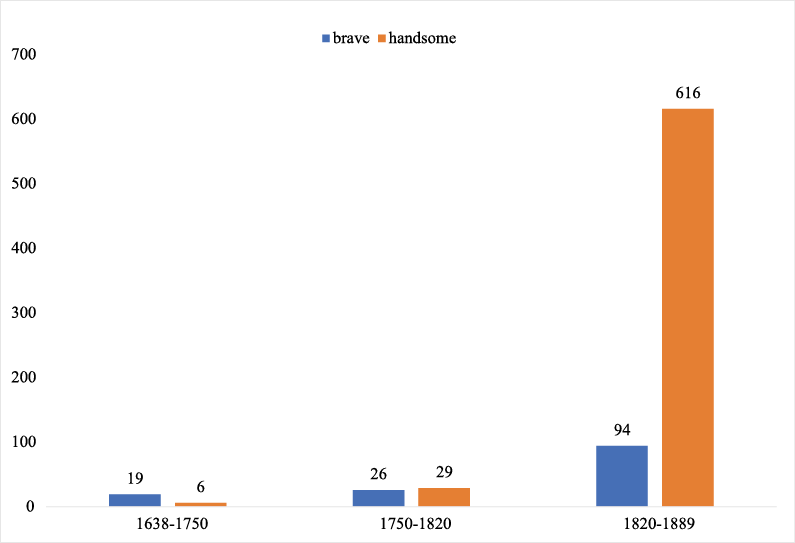
Figure 1 Proportional changes of the senses, brave and handsome of “guapo” (masculine adjectival valid tokens, CNDHE 1638–1889)
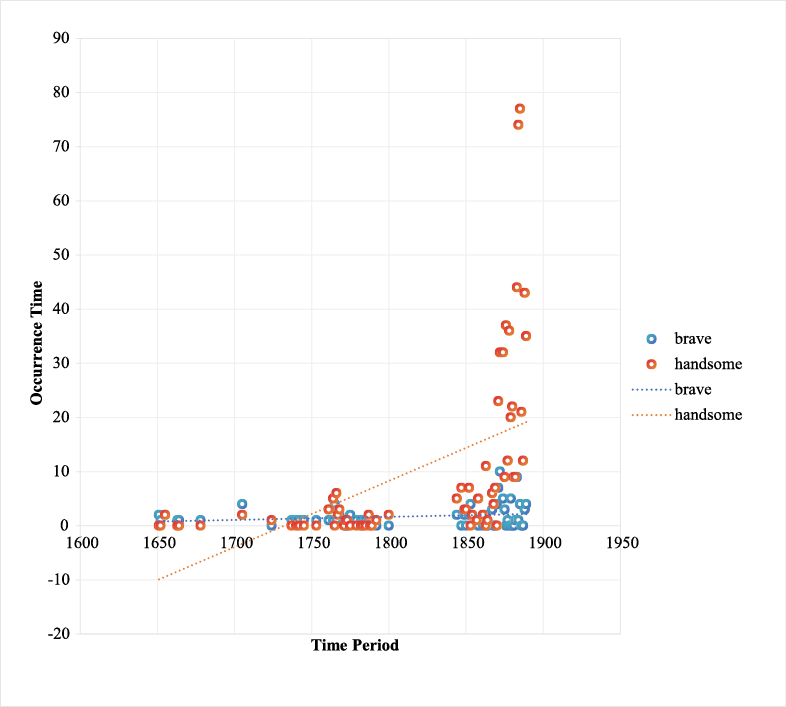
Figure 2 Diachronic frequency distribution of the senses brave and handsome of “guapo” (valid tokens, CNDHE 1638–1889)
4 Analysis of the sociocultural motivations for semantic evolution from the perspective of Area Studies
The diachronic corpus data presented above reveal the general trajectory of semantic change in “guapo”, but do not alone explain its underlying drivers. To explain why an adjective originally referring to an inner quality of bravery gradually shifted to describing external appearance, it is necessary to move beyond the linguistic system itself and enter the sociohistorical context of 18th and 19th-century Spain. The retention of the “brave” meaning in Andalusia is closely related to its traditional large estate economic structure. In contrast, the early adoption of the new “handsome” meaning in Madrid is synchronized with its process of urbanization and commercialization. This comparison suggests a co-varying relationship rather than a simple causal chain between the semantic evolution of “guapo”, social structural transformation, and cognitive psychological selection. In other words, social transformation provided the enabling conditions for semantic change, while the cognitive mechanism shaped its specific direction and trajectory. This section adopts the perspective of Area Studies to conduct an analysis across three dimensions: social structural transformation, the impact of war, and geospatial differences.
4.1 Social structural transformation: the rise of the bourgeoisie and the formation of new aesthetic standards
Sociolinguist W. Bright (1964) pointed out that when social life undergoes gradual or dramatic changes, language as a social phenomenon unambiguously changes in step with the progress of social life. The semantic evolution of “guapo” in the 18th and 19th centuries is precisely a linguistic manifestation of the structural transformation of Spanish society.
The 18th century witnessed a series of profound reforms in Spain under Bourbon rule. During the reign of Charles III (1759-1788), reforms accelerated. Roads and ports were constructed, internal trade barriers were abolished, and the appearance of cities such as Madrid began to modernize. Public lighting and drainage systems were improved, and the Paseo del Prado became a place for citizens to stroll and relax. These changes not only transformed the physical appearance of cities but also altered the lifestyle of citizens.
Within this process of urbanization, a new social group began to rise. Composed of the emerging commercial class, administrative officials, liberal professionals, and others, this group did not rely entirely on lineage and land. Instead, it gained social status through education and professional skills. However, this emerging group faced identity anxiety. They were neither traditional aristocrats nor content to be classified among the commoners. They needed a new set of aesthetic standards, distinct from those of the traditional landed aristocracy (who took pride in lineage and bravery), to construct their own class identity. The core concept of this new set of standards was “urbanidad” (“courtesy” or “civility”), referring to the etiquette, refinement, and proper behavior acquired through urban life. Within these new standards, a person’s external appearance became an important basis for judging their social worth.
In such a social atmosphere, the criteria for evaluating a person gradually shifted from “how brave is he” to “how presentable is he”. “Guapo”, due to its unique semantic characteristics (having already transformed from a pejorative term into a strongly positive evaluative word, being used primarily for men, and possessing semantic “flexibility”), became an ideal candidate to carry this new evaluative function. When a man from the citizen class appeared decently dressed in public, others praised him with “¡Qué guapo!” (How handsome!). What they appreciated was his overall external image. In this context, the semantic shift of “guapo” from “brave” to “handsome” was made possible by the convergence of two factors. Externally, urbanization and the rise of new aesthetic standards created a social need for a positive adjective to evaluate male appearance. Internally, “guapo” already carried a strong positive evaluative charge (from its first amelioration to “brave”), making it a semantically “ready” candidate. More importantly, a metaphorical mechanism was at work. In the emerging urban public spaces, a man’s “bravery” was no longer directly observable, but his “handsome appearance”, like his clothing, grooming, and demeanor, became the publicly visible proxy for his personal worth. Speakers thus extended “guapo” from an inner quality to its outward manifestation, a classic case of metonymic shift (part for whole, or cause for effect). This cognitive operation, repeated across countless daily interactions, gradually solidified the new meaning.
4.2 Nation-building and the impact of war: the catalytic role of the War of Independence
If the Bourbon reforms and urbanization provided the “push” for the semantic evolution of “guapo”, then the Spanish War of Independence from 1808 to 1814 provided an “accelerator”.
Firstly, war acted as a “rupture of order”. In May 1808, Napoleon invaded Spain, forcing Charles IV and Ferdinand VII to abdicate successively. Uprisings broke out across Spain, initiating six years of guerrilla warfare. Historian Lovett (1965) pointed out that this war “produced a decisive turning point in the development of Spanish history, fully exposing what was decaying within the old regime”. After the War of Independence, Spain entered a period of prolonged instability. The old absolutist monarchy could never be fully restored, and the value system closely tied to the old order, including the traditional praise of “brave” men, gradually lost its self-evident legitimacy.
Secondly, the political consequences of local elites and popular mobilization. During the War of Independence, provinces not occupied by the French army established “Supreme Juntas” (Juntas Supremas) as alternative governing bodies. Historian Hocquellet (2008) conducted a detailed analysis of the composition of these juntas, pointing out that although the establishment of these institutions had a significant character of popular uprising, their successful operation depended on the participation of local elites, especially the old guard who had opposed Godoy. This process of power restructuring broke down the hierarchical order of the old regime, allowing commoners and local elites to form new social connections and value consensuses through their joint resistance against the foreign enemy. The war “nationalized the personal experiences” of the Spanish populace. The political concept of national identity had begun to take shape before this conflict, but the war pushed this identity to all social strata. Throughout this process, the traditional aristocratic concept of honor tied to “bravery” gradually lost its monopoly.
Thirdly, the establishment of a new value system. Jin Zhongyuan (2003) points out that after the War of Independence, “Enlightenment ideas had been disseminated through Jovellanos and others, who propagated progressive thoughts and advocated for social reform.”The rationality, civility, and individual worth championed by these ideas gradually reshaped the evaluative standards of social elites, shifting the focus from ‘valor’ to ‘appearance’, which carried more modern civilizational characteristics. From the perspective of corpus data, the growth curve for the “handsome” meaning became significantly steeper after the War of Independence, with the number of instances growing exponentially after 1820. This confirms the catalytic role of the War of Independence.
4.3 Geospatial differences: linguistic lag in Andalusia and alternative continuity in the Rio de la Plata region
The geographical distribution of the meanings of “guapo”, with Andalusia retaining the “brave” meaning and the north-central region adopting the “handsome” meaning, is a typical manifestation of uneven regional development in Spain. However, the sense “brave” also persisted in transatlantic varieties such as Río de la Plata Spanish, where it became associated with urban male subculture, illustrating spatial divergence in semantic evolution.
Historical roots of the Andalusian latifundio system. Andalusia historically developed an agricultural economic structure centered on the latifundio (large estate). The formation of this structure can be traced back to the conquest of Al-Andalus by the Kingdom of Castile during the Middle Ages. Between 1212 and 1492, the Kingdom of Castile gradually occupied the territory of Al-Andalus. During the conquest, land was distributed to nobles, the Church, and military orders, forming the prototype of the latifundio system. Scholar García Fernández (2026) conceptualizes this process as “internal structural coloniality”, pointing out that the exploitation model of large estate owners gave rise to early capitalist forms, as land was distributed by right of conquest and became a tradable commodity. This historical legacy resulted in a highly rigid social structure in Andalusia with low mobility: a small number of landowners possessed the vast majority of land. In contrast, the overwhelming majority of peasants became landless day laborers. In this social structure, individual worth was more closely tied to traditional qualities such as family honor and bravery rather than to modern qualities such as personal appearance and cultivation. Consequently, “guapo” as an evaluative term meaning “brave” retained its vitality in this social context.
Transatlantic continuity of the “brave” meaning: the case of the Rio de la Plata. It is worth noting that the “brave” meaning of “guapo” was not only retained in Andalusia but also, after crossing the Atlantic, developed unique sociocultural connotations in the Rio de la Plata region, particularly in Argentina and Uruguay. According to historical research on tango, in late 19th and early 20th-century Buenos Aires, the word “guapo” was used to refer to a specific type of urban marginal figure. These individuals were typically “legendary characters who wore scarves and carried daggers”, displaying their courage and arrogance in cafes and on street corners. During this period, Argentine tango culture produced numerous classic works themed around “guapo”, such as El Último Guapo (The Last Guapo), Un Guapo del 900 (A Guapo from the 900s), and Ley de Guapos (Law of Guapos).
This transatlantic continuity of meaning carries significant implications for Area Studies. In the Rio de la Plata region, the “brave” meaning of “guapo” was not only retained but also deeply intertwined with urban marginal culture, the ecology of the immigrant underclass, and tango subculture, forming a distinct image of “guapo”. This figure was brave, aggressive, arrogant, and marginal, standing in sharp contrast to the “handsome” meaning on the Spanish peninsula. This phenomenon illustrates that the semantic evolution of words involves not only “temporal lag” but also “spatial divergence”. The same word may evolve along completely different trajectories in different colonial and postcolonial contexts, even exhibiting diametrically opposite semantic focuses within the same historical period.
4.4 The synergistic effect of social structure and cognitive psychology
The semantic evolution of “guapo” is the result of the synergistic effect between “social structural transformation” and “cognitive psychological selection”, two dimensions that are mutually embedded and inseparable. It is neither reducible to social causes alone nor to internal cognitive mechanisms alone.
At the level of social structure, the urbanization, commercialization, and Bourbon reforms of the 18th and 19th centuries in Spain gave rise to an emerging bourgeoisie. This class needed a new set of aesthetic standards based on appearance and cultivation to construct its class identity. The War of Independence, in turn, destabilized the traditional rural honor system centered on “bravery”, stripping the value judgments tied to the old order of their self-evident legitimacy. These two forces worked together to provide the social conditions for the shift of “guapo” from “brave” to “handsome”.
At the level of cognitive psychology, Provencio’s research explicitly states that semantic change is “driven by psychological motivations as well as metaphorical and metonymic mechanisms”. She further clarifies that these mechanisms are “generated by the encyclopedic knowledge of speakers and the sociocultural context in which they live”. In other words, the semantic shift of “guapo” was not an arbitrary linguistic phenomenon but rather a rational choice by language users, based on their cognitive understanding of the world and social experiences, to shift the evaluative focus from inner “bravery” to outer “handsomeness” through metaphorical mapping. Following the principle of economy, language users selected “guapo”, which already carried a strong positive connotation, to assume this new evaluative function. This process was not a conscious linguistic planning effort but rather a “semantic drift” gradually accomplished through countless contextualized uses in daily communication. The emerging urban public spaces of the 19th century (cafés, theaters, public promenades) served as key arenas for the dissemination of the new meaning, accelerating its spread and entrenchment.
Without the social conditions provided by social structural transformation, the new meaning of “guapo” would have lacked the social soil for diffusion. Without the pathways provided by cognitive psychological mechanisms, the semantic evolution could hardly have been completed within a finite timeframe. It is precisely the coupling of external social conditions and internal cognitive mechanisms that jointly shaped the semantic trajectory of “guapo” from “brave” to “handsome”. This trajectory not only reflects the regional unevenness of the modernization in Spain and its former colonies but also confirms language’s fundamental role as a mirror of society.
5 Discussion
This study faces three main limitations. First, the text types in the CNDHE corpus are biased toward literary works, with insufficient coverage of spoken language, letters, and other forms closer to everyday speech. This may affect, to some extent, the assessment of how quickly the new meaning spreads in oral language. Second, the study focuses on a single adjective and pays insufficient attention to the simultaneous changes in other lexical items within the semantic field of “handsomeness” (such as “hermoso”, “lindo”, “bonito”, etc.). It is therefore difficult to fully determine whether the evolution of “guapo” was a unique trajectory or part of a broader semantic reorganization. Third, the explanation for the retention of the “brave” meaning in Andalusia relies primarily on indirect historical documents and socioeconomic analyses, lacking direct evidence from spoken corpora or dialectal materials from within the region itself.
Future research may advance in the following directions. First, apply the Area Studies perspective to the study of semantic evolution in other Spanish adjectives to test the applicability and explanatory power of the theoretical framework developed here. Second, employ digital humanities techniques to conduct quantitative analyses of larger diachronic corpora, aiming to delineate more precisely the critical points and transmission pathways of semantic shifts. Third, conduct cross-regional comparative studies to systematically compare the similarities and differences in the evolution of the same lexical items between Spain and various Latin American countries, revealing the long-term effects of colonial history, migration patterns, and cultural policies on linguistic evolution. Through these efforts, research on language change may truly become an important bridge connecting linguistics, history, sociology, and Area Studies.
6 Conclusion
The semantic evolution of “guapo” from “brave” to “handsome” vividly reflects Spain’s social transformation and uneven regional development in the 18th and 19th centuries, essentially constituting a linguistic reflection of Spain’s modernization trajectory.
The rise of the emerging bourgeoisie, the advancement of urbanization, and the dissemination of Enlightenment ideas jointly gave rise to new aesthetic standards centered on “urbanidad” and outward appearance. The War of Independence undermined the traditional honor system linked to bravery, clearing ideological space for the semantic shift. Meanwhile, regions such as Andalusia, due to their unique latifundio economic structure and cultural conservatism, retained the archaic meaning of “brave”, creating a temporal lag relative to the central region.
From the perspective of Area Studies, situating lexical semantic evolution within the macro-historical context of Spain’s transformation from a traditional agricultural society to a modern nation-state reveals the deep coupling between language change and specific regional social structures, geographical differences, and institutional transformations. The shift of “guapo” from “brave” to “handsome” is not merely an internal adjustment within the linguistic system but also a clear linguistic trace of the asynchronous development between central and peripheral regions and the unevenness of the modernization process in Spain. This case demonstrates that language is not a neutral system of signs but rather a sedimented carrier of social cognition, cultural values, and historical experience. Semantic change often captures shifts in social psychology and the reconstruction of collective aesthetics more sensitively than institutional history does.
At the practical level, the evolution of “guapo” also provides historical clues for understanding contemporary linguistic differentiation within the Spanish-speaking world. In Latin America, particularly in the Rio de la Plata region, “guapo” did not completely shift toward “handsome”; rather, it was solidified within tango culture as the image of a “brave, marginal male figure”. This transatlantic semantic divergence reminds us that when studying global linguistic evolution, we must pay attention to the complex entanglement of colonial legacy, immigrant societies, and postcolonial identity.
References
[1] Bright, W. (1964). Sociolinguistics: Proceedings of the UCLA Sociolinguistics Conference. Mouton.
[2] Cai, J. G. (2025). Country-and-area studies for the discipline of foreign linguistics and literature: Difficulties, approaches and strategies. Foreign Language Learning Theory and Practice, 198(6), 54.
[3] Corominas, J., & Pascual, J. A. (1980–1991). Diccionario crítico etimológico castellano e hispánico. Gredos.
[4] Fernández y González, M. (1871). El guapo Francisco Estévan. Impr. de D. Valero.
[5] García Fernández, J. (2026). Latifundia, capitalism and internal structural coloniality (13th–17th centuries): Theoretical approaches to historical thinking on Andalusian latifundium. Revista Tabula Rasa, (85).
[6] Hocquellet, R. (2008). Local elites and patriotic uprising: The composition of the Juntas Provinciales in 1808. Historia y Política, (19), 110.
[7] Jiang, F., & Li, W. (2025). Research status and practical pathways of area studies. Journal of Northwest University (Philosophy and Social Science Edition), (6).
[8] Jin, Z. Y. (2003). The War of Independence: The first revolution of Spain in the 19th century. Historical Review, (5), 116–122.
[9] Labov, W. (1972). Sociolinguistic patterns. University of Pennsylvania Press.
[10] Lovett, G. H. (1965). Napoleon and the birth of modern Spain. New York University Press.
[11] Merriam-Webster. (n.d.). Wop. In Merriam-Webster.com dictionary. Retrieved from https://www.merriam-webster.com/dictionary/wop.
[12] Provencio Garrigós, H. (2016). Estudio diacrónico prototípico del adjetivo «guapo»: Mecanismos metonímicos y metafóricos. Anuari de filologia. Estudis de lingüística, (6), 161–194.
[13] Royal Spanish Academy (RAE). (n.d.). Corpus del Nuevo Diccionario Histórico de la Lengua Española (CNDHE). Retrieved from https://apps.rae.es/CNDHE/org/publico/pages/consulta/entradaCompleja.view.
[14] Wang, D. N. (2026). “Fujian” in the Ryukyuan language is more than a place-name symbol. Fujian Daily (Theory Weekly-Culture and History), 12.