Current Views: 369497
 Current Downloads: 223129
Advances in Linguistics Research
ISSN Print:2707-2622
ISSN Online:2707-2630
Contact Editorial Office



Subscribe to the latest published information from SCISCAN
A Study of Russian Nominalization Based on the State Russian National Corpus from the Perspective of Transitional Theory


-
Information:
College of Foreign Languages and Cultures, Xiamen University, Xiamen, China
-
Keywords:
Transitivity Theory; Substantivized Words; Adjectives; Russian National Corpus
- Abstract: Russian substantivized adjectives and substantivized participles possess the grammatical features of nouns, adjectives, and participles simultaneously, thus constituting a special linguistic phenomenon characterized by “both this and that”. Within the framework of Babaytseva’s transitivity theory, this paper takes bol’noy and stolovaya as typical cases and draws on the Russian National Corpus to examine their usage in natural contexts. It reveals their degree of substantivization across three dimensions: syntactic function, semantic features, and lexicalization. It further explores the changing characteristics of their word class in different contexts and over time, in order to disclose the gradual nature of the Russian substantivization process.
- DOI: 10.35534/lin.0802012
- Cite: Li, M. Z. (2026). A Study of Russian Nominalization Based on the State Russian National Corpus from the Perspective of Transitional Theory. Advances in Linguistics Research, 8(2), 138-150.
1 Introduction
The issue of parts of speech (часть речи) can be regarded as one of the “eternal problems” in linguistics. It is both a general linguistic problem—because every language involves the principles and criteria for classifying parts of speech—and a language-specific problem, because each language has its own unique morphological, structural and semantic features. Consequently, it is difficult to provide a universal definition or establish universally applicable criteria for parts of speech (Zhou, 2021, p. 17). The concept of “parts of speech” originated in ancient Greece. Plato, in his Cratylus, was the first to classify words based on logic, dividing speech into two categories: name (ονομα) and statement (ρημα), which later correspond to noun and verb, respectively. Building on Plato’s dichotomy, the elaboration of the part-of-speech system can be traced back to the fourth century BC. In Chapter 20 of Poetics, Aristotle discussed the overall structure of “speech” and divided its components into eight categories: monosyllabic sounds, syllables, conjunctions (also called copulatives), articles, nouns, verbs, cases, and sentences (Miao, 1990). Aristotle’s contribution lies in liberating language from the mysteries of mythology and naturalism, making it an object of rational study. His distinction between subject and predicate, substance and attribute, provided a logical-semantic prototype for subsequent part-of-speech classifications. Aristotle’s definitions of noun and verb laid the foundation for the basic classification of parts of speech in later periods. He was the first to distinguish the “timelessness” of nouns from the “temporality” of verbs. It can be said that Aristotle’s grammatical theory is closely intertwined with his logical forms of thought, and his contribution to the discussion of parts of speech has been profoundly influential.
Baudouin de Courtenay, as a founder of the Kazan linguistic school, was the first to examine parts of speech at the intersection of morphology and syntax. He believed that parts of speech are categories formed by words at the grammatical level based on certain features, including both morphological changes and the functions of words in sentences. Baudouin particularly emphasized the priority of formal criteria in part-of-speech classification. He argued that “the classification of parts of speech should be based primarily on the morphological features of words, not merely on semantics.” This view influenced the direction of Russian grammatical studies throughout the 20th century (Boduen de Kurtene, 1963).
Shcherba, a representative of the St. Petersburg linguistic school, published an article titled On Parts of Speech in Russian (О частях речи в русском языке) in 1928, proposing a theoretical framework that would have a profound influence on later research. He advocated that the classification of parts of speech must be based on three criteria simultaneously: semantic (the type of meaning referred to by the word), morphological (the formal grammatical features of the word), and syntactic (the function of the word in a sentence). Shcherba emphasized that parts of speech are grammatically formalized categories, and their classification depends on specific grammatical indicators. He focused on demonstrating that there exists in Russian a special category of words—modal words (модальные слова, also called “state words”)—which cannot be incorporated into traditional part-of-speech classifications because, although they lack inflectional features such as declension and conjugation, they serve as the main component in impersonal sentences (безличное предложение) expressing modality (модальность), e.g., можно, нельзя, надо, суждено, жаль, etc. (Shcherba, 1957, p. 63–84).
In Russian linguistics, the problem of part-of-speech classification has always been one of the core issues in grammatical research. Modern Russian grammar generally follows the traditional perspective, dividing Russian into ten parts of speech: nouns, adjectives, numerals, pronouns, adverbs, verbs, prepositions, conjunctions, particles, and interjections. The first six are notional words (знаменательные слова), i.e., they have independent lexical meaning and can serve as sentence constituents in a sentence. Prepositions, conjunctions, and particles are function words (служебные слова), used to express various relations or to form analytical forms or express modal meanings. Interjections express, but do not name, emotions or volitions; they generally do not serve as sentence constituents and have no morphological changes, thus differing from notional words. On the other hand, they cannot serve the organizational or relational function of conjunctions, prepositions, or particles, and thus differ from function words (Zhang, 2023, p. 309-310).
As Shcherba (1957) said: “In language, only the typical, extreme phenomena are clear; intermediate phenomena are at the initial stage—wavering and uncertain in the consciousness of the speaker—but it is precisely these uncertain, wavering phenomena that most deserve the attention of scholars.” Substantivized adjectives (субстантивированные прилагательные) and substantivized participles (субстантивированные причастия) are precisely such typical “intermediate phenomena” in modern Russian. They retain some features of adjectives or participles (e.g., gender, number, case agreement), while tending functionally toward nominalization (acquiring an independent object-referring function), thus forming a “hybrid word” (гибридные слова) that is both adjectival and nominal, i.e., a word that combines the distinctive features of different parts of speech. Such words exist abundantly in modern Russian, e.g., столовая, больной, учёный, рабочий, заведующий, русскоговорящий, раненый, учащийся, etc.
Based on 226 instances from the Russian National Corpus, Chumichkina’s study found that Russian substantivized participles still retain the voice feature of verbs: active voice (153 instances) is significantly more frequent than passive voice (73 instances), and animate nouns account for 77%. These words can be divided into situational uses (85%, with definite reference) and classificatory uses (15%, with generic, universal or existential reference). Morphologically, inanimate words are all neuter singular, while animate words can be masculine, feminine, singular or plural; among personal classificatory words, the plural is preferred. This study draws on Kim’s referential theory, Paducheva’s classification of referential status, and Shmelev’s discussion of the relationship between language and reality (Chumichkina, 2024). Based on a corpus of four novellas and short stories by Tolstoy (167 nominalized forms), Okuneva comprehensively analyzed the semantic classification, morphological features and syntactic functions of substantivized adjectives and participles. The study found that these nominalized words can be classified into seven semantic categories: persons, animals, abstract entities, natural phenomena, places, beverages, and urban facilities, among which the category of persons ranks highest, followed by abstract entities. The number of substantivized adjectives exceeds that of substantivized participles. In terms of syntax, they mainly serve as subjects and objects in sentences. Theoretically, the study draws on previous findings by Babaytseva, Vysotskaya, Zemskaya, Petrova and others on word-class conversion and nominalization, especially Shigurov’s synchronic analysis of the degree of substantivization. Through empirical data, the article further verifies and refines the typological features of nominalization, revealing the high frequency and functional diversity of nominalized words in Tolstoy’s literary language (Okuneva, 2021, p. 274-275).
Regarding transitional phenomena, Babaytseva conducted the most comprehensive and systematic research. In the 1950s, during her doctoral studies, she published an article titled “The Transition of Short-Form Adjectives into Impersonal-Predicative Words” (Переход кратких прилагательных в состав безлично-предикативных слов), which laid the theoretical foundation for her 2000 academic monograph, Transitional Phenomena in Russian Grammar (Явления переходности в грамматике русского языка), a work that consumed her lifelong effort. Transitivity is such a property of language that connects linguistic facts into an integral system, reflecting the synchronic interrelations and interactions of linguistic facts (Babaytseva, 2000). This paper is precisely based on Babaytseva’s transitivity theory, takes words such as bol’noy and stolovaya as typical representatives of substantivized adjectives, and uses the Russian National Corpus (Национальный корпус русского языка / НКРЯ) to examine their usage in authentic, verifiable contexts. It analyzes them from three dimensions—syntactic function, semantic features, and degree of lexicalization—and explores the causes of “transition” in nominalized words, in order to reveal the gradual nature of the substantivization process.
2 Analysis of the transitional features of substantivized adjectives
2.1 Babaytseva’s transitivity theory
By “transitivity” (переходность), Babaytseva (2000, p. 15) defines it as follows: “Transitivity refers to such a property of language that connects linguistic facts into an integral system, reflecting the synchronic interrelations and interactions among linguistic facts and enabling diachronic transformation.” She distinguishes diachronic transitivity and synchronic transitivity. Diachronic transitivity reflects the language system, the history of the development of its individual components, and its evolutionary process, manifesting the interrelations between linguistic elements that replace each other over time. Synchronic transitivity, by contrast, manifests itself in the modern language system as the interrelationships and interactions between opposing central categories, forming a comprehensive zone that includes peripheral and intermediate links. If expressed using a scale of transitivity (шкала переходности), then А → Аб → АБ → аБ → Б represents diachronic transformation, while А-Аб-АБ-аБ-Б represents synchronic relations between linguistic (or speech) phenomena. The two endpoints on the scale of transitivity, А and Б, respectively, represent two equally ranked components with a set of distinctive features that are contrasted with each other. They represent the centers of contrast and are typical structures of a certain classification. Between А and Б there exist several transitional links: Аб, АБ, аБ, which form an intersectional zone. Linguistic phenomena located in the intersectional zone differ in terms of the proportion of features acquired. In this representation, capital and lowercase letters indicate the proportion of features acquired: for example, at the Аб stage, features of А predominate; at the аБ stage, features of Б predominate; at the АБ stage, features of both А and Б are present (Zhou, 2021, p. 4). Babaytseva’s contribution lies in being the first to use the conceptual model of the scale of transitivity to clearly reveal transitional phenomena in language, which also provides a theoretical paradigm for this paper’s analysis of substantivized adjectives and substantivized participles. The boundaries between parts of speech are not so sharply drawn. Each part of speech has its typical features, but Russian contains a large number of words that possess features from multiple categorial types without fully possessing all the distinctive features of any single class. These words precisely constitute the transitional zone between parts of speech. The value of Babaytseva’s transitivity theory lies in revealing these “neither this nor that” or “both this and that” phenomena, thereby reflecting the true state of the language system more comprehensively and objectively.
2.2 Hybrid words and substantivization
Within the framework proposed by transitivity theory, Zhou Haiyan systematically studied “hybrid words” (гибридные слова), “intermediate words” (промежуточные слова), “peripheral words” (периферийные слова), and “syncretic words” (синкретичные слова) in Russian. At the same time, it was pointed out that some word classes already have specific terms to refer to them, such as “substantivized adjectives” (субстантивированные прилагательные) and “substantivized participles” (субстантивированные причастия) (Babaytseva, 2005, p. 164-165). Therefore, this paper uses “hybrid words” for substantivized adjectives that combine adjectival and nominal features, defining them as “words that combine the distinctive features of different parts of speech.” Parts of speech are distinguished precisely by possessing a series of distinctive features. Although hybrid words may have features of different parts of speech, the part-of-speech features manifested in actual use are not the same. For example, a verbal noun does not manifest verbal and nominal features equally; its verbal and nominal properties must be determined according to the actual function it performs in the context.
As noted above, the question of which part-of-speech features a “hybrid word” manifests cannot be separated from its context. Only by examining the part-of-speech of a “hybrid word” in context can its categorial affiliation be determined. For example, is bol’noy an adjective or a noun? How did stolovaya shift from adjective to noun, and in what form does its intermediate state exist? Such words not only pose challenges for part-of-speech classification but also cause considerable confusion for beginning learners of Russian.
А: Она взрослая, и такие примитивные методы с ней не прокатывают. Sorry. Тоже вспомнила легендарных классиков Ильфа и Петрова, только вот «Золотого теленка». А конкретно плач Паниковского: «Я старый больной человек! Меня девушки не любят!» [Форум: 12 часов в день? Не могу согласиться с М. Прохоровым (2010-2011)]1“She’s an adult and this primitive approach doesn’t work for her. I’m sorry. I remember the legendary classic of Irev and Petrov, only” The Golden Calf. “Specifically Panikowski’s cry is that I’m a sick old woman and the girls don’t like me!”
Б: То ли больных стало больше, то ли все выздоровели» Единая Россия» собрала сторонников на ٢ миллиона долларов Под лозунгом «Вместе с президентом!» партия «Единая Россия» провела съезд своих беспартийных сторонников. У них собирали «наказы», которые Борис Грызлов пообещал передать Путину. [Рустем Фаляхов. То ли больных стало больше, то ли все выздоровели // «Газета», ٢٠٠٣.٠٦.٣٠]2“Either there were many patients, or everyone recovered. Unity rallied $2 million supporters under the slogan of being with the president, and Unity rallied non-partisan supporters. Boris Grizlov collected instructions from them and promised to pass them on.”
In the two sentences above, больной is pronounced the same and has similar meanings, but its categorial meaning and syntactic function are entirely different; they belong to different parts of speech (adjective and noun, respectively). They are thus functional homonyms, forming a homonymic complex that creates a transitional phenomenon between parts of speech. In sentence A, больной is situated between старый and человек. In Babaytseva’s scale of transitivity representation, больной is located in the zone of endpoint A (typical adjective). It serves as an attributive in the sentence, modifying the noun человек, and retains the most important formal agreement feature of adjectives—complete agreement in gender, number, and case with человек. From the perspective of semantics and function, it is not difficult to see that in sentence A, the attributive meaning of больной is prominent. The meaning of the word emphasizes “sick” or “unhealthy” and does not independently refer to a category of people. Given the context, it is clear that the speaker is recalling or acting out Panikovsky’s crying words, so the word functions adjectivally to describe and restrict the speaker’s self-portrayal, i.e., it has a temporary, rhetorical quality. In sentence B, больной is located at the terminal point of the chain, i.e., zone B (typical noun). It is modified by the quantitative adverb Больше and functions as the subject (logical subject). At the same time, the word has acquired the nominal system of gender, number, and case (governed by Больше) and takes the plural genitive form, losing the adjectival agreement in gender, number, and case. From the perspective of semantics and function, it is not difficult to see that in sentence B, the referential meaning of больной is prominent; the meaning has shifted to a collective category of “sick people” or “patients.” It no longer modifies another noun but stands independently as a nominal component, possessing the generalizing and reifying properties typical of nouns.
Regarding substantivization, the views of Vinogradov and his academic tradition can be summarized as follows. In contemporary Russian grammatical studies, Vinogradov is regarded as one of the founders who addressed word-class conversion and substantivization. Some studies summarize his view as: substantivization is a transitional linguistic phenomenon in which other parts of speech shift into the noun class, involving a gradual process of semantic, derivational, and grammatical feature changes. His theoretical framework laid the foundation for later typological studies of substantivization (e.g., the distinction between fixed and non-fixed substantivization) (Vinogradov, 1972). Shcherba is regarded as one of the first scholars to systematically analyze word-class conversion as a dynamic transitional phenomenon within the grammatical system. His notion of “transitivity” provided an important theoretical premise for later research on substantivization. Shcherba’s theory was later developed into five types of substantivization: contextual, situational, medial, deep, and quasi-substantivization, arranged in increasing degree of nominalization (Shcherba, 1957). Babaytseva, from the perspective of structural-semantic analysis, examines the phenomenon of substantivization within her transitivity theory framework. She argues that the essence of substantivization lies in the intersection and fusion of grammatical features between other parts of speech (e.g., adjectives, participles) and the noun class, producing a “zone of syncretism “ (зона синкретизма). In Babaytseva’s scale of transitivity stages, substantivized words are located at the boundary between the noun core zone (A) and the zone of another part of speech (B), gradually shifting toward the noun class through the progressive acquisition and loss of grammatical features (Babaytseva, 2000, p. 640). Rosenthal defines substantivization as “the process by which adjectives (or participles) acquire the grammatical categories and syntactic functions of nouns.” He distinguishes “complete substantivization” (полная субстантивация) and “partial substantivization” (частичная субстантивация / неполная субстантивация). The former refers to adjectives fully acquiring all the grammatical features of nouns; the latter refers to adjectives functioning as nouns only in specific syntactic positions while still retaining some adjectival features (e.g., бедный, богатый used to refer to a class of people) (Rozental’, et al., 1991). Completely substantivized words have been fully transformed into independent nouns, i.e., endpoint B, e.g., столовая, набережная. Partially substantivized words possess both adjectival/participial and nominal uses, e.g., больной, подчинённый, etc. Furthermore, the substantivization of participles has its own specificity: because participles themselves have verbal grammatical categories such as tense, aspect, and voice, their verbal features gradually wear down as the degree of substantivization increases. Thus, the higher the degree of substantivization, the fewer verbal features are retained, and vice versa (Krysin, 2007). This paper, based on Babaytseva’s transitivity theory and her methods and means of investigating substantivization, examines the evolutionary features of word-class change in substantivized adjectives and substantivized participles from the perspective of transitivity theory.
3 Analysis of the nominalization of bol’noy and stolovaya from the perspective of Babaytseva’s transitivity theory
Adjectival substantivization (субстантивированные прилагательные) is one of the most common types of nominalization in Russian. This paper selects bol’noy and stolovaya as typical examples. The former is at the stage of partial substantivization (неполная субстантивация / частичная субстантивация), possessing both adjectival and nominal features; the latter is at the stage of complete substantivization (полная субстантивация), representing a typical noun.
3.1 The degree of nominalization of bol’noy: a synchronic frequency comparison based on corpus dataбольной
At the morphological level, as an adjective, bol’noy has a full system of gender, number, and case changes: bol’noy (masculine), bol’naya (feminine), bol’noe (neuter), bol’nye (plural); bol’neye (comparative), bol’no (adverb); bolen, bol’na (short forms). As an adjective, its meanings include: 1. sick, ill (bol’noe serdtse – diseased heart; weakness (figurative)); 2. morbid, weak (indicating the presence of illness); 3. almost morbid (synonym: boleznennyy); 4. illness, sickness. As a noun, bol’noy retains gender, number, and case changes but loses the comparative degree characteristic of adjectives. Moreover, it is typically used only in masculine and feminine forms to refer to male and female patients; the neuter form does not usually appear as a noun. At the syntactic level, as an adjective, bol’noy mainly functions as an attributive, agreeing with the noun it modifies in gender, number, and case, e.g., bol’noy chelovek (sick person). As a noun, bol’noy can function as subject, object, complement, etc., and can be modified by adjectives, e.g., tyazhelobol’noy (seriously ill patient), pozhiloy bol’noy (elderly patient). The following section uses the Russian National Corpus (Национальный корпус русского языка) to search for bol’noy as both an adjective and a noun, analyzing the grammatical relations and syntactic functions in the sentences in which they appear, in order to reveal the transitional features of bol’noy.
А. Ирина Евгеньевна: Ну ничего себе! А у нас, наоборот, учпортал—один из самых известных сайтов с разработками. И учителя пользуются, и—что интересно—даже многие ученики скачивают презентации.
AVT: Мужчина в школе—это либо «больной на всю голову», либо подвижник, что, по-моему, одно и то же. Да, еще есть категория «привыкших», ибо привычка—«замена счастию» (себя, пожалуй, к таким и отнесу: привык за двадцать с лишним лет, да и «лучше синица в руке, чем утка под кроватью…»).
Владимирович: ) О-о-о! Коллега?[Форум: Мужчина в школе (Взгляд на Мужчину в школе снаружи и изнутри) (2011)]3Here больной is an adjective modifying the phrase на всю голову , which translates as being sick in the brain.
В. Мнение профессионала «Алкоголизм не бывает ни пивным, ни водочным»,—утверждает нарколог Яков МАРШАК—Надо полагать, что ни производителям пива, ни тем, кто делает для них рекламу, доброго слова от вас не дождаться… А они не нуждаются в добрых словах. Пивоваров и рекламистов интересуют прибыли. Меня же, врача-нарколога, интересует судьба больных. Многие из них нуждаются в медицинской помощи как раз вследствие потребления спиртосодержащих напитков. А пиво всего лишь один из этих напитков. Однако я вовсе не хочу сказать, что ради моих нынешних и потенциальных пациентов следует полностью запретить «пивную» рекламу.[Евгений Толстых. Пивка для рывка // «Совершенно секретно», 2003.09.01]4больных is translated here as the plural two-case form of the patient, which is used as the non-consistent attribute of судьба and is translated as the fate of the patient.
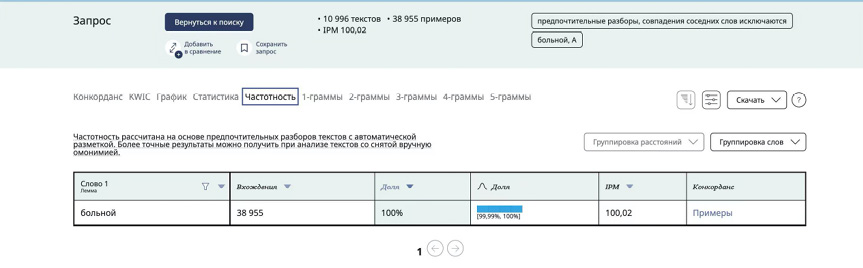
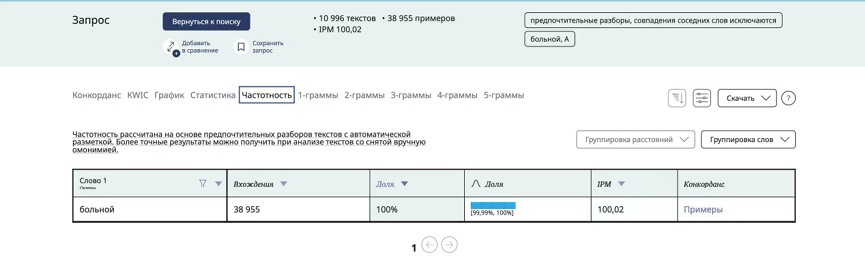
Figure 1 Corpus search results for больной as adjective(RNC, 38,955 instances, IPM=100.02)
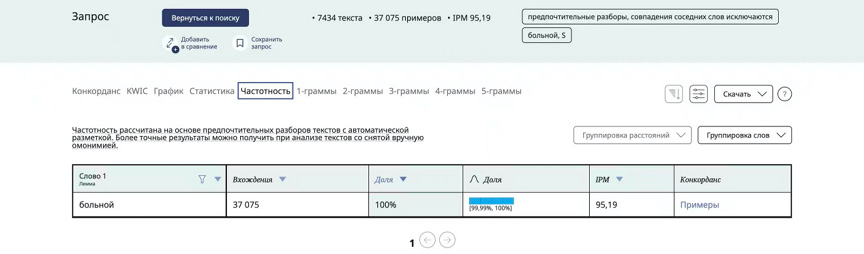
Figure 2 Corpus search results for больной as noun(RNC, 37,075 instances, IPM=95.19)
From the data, it can be seen that both uses of bol’noy are widespread in modern Russian and have fairly close frequencies. IPM (instances per million words) is calculated as frequency / total words × 1,000,000. As an adjective, bol’noy appears 38,955 times across 10,996 texts, with an IPM of 100.02. As a noun, its frequency is 37,075 times across 7,434 texts, with an IPM of 95.19. The frequencies, text distributions, and IPM values of both uses are on the same order of magnitude, with neither significantly overshadowing the other.
According to Babaytseva’s transitivity theory, when the usage frequency of the original part-of-speech (adjective) and the target part-of-speech (noun) of a linguistic unit are on the same order of magnitude and mutually balanced, the word should be located in the АБ stage of the scale of transitivity (possessing both typical adjectival and typical nominal features). Bol’noy belongs to the category of partial substantivization (неполная субстантивация). Although its nominalization process is highly developed, its adjectival function has not declined; together, the two constitute a dual-center pattern of this word in modern Russian. Therefore, the data shows that bol’noy is located in the transition position АБ → Б, and cannot be regarded as fully nominalized. Hence bol’noy falls within the domain of (неполная субстантивация). It is worth noting that the frequency of its occurrence as an adjective (IPM 100.02) remains slightly higher than that as a noun (IPM 95.19), indicating that while its nominalization is highly developed, it still retains a strong adjectival core.”
3.2 The nominalization path of столовая: diachronic evolution from столовая комната to столовка based on corpus data
Stolovaya is another typical case of adjectival nominalization. It originates from the adjective столовый (dining, of a table), formed by omitting the modified noun komnata (room): stolovaya komnata → simplified to stolovaya. This word now completely refers to “canteen/dining room,” and in everyday life, its adjectival function is hardly retained. From the semantic perspective, stolovaya has completely lost the adjectival meaning “dining, of a table” and retains only the nominal meaning “canteen/dining room.” This semantic specialization is a sign of completed nominalization. From the morphological perspective, stolovaya retains the feminine singular adjectival ending (-ая), but no longer possesses the agreement function of gender, number, and case. It does not need to agree with a modified noun; instead, as an independent noun, it acquires case changes: stolovaya (nominative), stolovoy (second case/prepositional case), stolovuyu (accusative), stolovoy (instrumental). Stolovaya is generally not used in the plural, which differs from typical nouns.
Searching for stolovaya in the Russian National Corpus with its grammatical attribute marked as adjective (прилагательное) yields the result “nothing found according to your query.” This does not mean that the adjectival use of stolovaya has completely disappeared in Russian. In fact, the adjective stolovyy is still active in fixed collocations such as stolovaya lozhka (tablespoon), stolovyy nozh (table knife), performing a modifying function. The main reason for the zero search result lies in the tagging logic of the Russian National Corpus: when stolovaya appears as an independent entry, the system primarily tags it as a noun based on its overwhelmingly nominal usage in actual language. In a structure like stolovaya lozhka, stolovaya is recognized as an inflected form of the adjective stolovyy, acting as a modifier of lozhka, and is not retrieved as an independent entry. Therefore, we focus our research perspective on the part-of-speech shift of stolovaya as an independent entry: it has now completed the transformation from adjective to noun in modern Russian, serving as a typical example of complete nominalization. Changing its grammatical attribute to a noun (существительное) yields the following example sentences:
А. Осталось 2 дня до открытия. Декорация усиленно рисует таблички с ценами, менеджеры ускоренно сканируют товар, работники валяют дурака, не понимая, что они не выйдут отсюда домой, пока все не будет сделано. Можно верить и в отсутствие веры, можно делать и отсутствие дела…» Обеды в столовой почему-то закончились через полчаса после начала обеда. В итоге едим яичницу, закусываем сосисками. Замечательно. Попить сока не удается, потому что в той же самой столовой (а другой у нас, к сожалению, до открытия не будет) нет сдачи5.[n. Запись LiveJournal (2004)] The word столовая has been fully nominalized to denote canteen, dining room. Use the adverbial of place in the example sentence as the sixth case.
столовка is a colloquial expression of столовая, which is also translated as canteen or restaurant. From the form of the word, the part of “ая” with the characteristics of adjectives at the end of the word has disappeared, and from the form of the end of the word, the word has already belonged to the category of nouns. A corpus search for the word столовка looks like this:
Б.Он изумился и, обращаясь даже не к начмеду, а к напарнику, воскликнул: «Дас ист фантастишь! Жорж, к нам приехал ревизор!» Дружок отозвался грубовато, недовольно: «У меня перерыв на обед, не пойду я никуда. Жрать хочу. Серж, сходи в столовку, возьми кефира. Тебе Антонина даст, ей ты нравишься. И еще беленького батон, гы-гы-гы… А я Светланку навещу, сахарком разживемся». Светка дрянь, девка грязная, большого мнения что-то о себе стала, обойдемся без ее сахара, пусть помучается…6[Олег Павлов. Карагандинские девятины, или Повесть последних дней // «Октябрь», 2001]
столовый
столовый (table) means as follows: 1. edible, eaten (употребляемый за столом во время еды) Tableware (столовый прибор) Salt (столовая соль) 2. Used for food; Meals (столовые расходы). A corpus search for the word столовый yielded the following results
В. Исаак Ньютон увлекался астрологией; …. кардинал Ришелье приказал закруглить столовые ножи, чтобы после «горячительных ужинов» не было возможности устроить дополнительные кровопускания; [Homo играющий: Было или не было? // «Знание -- сила», ٢٠٠٣] столовые ножки is the direct complement of закруглить in the sentence, which is translated as a meal knife.
Searching for the phrase stolovaya komnata aims to trace the time when this usage emerged and was used. The corpus records the earliest appearance of this expression in 1871, in artistic speech (художественная речь). At the same time, N. A. Leikin also used stolovaya komnata in Waiting for an Inheritance (1889). Entering the 20th century, valid data retrieved becomes very scarce: Svetlana Alliluyeva also used stolovaya komnata in Twenty Letters to a Friend (1963), in a publicistic/oratorical context (публицистика). “Stolovaya komnata appears only 16 times (IPM=0.04) in the 21st-century corpus, indicating it is obsolete in modern usage.”
Г.Наконец подали и кофе, в столовую комнату снова появился Данило Захарович; его из приличия спросили, хорошо ли он отдохнул; он, согласно со своим положением «удрученного горем человека», объявил, что «уж где ему отдыхать», что «ложится он теперь в постель, как в могилу, чтобы на минуту забыться», что «напрасно все и на цыпочках ходили, и шепотом говорили, так как на него теперь нечего обращать внимания, так как должен он привыкать и при шуме спать», и прочее и прочее, все в том же роде. [А. К. Шеллер-Михайлов. Лес рубят - щепки летят (1871)]
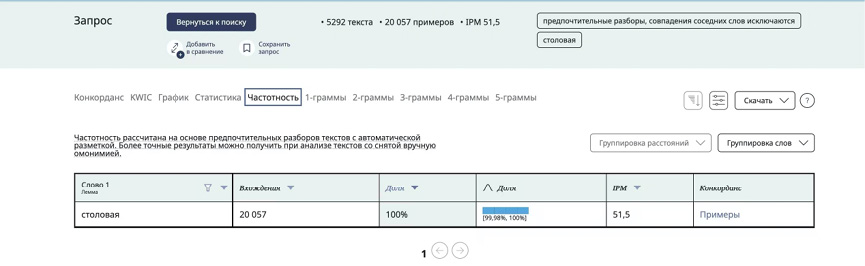
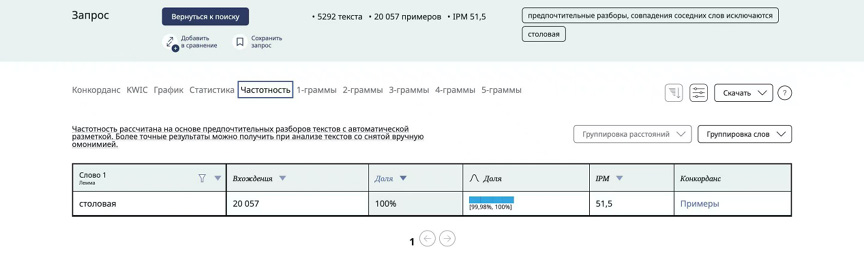
Figure 3 Corpus search results for столовая as noun (RNC, 20,057 instances, IPM=51.5)
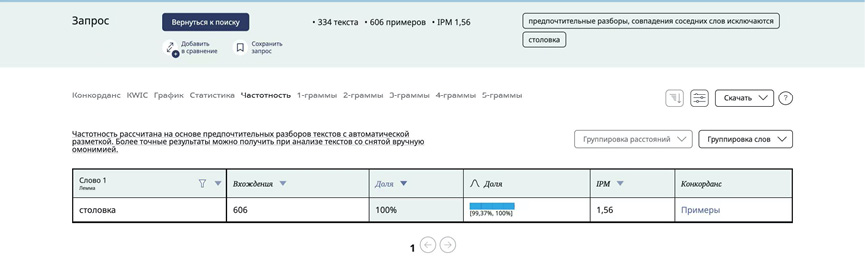
Figure 4 Corpus search results for столовка as noun (RNC, 606 instances, IPM=1.56)
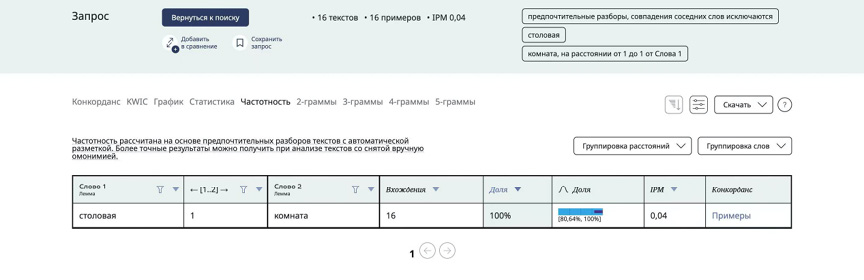
Figure 5 Corpus search results for столовая комната as phrase (RNC, 16 instances, IPM=0.04)
The IPM value of stolovaya komnata is extremely low, approaching zero. This indicates that in modern Russian National Corpus data, the use of the phrase stolovaya komnata to mean “dining room” has nearly disappeared. The high degree of nominalization has made the original adjective-noun combination redundant, leaving it only as an etymological relic. Stolovaya is the most central and stable usage, with an IPM as high as 51.5, and a relatively broad textual distribution (including 5,292 texts). This word has completed the nominalization process entirely, becoming an independent, high-frequency noun meaning “canteen/dining room.” According to Babaytseva’s transitivity theory, this word is already at stage Б, requiring no modifier, komnata, to express its meaning. Stolovka, as a colloquial suffixal derivative of stolovaya (via the suffix -ovka), has an IPM of 1.56, significantly lower than the general form stolovaya, reflecting its stylistically restricted nature (mainly occurring in colloquial, online, and informal registers). The existence of this word indirectly demonstrates that the status of stolovaya as a noun is sufficiently stable to allow secondary derivation, which is one of the typical markers of completed lexicalization. In summary, the decreasing sequence of these three IPM values (51.5 → 1.56 → 0.04) actually traces, in reverse, the complete evolutionary path of this word from the original adjective-noun combination A to fully nominalized Б: the original phrase is replaced by a pure noun form, which further derives colloquial variants, while the source form retreats to marginal remnants. This perfectly embodies the core assertion of transitivity theory that word-class evolution is irreversible and proceeds in distinct stages.
Based on the retrieval data from the Russian National Corpus, the comparative analysis of bol’noy and stolovaya profoundly reveals the different stages of adjectival nominalization (субстантивация) in Russian and their positions within transitivity theory (теория переходности). The data shows that the evolution of stolovaya has been fully completed: its original adjective+noun combination stolovaya komnata has almost disappeared (IPM only 0.04), while the nominalized stolovaya is used with high frequency (IPM 51.5) and has even generated the colloquial derivative stolovka (IPM 1.56), clearly demonstrating that it has fully reached the pure noun stage Б. In sharp contrast, while the nominal use of bol’noy is also very stable (IPM 95.19, 37,075 instances in 7,434 texts), its adjectival use (IPM 100.02) remains similarly frequent in the restricted subcorpus. This indicates that this word has not yet fully separated from the adjective category. According to Babaytseva’s theory, when the usage frequency of a linguistic unit’s original part-of-speech (adjective) and its target part-of-speech (noun) are on the same order of magnitude and compete with each other, the word should be located in the аБ stage of the transitivity scale (primarily possessing nominal features but still stably retaining typical adjectival functions), rather than in the fully nominalized Б stage as seen with stolovaya. This comparison fully demonstrates that adjectival nominalization is a gradual process, and different words exhibit significant differences in transition speed and degree of completion—stolovaya has been completely “reified” into an independent noun, while bol’noy is in a state of symbiotic co-existence where nominal features are highly developed but adjectival functions remain active. Together, the two cases verify the core claims of transitivity theory that word-class evolution is gradual, asynchronous, and uneven.
4 Conclusion
This paper takes Babaytseva’s transitivity theory as the core analytical framework, selects two typical Russian substantivized adjectives—bol’noy and stolovaya—as research objects, and uses large-scale authentic data from the Russian National Corpus to analyze the nominalization process of the two from multiple dimensions (syntactic function, semantic features, degree of lexicalization, and frequency of use) through a combination of synchronic and diachronic analysis. Transitivity theory provides an effective descriptive and explanatory model for nominalization. Babaytseva’s concept of the “zone of syncretism “ (зона синкретизма) and the scale of transitivity can clearly depict the intermediate stages in the shift from adjective to noun. The comparison between stolovaya and bol’noy fully confirms the core assertion of this theory: boundaries between parts of speech are not sharply delineated but rather form a continuum (континуум). Nominalization is not a sudden, “either-or” change, but a gradual process of “both this and that” in which grammatical features are gradually acquired and lost. At the same time, the research in this paper also verifies the fundamental judgment of scholars such as Vinogradov, Shcherba, and Rosenthal that nominalization is “a gradual process of semantic, derivational, and grammatical feature changes.” Russian adjectival nominalization is a dynamic, multi-stage lexical-grammatical process whose degree of completion varies from word to word. Stolovaya represents the endpoint of nominalization—a fully lexicalized independent noun. Bol’noy, by contrast, represents the “present progressive” of nominalization—a transitional state in which nominal features are highly developed but adjectival functions remain active. The synchronic differences between the two essentially reflect different stages of diachronic evolution, together revealing the “synchronic interrelations and the possibility of diachronic transformation of linguistic facts” emphasized by transitivity theory.
References
[1] Babaytseva, V. V. (2000). Yavleniya perekhodnosti v grammatike russkogo yazyka. Drofa.
[2] Babaytseva, V. V. (2005). Izbrannoye 1955–2005: Sbornik nauchnykh i nauchno-metodicheskikh statey. Stavropol State University Press.
[3] Boduen de Kurtene, I. A. (1963). Izbrannye trudy po obshchemu yazykoznaniyu. Izdatel’stvo Akademii Nauk SSSR.
[4] Chumichkina, A. K. (2024). O nekotorykh morfologicheskikh i pragmaticheskikh svoystvakh substantivirovannykh prichastiy v sovremennom russkom yazyke. In the 62nd International Student Scientific Conference “Yazykoznanie”. Novosibirsk National Research State University.
[5] Krysin, L. P. (2007). Modern Russian Language: Lexical Semantics. Lexicology. Phraseology. Lexicography. Drofa.
[6] Miao, L. (1990). Complete Works of Aristotle. China Studies Press.
[7] Okuneva, S. A. (2021). Substantivirovannye prilagatel’nye i prichastiya v rasskazakh i povestyakh L. N. Tolstogo. In Obshchestvo. Nauka. Innovatsii (Vol. 1). Vyatka State University.
[8] Rozental’, D. E., Golub, I. B., & Telenkova, M. A. (1991). Sovremennyy russkiy yazyk. Vysshaya Shkola.
[9] Shcherba, L. V. (1957). O chastyakh rechi v russkom yazyke. V Izbrannye raboty po russkomu yazyku. Uchpedgiz.
[10] Vinogradov, V. V. (1972). Russkiy yazyk (Grammaticheskoye ucheniye o slove). Vysshaya Shkola.
[11] Zhang, J. H. (2023). General theory of Russian in the new era. Commercial Press Publishing House.
[12] Zhou, H. Y. (2021). Research on Russian grammar with reference to transitional theory. Peking University Press.
1 Национальный корпус русского языка(https://ruscorpora.ru/).
2 Национальный корпус русского языка(https://ruscorpora.ru/).
3 Национальный корпус русского языка(https://ruscorpora.ru/).
4 Национальный корпус русского языка(https://ruscorpora.ru/).
5 Национальный корпус русского языка (https://ruscorpora.ru/).
6 Национальный корпус русского языка(https://ruscorpora.ru/).