Current Views: 355840
 Current Downloads: 214823
Advances in Linguistics Research
ISSN Print:2707-2622
ISSN Online:2707-2630
Contact Editorial Office



Subscribe to the latest published information from SCISCAN
A Study on the Slip of the Tongue and Voice Guiding Effect


-
Information:
1. School of Foreign Languages, Henan University, Kaifeng, China;
2. School of Foreign Studies, Henan Agricultural University, Zhengzhou, China
-
Keywords:
Slips of the Tongue; Voice Guiding Effect; Language Intuition; Speech Production
- Abstract: This article puts forward a new explanatory mechanism for slips of the tongue, namely the “voice guiding effect”, which operates within working memory. The “voice guiding effect” refers to a speech production mechanism that generates misaligned speech sound sequences, arising because mental phonological representations are activated prior to the articulatory movements of articulators. When speakers experience physical fatigue or emotional stress during speech production, initially activated phonological images stored in working memory direct speech organs toward phonetic implementation. The articulatory system may mistakenly prioritize recently generated phonological representations, then compensate for the omitted earlier representations to fix the mispronunciation. This article aims to investigate the underlying causes of the voice guiding effect. Additionally, it seeks to identify the specific mechanisms involved in this effect and determine the appropriate approach for addressing it. To validate this hypothesis, this study adopts Garman’s typology of speech errors. It analyzes instances from the MIT speech error corpus (English data) and a self-compiled corpus of spontaneous slips of the tongue in daily Chinese discourse.
- DOI: 10.35534/lin.0802019
- Cite: Liu, N. N., Fu, J. T., & Zhu, X. H. (2026). A Study on the Slip of the Tongue and Voice Guiding Effect. Advances in Linguistics Research, 8(2), 227-239.
The cause of a slip of the tongue is generally attributed to the functional disorder of the speech organs due to stress and pressure. This is only a rudimentary explanation, in that only the external cause has been identified, while the main cause of the condition has not yet been discovered. In-depth research so far suggests that in the process of language processing, there is a buffer and a linguistic coding processor. Linguistic codes retrieved from the mental lexicon first flow into this buffer, undergo procedural processing, and are then transmitted to the articulatory system to generate utterances (Garman, 1990). This view appears highly speculative and remains an untestable hypothesis. So this inconsistency raises a critical research question: What is the root cause of slips of the tongue? Is there any mechanism that can be used to explain why a slip of the tongue occurs?
1 Introduction and Data Collection
The earliest research on slips of the tongue can be traced back to the 8th century, when the Arabic linguist Alkisai compiled Errors of the Populace, a volume collecting diverse types of tongue slips. A more focused study of speech errors from a linguistic perspective emerged in the 19th century, gaining popularity in fields such as linguistics and psycholinguistics. After the 1950s, Western psycholinguists constructed influential speech error corpora focusing on tongue slips, including the UCLA Corpus (Fromkin, 1973), MIT Corpus (Garrett, 1975), Toronto Corpus (Dell & Reich, 1980), and London-Lund Corpus (Cutler, 1982). The example analysis in this article is based on the corpus developed by the aforementioned MIT corpus and the daily-use language in Chinese-speaking. English examples are sourced directly from the public MIT speech error corpus, whereas Chinese natural speech slips are self-compiled by the authors via long-term real-life observation and transcription of spontaneous dialogue. This approach ensures that our research does not rely solely on a single public database but incorporates authentic, cross-linguistic evidence. Linguist Hermann Paul believed that slips of the tongue could reveal natural causes of specific language changes. In the 1970s, research on speech errors reached its peak when Fromkin (1971) published the renowned work The Non-Anomalous Nature of Anomalous Utterances. She analyzed language production from the smallest unit of morpheme to syntactic components, proposing a generative model of language performance. Concurrently, other significant publications included Butterworth’s (1980) Language Production: Speech and Talk and Cutler’s (1982) Slips of the Tongue and Language Production, both shedding light on the field. Aitchison (2000) argues that the so-called “slips of the tongue” are essentially “slips of the brain”. She divides language planning into two canonical stages: macro-planning and micro-planning. Aitchison (2000) proposes that language planning involves two stages: macro-planning, which covers the selection of core concepts and syntactic frameworks, and micro-planning, which selects and arranges specific lexical items and phonological forms for articulation. The temporal relationship between these stages is complex and often overlapping, rather than strictly sequential with clause boundaries. This language planning is like an “internal program”. The process of program generation will inevitably be disordered, which interferes with speech production. Li (2013) categorizes the triggers of slips of the tongue into intralinguistic and extralinguistic factors; Intralinguistic triggers include similarity between linguistic units, token frequency of multi-phoneme words, and structural complexity of linguistic constituents, alongside cross-linguistic interference. However, these reasons merely scratch the surface and do not delve into the actual mechanisms underlying slips of tongue. To explore these mechanisms, we propose a novel concept.
We believe that a slip of the tongue is caused by the “voice guiding effect”. This “voice guiding effect” is a term proposed by the authors. Unlike prior research, which attributes slips of the tongue merely to articulatory dysfunction and analyzes errors only from speech production and syntactic dimensions, the present study centers on the interaction between mental phonological images and speech organs, and proposes the hypothesis of the “voice guiding effect”. It highlights the “voice guiding effect” as an important mechanism that leads to slips of the tongue. It explains the discrepancy between the forwardness of the sound image in the brain and the lagging nature of the speech organ, which triggers the production of slips of the tongue. But what does the voice-guiding effect mean, and what are the causes of this effect? What types of mechanisms are involved? And how should we treat this effect? To justify the above hypothesis, we used Garman’s (1990) canonical typology of speech production errors, tongue slips fall into two primary superordinate categories: articulatory phonetic errors and lexico-syntactic errors1.
2 Discourse Generation Model
The authors believe that slips of the tongue are caused by the “voice guiding effect”, a neologism coined by the authors, which constitutes an innovative analytical framework for interpreting slips of the tongue in psycholinguistic research. The “voice guiding effect” is a speech production mechanism: mental phonological images guide speech organs to generate audible sounds. Since internal phonological representations appear earlier than physical articulatory movements, temporal mismatch further leads to speech sound misalignment. In the process of speech production, thoughts (semantics) are first transformed into phonological images in the brain. Then, for expression, the brain commands the speech organs to simulate the phonological images, temporarily existing in the brain, to convert them to audible words. The reason for the production of a slip of the tongue is the advancement of the mental phonological image, Because the process of language generation involves highly complex brain activities, it encompasses visual perception, the formation of a concept in the brain, searching for suitable words in the mental lexicon, associating them with the concept, and ultimately expressing them verbally by speech organs (Qiu, 2012). That is to say that Phonological representations are activated prior to articulatory motor programming and temporarily maintained within short-term storage, the active processing component of which is known as working memory. The articulatory action of the audible words produced by the speech organs is lagging and passive, which is a passive simulation of phonological images in the brain that are temporarily stored in short-term memory. It is worth noting that thoughts (semantics) do not directly control articulatory actions. Instead, semantics first transforms into mental phonological images, and speech organs then perform passive simulation based on these phonological representations under the overall regulation of semantic information. Thoughts are not directly transformed into audible words, but first into mental phonological images, and then the speech organs are guided to simulate them into audible words (Qiu, 2012). In fact, for expression, the brain sends out instructions to the speech organs to let them simulate the already existing phonological images (sequences) to produce audible words. That is, if it is not necessary to speak out the audible words, the phonological sequences can be temporarily held in short-term or long-term memory; sufficiently reinforced representations may be permanently retained in long-term storage. and can be readily extracted as working memory, and we can perceive their existence. For example, the declaration made by Chairman Mao Zedong in Beijing’s Tiananmen Square can be recalled by most of the Chinese people, especially for Chinese individuals born in the 1990s and earlier, as if it were echoing in our ears. Figure 1 shows the process of discourse
generation.
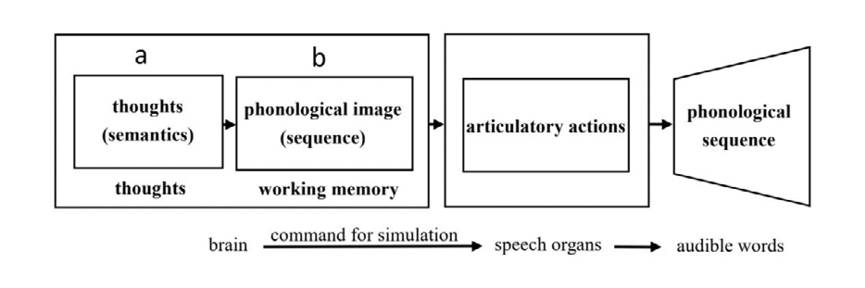
Figure 1 Discourse Generation Model
It can be seen from Figure 1 that through thinking, our brain generates thoughts, but at this point, the brain is not directing the speech organs to express them directly (and of course, they cannot be expressed). The critical role of auditory input and feedback in speech development is well-established in psycholinguistics. Individuals with congenital profound hearing loss often face significant challenges in developing spoken language due to the absence of auditory models and the inability to monitor their own vocalizations, which are crucial for the formation and refinement of phonological representations and articulatory control. Their thoughts can only be expressed by gestures, and hence, the function of the speech organs is permanently lost. Almost at the same time when thoughts (semantics) are transformed into phonological images (sequences), the brain sends out instructions to the speech organs to simulate the phonological images (sequences) that already exist in the brain’s short-term memory as the audible words that the listener can receive. In other words, the phonological images (sequences) in the short-term memory exist before the articulatory actions of the speech organs. The reason for this principle is that cerebral conceptual processing operates at an imperceptible speed. Also, there is a very close connection between thoughts (semantics) and phonological images, which reaches “Know its pronunciation when thinking of the meaning, and know its meaning when hearing the pronunciation”. Once there is a thought (semantics) in the brain, it can be instantly transformed into a phonological image. This is compelling evidence for why words usually accompany our thoughts. It also shows that thinking is not inseparable from language, and the mental language is just a psychological phenomenon that occurs almost automatically at the same time as thinking. The thinking activity of the aphasic is also strong evidence. The thinking activity and the thoughts generated by the people who were born deaf-mute have no connection with phonological images. Phonological images do not accompany the brain, so the expressions are carried out only with the help of gestures. This shows that audible words and gestures belong to the same expression system of thoughts, and there is no difference among them in essence. Another reason why phonological images (sequences) in the short-term memory exist before the articulatory action of the speech organ is that although the brain can give articulatory instructions to the speech organs while thinking, the muscles of the speech organs make articulatory actions, which are physical acts, as opposed to biochemical transformation processes, such as thoughts (semantics) being transformed into phonological images (sequences), so the reaction speed is of course slower. After the brain generates semantic thoughts, these concepts are converted into phonological sequences stored in short-term memory. To transmit these meanings to interlocutors, the brain transmits motor commands to speech organs, and the speech organs then simulate the phonological images (sequences) in the short-term memory and produce audible words. Through this, the speech production process is completed (Boomer & Laver, 1968). Although slips of the tongue are seemingly aberrant linguistic phenomena, Fromkin (1971) famously argued for their ‘non-anomalous nature,’ positing that these errors are not random but rather reveal systematic regularities in language production, thereby providing crucial insights into the underlying mechanisms of language creation.
A unidirectional activation cascade runs from semantic concepts (conceptual thoughts) stored in the mind via phonological representations (sequential phonemic strings) to articulatory motor movements of articulators, finally realizing overt speech. The voice guiding effect refers to the mechanism through which phonological representations (sequences) held in short-term memory drive the speech organs to passively simulate and create audible words. The process of passive phonological simulation by the speech organs also makes it possible to produce a slip of the tongue (mainly syllable misalignment).
3 The Mechanism of the Occurrence of Slips of the Tongue
Slip of the tongue arises because of the difference between the high speed of thoughts and their transformation into phonological images and the relatively low articulatory motor latency of the articulatory movements of the speech organs. Because of the linear nature of language thought, the phonological images transformed in the brain are, likewise, presented linearly. There are differences in the duration and intensity of the first-transformed and later-transformed phonological images in the brain. The first-transformed phonological images, influenced by the short-term memory of the sound images, are less clear in the brain and less stimulating to the articulatory nerve than the later-transformed phonological images because of the long intensity fade time. Similarly, the later-transformed phonological images are clearer in the brain and more stimulating to the articulatory nerve because of the relatively short intensity fade time. When the speaker is stressed or fatigued, the articulatory nerve mistakenly sends the stronger stimulus signal of the phonological image to the speech organ, that is, the stimulus signal of the recently transformed phonological image in the brain is sent to the speech organ system before the stimulus signal of the first-transformed phonological image, and the articulatory system prematurely articulates recently generated phonological representations, omitting representations that should have been uttered first and resulting in anticipatory syllable or word slips. Almost at the same time, the speaker realizes the mispronunciation or realizes that there is still a phonological image in the short-term memory that has not yet been presented, and then quickly makes up for it by issuing the earlier transformed phonological image that has not completely disappeared in the brain but the clarity has been reduced due to the short-term memory filling in the position of the speech sequence of the recently transformed phonological image, thus it results in the majority of common phenomena of the slip of the tongue. According to Wang Xiaolu and Wang Yunqi (2010), the conflict and confusion of concepts while the brain is processing information underlie slips of the tongue. The contradiction between parallel thinking processing and sequential linguistic expression results in occasional slips of the tongue. But the authors believe that the origin of the mechanism of the slip of tongue is still in the existence of the voice guiding effect. The phonological images that are first produced in the brain guide the speech organs to produce the voice, and the speech organs mistakenly process the newly produced phonological images first, and then correct them to process the missed phonological images.
In the case of a slip of the tongue of a famous host of China Central Television (CCTV), xuan cha fan shu (fan cha xuan shu which means the contrast is huge), the mechanism of its production is as follows: before uttering the word, due to the high speed of thought and the high speed of transforming semantics into sound images in the brain, its complete phonological image appears in the short-term memory of the speaker’s brain in the order of the syllables, but there is a difference in the clarity of the phonological image of the four syllables fan, cha, xuan, and shu in the short-term memory, which are arranged from low to high, that is, weaker in the distance and stronger in the near, which is caused by the fact that the short-term memory is always decreasing (Meng, 1999). In this way, when the speech organs simulate these syllables, the brain’s ability to discriminate and command them decreases due to stress or fatigue. The phonological image of the brain of Xuan is simulated and forwarded in the position of Fan, leaving out the fan. However, the phonological image of fan in the brain doesn’t disappear completely due to the short-term memory effect, allowing the speaker to remedy the situation by filling in the position of the word xuan when simulating the pronunciation of the phonological image in the brain one by one, thus producing the slip of the tongue xuan cha fan shu. This error-generating process is illustrated in Figure 2.
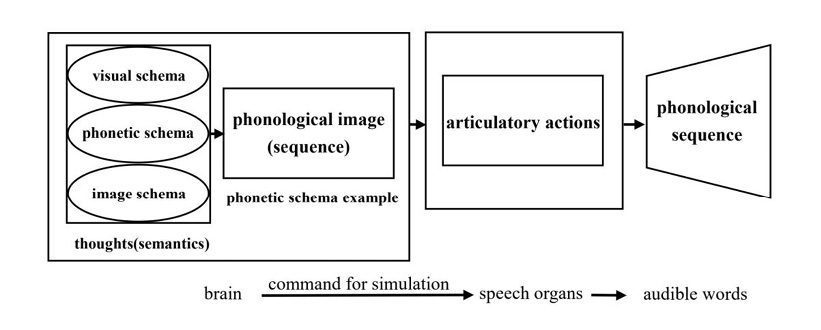
Figure 2 Mechanism Underlying the Anticipatory Slip xuan cha fan shu
From the diagram, the first action of the speech organs first presents xuan in the first position of the sequence, which should be present in the third position of the phonological image (sequence), and the position of cha does not change. The third action of the speech organ is to present the phonological image fan in the third position of the sequence, which should be in the first position of the phonological image (sequence). Finally, the shu is presented without changing the sequence position. Instead of pronouncing the phonological images (sequences) in their normal order, the speech organ produces the sound by simulating a phonological image that is formed later but with less loss of intelligibility, thus a phonological sequence with reversed order, in other words, audible words were produced, which, however, is a slip of the tongue.
4 Discussion of the Voice Guiding Effect
Almost all types of slips of the tongue can be explained by the voice-guiding effect. According to Garman (1990), there are two categories of a slip of the tongue: Articulatory errors and Grammatical errors, of which Grammatical errors include Exchange errors, Stranding exchanges, Shifts, Blends, and Substitutions. They are as follows:
Articulatory Errors
1. it’s the /g/olly green giant (for ‘jolly’)
2. …thir/th/ and fourth… (for ‘third’)
3. a clear p/l/iece (for ‘piece’)
4. he could at /w/east --- at least get them into line (/w/ Unknown source)
5. /b/ate of /d/irth (for ‘date of birth’)
6. cu/ck/ ca/p/e (for ‘cup cake’)
7. s/e/dden d/u/th (for ‘sudden death’)
8. /lin/ing it on the /lay/ (for ‘laying it on the line’) (Syllable transposition)
9. /st/ee /fr/anding (for ‘free standing’)
10. gr/ai/n gr/ee/p (for ‘green grape’)
11. m/ur/k b/il/ning (for ‘milk burning’)
12. s/ole/….h/ock/ (for ‘sock…hole’)
13. made my t/url/s c/oe/ (for ‘toes curl’)
14. p/l/ay a /f/at fee (for ‘pay a flat fee’)
15. sp/r/it b/l/ain (for ‘split brain’)
16. /sh/ow /sn/ovelling (for ‘snow shovelling’)
17. ti/ck/ of the tu/m/ (for ‘tip of the tongue’)
Grammatical Errors
a. Exchange Errors
1. I got into /this guy/ with a /discussion/ (for ‘I got into a discussion with this guy’)
2. forgot to add /the list/ to /the roof/. (for ‘forgot to add the roof to the list’)
3. Once I /stop/, I can’t /start/. (for ‘Once I start, I can’t stop.’)
4. As you /reap/, Roger, so shall you /sow/. (for ‘As you sow, Roger, so shall you reap’)
5. Everytime I put one of these buttons /off/, another one comes /on/. (for ‘Everytime I put one of these buttons on, another one comes off’)
b. Stranding Exchanges
1. You have to /square/ it /face/ly. (for ‘You have to face it squarely’)
2. I thought the /park/ was /truck/ed. (for ‘I thought the truck was parked.’)
3. It makes the /warm/ /breath/er /air/. (for ‘It makes the air warmer to breathe.’)
c. Shifts
1) words transposing with phrases
1. If you can’t figure /what that/ /out/ is, (for ‘If you can’t figure out what that is,’)
2. Who /did you think/ /else/ would come? (for ‘Who else did you think would come?’)
3. Maybe that has /to do/ /something/ with it. (for ‘Maybe that has something to do with it’)
4. You /have to do/ /learn/ that. (for ‘You have to learn that.’)
2) words transposing with words
1. Did you stay up /late/ /very/ last night? (for ‘Did you stay up very late last night?’)
2. Unless you got somethin’ /to/ /better/ do…. (for ‘Unless you got somethin’ better to do ….’)
3. They’re /only/ /the/ ones that… (for ‘They’re the only ones that…’)
4. They’d tell me /to/ /who/ go see. (for ‘They’d tell me who to go see.’)
3) stranding of an affix by a word
1. He point out/ed/ that… (for ‘He pointed out that…’)
2. I’d forgot about/en/ that. (for ‘I’d forgotten about that.’)
3. the same as add ten/ing/ (for ‘the same as adding ten’)
4. easy enough/ly/ (for ‘easily enough’)
d. Blends
1. How much dol youl want? A/s/ lot…as much as possible. (for ‘A lot….as much as possible’)
2. How many of /there/ are you? (for ‘How many of you are there?’)
3. gone /mild/ (for ‘mad/wild’)
4. That’s /torrible/! (for ‘That’s terrible/horrible!’)
5. /enlicit/ your support (for ‘enlist/elicit’)
6. He /misfumbled/ the ball. (for ‘He mishandled/fumbled the ball.’)
7. Have you ever /flivven/ (for ‘flown/driven’)
8. sudden quick/s/…stops (for ‘sudden quick stops’)
e. Substitutions
1. He rode his bike to school /tomorrow/ (yesterday)
2. You go /wash/ (brush) your hair.
3. /Ask/ (Tell) me whether….
4. Is anyone using this /seat/ (chair), please?
5. What a lovely /rose/ (flower)!
6. because I’ve got an /apartment/ (appointment) now
7. No – I’m /amphibian/ (ambidextrous).
8. it doesn’t /sympathise/ (synthesise) it
9. most cities are true of that (‘that is true of most cities’)
10. (‘bumper cars’) I got a paper on my test (‘an A on my paper’)
11. we always never do that (‘we almost never’)
(Garman, 1990)
We generally approve of this classification. In this paper, based on this classification, we explore the influence of the voice guiding effect on the slip of the tongue and find that almost all these types of slip of the tongue phenomena can be explained by the voice guiding effect. However, Garman’s classification may be enhanced further; we updated it and added two more classifications, namely, Hysteresis (lagging) and Adding or subtracting, which can enhance the completeness and scientific accuracy of the mechanism of the voice guiding effect. This classification is also applicable to the Chinese context. The occurrence mechanisms of cases of spoken errors are categorized as follows in this research.
4.1 Articulatory Errors
The examples of articulatory errors discussed by Garman are divided into two main categories: substitutions of one sound for another, where the articulatory error may or may not be a real word, and exchange articulatory errors. This model of voice-guiding effect can explain these errors. For example:
it’s the /g/olly green giant (for ‘jolly’). (example from Garman, 1990), as shown in Figure 3:
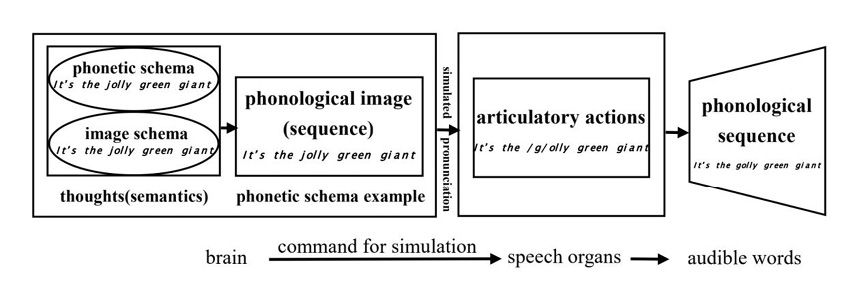
Figure 3 The mechanism of occurrence of it’s the golly green giant slip of the tongue
Due to the voice-guiding effect, the phonological image of [g] is already generated in the speaker’s brain before the [dʒ] is pronounced. It is pronounced in the place of the [dʒ] without filling it in at the end, because the rhythm and temporal value of the phonological image (sequence) have no extra place for it.
4.2 Grammatical Errors
4.2.1 Exchange Errors
ta tiao de /kuai/ pao de /gao/2 (for ‘ta tiao de gao pao de kuai’)
Meaning: he jumps high and runs fast. As shown in Figure 4:
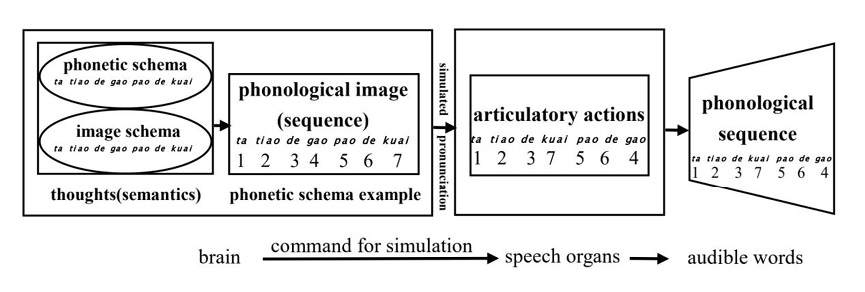
Figure 4 The Mechanism of Occurrence of ta tiao de kuai pao de gao Slip of the Tongue
This type of error is the same as the xuan cha fan shu we analyzed earlier. When a slip of the tongue occurs, the phrase ta tiao de gao pao de kuai (he jumps high and runs fast) is replaced by ta tiao de kuai pao de gao (he jumps fast and runs high). Due to the voice guiding effect, the phonological image of kuai (fast) is created in the speaker’s brain and presented in the position of gao (high) before the gao (high) is produced. At this point, the speaker has realized that the gao (high), which still exists in short-term memory, has not yet been produced, and then pronounces it in the position of kuai (fast).
Garman (1990) treated Stranding exchanges as a complex type of Exchange errors and classified them separately. In the voice guiding effect, its mechanism of occurrence is of the Exchange type. Stranding exchanges are a common error type in English. Within the scope of the collected Chinese corpus for this research, no typical cases of stranding exchanges were found. Therefore, this study incorporates this category into general exchange errors for unified analysis.
4.2.2 Shifts
lin le ge luo /ji/ /tang/ (for ‘lin le ge luo tang ji’)
Meaning: be caught in the rain and soaked through. As shown in Figure 5:
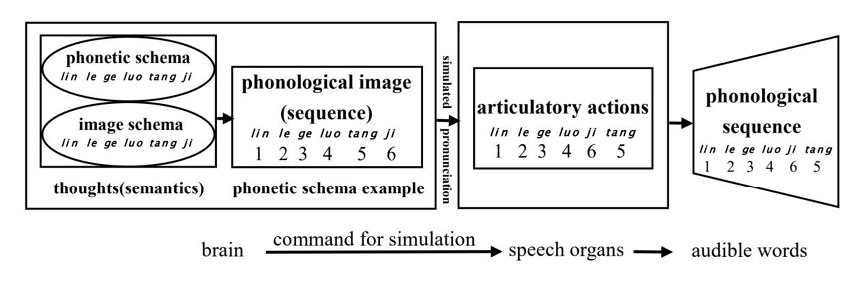
Figure 5 The mechanism of occurrence of lin le ge luo ji tang slip of the tongue
When a slip of the tongue occurs, due to the voice-guiding effect, the phonological image of ji (chicken) is already created in the speaker’s brain and presented in the position of tang (hot water) before the tang (hot water) is produced. At this point, the speaker has realized that the tang (hot water), which still exists in short-term memory, has not yet been produced, and then pronounces it in the position of ji (chicken), reversing the lin le ge luo tang ji to lin le ge luo ji tang. A shift refers to the one-way forward or backward displacement of a linguistic unit in a sentence, while an exchange means the two-way mutual replacement of two words or phrases. The two error types are mainly distinguished by movement direction, and the adjacency of words is not an absolute judging criterion.
4.2.3 Blends
zhe xie /tian qi/ bu cuo (for ‘zhe xie tian tian qi bu cuo’)
Meaning: Nice weather these days. As shown in Figure 6:
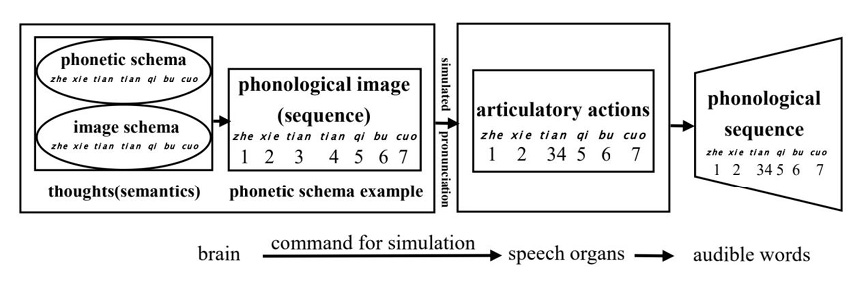
Figure 6 The Mechanism of Occurrence of zhe xie tian qi bu cuo Slip of the Tongue
When a slip of the tongue occurs, the sentence zhe xie tian tian qi bu cuo (the weather is nice these days) can transform to zhe xie tian qi bu cuo (these weathers are nice), in which one of the tian is omitted. Due to the voice-guiding effect, the phonological image of qi is already created in the speaker’s brain before the second tian is pronounced and follows the first tian. In the speaker’s consciousness, the two pronunciations of the tian are conflated into one in short-term memory, so that after the first tian is pronounced, the speaker mistakenly believes that the pronunciation of both tian has been completed, and thus pronounces the qi following the first tian.
4.2.4 Substitutions
jin er sun lao shi ba ta de nv er /na/ lai le (for ‘jin er sun lao shi ba ta de nv er dai lai le’)
Meaning: Today, Ms. Sun brought her daughter here. This process is illustrated in Figure 7:
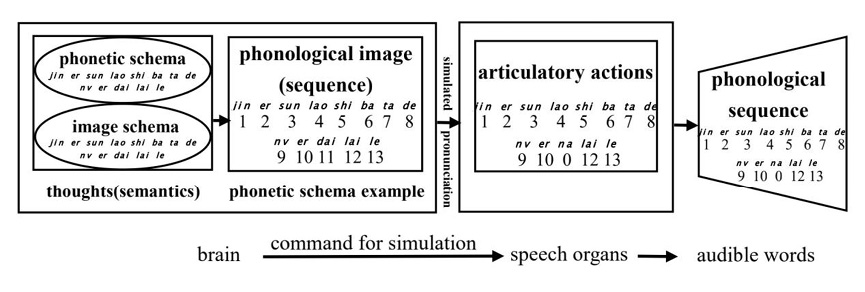
Figure 7 The Mechanism of Occurrence of jin er sun lao shi ba ta de nv er na lai le Slip of the Tongue
When a slip of the tongue occurs, jin tian sun lao shi ba ta de nv er dai lai le (today Ms. Sun brought her daughter here” is replaced by jin tian sun lao shi ba ta nv er na lai le (today Ms. Sun handed her daughter here). Due to the voice guiding effect, the phonological image of na (hand) is already created in the speaker’s brain for some reason before the dai (bring) is pronounced in the place of the dai and replaces it in the produced speech. However, it is safe to say that either before the sentence was spoken or at the same time as something else was going on in the brain, the phonological image of na must have been presented in the speaker’s brain, and the likelihood of the speech organ failing is very low. This type of slip of the tongue often occurs when two words have similar sounds or meanings, and the word is usually a new word outside of the sentence.
4.2.5 Hysteresis (Lagging)
Na hu da /hu/ qu (for ‘na hu da shui qu’)
meaning: Take the jug to get the water. As shown in Figure 8:
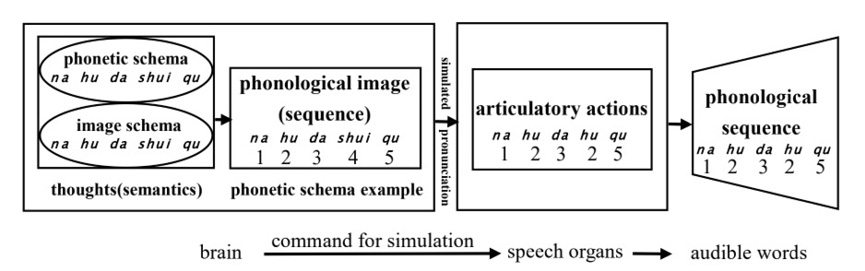
Figure 8 The Mechanism of Occurrence of na hu da hu qu Slip of the Tongue
When a slip of the tongue occurs, the phrase na hu da shui qu, which means “Take the jug to get the water”, could be replaced by na hu da hu qu (take the jug to get the jug). Due to the voice-guiding effect, the phonological image of hu (jug) has a strong short-term memory lag. It is repeated in the phonological position of shui (water), crowding out the phonological position of shui (water), which is completely omitted from the utterance because the rhythm and temporal value of the phonological image (sequence) have no extra place for it. This type of slip of the tongue is often triggered by a lag in vocabulary that has already appeared in this sentence.
4.2.6 Adding or Subtracting
jiu shi ni gan mao de (for ‘jiu shi ni gan mao chuan ran de’)
Meaning: It’s your cold that infected me. As shown in Figure 9:
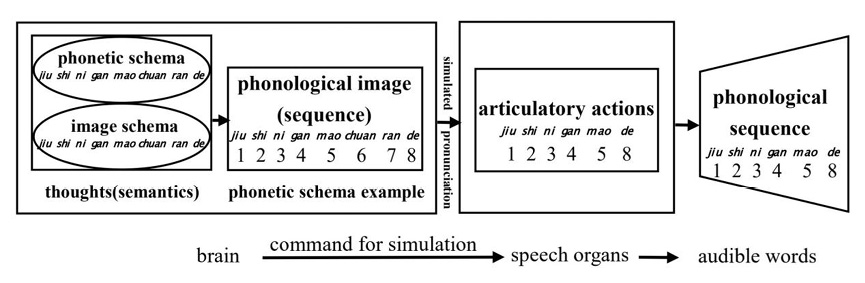
Figure 9 The Mechanism of Occurrence of jiu shi ni gan mao de Slip of the Tongue
When a slip of the tongue occurs, the sentence jiu shi ni gan mao chuan ran de (it’s your cold that’s infecting me) is altered to jiu shi ni gan mao de (it’s you who has a cold). Due to the voice-guiding effect, the phonological image of the word de is already created in the speaker’s brain before the pronunciation of the word chuan ran (infect) is presented. For some reason, the speaker does not realize that the chuan ran has not yet been produced, perhaps because the phonological image of chuan ran has not been produced originally in short-term memory or has been blurred, and the speaker mistakenly believes that the phonological simulation of the semantics has been completed. This example strongly illustrates the important point that the articulatory actions of the speech organs are purely simulative, and they are hardly influenced by semantics other than simulation.
5 Conclusion
5.1 Findings
In conclusion, under the influence of external factors such as stress or excitement, the speaker’s articulatory system incorrectly processes the phonological images that already exist in the brain, especially in sequence, thus resulting in the slip of the tongue. This phenomenon, in which the phonological images in the brain guide the speech organs to produce voice, is known as the voice guiding effect. The voice guiding effect is objective and plays a very important role in our language practice. This framework not only reveals the core cognitive triggers of slips of the tongue but also demonstrates that the voice-guiding effect constitutes a core cognitive mechanism shaping universal linguistic intuition. Further research in this area will help us to gain a deeper understanding of the nature of language and the regularity of language teaching.
5.2 Limitations
Despite the aforementioned findings, our research has its own limitations owing to our constrained abilities and resources. The primary constraint lies in the breadth of our corpus. Although slips of the tongue are present across various aspects of our lives, gathering material for analysis is cumbersome and inconvenient. Moreover, some speech error cases (e.g., stuttering variants) are atypical and unaccounted for by the above classification and require further exploration. The second limitation is the scarcity of direct Chinese reference materials available to us, let alone authoritative ones. Even relevant English resources are notably outdated. Additionally, since the “voice guiding effect” is a newly proposed theoretical concept in this study, it has not been verified by existing academic literature and still needs more empirical tests. All analyses in this paper are carried out based on this exploratory hypothesis, and relevant viewpoints are tentative conclusions for further discussion. In summary, the current study is not exhaustive but rather suggestive, necessitating further refinement.
References
[1] Aitchison, J. (2000). The articulate mammal: An introduction to psycholinguistics. Routledge.
[2] Boomer, D. S., & Laver, J. D. M. (1968). Slips of tongue. British Journal of Disorders of Communication, 3(1), 2–12.
[3] Butterworth, B. (1980). Language production: Speech and talk. Academic Press.
[4] Cutler, A. (1982). Slips of the tongue and language production. De Gruyter.
[5] Dell, G., & Reich, P. (1980). Toward a unified theory of slips of the tongue. In V. Fromkin (Ed.), Errors in linguistic performance: Slips of the tongue, ear, pen, and hand (p. 273–286). Academic Press.
[6] Fromkin, V. A. (1971). The non-anomalous nature of anomalous utterances. Language, 47(1), 27–52.
[7] Fromkin, V. A. (1973). Speech errors as linguistic evidence. Mouton.
[8] Garman, M. (1990). Psycholinguistics. Cambridge University Press.
[9] Garrett, M. F. (1975). The analysis of sentence production. In G. H. Bower (Ed.), The psychology of learning and motivation. Academic Press.
[10] Li, T. T. (2013). Pragmatic study of Chinese tongue slips in online TV programs [Master’s thesis]. Sichuan International Studies University.
[11] Meng, G. (1999). The problem of slips of the tongue in Chinese. Chinese Study, 1, 40–44.
[12] Qiu, M. M. (2012). Insights into the psychological mechanisms of speech production through slips of the tongue. Zhejiang Social Sciences, 10, 119–124+160.
[13] Wang, X. L., & Wang, Y. Q. (2010). The conscious exploration of slip of the tongue. Dialectics of Nature Newsletter, 5, 21–25+115–117+126.
1 We refer to Garman’s classification of slips of the tongueas a foundational framework. Our study extends this by proposing the “voice guiding effect” as an explanatory mechanism for the occurrence of these slips, rather than merely categorizing them.
2 Starting from this example, the remaining examples are all common slips of the tongue found in everyday Chinese communication, hence lacking specific sources.