Current Views: 125591
 Current Downloads: 76896
Environment and Resource
ISSN Print:2707-2398
ISSN Online:2707-2401
Contact Editorial Office



Subscribe to the latest published information from SCISCAN
先存断层倾角对断层活化特征的影响——基于离散元数值模拟实验
The Influence of Pre-existing Fault Dip Angle on Fault Activation Characteristics: Insights from Discrete Element Method (DEM) Numerical Simulation Experiments


-
Information:
西南石油大学地球科学与技术学院,成都
-
Keywords:
Pre-existing fault; Fault dip angle; Fault activation; Discrete element method; Numerical simulation先存断层; 断层倾角; 断层活化; 离散元; 数值模拟
- Abstract: Pre-existing fault activation is a key inducing factor of geological disasters in engineering construction and mineral resource development. As a core parameter controlling the mechanical properties of faults, the influence law of fault dip angle on activation characteristics remains to be clarified urgently. To reveal this mechanism, this study adopted the discrete element method (DEM) simulation software ZDEM and designed four groups of comparative experiments with fault dip angles of 15°, 30°, 45°, and 60°. The activation process, strain distribution, and failure mode of faults under different dip angle conditions were systematically analyzed. The results show that: the 45° dip angle fault initiates activation the earliest (with a critical compression of only 4.5 km), and its activation process is the most intense with significant concentration of shear strain; the 15° low-dip angle fault is dominated by vertical compressive strain, forming a wide and gentle fold-fracture assemblage; the 30° dip angle fault has the densest secondary fractures with well-developed shear fracture zones; the 60° high-dip angle fault eventually forms a “Y”-shaped fracture assemblage, and the dip angle of the main fault deflects significantly. This study quantitatively reveals the influence of fault dip angle on activation threshold, strain distribution, and failure mode, and provides a theoretical basis and technical reference for engineering stability evaluation and disaster prevention and control in areas with pre-existing faults. 先存断层活化是工程建设与矿产开发中引发地质灾害的关键诱因,断层倾角作为控制断层力学特性的核心参数,其对活化特征的影响规律亟待明确。为揭示该机制,本文采用离散元模拟软件ZDEM,设计断层倾角为15°、30°、45°、60°的4组对比实验,系统分析不同倾角条件下断层的活化过程、应变分布及破坏模式。结果表明:45°倾角断层活化启动最早(临界挤压量仅4.5km),活化过程最剧烈,剪切应变集中显著;15°低倾角断层以垂向压缩应变为主,形成宽缓的褶皱断裂组合;30°倾角断层次级破裂最密集,剪切破碎带发育;60°高倾角断层最终形成“Y”字型断裂组合,主断层倾角发生明显偏转。研究明确了断层倾角对活化阈值、应变分布及破坏模式的量化影响规律,为含先存断层区域的工程稳定性评价与灾害防控提供了理论依据与技术参考。
- DOI: 10.35534/er.0801002
- Cite: 张渝,余养里.先存断层倾角对断层活化特征的影响——基于离散元数值模拟实验[J].环境与资源,2026,8(1):12-17.
在油气开采、隧道开挖、矿山采掘等地下工程活动中,地下应力场的扰动极易引发先存断层活化,进而诱发地表塌陷、工程结构损毁甚至突水等地质灾害,严重威胁工程安全与人员生命财产安全[1,2]。统计显示,约80%的煤矿突水事故与断层活化直接相关,而断层倾角作为断层最基础的几何参数,直接决定了断层两盘的受力状态、运动方式及应力传递路径,对活化的触发条件、演化过程及破坏程度具有关键控制作用[3]。断层活化是一个受多种因素综合控制的复杂过程,包括断层几何参数(倾角、落差、破碎带宽度)、岩体物理力学性质、地应力条件及工程扰动方式等[3]。其中,断层倾角作为断层最基础的几何属性,直接决定了断层两盘的受力状态、应力传递路径及相对运动方式,对活化的触发条件、演化速率、破坏模式及灾害程度具有核心控制作
用[4]。例如,低倾角断层可能因垂向应力集中更显著而易于发生拉伸—挤压复合破坏,中倾角断层则可能因剪切应力占比主导而表现为剧烈滑移,高倾角断层则可能伴随明显的应力释放与断裂转型[5]。因此,系统探究断层倾角对先存断层活化特征的影响规律,对于精准预判灾害风险、优化工程设计具有重要的理论与实践价值。
目前,国内外学者已通过现场监测、室内实验及数值模拟等手段,对断层活化开展了大量研究。现已有学者利用FLAC3D模拟发现低倾角逆断层更易活化,诱发突水危险性更高[2];通过正交试验与灰色关联度分析,证实断层倾角是影响断层活化的首要主控因素[3];建立力学模型,揭示了断层倾角对断层面剪切应力与法向应力的调控机制[1]。然而,现有研究多集中于正断层或逆断层单一类型,针对不同倾角先存断层在挤压应力场下的活化特征差异、应变演化规律及破坏模式转型机制的系统性研究仍较为匮乏,尤其缺乏离散元方法从微观颗粒尺度对活化过程的精准刻画。
离散元方法(DEM)能够有效模拟地质材料的非线性变形、裂隙扩展及不连续面运动,在断层活化研究中具有独特优势[6,7]。基于此,本文采用ZDEM离散元软件,以断层倾角为唯一控制变量,设计4组对比实验,系统探究15°、30°、45°、60°倾角下先存断层的活化阈值、应变分布、断裂组合及主断层演化特征,旨在揭示倾角对断层活化的影响规律,为含断层区域的工程规划、灾害预警及支护设计提供科学支撑。
1 离散元数值模拟实验设计
1.1 离散元模拟原理与软件选择
离散元方法(DEM)的核心思想是将连续的地质材料离散化为大量可独立运动的颗粒(本文采用圆盘颗粒),通过求解每个颗粒在接触力作用下的运动方程,从微观角度再现材料的宏观力学行为与破坏过程[7]。其计算过程采用循环迭代模式,主要包含两个核心步骤:一是接触检测与力计算,通过识别颗粒间的接触关系,依据预设的接触力学模型计算颗粒间的相互作用力;二是运动更新,根据颗粒所受合力求解牛顿第二运动方程,更新颗粒的位置与速度,循环迭代直至模拟达到预设收敛条件[8]。该方法能够有效模拟地质材料的非线性变形、裂隙扩展等过程,尤其适用于先存断层活化这类涉及不连续面运动的问题研究。
本次模拟选用离散元程序ZDEM(www.geovbox.com)作为计算平台,该软件在地质体变形与断裂模拟方面具有独特优势[9]。模拟采用Hertz-Mindlin接触力学模型计算颗粒间的接触力,该模型能够精准描述颗粒间的弹性接触行为,符合岩石类材料的力学特性[6];采用蛙跳法更新颗粒的位移与速度,该方法具有计算效率高、稳定性强的特点,可保障模拟过程的精准性与高效性[7]。
1.2 实验方案设计
本次模拟首先在矩形计算域内随机生成约50000个圆盘颗粒,通过重力沉积过程形成初始平衡模型,最终确定模型尺寸为长60 km、高12 km(图1)。为保障模拟结果的合理性,结合常见沉积岩的物理力学特性,设定颗粒微观参数如下:颗粒直径60~80 m,剪切模量2.9e9 Pa,泊松比0.2,密度2.5e3 kg·m⁻³,摩擦系数0.3,重力加速度9.8 m·s⁻²,时间步5.0e-2 s,局部阻尼系数0.4(表1)。为模拟岩石的粘结特性,对模型中颗粒设置粘结参数,具体为杨氏模量2.0e8 Pa,剪切模量2.0e8 Pa,抗拉强度1.0e7 Pa,剪切强度2.0e7 Pa,对应的宏观粘聚力为10.5 MPa,内摩擦角18.6°(表2)。同时,在模型最下部设置滑脱层与先存断层,通过选取特定颗粒范围,将其摩擦系数调整为0.0并标记为红色,以模拟断层软弱带的力学特性。
本次实验采用控制变量法,将断层倾角作为唯一变量,设计4组对比实验,断层倾角分别设定为15°、30°、45°、60°,倾角取值覆盖低、中、高三个典型范围,符合自然界断层倾角分布规律。所有实验的模型尺寸、材料参数、边界条件等均保持一致,以确保实验结果的可比性。加载方式采用左侧挡板墙匀速挤压,挤压速度设定为2.0 m·s⁻¹,总挤压量为10 km,为精准捕捉活化过程中的关键信息,每挤压500 m保存一次模拟数据。
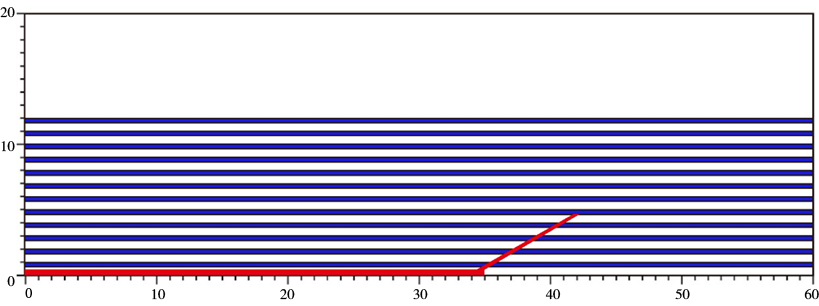
图 1 离散元基础模型
Figure 1 Discrete element method (DEM) basic model
表 1 颗粒的微观参数
Table 1 Microscopic parameters of particles
| D(m) | G(Pa) | v | ρ(Kg·m-3) | g(m·s-2) | dt(s) | α | μ |
| 60 80 | 2.9e9 | 0.2 | 2.5e3 | 9.8 | 5.0e-2 | 0.4 | 0.3 |
表 2 颗粒间的粘结参数
Table 2 Bonding parameters between particles
| 粘结参数集 | 微观参数 | 宏观参数(μ=0.3) | ||||
| 杨氏模量 | 剪切模量 | 抗拉强度 | 剪切强度 | 粘聚力 | 内摩擦角 | |
| Pa | (MPa) | (°) | ||||
| T1 | 2.0e8 | 2.0e8 | 1.0e7 | 2.0e7 | 10.5 | 18.6 |
2 实验结果分析
2.1 不同倾角下断层活化特征
通过对4组不同倾角实验的构造演化过程进行分析,发现断层倾角对活化启动时间、演化路径及最终破坏形态均具有显著影响(图2)。15°低倾角断层:活化启动较晚,在挤压量达到7 km时才出现明显的断层滑动迹象,活化过程较为平缓,断层两盘以垂向相对位移为主,最终形成宽缓的褶皱-断裂组合构造,后翼破裂分布范围较广但密度较低,主断层未沿着15°倾角发育,最终倾角为35°。30°倾角断层:活化启动挤压量约为5 km,介于15°与45°之间,活化过程兼具平缓与剧烈特征,断层两盘既有垂向也有水平位移,最终形成逆冲断层构造,后翼裂隙发育集中在断层上盘附近,呈斜交分布,主断层倾角发生变化,最终为40°。45°倾角断层:活化启动最早,挤压量仅为4.5 km时即发生明显滑动,活化过程剧烈,断层两盘以水平剪切位移为主,位移量显著大于其他倾角组,最终形成典型的逆冲断层构造,后翼裂隙发育密集且贯通性强,形成明显的剪切破碎带,主断层倾角未发生明显变化。60°高倾角断层:活化启动挤压量约为5 km,略早于30°组,活化过程以水平位移为主,断层两盘滑动速度较快但位移量小于45°组,最终形成高角度逆冲断层构造,后翼裂隙主要沿主断层倾向相反方向发育,破碎带宽度较窄但破坏程度较高,主断层倾角发生明显变化,最终为30°。4组实验具有共同特征:随着挤压与横向缩短作用逐渐增强,主断层逐渐突破上覆地层向上传播;褶皱作用也随断层作用逐渐增强,整体呈现前翼陡倾后翼宽缓的不对称褶皱样式;当缩短量达到一定程度后,褶皱后翼逐渐发育次级反冲断层,倾向与主断层相反,组成“Y”字形断裂组合,形成“Pop-up”构造。
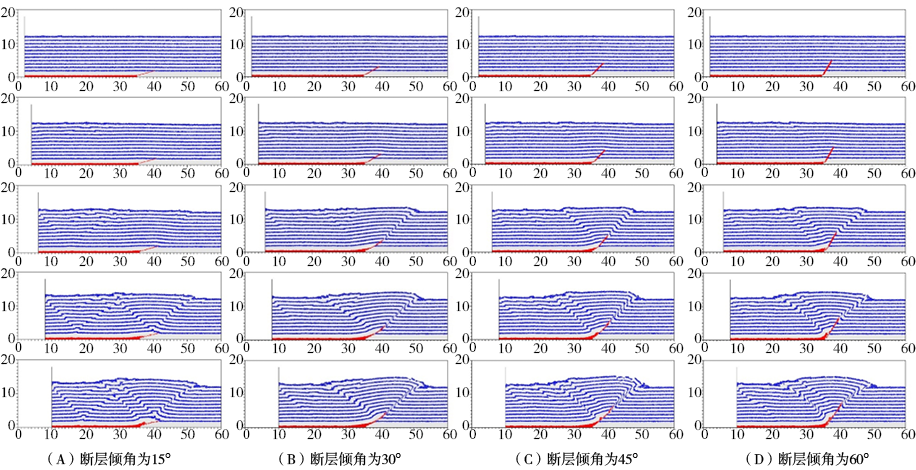
图 2 15°到60°模拟实验构造演化图
Figure 2 Tectonic evolution diagrams of simulation experiments with dip angles from 15° to 60°
2.2 倾角对断层应变分布的影响
不同倾角断层活化过程中的应变分布特征存在显著差异(图3)。15°低倾角断层:应变集中区域主要分布在断层上盘,以垂向压压力集中为主,体积应变以压缩应变为主,分布范围较广,剪切应变相对较小,表明低倾角断层活化主要受垂向挤压作用控制,后翼断裂复杂,由两套倾向相反的断裂组成。30°倾角断层:应变集中区域分布在断层两盘,垂向压应力与水平剪应力均有明显集中,剪应变较15°组显著增大,表明此时断层同时受挤压与剪切作用影响,后翼破裂未延伸至地层深部与主断层相连,次级破裂较多且最为密集,形成剪切破裂带。45°倾角断层:应变集中区域集中在断层带内部及两端,以水平剪应力集中为主,体积应变较小,剪应变分布密集,表明45°倾角断层活化以剪切作用为主,这也是其最易发生活化的关键原因,同时后翼断裂与主断层相接,且后翼破裂数量最多,形成的褶皱顶部出现拉裂现象。60°高倾角断层:应变集中区域主要分布在断层上盘,体积应变以压缩应变为主,后翼断裂与主断层相接,组成“Y”字型断裂组合。
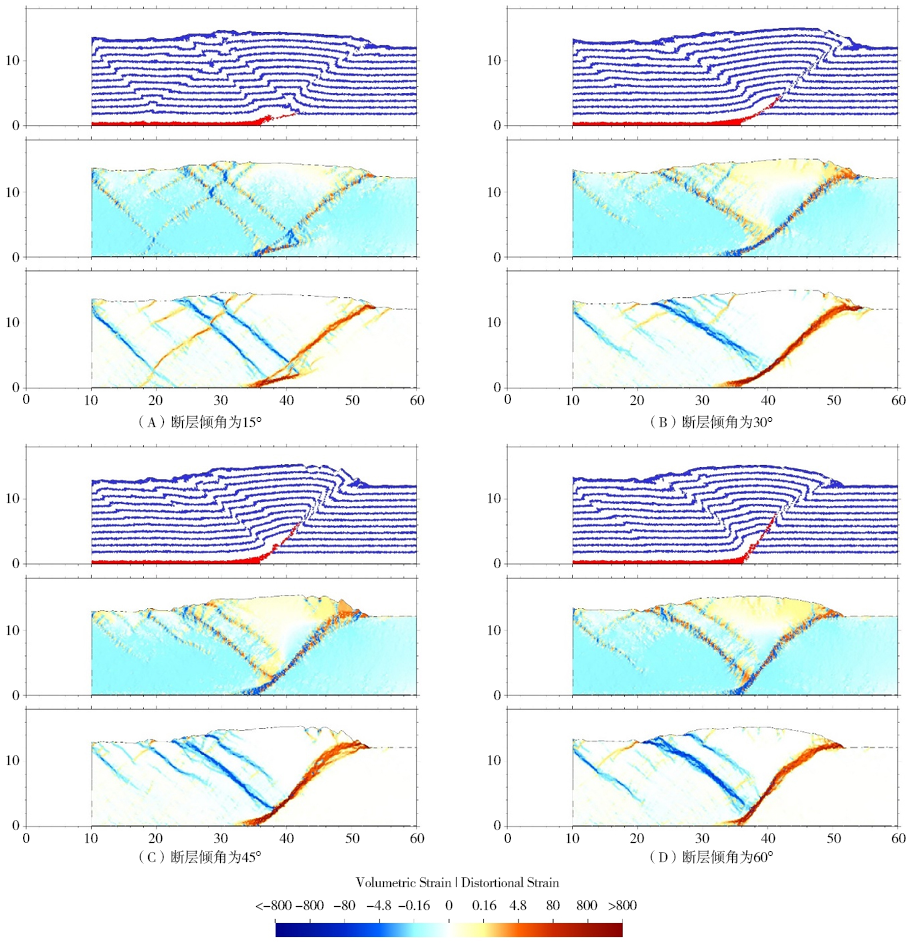
图 3 15°到60°模拟实验应变对比图
Figure 3 Strain comparison diagrams of simulation experiments with dip angles from 15° to 60°
3 倾角对断层活化特征的影响规律
综合4组实验的活化启动条件、位移演化、应力分布及破坏模式等特征,可总结出断层倾角对先存断层活化特征的核心影响规律如下。
第一,断层倾角显著影响活化触发阈值。随着倾角从15°增大至45°,断层活化所需的临界挤压量从7 km减小至4.5 km,活化触发阈值逐渐降低;当倾角从45°增大至60°,临界挤压量从4.5 km增大至5 km,活化触发阈值有所升高。这表明45°倾角断层处于最不稳定状态,最易发生活化,其原因在于45°倾角下断层所受剪应力达到最大值,而正应力处于适中水平,剪应力与正应力的比值最大,导致断层易发生剪切滑动。
第二,倾角决定断层位移演化特征。低倾角(15°)断层活化以垂向位移为主,位移增长速率平缓,最终稳定位移量较小;中倾角(30°、45°)断层以水平剪切位移为主,其中45°倾角断层位移增长速率最快,稳定位移量最大;高倾角(60°)断层虽也以水平位移为主,但位移增长速率与稳定位移量均小于45°组。这一规律与不同倾角下断层的受力状态直接相关,低倾角断层受垂向挤压作用更显著,而中高倾角断层受剪切作用主导。
第三,倾角控制断层应力分布与破坏模式。低倾角(15°)断层以垂向压应力集中为主,破坏模式为拉伸-挤压复合破坏,裂隙分布较分散;中倾角(30°、45°)断层以水平剪应力集中为主,破坏模式为剪切破坏,其中45°倾角断层剪切破碎带最发育;高倾角(60°)断层以水平剪应力集中为主,伴随局部拉伸作用,破坏模式为剪拉复合破坏,破碎带宽度较窄。这一差异源于不同倾角下断层两盘的应力传递路径与能量积累方式不同,最终导致破坏形态的多样化。
4 结论与展望
本文通过离散元数值模拟,系统研究了15°、30°、45°、60°四种倾角下先存断层的活化特征及应变分布规律,结合模拟结果与相关理论分析,得出以下主要结论。
(1)断层倾角显著影响断层活化与演化速率。45°倾角断层活化启动最早,且活化过程最剧烈;15°低倾角断层活化启动最晚,演化过程最为平缓。
(2)倾角决定断层应变集中特征与断裂组合模式。15°倾角断层应变集中于上盘,形成宽缓的褶皱断裂组合;30°倾角断层剪应变显著增大,次级破裂最密集,发育剪切破碎带;45°倾角断层应变集中于断层带内部及两端,剪切应变分布密集,贯通性强;60°倾角断层应变集中于上盘,体积应变以压缩为主,形成“Y”字型断裂组合。
(3)不同倾角下主断层演化特征存在差异。15°、30°、60°倾角断层活化后主断层倾角均发生明显偏转(最终分别为35°、40°、30°),而45°倾角断层主断层倾角保持稳定,表明该倾角下断层受力状态更稳定,剪切滑移主导性更强。
本次模拟结果表明45°倾角断层最易活化,这与经典岩石力学理论中“45°+φ/2(φ为内摩擦角)为最易滑动倾角”的结论基本一致,验证了模拟结果的合理性。但由于模拟过程中对地质体进行了简化,未考虑岩性非均质性、断层充填物特性等因素,可能导致模拟结果与现场实际存在一定偏差。此外,本次实验采用匀速挤压加载方式,与工程实际中的动态应力扰动存在差异,后续可开展动态加载条件下的断层活化模拟研究。从工程应用角度来看,本文研究成果可为含先存断层区域的工程规划与设计提供参考。对于含45°左右中倾角先存断层的区域,应重点加强监测预警,采取针对性的支护措施以提高工程稳定性;对于低倾角与高倾角断层区域,需根据其活化特征差异,制定差异化的灾害防控方案。
参考文献
[1] 卜万奎,茅献彪.断层倾角对断层活化及底板突水的影响研究[J].岩石力学与工程学报,2009,28(2):386-394.
[2] 苗旺,张培森,王浩,等.断层倾角对逆断层活化规律影响的模拟分析[J].煤矿安全,2016,47(9):187-189,193.
[3] 李鹏飞,刘启蒙,陈秀艳.断层活化的主控因素关联度分析[J].矿业安全与环保,2018,45(5):109-114.
[4] 史应恩.采动影响下断层应力分布与活化规律研究[D].湖南科技大学,2016.
[5] 杨继强.水平应力影响下断层活化规律研究[D].山东科技大学,2019.
[6] Morgan J K.Effects of cohesion on the structural and mechanical evolution of fold and thrust belts and contractional wedges:Discrete element simulations[J].Journal of Geophysical Research:Solid Earth,2015,120(5):3870-3896.
[7] Itasca Consulting Group Inc.PFC2D Users’ Manual(Version 3.1)[M].Minnesota:Itasca Consulting Group Inc,2004.
[8] 尹宏伟,贾东,汪伟,等.数值模拟在沉积盆地褶皱冲断构造变形研究中的应用与发展[J].地质学报,2023,97(9):2914-2926.
[9] 李长圣.基于离散元的褶皱冲断带构造变形定量分析与模拟[J].南京大学,2019.