Current Views: 125062
 Current Downloads: 76514
Environment and Resource
ISSN Print:2707-2398
ISSN Online:2707-2401
Contact Editorial Office



Subscribe to the latest published information from SCISCAN
渤海太古界变质岩潜山储层特征研究
Study on Reservoir Characteristics of the Archaean Metamorphic Rock Buried Hill in the Bohai Sea


-
Information:
西南石油大学地球科学与技术学院,成都
-
Keywords:
Bozhong Sag; Metamorphic rock buried hill; Vertical zonation; Reservoir characteristics; Fracture渤中凹陷; 变质岩潜山; 纵向分带; 储层特征; 裂缝
- Abstract: B Oilfield, a 100-million-ton-class oil reservoir hosted in Archaean metamorphic rock buried hills, has been recently identified in the Bohai Bay Basin. Understanding the vertical reservoir properties is crucial the vertical reservoir properties is of crucial importance for the development of this oil accumulation. To this end, the present study carries out an investigation into the vertical reservoir characteristics by integrating multiple datasets, including XRD whole-rock clay analysis, cast thin section observations, and imaging logging data. Based on the degree of weathering, the Archaean metamorphic rock buried hill reservoir can be vertically stratified from top to bottom into three distinct zones: the intense weathering zone, the moderate weathering zone, and the internal basement zone. The dominant lithologies within these zones consist of migmatitic granite, cataclastic migmatitic granite, migmatitic granitic cataclasite, and migmatitic gneiss. From the intense weathering zone down to the internal basement zone, the reservoir displays consistent evolutionary trends: in terms of mineral composition, the relative abundances of quartz and clay minerals show a gradual decline, whereas those of feldspar and mica minerals increase steadily; with respect to clay mineral assemblages, the proportions of illite and kaolinite tend to decrease, while the contents of chlorite and illitesmectite mixed layers rise correspondingly. Overall, the reservoir is characterized by ultra-low porosity and ultra-low permeability, with its physical properties deteriorating progressively from top to bottom. Specifically, this deterioration is reflected in a reduced pore-throat radius, elevated displacement pressure, and weakened dissolution intensity. Concomitantly, the fracture aperture narrows, the fracture filling degree diminishes, and the fillings are predominantly composed of siliceous minerals, calcareous minerals, and mica. B油田是渤海湾盆地近年新发现的亿吨级太古界变质岩潜山油藏,明确其储层纵向特征对该油藏开发具有重要意义。本文依托XRD全岩黏土、铸体薄片、成像测井等资料,开展储层纵向特征研究。依据风化程度,太古界变质岩潜山储层自上向下可划分为强风化带、次风化带、内幕带三类,岩性以混合花岗岩、碎裂化混合花岗岩、混合花岗质碎裂岩及混合片麻岩为主。从强风化带到内幕带,储层呈现如下规律:矿物组成上,石英与黏土矿物相对含量递减,长石与云母矿物相对含量递增;黏土矿物组分中,伊利石、高岭石占比呈下降趋势,绿泥石与伊蒙混层占比则相应增加。储层整体表现为超低孔、超低渗特征,且物性自上向下逐渐变差,具体表现为孔喉半径缩小、排驱压力增大、溶蚀作用减弱;裂缝开度随之减小,充填程度降低,充填物主要为硅质、钙质及云母等。
- DOI: 10.35534/er.0801001
- Cite: 张敏,唐洪明.渤海太古界变质岩潜山储层特征研究[J].环境与资源,2026,8(1):1-11.
B油田于2023年3月发现,是中国渤海湾盆地的重要海上油田之一,据研究区最新勘探认识,B油田变质岩潜山油气藏更是全球最大的变质岩潜山油气藏,其探明储量数亿立方米,渤海变质岩潜山油气藏具有巨大的勘探开发潜力[1]。该油藏太古界变质岩潜山油田位于中国东部渤海湾盆地,其历经多期构造运动、长期风化剥蚀与热液改造,形成了兼具构裂缝与孔隙的复合型储层。太古界变质岩潜山储层具有岩性复杂、非均质性强、储集空间类型多样的特征[2],其储层物性既受控于原始岩性与变质程度,又受后期风化作用、构造应力、热液蚀变等多因素叠加影响,导致储层特征的纵向分异规律极为复杂。徐长贵等对研究区地质研究发现,储层受印支期、燕山期和喜山期构造作用影响使裂缝发育,后期溶蚀作用使其成为优质潜山储层[3]。目前,针对渤中 26-6 太古界潜山储层的研究多聚焦于油气成藏、构造演化等维度,尚未系统厘清不同垂向风化带(强风化带、次风化带、内幕带)[4]储层岩性、物性参数、储集空间类型的差异化特征,难以满足油田精细化开发的需求。基于此,本文以渤中 26-6 太古界潜山储层为研究对象,综合利用岩心观察、岩石薄片鉴定、XRD 全岩黏土分析、高压压汞、成像测井等多种技术手段,系统开展储层岩性特征、物性参数、储集空间类型的定性与定量表征,揭示储层特征的纵向分异规律。
1 区域地质背景
B油田在构造区划上属于渤南低凸起西段。该区域呈现出近东西向边界大断层夹持的大型古隆起形态,其南侧与北侧分别毗邻黄河口凹陷、渤中凹陷两大富烃凹陷[1,3]。研究区形成与演化过程主要历经印支期挤压逆冲造山阶段、燕山期挤压切割及块断隆升阶段、喜马拉雅期改造与埋藏定型阶段[6,7]。研究区潜山顶面构造图中显示,其中发育多组断层,各井潜山顶构造深度从3700m至4100m不等。B油田具有似层状构造,后通过对潜山纵向上的风化程度、岩性特征,物性特征,裂缝发育特征的具体研究,可将其自上而下分为强风化带(Ar-Ⅰ),次风化带(Ar-Ⅱ),潜山内幕(Ar-Ⅲ)。研究区储层品质受风化程度、储层发育及构造共同控制,具有高度非均质性[8,9]。地层岩性以变质岩为主,其中混合花岗岩占主要地位,该类岩石裂缝较为发育,其内部穿插有斜长角闪岩和辉绿岩侵入岩脉。混合片麻岩颜色多样,主要有灰色、浅红色及灰白色,矿物成分以长石为主,含少量石英、角闪石及黑云母,潜山上部风化带变质岩风化程度高,长石部分风化为黏土矿物。
针对研究区太古界储层纵向分异特征不明的问题,本文以典型井为例,对储层岩性特征、物性参数、储集空间类型进行定性与定量表征,揭示储层特征的纵向分异规律,为后期开发策略制定提供依据。
2 岩性特征
据刘鹏程对渤海湾太古界岩性研究,本研究区岩石类型包括经混合岩化作用形成的混合岩类,即浅色体含量大于85%的混合花岗岩、浅色体含量在50%~85%的混合片麻岩以及浅色体矿物含量小于50%的混合岩化片麻岩;区域变质作用所形成的表壳岩类中的变粒岩/浅粒岩;动力变质作用形成碎裂岩类;和不同阶段岩浆作用形成的侵入岩类所组成的杂岩体,如基性的辉绿岩,中性的闪长玢岩和酸性的花岗斑岩[10-12]通过对研究区319块铸体薄片的鉴定表明,储层岩性主要为混合花岗岩、碎裂化混合花岗岩和混合花岗质碎裂岩和少量混合片麻岩、变粒岩及碎裂化混合片麻岩等变质岩及辉绿岩、花岗玢岩及闪长玢岩等侵入岩(图1、图2)。
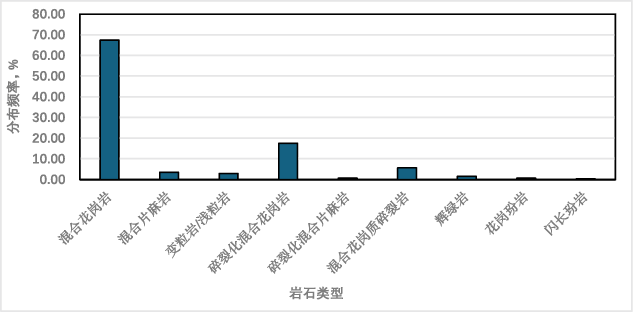
图 1 B油田太古界储层潜山铸体薄片岩性统计结果
Figure 1 Lithologic statistics results of cast thin sections of Archaean buried hill reservoirs in B Oilfield
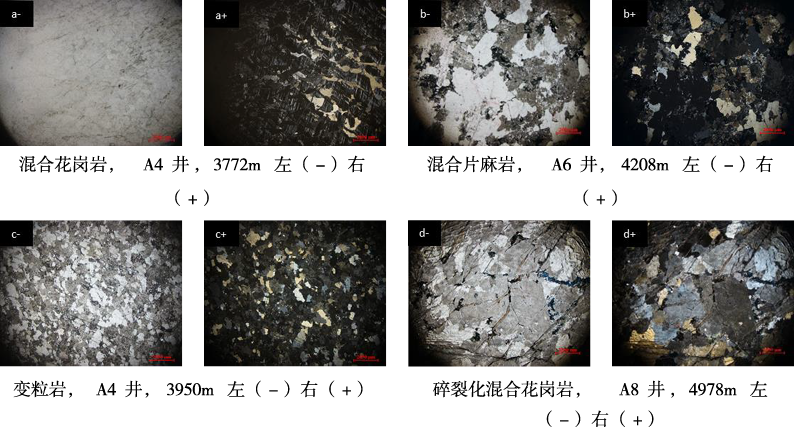
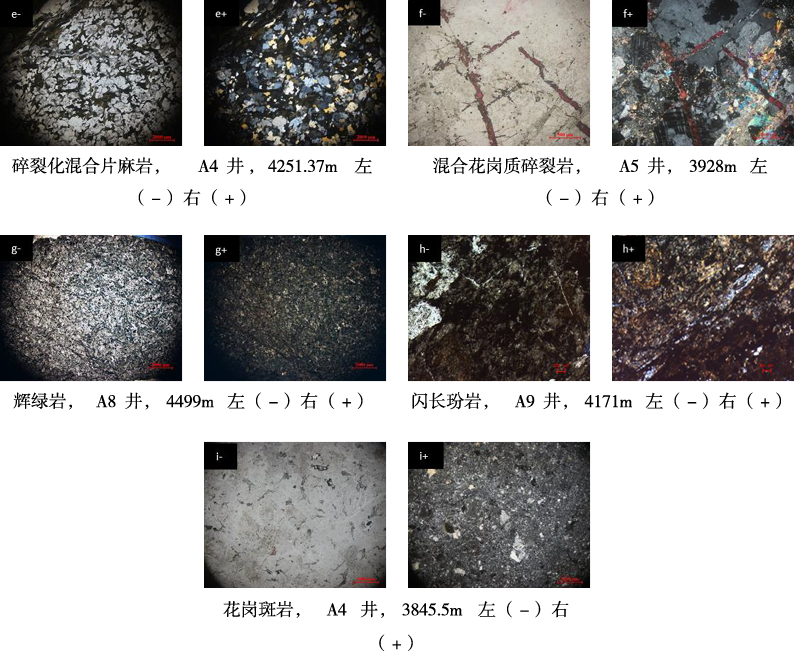
图 2 不同类型岩性镜下矿物组合特征
Figure 2 Microscopic mineral assemblage characteristics of different lithologic types
研究区纵向上自强风化带到内幕带:岩石类型中混合花岗岩相对含量逐渐升高,而碎裂化混合花岗岩与混合花岗质碎裂岩相对含量逐渐降低(图 3)。
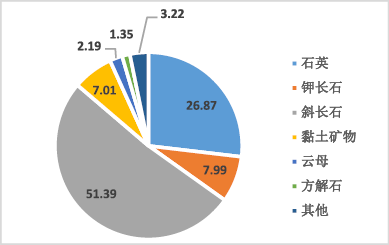
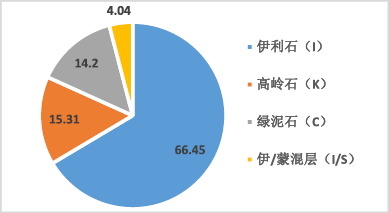
通过对研究区233样次XRD全岩和145样次XRD黏土分析统计可知,石英平均含量为26.87%,钾长石平均含量为7.99%,斜长石平均含量为51.39%,黏土矿物平均含量为7.01%,云母矿物为2.19%,方解石为1.35%,其余成分约占3.22%(图 4a)。其中黏土矿物主要为伊利石(相对含量为66.45%),还包括少量高岭石(相对含量为15.31%)、绿泥石(相对含量为14.2%)和伊蒙混层(相对含量为4.04%)(图 4b)。
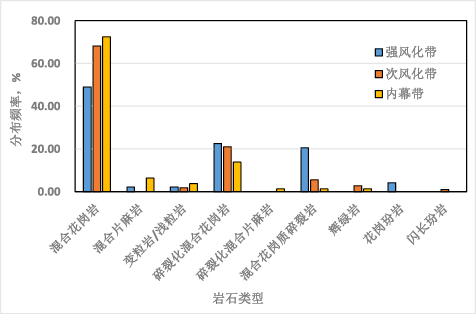
图 3 各分带岩石类型分布直方图
Figure 3 Histogram of rock type distribution in different zones
a.矿物绝对含量
b.黏土矿物相对含量
图 4 研究区矿物绝对含量与黏土相对含量饼图
Figure 4 Pie chart of absolute mineral content and relative clay mineral content in the study area
研究区纵向上自强风化带到内幕带:长石与云母矿物相对含量逐渐升高,石英、黏土矿物相对含量逐渐降低;绿泥石与伊蒙混层相对含量逐渐升高,黏土矿物中伊利石与高岭石相对含量逐渐降低(图 5)。
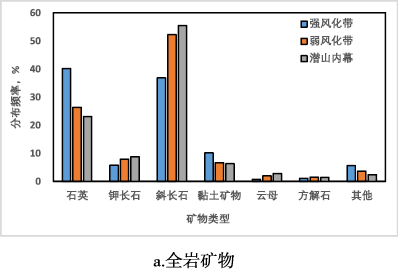
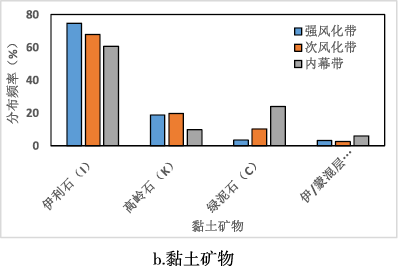
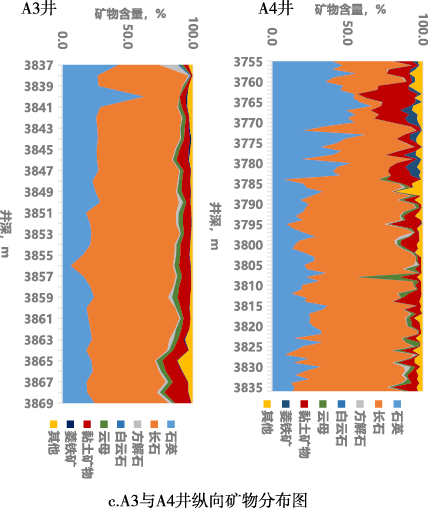
图 5 各分带矿物、黏土矿物分布直方图与单井纵向矿物分布图
Figure 5 Histograms of mineral and clay mineral distribution in different zones and vertical mineral distribution maps of single wells
3 物性特征
取75块标准柱塞样品进行物性测试,对其孔渗数据进行统计,可知研究区孔隙度介于0.43~15.5%,平均孔隙度为3.6%;渗透率介于0.00019~0.47mD,平均渗透率为0.0314mD,属于超低孔、超低渗储层。
随着深度的增加,风化程度逐渐减弱,储层物性呈变差趋势。从强风化带-次风化带-内幕带,整体上物性呈现逐渐变差的趋势。研究区纵向上自强风化带到内幕带:孔隙度从5.6%降至3.8%再降至2.9%,气测渗透率从0.089mD降至0.0291mD再降至0.0195mD(图6)。
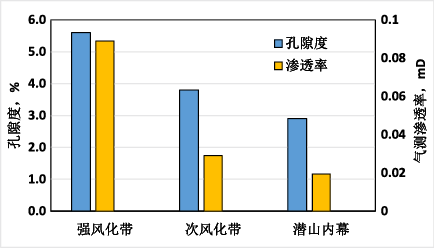
图 6 不同分带的孔隙度与渗透率分布直方图
Figure 6 Histogram of porosity and permeability distribution in different zones
4 储集空间特征
B油田太古界潜山为孔隙—裂缝型储层,故研究区储集空间类型可分为孔隙与裂缝。孔隙类型有粒间孔、溶蚀孔和晶内溶孔,裂缝类型有构造缝与溶蚀缝,如表1所示。
表 1 研究区储集空间类型划分[13]
Table 1 Classification of reservoir space types in the study area
| 分类 | 类型 | 特征 |
| 孔隙型 | 粒间孔 | 原岩经过风化,原岩破碎的颗粒堆积的残留的原生孔隙 |
| 溶蚀孔 | 流体对岩石中的可溶性矿物进行溶解作用形成 | |
| 晶间溶孔 | 矿物晶体经流体溶蚀改造扩大而成 | |
| 裂缝型 | 构造缝 | 构造运动产生的应力超过岩石强度,导致岩石破裂形成 |
| 溶蚀缝 | 先存构造缝、成岩缝等经后期流体溶蚀扩大形成 |
4.1 孔隙结构特征
研究区孔隙类型中粒间孔多发育在风化带和动力变质作用强烈的井段,溶蚀孔和晶间溶孔常见于长石、角闪石等易溶矿物中,或粒间、裂缝内的碳酸盐类填隙物溶蚀形成(图7)。
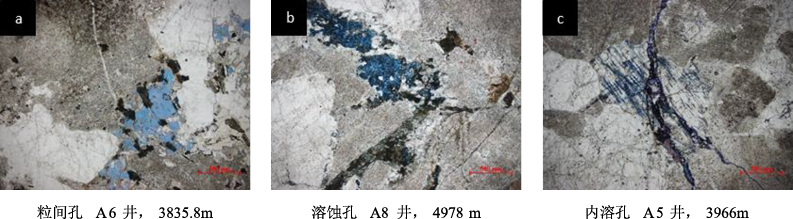
图 7 B油田太古界储层孔隙结构镜下特征
Figure 7 Microscopic characteristics of pore structure of Archaean buried hill reservoirs in B Oilfield
通过对研究区岩心进行常规压汞实验得出(图8、表2):强风化带压汞曲线细歪度,分选性极差,Rmax、RA、R50、Rc平均值分别为1.09、0.22、0.16、0.19μm,退汞效率平均值为32.71%,分选系数平均值为2.66;次风化带压汞曲线呈细歪度,分选性极差,Rmax、RA、R50、Rc平均值分别为0.42、0.09、0.02、0.04μm,退汞效率平均值为38.60%,分选系数平均值为2.19,孔喉结构品质次于强风化带;内幕带压汞曲线细歪度,分选性极差,Rmax、RA、R50、Rc平均值分别为0.30、0.08、0.04、0.06μm,退汞效率平均值为38.53%,分选系数平均值为1.82,孔喉结构品质最差。总体来说纵向上从强风化带到内幕带,孔喉半径变小,排驱压力变大,孔喉结构变差。
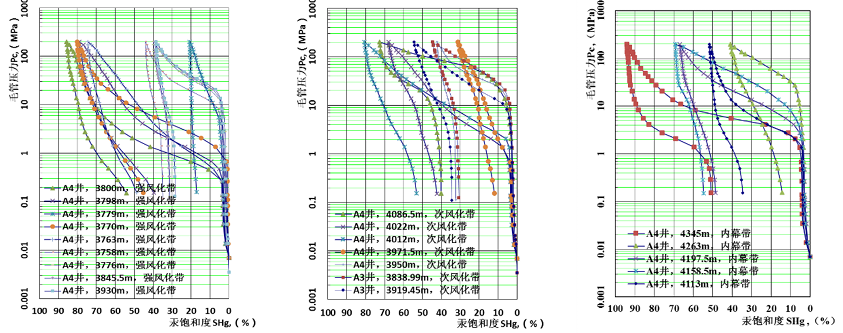
a.强风化带(N=9) b.次风化带(N=7) c.内幕带(N=5)
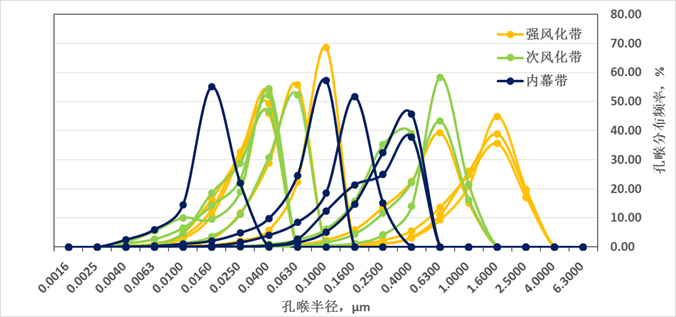
d.各带孔径分布特征
图 8 不同分带压汞曲线图及孔径分布特征
Figure 8 Mercury intrusion curves and pore size distribution characteristics in different zones
表 2 压汞参数数据表
Table 2 Data table of mercury intrusion parameters
| 分带 | 数据 | 孔隙度,% | 渗透率,mD | 孔隙结构参数表,μm | 排驱压力(MPa) | 最大汞饱和度 (%) | 退汞效率(%) | 分选系数 | 均质系数 | |||
| Rmax(μm) | RA(μm) | R50(μm) | Rc(μm) | |||||||||
| 强风化带 | 最大值 | 15.5 | 0.009 | 2.78 | 0.66 | 0.38 | 0.71 | 13.77 | 85.84 | 49.75 | 3.39 | 0.33 |
| 最小值 | 1.3 | 0.145 | 0.05 | 0.02 | 0.06 | 0.01 | 0.26 | 20.77 | 17.28 | 1.14 | 0.16 | |
| 平均值 | 5.6 | 0.044 | 1.09 | 0.22 | 0.16 | 0.19 | 6.28 | 55.78 | 32.71 | 2.66 | 0.26 | |
| 次风化带 | 最大值 | 6.8 | 0.011 | 1.09 | 0.24 | 0.04 | 0.11 | 13.78 | 80.72 | 61.94 | 2.73 | 0.31 |
| 最小值 | 1.7 | 0.001 | 0.05 | 0.01 | 0.01 | 0.01 | 0.68 | 31.16 | 23.41 | 1.07 | 0.18 | |
| 平均值 | 3.72 | 0.007 | 0.42 | 0.09 | 0.02 | 0.04 | 7.47 | 56.27 | 38.60 | 2.19 | 0.24 | |
| 内幕带 | 最大值 | 6.88 | 0.021 | 0.54 | 0.16 | 0.11 | 0.15 | 27.56 | 93.95 | 64.94 | 2.49 | 0.38 |
| 最小值 | 0.99 | 0.001 | 0.03 | 0.01 | 0.01 | 0.01 | 1.37 | 40.95 | 20.92 | 0.88 | 0.22 | |
| 平均值 | 3.3 | 0.01 | 0.30 | 0.08 | 0.04 | 0.06 | 7.71 | 64.52 | 38.53 | 1.82 | 0.27 | |
Rmax:最大吼道半径;RA:平均吼道半径;R50:中值吼道半径;Rc:主流吼道半径;
4.2 裂缝发育特征
对研究区地震、成像测井,岩心、铸体薄片等资料进行分析统计可知,研究区裂缝走向主要以NW-SE向为主,其次为NEE-SWW向;裂缝主要分布在40°~80°高角度缝,小于10°的水平缝基本不发育(图 9、图 10)。
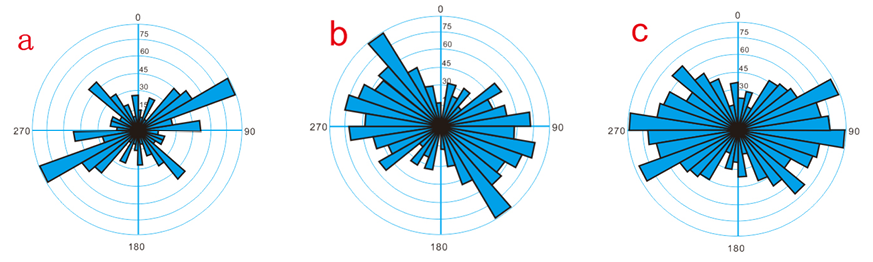
a. A5井 b. A6井 c. A3井
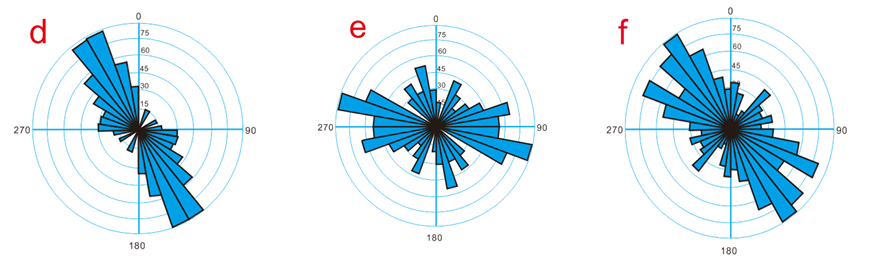
d. A4井 e. A9井 f. A8井
图 9 B油田太古界储层裂缝走向玫瑰花图
Figure 9 Rose diagrams of fracture strike of Archaean buried hill reservoirs in B Oilfield
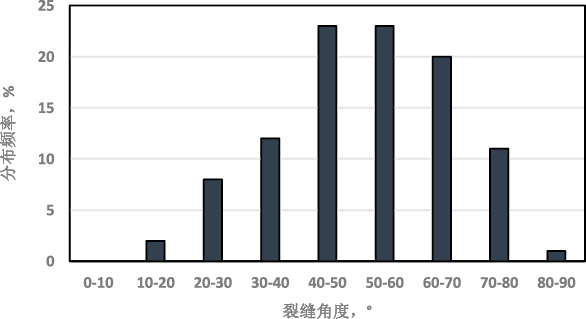
图 10 B油田太古界储层裂缝倾角统计直方图
Figure 10 Histogram of fracture dip angle statistics of Archaean buried hill reservoirs in B Oilfield
通过对研究区成像测井数据处理发现(图11),强风化带裂缝以网状缝为主,多为中高角度缝,溶蚀作用明显,裂缝开度主要为80~200μm ;次风化带以构造缝为主,多为中高角度缝,溶蚀作用减弱,裂缝开度为40~120μm;内幕带裂缝多以构造缝和高角度缝为主,裂缝开度为20~70μm。
研究区受印支期、燕山期和喜山期三期构造作用影响,多发育二期至三期次裂缝(图12),一期裂缝内多充填方解石,石英,黏土矿物,二、三期次裂缝充填硅质,菱铁矿等矿物。
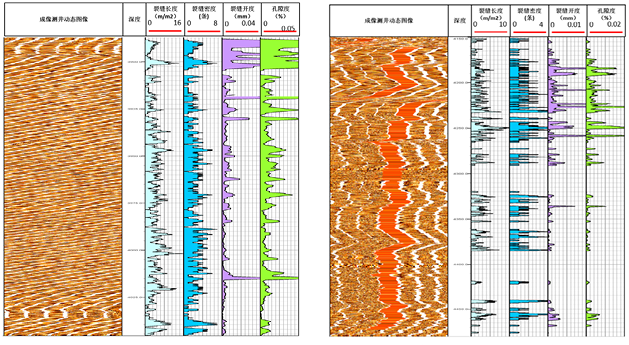
a.A5井 b. A9井
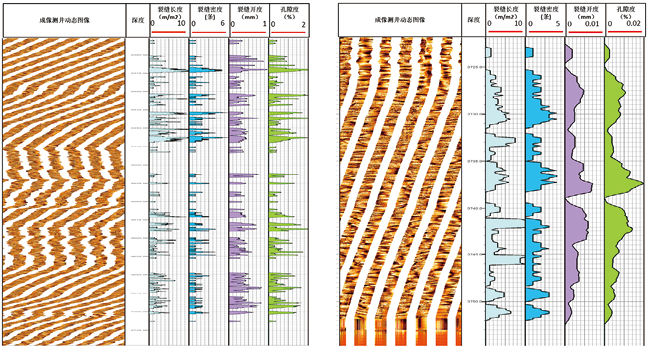
c. A11井 d. A12井
图 11 研究区各井成像测井裂缝参数
Figure 11 Fracture parameters of imaging logging in each well of the study area
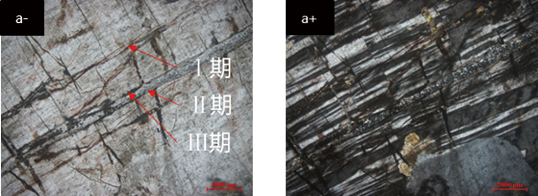
Ⅰ期钙质充填,Ⅱ期硅质充填,Ⅲ期沥青质充填,A4井,3965m左(-)右(+)
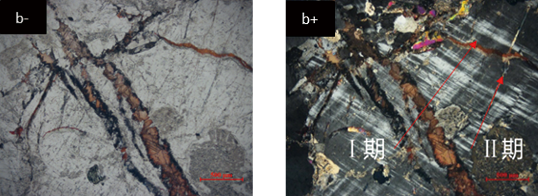
Ⅰ期石英充填,Ⅱ期钙质充填,A6井,3936.9m左(-)右(+)
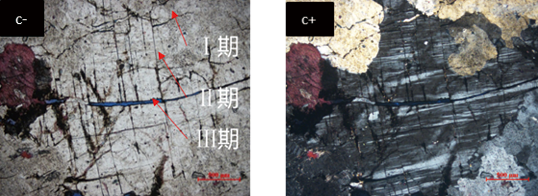
Ⅰ期黏土矿物半充填,Ⅱ期黏土矿物充填,Ⅲ期未充填,A6井,3841m左(-)右(+)
图 12 不同期次裂缝充填物镜下特征
Figure 12 Microscopic characteristics of filling minerals in fractures of different stages
研究区裂缝充填物包括:石英等硅质充填物;白云石、方解石等钙质充填物;各种黏土矿物充填物;菱铁矿等铁质矿物和沥青质充填物等(表3)。
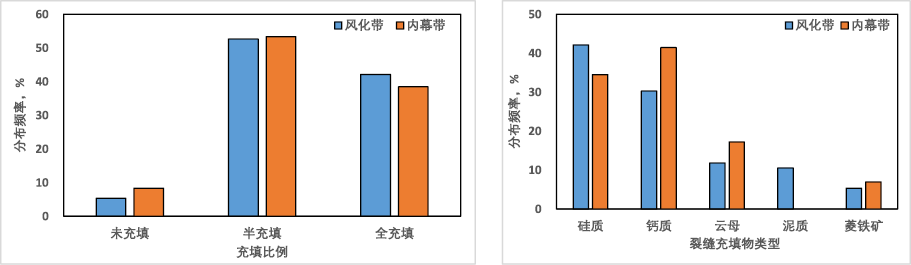
从风化带到内幕带全充填缝占比降低3.8%,半充填缝增加0.8%,未充填缝占比增加3%;裂缝充填物中硅质含量降低7.6%,钙质含量增加11.1%,云母含量增加6.4%,菱铁矿含量增加1.6%,如图13所示。
表 3 A4井纵向上裂缝及充填物发育特征
Table 3 Vertical development characteristics of fractures and filling materials in Well A4
| 分类 | 现象 | 铸体薄片 | |||
| 强风 化带 | 溶孔、溶缝发育 |

|
|
|
|
| 3700m,菱铁矿充填(-) | 3724m,白云石充填(-) | ||||
|
|
|
|
|
||
| 3783 m,硅质充填(-) | 3800 m,黏土充填(-) | ||||
| 次风 化带 | 中高角度 裂缝 |
|
|
|
|
| 3961 m,黏土充填(+) | 4030 m,硅质充填(+) | ||||
|
|
|
|
|
||
| 4053 m,钙质充填(-) | 4053 m,菱铁矿充填(-) | ||||
| 内幕带 | 高角度裂缝增加 |
|
|
|
|
| 4135m,黏土充填 | 4343m,硅质充填 | ||||
|
|
|
|
|
||
| 4345m,钙质充填 | 4350m,未充填 | ||||
a.纵向上裂缝充填比例 b. 纵向上裂缝充填物类型
图 13 纵向上裂缝充填特征
Figure 13 Vertical filling characteristics of fractures
研究区纵向上:强风化带溶缝发育,裂缝开度为80~200μm,充填物多为硅质、钙质;次风化带以中—高角度构造缝为主,裂缝开度为40~120μm,充填物多为硅质、钙质,泥质充填物占比增加;内幕带裂缝多以高角度构造缝为主,裂缝开度为20~70μm,充填物多为硅质、钙质,钙质充填物增加,少见泥质充填物。总体来说,研究区纵向上呈现裂缝开度有减小、发育程度减弱、裂缝充填物钙质充填物增加,而泥质充填物减少的趋势。
5 结论
B油田太古界变质岩潜山储层受构造活动、风化淋滤及岩性差异多重因素控制,纵向分带明显。依据风化程度将储层从纵向上划分为强风化带、次风化带与内幕带,基于此研究各带储层特征的差异,得到以下结论和认识。
(1)岩性特征自强风化带到内幕带。混合花岗岩相对含量升高,碎裂化混合花岗岩与混合花岗质碎裂岩相对含量降低;自上向下,石英、黏土矿物相对含量降低,长石、云母矿物相对含量增加;黏土矿物中伊利石、高岭石相对含量降低,绿泥石与伊蒙混层相对含量增加。
(2)研究区平均孔隙度为3.6%,平均渗透率为0.0314mD,属于超低孔超低渗储层。自强风化带到内幕带:气测渗透率从5.6%降至2.9%,气测渗透率从0.089mD降至0.0195mD。
(3)研究区为孔隙—裂缝型储层,储集空间类型包括孔隙与裂缝,通过压汞实验可知,研究区孔喉结构较差,自强风化带到内幕带,孔喉半径减小,排驱压力变大,孔喉结构逐渐变差。
(4)研究区裂缝多为高角度缝,自强风化带到内幕带,溶蚀作用减弱,裂缝开度越来越小,裂缝角度逐渐增大;裂缝充填程度降低,充填物中硅质含量降低,钙质、云母、菱铁矿含量增加。
参考文献
[1] 官大勇,石文龙,赵弟江,等.渤海湾盆地渤中26-6潜山油田油气异源混合成藏特征及充注过程[J].地球科学,2025,50(2):478-493.
[2] 谭礼洪.声波全波列测井在渤海变质岩储层有效性评价中的应用研究[D].长江大学,2023.
[3] 徐长贵,周家雄,杨海风,等.渤海湾盆地大型变质岩潜山油田勘探发现及地质意义[J].石油学报,2023,44(10):1587-1598+1611.
[4] 康凯,赵林,罗宪波,等.裂缝性潜山气藏产能评价新方法及其应用[J].中国海上油气,2021,33(3):100-106.
[5] 谭先锋.陆相断陷湖盆旋回沉积机理与成岩系统物质耦合关系研究[D].成都理工大学,2013.
[6] 周家雄,杨海风,官大勇,等.渤海湾盆地渤中26-6变质岩潜山大油田发现与认识创新[J].中国海上油气,2023,35(4):1-11.
[7] 肖胜东.渤海湾盆地渤中凹陷凝析气藏相态识别及其成因机制[D].西北大学,2019.
[8] 官大勇,石文龙,赵弟江,等.渤海湾盆地渤中26-6潜山油田油气异源混合成藏特征及充注过程[J].地球科学,2025,50(2):478-
493.
[9] 范廷恩,杜昕,樊鹏军,等.断-貌双控渤中26-6油田太古界潜山储层综合预测[J].地球科学,2023,48(2):429-438.
[10] 刘鹏程.渤海海域典型区带太古宇变质岩潜山岩性分布规律与次生溶蚀孔隙成因[D].吉林大学,2024.
[11] 任淑悦.渤海湾盆地太古宇变质岩潜山储层表征及发育模式[D].吉林大学,2023.
[12] 赵鹏飞,刘朋,明君,等.渤中A凝析气田潜山储层特征及其地球物理判识方法[J].地球科学,2025,50(2):504-520.
[13] 宋国民.渤中凹陷19-6构造区太古界潜山变质岩裂缝型储层特征与控制因素分析[D].吉林大学,2021.