Current Views: 125410
 Current Downloads: 76725
Environment and Resource
ISSN Print:2707-2398
ISSN Online:2707-2401
Contact Editorial Office



Subscribe to the latest published information from SCISCAN
四川盆地南部深层页岩气富集主控因素以及成藏模式分析
Main Controlling Factors and Hydrocarbon Accumulation Model of Deep Shale Gas Enrichment in the Southern Sichuan Basin


-
Information:
中国石油川庆钻探工程有限公司地质勘探开发研究院,成都
-
Keywords:
Deep–ultradeep; Shale gas enrichment; Main controlling factors; Accumulation model深层-超深层; 页岩气富集; 主控因素; 成藏模式
- Abstract: The Wufeng–Longmaxi Formations in the Luzhou area of the Sichuan Basin possess significant potential for shale gas resources. However, considerable variations in shale reservoir quality and gas content exist across different structural units. Natural fracture development and tectonic reworking strongly influence the enrichment patterns, structural controls, and accumulation models of shale gas. Based on logging interpretation, geophysical prediction, core analysis, laboratory test data, and focused ion beam scanning electron microscopy (FIB-SEM) of deep shale samples from the Wufeng–Longmaxi Formations in the Luzhou area, a shale gas enrichment and accumulation model was established. The results indicate that: (1) The variations in deep shale gas reservoirs are attributed to the combined influence of reservoir space characteristics, diagenesis, structural position, tectonic evolution, and fracture–fluid interactions. Organic-rich siliceous shales retain favorable reservoir properties, characterized by organic matter pores that dominate the pore structure, relatively high porosity and permeability, and good pore preservation and gas-bearing capacity under overpressure conditions. (2) Structural style is a primary control on variations in gas content, with synclines exhibiting significantly better gas content than anticlines. Free gas migration governs the enrichment pattern: high fluid pressure in syncline cores drives free gas migration toward anticlines. High gas content zones develop in the core and flanks of synclines where structural integrity is maintained, whereas gas content declines near fault zones in anticlinal areas. (3) Shale gas enrichment relies on the coupled interaction of “high organic carbon content, high-quality pore reservoirs, and strong tectonic preservation conditions.” Syncline cores are typically distant from faults and exhibit good structural integrity and preservation conditions. Driven by buoyancy and other factors, free gas migrates laterally from structurally low areas to adjacent high-position anticlines, while a certain amount of free gas is retained on syncline flanks. Syncline structures are more favorable for shale gas preservation than anticline structures. 四川盆地泸州地区五峰组—龙马溪组页岩气资源潜力巨大,不同构造单元页岩储层品质、含气性差异较大,天然裂缝发育特征、构造改造作用对页岩气富集规律、构造控制作用及成藏模式影响较大。采用泸州地区深层页岩气五峰组—龙马溪组测井解释、物探预测、岩心分析化验资料,以及聚焦离子束扫描电镜等技术,建立页岩气富集成藏模式。研究结果表明:深层页岩气藏储层差异主要受储集空间特征、成岩作用、构造位置、构造演化和裂缝-流体活动共同控制,富有机质硅质页岩仍保持良好储集性能,表现为有机质孔主导的孔隙结构、相对较高的孔隙度和渗透率,超压保孔含气性较好;构造样式主导含气性差异,向斜区显著优于背斜区,游离气运移控制富集格局,向斜区核部流体高压驱动游离气向背斜区运移,向斜区核部、翼部因构造完整形成高含气量带,背斜区域靠近断层含气量降低;页岩气富集依赖“高有机碳物质基础-优质孔隙储集空间-强构造保存条件”的协同配置。向斜核部远离断层,构造完整性和保存条件较好,低部位的游离气在浮力等因素的影响下向两侧高部位背斜区发生侧向运移,一定量的游离气在向斜区翼部保存下来,向斜构造相对于背斜构造更有利于页岩气的保存。
- DOI: 10.35534/er.0802020
- Cite: 黎菁,刘兴,龚鑫,等.四川盆地南部深层页岩气富集主控因素以及成藏模式分析[J].环境与资源,2026,8(2):150-158.
近年来,四川盆地上奥陶统五峰组~下志留统龙马溪组页岩气已实现了规模化、高效的勘探开发,先后建成了泸州、长宁、威远等9个页岩气田,年产能达到
240×108 m3,成为推动中国天然气增储上产的重要支撑[1-3]。随着勘探开发的深入,四川盆地深层(埋深> 3500m)、超深层(埋深>4500m)、常压(压力系数<1.20)及新区新层系页岩气成为重要的增储上产领域,尤其是深层和超深层页岩气资源最为丰富。四川盆地内五峰组~龙马溪组深层页岩气有利区面积超2×10⁴ km2,资源量超10×1012 m3,是中国天然气可持续发展的重要接替领域[5-8]。近年来随着页岩气勘探开发力度的不断加大,中石油进一步加快了川南深层页岩气整体快速上产的节奏。L1~L2井区位于泸州中区,五峰组~龙马溪组深水陆棚相广泛发育,富有机质页岩厚度大、分布稳定,2023年井区内完钻的11口评价井资料显示,井区五峰组~龙马溪组Ⅰ类储层连续厚度14~20m,脆性矿物、孔隙度、含气饱和度等储层参数优,具有巨大的开发
潜力。
川南地区上奥陶统五峰组至下志留统龙马溪组页岩层系是当前页岩气勘探开发的核心目标层段,富含大量页岩气资源。页岩孔隙作为气体储存与运移的关键通道,其微观形态与结构对气体吸附及流动行为具有重要控制作用,受多种地质因素的综合影响。其中,构造作用对页岩储层孔隙结构的改造尤为突出。不同构造组合类型、构造样式及其空间部位,往往导致页岩孔隙结构特征与储层品质的差异,从而显著影响储层的含气性表现。由于页岩孔隙孔径细微、结构复杂,构造挤压作用可能引发孔隙的变形与损失。在构造应力作用下,有机质和黏土矿物等塑性组分易于发生形变,进而改变孔隙形态、降低孔隙体积,削弱页岩的储集能力[9-13]。但也有研究指出,构造作用可诱发劈理发育,从而在一定程度上提高孔隙容积与比表面积。
本文为查明深层页岩气富集主控因素以及成藏模式,利用扫描电镜、矿物组分分析、物探资料以及测井综合解释资料,分析深层页岩的沉积环境,结合储层孔隙结构特征以及储集空间特征等实验资料讨论了深层页岩气富集特征及勘探潜力评价,本文厘清了构造部位差异与页岩含气性的耦合关系,研究成果丰富了对构造控藏机理的认知,为完善构造背景下的页岩成藏模式贡献了新的理论依据。
1 区域地质概况
泸州地区在构造上受到西侧华蓥山断裂和东侧綦江断裂的夹持,同时受到南侧长垣坝构造的限制,整体形成三角形构造区,属于多构造过渡体系。泸州区块L1~L2井区在区域构造上主要位于川南低陡构造带,按照构造样式、断裂体系等分类,二级构造单元属于泸州北部帚状构造,三级构造单元包括福集向斜、得胜-宝藏向斜、来苏-云锦向斜。L1~L2井区延续了泸州北区的“低陡背斜夹持宽缓向斜”的构造格局,内部微幅构造和小断裂较北区更发育。井区内五峰组底界Ⅰ级断层不发育,Ⅱ级断层经过中部构造转换带后断层方向发生一定的偏转,向斜内部Ⅲ、IV级小断层较发育,具有北东~南西向、南北向、东西向三个方向[14,15]。
五峰组沉积时期,受广西运动的影响,华夏与扬子地块碰撞拼合作用减缓,四川盆地及邻区形成了三隆夹一坳的古地理格局。在龙马溪组沉积的早期(鲁丹期~埃隆早期),受南极冰盖融化造成的海平面快速上升影响,整个川南地区处于大面积缺氧的深水陆棚沉积环境。龙马溪组的沉积中晚期(埃隆中期~特列奇期),扬子板块与周边地块的碰撞拼合作用加剧,沉降中心向川中和川北迁移,海平面大幅度下降,泸州区块在该时期从深水陆棚向钙质浅水陆棚转化[16-19]。
2 深层页岩储层特征以及富集主控因素
2.1 页岩孔隙类型
通过扫描电镜识别出研究区龙一1亚段页岩共发育6种孔隙类型:固体干酪根孔、焦沥青孔、黏土矿物粒内孔、硅质矿物粒间孔、硅质矿物溶蚀孔和碳酸盐溶蚀孔;使用Image J软件对扫描电镜图片处理,发现焦沥青孔面孔率最高为21.04% ~ 31.65%,根据各基质组分对页岩孔隙贡献比例的定量分析,页岩储层孔隙发育的主要贡献者是有机质孔,占比达到59.99% ~ 63.39%,其中99%的孔由焦沥青提供[20-22]。
(1)有机质孔隙
研究结果表明,有机质孔的发育特征具有显著的组分选择性,并直接控制着气体的储集与运移能力。依据有机质形态、颜色、与矿物的接触关系及孔隙发育特征,可将研究区有机质划分为固体干酪根与焦沥青两类。其中,固体干酪根多呈条带状或块状充填于矿物基质中,其内部孔隙极不发育,偶见少量形态不规则的孤立孔隙,孔隙间连通性较差。相比之下,焦沥青内部普遍发育大量海绵状或蜂窝状有机质孔,孔隙形态复杂且常呈嵌套式组合(大孔中包含小孔),形成高度连通的孔隙网络[23]。这种微观结构的差异表明,焦沥青相较固体干酪根具有更强的气体储集与运移能力,是页岩储层中有机质孔的主要贡献者。
(2)无机质孔隙
依据矿物学特征与孔隙成因,研究区无机孔隙可划分为黏土矿物粒内孔、硅质矿物粒间孔与溶蚀孔,以及碳酸盐溶蚀孔三类[24-26]。黏土矿物粒内孔多呈狭缝状且具层状结构,孔隙内部常见有机质充填现象。硅质矿物孔隙主要包括粒间孔与溶蚀孔,其中粒间孔的发育得益于生物成因石英的早期聚集,该类型石英集合体形成时间早且抗压性强,有利于粒间孔隙的有效保存。碳酸盐溶蚀孔形态多呈不规则状或椭圆状,其形成与页岩生烃过程中释放的有机酸对不稳定矿物的溶解作用密切相关(图1)。


图 1 典型井龙马溪组孔隙微观特征
Figure 1 Pore microscopic characteristics of the Longmaxi formation in typical wells
(3)孔隙度分布特征
如图2所示,对川南泸州地区典型井龙马溪组样品进行低场核磁T2谱特征分析,谱图主要呈现两个特征峰:主峰位于T2≈1~10 ms区间,对应样品内部的中小孔隙水;次峰位于T2≈100 ms 区间,对应较大孔隙或裂隙水。随渗吸时间从10 min延长至7 d,主峰信号强度呈递增趋势:渗吸初期(10 min~2 h)信号增长平缓,表明水分缓慢进入基质孔隙;中期(4 h~2 d)信号显著增强,反映渗吸速率加快,更多中小孔隙被水充填;后期(4 d~7 d)信号趋于稳定,提示孔隙水分布接近平衡。与饱水样品相比,渗吸7d 时主峰强度仍略低于饱水状态,表明长时间渗吸可使大部分中小孔隙被水饱和,但未完全达到饱水条件。次峰(T2≈100 ms)信号强度整体较弱,且随渗吸时间延长无明显变化,说明较大孔隙或裂隙在渗吸初期即被水占据,对总水含量贡献较小。整体而言,T2谱分布特征直观揭示了渗吸过程中水分在 样品孔隙中的赋存状态与动态演化规律:渗吸时间主导中小孔隙水的充填过程,而大孔隙水在渗吸早期即达到饱和[27-30]。
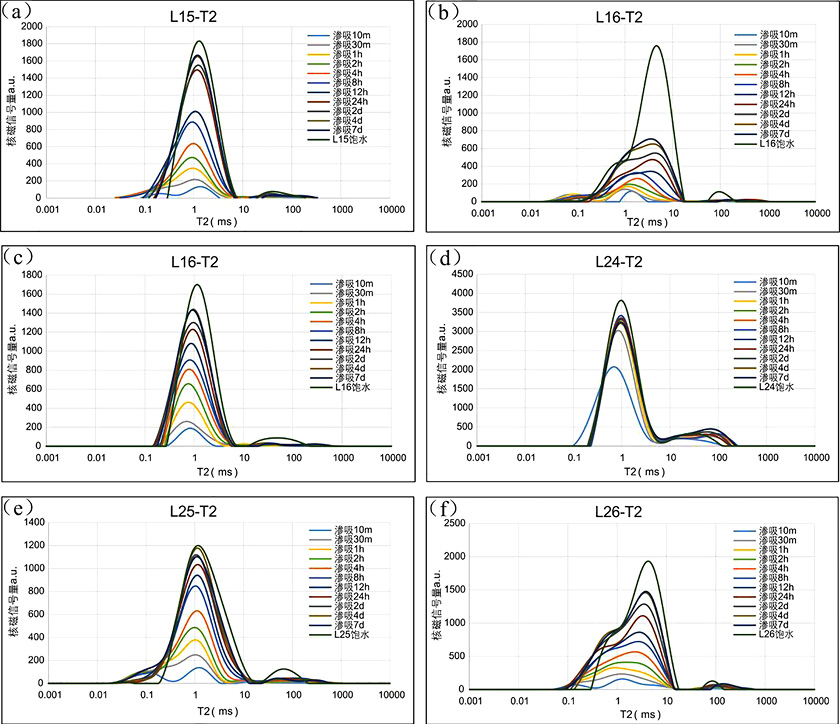
图 2 典型井龙马溪组样品低场核磁T2谱特征
Figure 2 Low-field NMR T2 spectrum characteristics of shale samples from the Longmaxi formation in typical wells
总体上气井核磁孔隙度介于3.62%~8.38%,平均值为5.13%。气井孔隙含水饱和度介于10.84%~22.73%,平均值为14.51%。根据核磁实验,龙一2亚段页岩储层孔隙中束缚水饱和度介于88.21%~91.59%,平均值为83.56%;可动水饱和度介于8.41%~16.44%,平均值为8.41%。
2.2 有机质含量及热演化程度
(1)有机质丰度
有机质丰度的表征参数主要包括有机碳含量(TOC),氯仿沥青“A”以及总烃。考虑到整个四川盆地龙马溪组页岩处于过成熟阶段,主要采用TOC对五峰组~龙一1亚段有机质丰度进行表征与评价。泸201~泸202井区下层系TOC介于2.9%~3.4%之间,略低于泸州北区;上层系TOC介于2.1%~2.5%,同样略低于北区。
(2)有机质类型
有机质类型不仅对烃源岩的产气能力具有显著控制作用,同时也会影响有机质自身的吸附性能,通常可通过干酪根类型与干酪根碳同位素组成进行有效表征。在显微观察下,干酪根可划分为腐泥组、壳质组、镜质组和惰质组四种组分,其物质来源主要为动植物的不同组织与器官。受沉积环境及物源供给差异的影响,不同地区、不同层位干酪根各组分的相对含量存在明显差别。早古生代时期,全球范围内尚未出现高等植物,烃源岩中的有机质主要来自低等水生生物及浮游生物。四川盆地下志留统龙马溪组整体以细粒沉积为主,地层中富含笔石化石,沉积环境为强还原环境,有机质输入以低等水生生物占绝对主导。对泸州区块五峰组-龙一1亚段岩心样品的干酪根镜检结果显示,其有机质组分以腐泥型为主,干酪根类型为Ⅰ型。在总有机碳(TOC)含量相同的条件下,Ⅰ型干酪根具有最优的生烃潜力。
(3)有机质热演化程度
有机质成熟度是评价有机质热演化程度的一项指标,干酪根的镜质体反射率(Ro)是最直观的表征有机质成熟度的参数,也是划分有机质热演化阶段的标准。根据分析化验结果,泸201~泸202井区有机质成熟度较高,五峰组-龙一1亚段Ro分布在2.5%~3.4%,平均为3.2%,处于过成熟阶段,以产干气为主。
2.3 微观孔隙吸附气及游离气含气性特征
图3a到图3d展示了样品在不同压力条件下的甲烷吸附量变化特征,整体吸附曲线呈现典型的Langmuir型吸附特征:在低压阶段(0~10 MPa),吸附量随压力升高呈快速线性增长;当压力超过10 MPa后,吸附速率逐渐放缓,曲线趋于平缓并向吸附饱和状态过渡。实测吸附量数据点(蓝色圆点)与拟合过剩吸附曲线(蓝色实线)高度吻合,验证了拟合模型的可靠性;而拟合绝对吸附量(橙色实线)在高压段持续缓慢上升,始终高于过剩吸附量,清晰反映出高压条件下气体相态压缩效应对吸附量计算结果的显著影响。
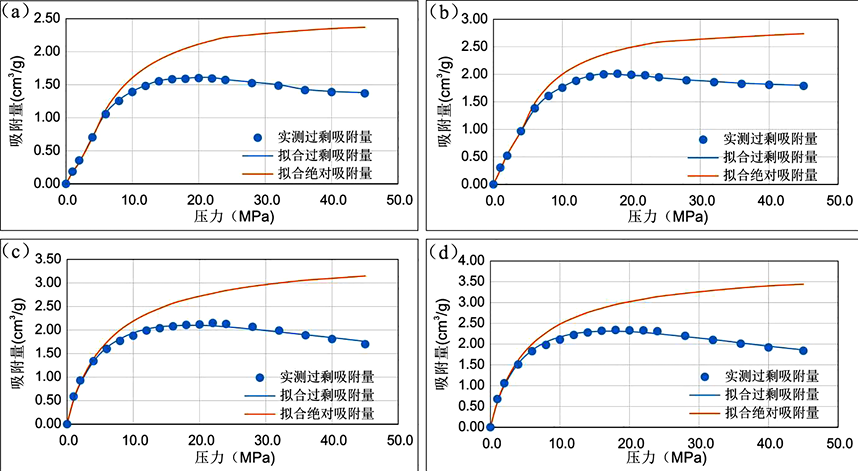
图 3 典型井龙一1亚段高温高压等温吸附实验 (a)L13, 3小层,4159m;(b)L16, 2小层,4615m;
(c)L16,2小层,4620m;(d)L26,2小层,4561m
Figure 3 High-temperature and high-pressure isothermal adsorption experiments on typical wells in the Longyi1 Submember (a) Well L13, Layer 3, 4159 m; (b) Well L16, Layer 2, 4615 m; (c) Well L16, Layer 2, 4620 m;
(d) Well L26, Layer 2, 4561 m
随深度增加,温度和压力不断升高,页岩吸附甲烷的能力先增加后降低,页岩在500~1000m左右达到最大吸附能力。埋藏深度小时,压力是页岩吸附甲烷的主导因素,随埋藏加深,温度对页岩吸附甲烷能力的控制作用增强。随TOC增大,页岩吸附甲烷能力增加,达到最大吸附能力时的深度也随之增加。如图4所示,气井每增加2%的TOC页岩对甲烷吸附的上限大约增加0.85cm3/g,龙一1亚段页岩整体吸附气含量较高。页岩游离气量随埋藏深度增加而增加;埋藏深度相同时,随孔隙度增大,页岩游离气量呈现显著增大的趋势。埋藏深度相同时,随含水饱和度增大,页岩游离气量呈现逐渐减小的趋势,但影响程度低于孔隙度的影响。
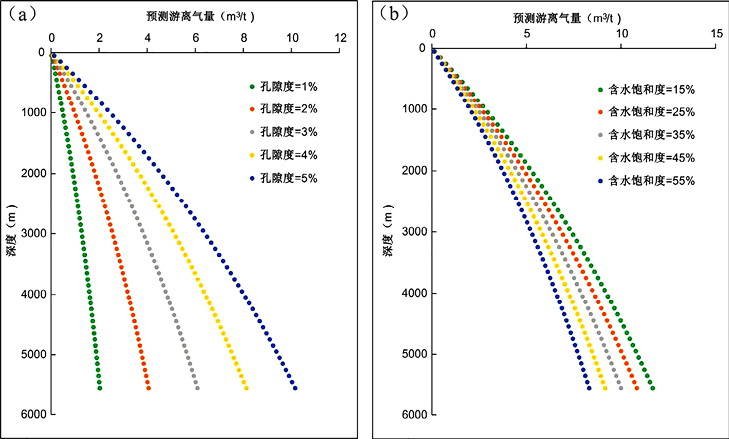
图 4 泸州地区不同孔隙度、含水饱和度页岩游离气量随埋藏深度变化曲线
Figure 4 Variation curves of free gas volume in shale with burial depth under different porosity and water saturation in the Luzhou area
2.4 深层页岩气富集主控因素
2.4.1 有机质类型与含量
结合前文干酪根类型分析,本研究进一步通过高压等温吸附实验揭示了Ⅰ型干酪根主导的龙马溪组页岩样品吸附行为特征。本样品以Ⅰ型腐泥型干酪根为主,在相同TOC条件下具备最优生烃潜力,同时其富氢、致密的有机质结构也为甲烷分子提供了丰富的纳米级吸附孔隙,这是样品在高压下仍能维持较高吸附量的物质基础。相较于Ⅲ型干酪根主导的样品,Ⅰ型干酪根页岩通常具有更高的比表面积与更发达的微孔结构,从而表现出更强的甲烷吸附能力,这一结论也与本实验中较高的饱和吸附量特征相匹配。
有机质干酪根类型是造成生烃潜力差异的直接原因,川南泸州地区五峰-龙马溪组页岩干酪根类型主要为Ⅰ型,含少量Ⅱ1型,表明有机质来源主要为浮游生物及藻类堆积物,生烃潜力大。TOC含量及优质页岩厚度共同决定了生烃母质的总量,构成页岩气藏形成的物质基础。结合川南地区五峰-龙马溪组页岩TOC纵向变化规律,五峰组及龙马溪组底部优质页岩厚度普遍在60m以上,泸州地区典型井L12、L18、L26井五峰组-龙马溪组页岩整体有机质含量介于0.28%~7.5%之间,底部优质页岩有机质含量介于1.9%~7.5%,平均为3.97%,纵向上具有“降低—升高—降低”的“三段式”变化特征(图5),TOC含量分别在龙一11及龙一13小层出现峰值。L12、L18、L26井的U/Th比在龙一亚段的1小层分别达到3.38、3.63、5.08。泸州地区页岩样品有机质等效镜质体反射率测试结果显示,川南地区有机质热演化程度普遍在2.0以上,最大热演化程度为2.95。结合不同热演化程度有机质生烃产物的差异,川南地区有机质处于高-过成熟阶段热解产干气阶段,保证了有机质生烃转化。高有机质丰度、适度的热演化及高有效厚度共同保证了页岩气藏的烃源供给。
2.4.2 构造样式主导含气性差异
(1)向斜构造
背冲式向斜构造由2条相向逆冲断层共同构成,向斜区核部被夹持于断层之间。按照构造样式、断裂体系等将L1~L2井区进一步划分为福集向斜、得胜-宝藏向斜、来苏-云锦向斜3个三级构造单元。福集向斜整体自北向南逐渐由浅洼向深洼过渡,构造宽度逐渐增大。向斜北区L3井区褶皱强烈,断层规模大;南区L1~L2井区西部褶皱较弱。整个向斜内断层规模小,Ⅲ、Ⅳ级小断层增多,发育多个背斜、向斜组合。得胜-宝藏向斜内整体自北向南逐渐由浅洼向深洼过渡,构造宽度逐渐增大。向斜北区Y1井区构造走向为北东-南西向,存在北东向和近东西向两组断层,呈宽向斜、窄背斜的构造样式;向斜南区L1~L2井区保持宽向斜、窄背斜的构造样式。来苏-云锦向斜内构造形态简单,地层平缓,断裂不发育,向斜北区构造走向为北东-南西向,呈宽向斜、窄背斜的构造样式;南区构造走向朝东西向过渡,保持宽向斜、窄背斜的构造样式。
在该构造背景下,储层普遍发育一定数量的低角度剪切裂缝。在挤压应力作用下,上覆泥岩、致密灰岩等高完整性岩层未发生明显破裂,盖层具备良好的封闭性,可有效阻止页岩气向上逸散;同时,储层内裂缝的发育也为有机质的聚集与保存提供了有利条件[31-33]。以福集1号向斜核部的L13井为例,该井所处位置裂缝发育中等,构造封闭性良好,L13井TOC值、脆性矿物含量越高,裂缝密度越大,龙一11小层TOC值为5.8%,脆性矿物含量为79.3%,裂缝密度最高达到14.4条/m,页岩平均含气量高达9.4m3/t,展现出较强的富气能力。L12井位于天生向斜核部,裂缝密度与 TOC 值、脆性矿物含量呈正相关关系,龙一11小层TOC值为6.1%,脆性矿物含量为85.2%,裂缝密度最高达到6.8条/m,平均含气量为10.5m3/t。
(2)背斜构造
背冲式背斜构造由宽缓背斜与两翼相向倾斜的逆断层构成,褶皱呈现高幅度隆起,页岩变形更为强烈。泸州区块位于四川盆地川南低陡构造带与川西南低褶构造带交界构造区的自流井构造群、阳高寺构造群。大部分区域属于阳高寺构造群,背斜发育较多,自西向东分为轴向北东向的三个构造条带。该构造带主体展布方向为NE向,构造以雁行状、弧形、“S”形展布,以高尖、高陡、低陡背斜为主,背斜向东南延伸,向S偏转呈帚状,褶皱规模、强度、幅度由弱变强,具压扭性,地下高点在同一背斜上的偏移部位随背斜延伸而不同。断面在剪切应力下持续活动,形成破碎带,顶底板也未发育上下贯通的垂向裂缝,侧向封堵能力差,页岩气保存条件一般。靠近断层带区域的产气能力略逊于向斜核部,L1井位于海潮向斜构造高部位,龙一11小层TOC值为5.5%,脆性矿物含量为76.7%,龙一11~龙一12小层裂缝最为发育,最高达9.5条/0.5m,页岩平均含气量降低为8.4m3/t。
3 深层页岩不同构造部位页岩气成藏模式
页岩气富集主要取决于物质基础、储集空间与保存条件的有利配置。向斜构造单元中,页岩气保存需要良好的顶、底封盖及侧缘遮挡。泸州地区具有良好的顶底板条件,顶、底板都属于低孔低渗致密地层,在页岩气形成和后期构造过程中对页岩气层都具有很好的封隔作用。泸州地区褶皱变形带向斜区所受变形强度小于背斜区,向斜构造区表现出更为优越的储集性能,具体表现为页岩孔隙度显著增加、总孔隙体积明显增大,同时微裂隙系统的高度发育极大地改善了页岩储层的储集和渗流能力[3-37]。按照泥页岩断裂滑移性评价标准,对L1~L2井区断裂进行评价,发现北部断裂稳定性好,滑移性较弱,无强滑移断裂,发育6条中滑移断裂和7条弱滑移性断裂,而南部断裂稳定性差,发育3条强滑移断裂、8条中滑移断裂和2条弱滑移断裂。
L15井远离断层,构造完整性和保存条件较好,低部位的游离气在浮力等因素的影响下向两侧高部位背斜区发生侧向运移,一定量的游离气在向斜区翼部保存下来,孔隙度中等5.1%,但微裂缝改善了储集能力,含气量较高为7.5m3/t;L25井靠近断层,孔隙度较低,断裂破坏了储层连续性,游离气可沿页理顺层逸散,含气量较低为4.9m3/t;L1井位于强改造的背斜区,断裂发育,受高角度缝发育和方解石充填的影响,储集空间劣化,不利于页岩气的保存,页岩含气量较低为5.3m3/t。因此,宏观上,向斜构造相对于背斜构造更有利于页岩气的
保存。
4 结论
(1)泸州区块五峰组—龙马溪组沉积期水体由缺氧向氧化转化;优质页岩有机质丰度高(TOC>3%)、类型好(Ⅰ型干酪根)、热演化程度高(Ro>3.0),处于高—过成熟干气阶段;储层孔隙以有机质孔为主,孔径20~170 nm,孔隙度多>5.0%,高TOC与厚层优质页岩共同构成页岩气形成的物质基础。
(2)页岩吸附气量随TOC增加而升高(每增加2% TOC,吸附气上限增0.85 cm3/g),龙一1亚段吸附气含量较高;游离气量随埋深和孔隙度增加而增大,随含水饱和度增加而减小,其中孔隙度影响更为显著。研究区页岩气以游离气为主,向斜区游离气占比明显高于背斜区,构造部位差异主导含气性变化。
(3)页岩气富集成藏受“物质基础—储集空间—保存条件”三元协同控制。构造样式决定性影响含气性,向斜区远离断层、构造完整、保存条件好,游离气在浮力驱动下向两侧背斜运移,翼部仍保留一定气量;斜坡及背斜区因断裂发育、储层连续性破坏及裂缝充填,保存条件较差。宽缓向斜区在三元协同作用下是页岩气勘探的最有利区。
参考文献
[1] 马新华,谢军,雍锐,等.四川盆地南部龙马溪组页岩气储集层地质特征及高产控制因素[J].石油勘探与开发,2020,47(5):841-855.
[2] 邹才能,赵群,丛连铸,等.中国页岩气开发进展、潜力及前景[J].天然气工业,2021,41(1):1-14.
[3] 白立勋,高之业,魏维航,等.川南地区龙马溪组中深层与深层页岩孔隙结构对比研究[J].特种油气藏,2023,30(4):54-62.
[4] 赵圣贤,刘勇,李博,等.四川盆地泸州区块五峰组-龙马溪组页岩气储层孔隙连通性特征及模式[J].石油与天然气地质,2024,45(6):1720-1735.
[5] 刘印华,杨英,马文涛,等.海陆过渡相页岩孔隙结构表征及页岩气渗流规律模拟[J].断块油气田,2024,31(2):207-215.
[6] 徐向,辛志源,刘超,等.深层常压页岩气富集机制研究:以涪陵页岩气田白马区块为例[J].石油地质与工程,2024,38(3):53-60.
[7] 于润,杨辉廷,蒋裕强,等.泸州北部海相页岩储层纹层组特征对储集性能的影响[J].断块油气田,2025,32(3):455-462.
[8] 张金川,陶佳,李振,等.中国深层页岩气资源前景和勘探潜力[J].天然气工业,2021,41(1):15-28.
[9] Gong X,He J,Li J,et al.Professional Evaluation and Distribution Patterns of Shale Gas Reservoirs in the Wufeng Formation-Long 11 Sub-member of Well Block Z205,Sichuan Basin[J].Journal of Geo-Energy and Environment,2025,1(2):96-105.
[10] Luo A,He J,Li J,et al.Experimental Study on the Influence of Water-rock Interaction on the Mechanical Characteristics and Creep Behavior of Shale[J].Journal of Geo-Energy and Environment,2025,1(2):61-69.
[11] Li H,He S,Radwand A E,et al.Quantitative analysis of pore complexity in lacustrine organic-rich shale and comparison to marine shale:Insights from experimental tests and fractal theory[J].Energy Fuels,2024,38(17):16171-16188.
[12] Li J,Li H,Jiang W,et al.Shale pore characteristics and their impact on the gas-bearing properties of the Longmaxi Formation[J].Scientific Reports,2024,(14):16896.
[13] Li H,Xu Z Q,Gao X D,et al.Pore structure evolution and geological controls in lacustrine shale systems with implications for marine shale reservoir characterization[J].Scientific Reports,2025,(15):17702.
[14] 罗超,李金玺,李智武,等.四川盆地泸州区块构造变形特征及形成过程[J].成都理工大学学报(自然科学版),2022,49(6):665-673.
[15] Li J,Zhang Q,Jiang W,et al.Lithological controls on pore structure and their implications for deep shale gas reservoir quality in the Longmaxi Formation,Luzhou area,Southern Sichuan Basin,China[J].Energy Fuels,2025,39(3):1541-1558.
[16] Zheng M,Tang H,Li H,et al.Geomechanical analysis for deep shale gas exploration wells in the NDNR blocks,Sichuan Basin,southwest China[J].Energies,2020,13(5):1117.
[17] Li J,Huang T,Li H,et al.Geological Characteristics and Three-Dimensional Development Potential of Deep Shale Gas in the Luzhou Area,Southern Sichuan Basin,China[J].Journal of Geo-Energy and Environment,2025,1(1):32-44.
[18] 李超然,付金刚,严文德,等.基于APSO-LSTM的可解释性气井产量预测研究—以川南泸州区块深层页岩气井为例[J].深地能源科技,2025,1(5):66-77.
[19] 梁孝柏,鞠玮.基于拓扑结构分析的断层连通性评价——以川南泸州中区深层页岩气储层多级断层为例[J].油气藏评价与开发,2024,14(3):446-457.
[20] He S,Tan W C,Li H,et al.Mineralogical and lithofacies controls on gas storage mechanisms in organic-rich marine shales[J].Energy Fuels,2025,39(8):3846-3858.
[21] Li Y,Shan C,Mi X.Identification and distribution characteristics of mudstone intercalations in ultra-deep tight fractured sandstone gas reservoirs:a case study of the Keshen A gas reservoir,Tarim Basin[J].Journal of Geo-Energy and Environment,2026,2(1):34-45.
[22] Shi S,Shan C,Zhao Z,et al.Organic geochemical characteristics and thermal evolution characteristics of Paleogene to Neogene source rocks in Mangai Area,Qaidam Basin[J].Journal of Geo-Energy and Environment,2026,2(1):56-72.
[23] Fan C H,Nie S,Li H,et al.Geological characteristics and major factors controlling the high yield of tight oil in the Da’anzhai member of the western Gongshanmiao in the central Sichuan basin,China[J].Geomechanics and Geophysics for Geo-Energy and Geo-Resources,2024,10(1):67.
[24] 周尚文,董大忠,张介辉,等.页岩气储层孔隙度测试方法关键参数优化[J].天然气工业,2021,41(5):20-29.
[25] 郭彤楼.深层页岩气勘探开发进展与攻关方向[J].油气藏评价与开发,2021,11(1):1-6.
[26] Tang W,Tuo C,Ma S,et al.Shale reservoir characterization and implications for the exploration and development of the upper Permian Wujiaping Formation,Longmen-Wushankan area,eastern Sichuan Basin[J].Frontiers in Earth Science,2024,(12):1453098.
[27] 黄心尧.泸州北区深层页岩气开发主力层段孔隙度地质控因[D].中国矿业大学,2024.
[28] 王燕,雷有为,付小平,等.元坝地区大安寨段二亚段页岩气储层孔隙度计算方法[J].复杂油气藏,2022,15(3):7-10+50.
[29] 饶权,康永尚,黄毅,等.蜀南地区龙马溪组页岩气工业建产区游离气和孔隙度下限讨论[J].现代地质,2021,35(4):1054-1064.
[30] 李军,武清钊,路菁,等.页岩气储层总孔隙度与有效孔隙度测量及测井评价—以四川盆地龙马溪组页岩气储层为例[J].石油与天然气地质,2017,38(3):602-609.
[31] Li J,Li H,Xu J,et al.Effects of fracture formation stage on shale gas preservation conditions and enrichment in complex structural areas in the southern Sichuan Basin,China[J].Frontiers in Earth Science,2022,(10):921988.
[32] 邹才能,赵群,王红岩,等.中国海相页岩气主要特征及勘探开发主体理论与技术[J].天然气工,2022,42(8):1-13.
[33] 孙川翔,聂海宽,熊亮,等.从“源盖控烃”探讨四川盆地威远地区深层页岩气田富集高产地质因素[J].海相油气地质,2022,27(2):135-145.
[34] Wang S,Li H,Lin L,Yin S.Development characteristics and finite element simulation of fractures in tight oil sandstone reservoirs of Yanchang Formation in western Ordos Basin[J].Frontiers in Earth Science,2022,(9):823855.
[35] 熊亮,杨振恒,申宝剑,等.川南威荣地区五峰组—龙马溪组深层页岩气微观储集空间发育特征及意义[J].天然气地球科学,2022,33(6):860-872.
[36] Li H.Quantitative prediction of complex tectonic fractures in the tight sandstone reservoirs:a fractal method[J].Arabian Journal of Geosciences,2021,14(19):1986.
[37] 何治亮,聂海宽,蒋廷学.四川盆地深层页岩气规模有效开发面临的挑战与对策[J].油气藏评价与开发,2021,11(2):135-145,175.