Current Views: 124433
 Current Downloads: 76049
Environment and Resource
ISSN Print:2707-2398
ISSN Online:2707-2401
Contact Editorial Office



Subscribe to the latest published information from SCISCAN
Preparation of Adhesive Lost Circulation Control Agent and Its Application in Drilling Fluids


-
Information:
College of Chemistry and Chemical Engineering, Chongqing University of Science and Technology, Chongqing
-
Keywords:
Drilling fluid lost circulation prevention and control; Adhesion; Lost circulation control; Plugging
- Abstract: Aiming at the problems of traditional lost circulation materials (LCMs) in oil and gas drilling, such as poor particle size matching, low pressure-bearing capacity, and easy repeated lost circulation, an adhesive material CK-SHeal containing disulfide bonds and hydrogen bonds was constructed based on the principle of dynamic reversible disulfide bond exchange, using polytetrahydrofuran and diphenylmethane diisocyanate (MDI) as main raw materials and introducing dimethyl disulfide (DMDS). The CK-SHeal was crushed into 6-80 mesh particles and compounded with elastic particles, rigid particles, etc., to prepare an adhesive lost circulation control agent for drilling. The comprehensive properties of the LCM were investigated through microstructure characterization, rheological and filtration performance tests, plugging performance tests, and healing performance tests. The results show that as the particle size of the adhesive material decreases, the apparent viscosity (AV) and plastic viscosity (PV) of the drilling fluid increase monotonically, which can maintain the fluidity of the drilling fluid and enhance the viscosity-increasing plugging effect; after shearing, splicing and curing at 80 ℃ for 12 h, the healing rate of the material reaches 72.7%, and the SEM images show that the cracks are significantly closed, with the dynamic exchange of disulfide bonds and reversible reconstruction of hydrogen bonds as the core repair mechanism; in the medium-temperature and medium-pressure sand bed filtration test, the system achieves a minimum sand bed penetration depth of 8.5 cm with no filtrate outflow, and the filtration loss reduction rate for micropores is ≥ 63.2%. This while-drilling LCM breaks through the limitation of particle size matching, is compatible with various mud systems, can realize adhesive plugging while drilling, effectively improves the success rate of one-time lost circulation control, and has important engineering significance for efficient treatment of lost circulation, reservoir protection, and improvement of oil and gas drilling efficiency.
- DOI: 10.35534/er.0802032
- Cite: Yang, Y. J. (2026). Preparation of Adhesive Lost Circulation Control Agent and Its Application in Drilling Fluids. Environment and Resource, 8(2), 237-244.
1 Introduction
China’s national economy is in a stage of medium-to-high speed development, with a huge consumption of oil and natural gas, and the external dependence on oil and gas supply has remained high for a long time. As shown in Figure 1, China’s external dependence on crude oil reached 72.93% in 2023, far exceeding the 50% international oil security warning line, and the external dependence on natural gas stood at 42.2%. Energy security is facing severe challenges, making it an urgent need to improve the self-sufficiency capacity of oil and gas(Sun J S et al., 2024). The development of drilling fluid technology is not only related to the requirements of oil and gas exploration and development, applicable operating environments and safe and efficient drilling processes, but also to the progress in the synthesis technology of treating agents. When drilling into complex formations with strong water sensitivity, poor cementation, as well as developed, randomly oriented and fractured cracks, plugging agents matching the formation characteristics are usually added to prepare drilling fluids with excellent plugging performance, so as to prevent complex downhole conditions such as borehole wall instability, pipe sticking caused by falling cuttings and logging resistance during drilling(Wang Z H, 2023). Lost circulation during drilling operations and sidetracking to avoid complex lost circulation zones when repeated plugging attempts fail have seriously delayed the drilling schedule and increased drilling costs(Liu X R, 2023; Zhao F H and Huang W A, 2020; Sun J S et al., 2021). Therefore, it is particularly critical to carry out effective lost circulation control operations after the occurrence of lost circulation. At present, a variety of lost circulation prevention and control materials and technologies have been developed worldwide, such as the commonly used cement plugging, bridge plugging, high fluid loss material plugging and gel plugging(Zhao H B et al., 2021; Chen L et al., 2021; Zhai K J et al., 2021; Li W et al., 2021; Sun J Set al., 2020; Sun J Set al., 2020). To ensure safe and efficient production and adapt drilling operations to the complex downhole conditions in specific areas, it is necessary to propose reasonable and targeted while-drilling technical countermeasures(Xiao X Y et al., 2017). Petroleum researchers at home and abroad have developed a variety of lost circulation control materials with low production cost and wide raw material sources, which have achieved certain effects in field lost circulation prevention and control operations. However, there is a lack of special and high-efficiency lost circulation control materials, and most lost circulation control operations still rely on traditional materials such as bridging, water-swellable and polymer gel types, which have certain shortcomings. For example, bridging lost circulation control materials rely on friction with fractures and their own strength to form a plugging layer, and pressure fluctuations can easily lead to repeated lost circulation; water-swellable lost circulation control materials have poor temperature and salt resistance, and their strength and pressure-bearing capacity decrease after swelling; polymer gel lost circulation control materials have poor high temperature and high pressure resistance and insufficient compressive strength. The while-drilling lost circulation control process is simple and fast to operate, saving time and economic costs, but the particles are difficult to match the fractures, resulting in a low success rate of lost circulation control and poor pressure-bearing capacity.
The bridging and retention of lost circulation control materials in fractures to form a supporting skeleton for the plugging layer is a prerequisite for achieving dense and pressure-bearing plugging. To improve the migration capacity of lost circulation control materials in the wellbore and their adaptive bridging and plugging capacity in fractures and to realize high-efficiency lost circulation control, cementitious lost circulation control particles take advantage of their excellent mechanical properties, stacking and plugging characteristics and cementitious properties. They are compounded with other materials to form good compatibility, which not only improves the success rate of lost circulation control and basically does not affect the basic properties of drilling fluids, but also enhances the pressure-bearing strength of the plugged zone. The cementitious material is prepared from prepolymers synthesized from polyols, isocyanates and disulfides, which are crushed into 40~100 mesh particles. Combined with elastic particles and mineral fibers, these particles enter fractures while drilling, then stack and cement to form a high-strength local cementitious body, which can plug fractures and enhance the pressure-bearing capacity of formations. Chemically cementitious lost circulation control particles are developed based on the mechanism of dynamic bond reversible exchange, and they can stack and plug in lost circulation zones through strong cementation and self-healing, thus exhibiting high pressure-bearing capacity. Therefore, the development of cementitious lost circulation control particles is of great significance for improving the efficiency of oil and gas drilling and production.
2 Materials and Methods
2.1 Materials
Polytetrahydrofuran (PTMEG) and dimethyl disulfide (DMDS), Shandong Yuxuan Chemical Products Co., Ltd.; diphenylmethane diisocyanate (MDI), Jiyang District Xinyue Chemical Sales Center; dibutyltin dilaurate (DBTDL), Shandong Yunxin New Material Technology Co., Ltd.; N, N-dimethylformamide (DMF), Shandong Juxing Chemical Co., Ltd.; silicone-based defoamer, Wuhan Jixinyibang Biotechnology Co., Ltd.; ultrafine calcium carbonate, Ciyu Branch of Shijiazhuang Lingshou Company, Hebei Province.
2.2 Methods
(1)Preparation of the Adhesive Material

Figure 1 Preparation flow chart of the adhesive material
(2)Compatibility Test of Adhesive Material with Drilling Fluid
Drilling fluid base slurry: 4% bentonite slurry + 0.2% XC. Adhesive materials with particle sizes of 6-10, 10-20, 20-40 and 40-80 mesh were added to the drilling fluid, followed by rolling aging at 120 °C for 16 h, so as to investigate the effect of particle size on the performance of drilling fluid.
(3)Healing Performance Test of the Adhesive Material
The tensile strength of rectangular adhesive specimens was tested using an electronic universal testing machine. The specimens were first subjected to shear force at the middle position, then the fractured surfaces were extruded and spliced, followed by curing in an oven at 80 °C for 12 hours before retesting. The dimensions of the adhesive specimens were 70 mm × 15 mm × 5 mm. Test parameters: testing speed of 10 mm/min, gauge length of 40 mm.
(4)Scanning Electron Microscopy Analysis
A scanning electron microscope scans the surface of the sample to be tested with an electron beam to generate physical signals, which are then imaged to produce images reflecting the surface characteristics of the sample. The products, which had been cut, spliced and cured in an oven at 80 °C for 12 h, were sputter-coated with gold on the surface, and their surface morphologies were observed via SEM to examine the recovery of crack width.
(5)Medium-temperature and Medium-pressure Sand Bed Filtration Performance Test
Drilling fluid system: 4% bentonite slurry + 0.2% XC + 2% 40–80 mesh rubber particles + 1% 800 mesh calcium carbonate. 20–40 mesh quartz sand was laid in an impermeable sand bed filtration tester, and after pouring the plugging system into it, the sand bed filtration loss was tested at 0.69 MPa, with the sand bed penetration depth measured simultaneously.
3 Results and Analysis
3.1 Analysis of Drilling Fluid Compatibility of Adhesive Materials with Different Particle Sizes
Figure 2 shows the effects of adhesive materials with four particle sizes (6-10 mesh, 10-20 mesh, 20-40 mesh, and 40-80 mesh) on the apparent viscosity (AV) and plastic viscosity (PV) of the drilling fluid. As the particle size of the adhesive material gradually decreased, AV increased steadily from 6 mPa·s to 9 mPa·s, and PV rose from 5 mPa·s to 10 mPa·s, both showing a monotonically increasing trend. This is because fine particles have a larger specific surface area than coarse particles, and the adsorption of polar groups in the adhesive material with water molecules and clay particles in the drilling fluid is significantly enhanced, forming a denser spatial network structure and greatly increasing the internal frictional resistance of the system. Fine particles form a continuous adhesive network in the drilling fluid, which improves the plastic structural strength of the system. In contrast, coarse particles only provide limited physical viscosity enhancement and are suitable for plugging formations with large fractures, microfractures, and porous media. Meanwhile, the drilling fluid still maintains good fluidity, avoiding difficulties in pumping and resistance during tripping operations caused by excessively high viscosity.
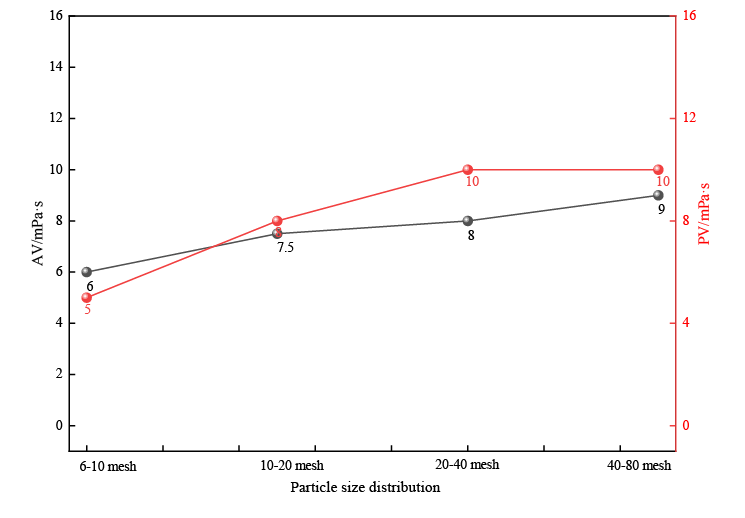
Figure 2 Effects of different particle-size adhesive materials on the rheological properties of drilling fluids
3.2 Analysis of the Healing Performance of Adhesive Material
As shown in Figure 3, the tensile test results indicate that the tensile strength of the adhesive material after shearing and healing reaches 338 kPa, corresponding to a healing efficiency (η₁) of ٧٢.٧٪. The mechanical properties of the material remain relatively stable before and after the bonding and healing process, which directly verifies its excellent self-healing and adhesive properties under the experimental conditions. Such a high healing efficiency demonstrates that the dynamic reversible chemical bonds within the adhesive material can effectively reconstruct the internal structure at the fractured interface, thereby restoring a considerable portion of the original mechanical strength. This characteristic is of great significance for downhole plugging applications, as it enables the material to maintain structural integrity and bearing capacity even under repeated stress and deformation in complex formations, thus improving the long-term stability and reliability of the plugging layer.
表
|
No. |
Condition |
Tensile strength/kPa |
Healing efficiency/% |
|
1 |
Intact adhesive material |
465 |
72.7 |
|
2 |
Sheared adhesive material |
338 |
3.3 SEM Analysis
Figure 3 presents SEM images showing the crack evolution of the adhesive material after shearing, splicing, and aging at 80 °C for 12 hours. Image (a) exhibits the initial state of the fractured interface, where a distinct gap can be clearly observed between the two spliced sections, representing the unhealed crack morphology immediately after mechanical damage. In contrast, image (b) reveals that after thermal treatment, the crack width is significantly reduced, and the two fractured surfaces become much closer and tend to fuse with each other, visually confirming that the adhesive material possesses outstanding self-healing and interfacial bonding repair capabilities. The underlying healing mechanism is mainly attributed to the dynamic, reversible chemical bonds and intermolecular interactions within the material system. Under thermal stimulation at 80 °C, dynamic exchange reactions occur in the disulfide bonds (-S-S-),
accompanied by the reversible dissociation and reformation of hydrogen bonds. These dynamic reversible behaviors promote the diffusion, entanglement, and rearrangement of molecular chains across the crack interface, facilitating the reconnection and rebonding of the fractured surfaces. Consequently, the crack gap is gradually closed and effectively healed, enabling the material to restore its structural integrity and achieve efficient damage repair. This thermally triggered self-healing characteristic is highly favorable for downhole plugging scenarios, as it allows the material to repair micro-cracks automatically and maintain stable sealing performance in complex formation environments.
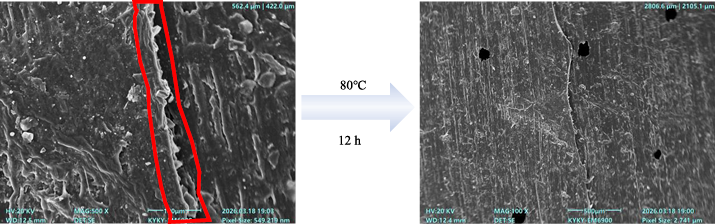
Figure 3 SEM images of crack evolution in adhesive material before and after healing following shearing and splicing
3.4 Analysis of Medium-temperature and Medium-pressure Sand Bed Filtration Loss Performance
The sand bed filtration test was conducted using 20-40 mesh quartz sand in an impermeable sand bed filtration apparatus. After adding different wellbore wall strengthening agents, fluid loss was measured under 0.69 MPa pressure while recording the penetration depth. As shown in the figure 4, the base mud completely leaked through the sand bed. The system containing 1% CKSHeal showed the shallowest penetration depth with an average of less than 9 cm and no fluid loss, demonstrating excellent sealing efficiency. In contrast, the wellbore wall strengthening agents 1 and 2, while drilling, showed average penetration depths greater than 12 cm, with the maximum reaching 15 cm (total length of the sand column). Traditional LCMs rely on particle accumulation to achieve plugging, resulting in poor performance at low concentrations. In contrast, CK-SHeal achieves targeted and robust surface sealing even at low dosages through its synergistic mechanisms of deformation, self-healing film formation, and encapsulation with conventional bridging materials, significantly reducing material costs and making it more suitable for field applications.
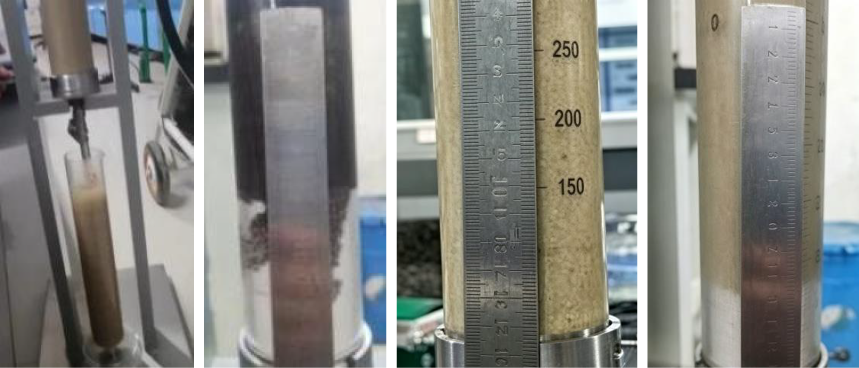
(a) (b) (c) (d)
Figure 4 Sand bed filtration results of different wellbore wall strengthening agents under ambient temperature and medium pressure: (a) Base mud; (b) Base mud+1 %CKSHeal; (c) Base mud+4 % wellbore wall strengthening agent 1; (d) Base mud+4 % wellbore wall strengthening agent 2
3.5 Application of Adhesive Plugging Agent CKSHeal in Drilling Fluids
Based on the core advantages of reversible exchange of dynamic disulfide bonds and synergistic interaction with hydrogen bonds, the adhesive lost circulation material CKSHeal breaks through the particle size matching limitations of conventional plugging materials. It can be directly compounded into drilling fluid systems to achieve plugging while drilling, and is compatible with various mud systems, including waterbased drilling fluids, showing extensive and efficient engineering application value in the treatment of lost circulation in complex formations during oil and gas drilling. The specific application scenarios and effects are summarized as follows. In terms of compatibility in drilling fluid systems, CKSHeal exhibits excellent compatibility with drilling fluids. It can form a dense spatial network structure with water molecules and clay particles in the drilling fluid, moderately increase the viscosity of the system, and enhance the suspension and plugging performance of the drilling fluid. At the same time, it can maintain favorable fluidity and pumpability of the drilling fluid, avoiding resistance and blocking during tripping operations. Therefore, it is suitable for plugging while drilling in formations with large fractures, microfractures and porous media, and can adapt to different lost circulation formations. In the field application of plugging while drilling, CKSHeal can enter the loss zones directly with the circulation of drilling fluid without additional adjustment of the drilling fluid system. The operation is simple and efficient, greatly saving construction time and economic costs of lost circulation control. After entering the loss zones, the material relies on its inherent adhesive characteristics to interact with elastic particles, rigid particles, fibers and other composite components in the system as well as the fracture walls of the formation. It accumulates and cements into a highstrength and dense consolidated body, forming a stable supporting framework of the plugging layer, which effectively fills fractures and micropores and improves the pressure-bearing capacity of the formation. In this way, it solves the problem of repeated lost circulation easily caused by pressure fluctuations in conventional bridging plugging materials.
In summary, the plugging agent possesses excellent adhesive repair performance. If microcracks occur in the plugging layer under pressure impact during drilling, the formation temperature of 80 °C can trigger the dynamic exchange reaction of disulfide bonds and the dissociation and reconstruction of hydrogen bonds in the material, driving the diffusion and entanglement of molecular chains to realize crack selfhealing, thus further improving the stability and durability of the plugging layer. Therefore, CKSHeal can be widely used in complex oil and gas drilling formations with strong water sensitivity, poor cementation and welldeveloped fractures, achieving efficient plugging while drilling, significantly improving the success rate of onetime plugging and promoting safe and efficient operation in oil and gas drilling construction.
4 Conclusion
To address the challenge of lost circulation control in oil and gas drilling, CK-SHeal, which contains dynamic disulfide bonds and hydrogen bonds, was successfully developed. Systematic studies were conducted on its microstructure, rheological and filtration properties, plugging performance, and self-healing capability. The main conclusions are as follows:
The particle size of the adhesive material exerts a significant regulatory effect on the rheological properties of drilling fluids as the particle size is refined from 6–10 mesh to 40–80 mesh, both AV and PV of the drilling fluid increase synchronously. Coarse particles help maintain the favorable fluidity of the drilling fluid, while fine particles enhance viscosity and plugging efficiency. Through particle size gradation, the material can meet the requirements of different lost circulation formations.CK-SHeal exhibits excellent self-healing and adhesive properties. After shear fracture and curing at 80 °C for 12 hours, the cracks are significantly closed with a healing efficiency of 72.7%. The core mechanism lies in the dynamic exchange of disulfide bonds and reversible reconstruction of hydrogen bonds, which drive the diffusion and entanglement of molecular chains at the fractured interface, thereby realizing the re-bonding of the broken interface. Medium-temperature and medium-pressure sand bed filtration tests indicate that the drilling fluid system compounded with CK-SHeal achieves a minimum sand bed penetration depth of only 8.5 cm without filtrate seepage. The filtration loss reduction rate for micro-pores reaches ≥63.2%, demonstrating outstanding filtration control performance and effective mitigation of water-sensitive damage to reservoirs. Breaking through the particle size matching limitation of conventional bridging plugging materials, CK-SHeal shows good compatibility with various water-based drilling fluids and enables adhesive plugging while drilling. It significantly improves the formation pressure-bearing capacity, solves the problem of repeated lost circulation, and greatly enhances the success rate of one-time plugging.
In summary, CK-SHeal integrates excellent rheological properties, plugging performance, self-healing capability, and reservoir protection. It provides an efficient and reliable technical solution for lost circulation control in complex formations, holding important engineering application value and broad promotion prospects.
References
[1] Sun J S, Wang R & Long Y F. (2024). Challenges, developments, and suggestions for drilling fluid technology in China. Drilling Fluid & Completion Fluid, 41(1), 1-30.
[2] Wang Z H. (2023). Current situation and development suggestions of domestic drilling fluid technology. Petroleum Drilling Techniques, 51(4), 114-123.
[3] Liu X R. (2019). Study on leakage prevention and plugging mechanism and experimental evaluation in the eastern Hubei area (Master’s thesis). China University of Petroleum (Beijing).
[4] Zhao F H & Huang W A. (2020). Research progress of lost circulation prevention and control materials for drilling fluids. Complex Hydrocarbon Reservoirs, 13(4), 96-100.
[5] Sun J S, Bai Y R, Cheng R C, et al. (2021). Research progress and prospects of plugging technologies for fractured formations with severe lost circulation. Petroleum Exploration and Development, 48(3), 630-638.
[6] Zhao H B, Yang S, Chen G F, et al. (2021). Application of graded lost circulation control technology in the Eastern Ordos Basin. Drilling Fluid & Completion Fluid, 38(5), 583-592.
[7] Chen L, Hu J K, Geng D, et al. (2021). Exploration of new technology of plugging and anti-collapse in oil-based drilling fluid for shale gas wells in Chongqing. Oil & Gas Reservoir Evaluation and Development, 11(4), 527-535.
[8] Zhai K J, Fan S, Fang J W, et al. (2021). Development and performance evaluation of water-swelling resin composite lost circulation material. Oilfield Chemistry, 38(2), 196-203.
[9] Li W, Bai Y R, Li Y T, et al. (2021). Research and application status of drilling fluid lost circulation materials and countermeasures of plugging technology. Science, Technology and Engineering, 21(12), 4733-4743.
[10] Sun J S, Lei S F, Bai Y R, et al. (2020). Research progress and application prospects of smart materials in drilling fluid lost circulation control. Journal of China University of Petroleum (Edition of Natural Sciences), 44(4), 100–110.
[11] Sun J S, Zhao Z, Bai Y R, et al. (2020). Research progress of intelligent self-healing gels and application prospects in the drilling fluid field. Acta Petrolei Sinica, 41(12), 1706-1718.
[12] Xiao X Y, Shi D J, Li G N, et al. (2017). Permian lost circulation control technology while drilling in the Shunbei area, Tarim Basin. Exploration Engineering(Rock & Soil Drilling and Tunneling), 44(10), 37-41.