 Current Views: 628747
 Current Downloads: 373569
Leisure Sports and Health
ISSN Print:2710-0154
ISSN Online:2710-0162
Contact Editorial Office



Subscribe to the latest published information from SCISCAN
运动对神经发育障碍儿童身体素质的影响——基于ICF和Meta分析的系统综述
Effects of Exercise on Physical Fitness in Children and Adolescents with Neurodevelopmental Disorders: A Systematic Review Based on ICF and Meta- Ananlysis


-
Information:
湖北大学体育学院,武汉
-
Keywords:
Children with neurodevelopmental disorders; Physical fitness; ICF; Meta-analysis神经发育障碍儿童; 身体素质; ICF; Meta分析
- Abstract: Objective: Based on the International Classification of Functioning, Disability and Health (ICF), the present meta-analysis explores the effects of fitness training, motor skills training and virtual reality training on physical fitness of children and adolescents with neurodevelopmental disorders (NDDs). Methods: Literatures related to the effects of exercise intervention on physical fitness of children and adolescents with NDDs in the recent 15 years were searched through PubMed, EBSCO, Web of Science, CNKI and other databases. The overall effect, subgroup analysis, heterogeneity, and risk of bias were evaluated Revman 5.4 software. The mean (M), standard deviation (SD), standardized mean difference (SMD) and 95% confidence interval (95% CI) were used to study the effect size among the three different exercises. Results: After screening through the PRISMA guideline, a total of 12 articles were included in the study. Exercise significantly improved the physical fitness of children and adolescents with NDDs: fitness training [SMD=1.30, 95%CI=(0.02, 2.57), p=0.05], motor skills training [SMD=3.54, 95%CI=(0.68, 6.39), p=0.02], and virtual reality training [SMD=5.93, 95%CI=(0.46, 11.39), p=0.03]. Subgroup analyses result showed that the exercise period of 6-8 weeks, total duration of 960-1440 minutes and motor skill had the strongest effect on the physical fitness of children and adolescents with NDDs. Conclusion: Fitness training, motor skills training, and virtual reality exercise could positively improve the physical fitness of children and adolescents with NDDs. Future research should design appropriate intervention types, periods, and durations for children with different types of disorders, thereby providing individualized sports intervention protocol for children and adolescents with NDDs. 目的:依据《国际功能、残疾和健康分类》(ICF框架),探讨体适能类、运动技能类和虚拟现实类三种运动干预对神经发育障碍(NDDs)儿童青少年身体素质的影响。方法:通过PubMed、EBSCO、WebofScience、CNKI等数据库,检索近15年运动干预对NDDs儿童青少年身体素质影响的相关文献。运用Revman5.4软件对整体效应、亚组分析、异质性和偏倚性风险进行评估,探究运动干预周期、总时长和类型对NDDs儿童青少年身体素质的影响;以平均数(M)、标准差(SD)、标准化均数差(SMD)和95%置信区间(95%CI)计算三种不同运动间的干预效应量。结果:PRISMA指南筛选后,共有12篇文章纳入研究。合并效应量结果显示,体适能类干预[SMD=1.30,95%CI=(0.02,2.57),p=0.05]、运动技能类干预[SMD=3.54,95%CI=(0.68,6.39),p=0.02]、虚拟现实类干预[SMD=5.93,95%CI=(0.46,11.39),p=0.03]均对NDDs儿童青少年身体素质有显著的积极影响。亚组分析结果显示,干预周期6~8周、总时长960~1440分钟的运动技能干预,对NDDs儿童青少年身体素质的影响效果最佳。结论:体适能类、运动技能类和虚拟类干预均能改善NDDs儿童青少年的身体素质。未来研究应针对不同的障碍类型选择适合的干预方式、周期和时长,为NDDs儿童青少年制定个性化的运动干预方案。
- DOI: 10.35534/lsh.0601014
- Cite: 周静.运动对神经发育障碍儿童身体素质的影响——基于ICF和Meta分析的系统综述[J].休闲运动与健康,2026,6(1):81-90.
神经发育障碍(neurodevelopmental disorders,NDDs)儿童指的是在儿童发育时期,由于双亲遗传或者其他病因导致大脑的认知、运动、社会适应、行为等功能区受损,从而引发的慢性发育性脑功能障碍性疾病[1]。根据《国际疾病分类》第11版和美国《精神疾病诊断与统计手册》第5版,NDDs主要包括智力发育障碍(disorder of intellectual development,DID)、唐氏综合征(downs syndrome,DS)、孤独症谱系障碍(autism spectrum disorder,ASD)、注意缺陷多动障碍(attention deficit hyperactivity disorder,ADHD)、脑性瘫痪(cerebral palsy,CP)和其他障碍[2]。联合国儿童基金会(UNICEF)和世界卫生组织(WHO)联合报告显示,2019年全球患有NDDs的19岁以下儿童和青少年约有3.17亿,其中男性约有1.797亿,女性有1.37亿。全球疾病负担(Global Burden of disease,GBD)研究和UNICEF多指标类集调查(Multiple Indicator Cluster Surveys,MICS)结果显示,5岁以下儿童的发病率约为7.5%,而15~19岁的青少年中发病率达到13.9%[3]。我国《国家残疾预防与行动计划(2021—2025年)》明确将体育健身纳入残疾康复服务体系,强调为神经发育障碍儿童提供早期、个性化的运动康复支持。世界卫生组织《全球身体活动行动计划(2018—2030)》与美国《身体活动指南》均将运动干预列为神经发育障碍儿童健康促进的优先策略,倡导通过结构化体育活动改善其身体功能、提升生活质量。在此背景下,系统梳理运动干预对神经发育障碍儿童青少年身体素质的影响,厘清其作用机制,对完善特殊儿童康复服务体系、推动健康中国战略在特殊群体中的落地具有重要现实意义。
身体素质包括心肺健康、肌肉力量和耐力、身体成分、灵活性、平衡和反应时间[4]。NDDs儿童青少年的身体素质水平较低、参与社交活动较少,存在久坐不动、肥胖率较高等问题,会加剧健康障碍,并增加该人群的发病和死亡风险[5]。同时,NDDs儿童青少年的下肢肌肉力量较弱,对该人群的整体健康和日常运动能力存在消极影响[6-8]。已有证据表明一些动态的身体运动可以改善NDDs儿童的身体功能和结构,如提高CP儿童的心肺耐力和肌肉力量[9];DID儿童青少年参与不同强度的、有计划的体育锻炼干预可能会对运动功能、身体素质和生活质量产生积极影响[10];运动可以提高ASD儿童的平衡、力量、柔韧性等身体素质[11];运动疗法显著提高ADHD儿童青少年的力量、速度、柔韧性和耐力素质[12]。
此研究基于《国际功能、残疾和健康分类》(ICF)框架,系统综述NDDs儿童青少年的运动干预类型、身体素质及健康结果[13],分析NDDs儿童青少年存在主要的身体机能相关的问题、运动干预处方及其对NDDs儿童青少年的身体与健康效益,为特殊教育学校、康复机构制定个性化运动干预方案提供了循证依据,可为推动运动干预纳入神经发育障碍儿童综合康复服务体系提供数据支撑。
1 研究方法
1.1 PICO架构
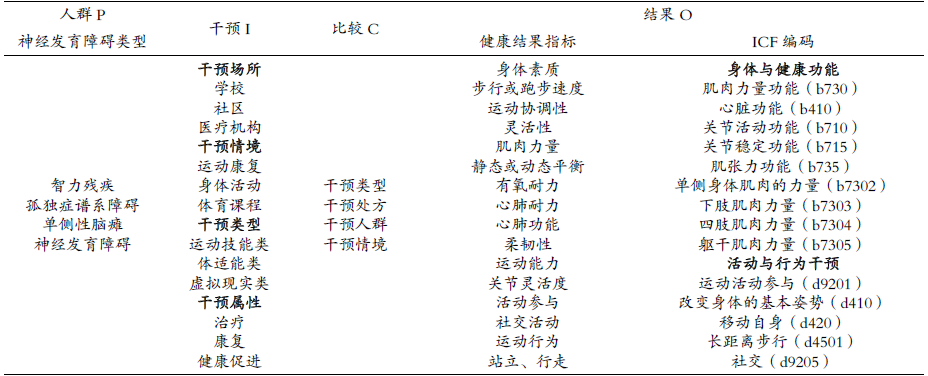
此研究关注体育运动对NDDs儿童青少年身体素质的影响,基于ICF框架,从身体与心理功能、活动与行为健康方面,分析NDDs儿童青少年运用的干预场所、干预情境、干预类型和干预属性,分析干预的结局指标和对应的ICF编码。此研究的PICO架构[14]如表1所示。
表 1 本研究PICO架构
1.2 文献检索
英文检索式:(mentally disabled children OR intellectual impairment adolescent)AND( basketball OR football OR gymnastics OR swimming OR jogging)AND(balance ability OR agility OR muscle endurance OR running speed OR flexibility)
中文检索式:(智障儿童OR自闭症儿童OR唐氏综合征儿童OR单侧脑瘫儿童)AND(体力活动OR健美操OR抗阻训练)AND(身体素质OR平衡能力OR肌肉力量OR灵敏性OR肌肉耐力OR速度OR柔韧性)
1.3 纳入标准和排除标准
纳入标准:(1)研究对象年龄5~18岁;(2)确认为NDDs的儿童青少年;(3)干预手段为身体活动或康复锻炼;(4)采用随机对照试验;(5)每篇文献至少研究一项体育活动对身体素质的影响。
排除标准:(1)重复发表的文献;(2)未正式刊发的硕博论文、会议摘要、墙报、广告等;(3)干预方案不明确;(4)无干预效果的文献;(5)不能获取全文的文献。
1.4 文献筛选与数据提取
在PubMed、EBSCO、Web of Science、CNKI等数据库开展检索,浏览论文标题、作者、国别、发表时间、研究目的、研究对象、研究方法、研究结果和结论,共获得719篇文献;首先删除重复文献、已发表的Meta分析和系统综述文献,获得250篇文献;然后剔除研究对象为正常发育或肥胖儿童的文献,获得142篇文献;再删除干预方式为非运动及非对照试验文献,获得52篇文献;最后删除无具体研究数据的文献,纳入符合研究需求的12篇文献。文章检索筛选过程PRISMA规范,对应的流程图[15]如图1所示。
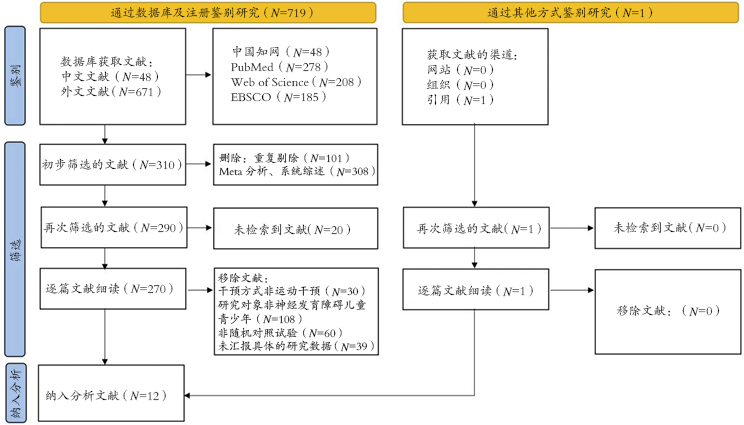
图 1 文献筛选PRISMA流程图
1.5 纳入文献的质量评价
针对纳入的12篇文献,采用Revman 5.4软件,运用Cochrane偏倚风险评估工具,进行质量评估,结果如图2所示,项目评估百分比如图3所示。纳入文献均采用对照实验,5篇文献采用非随机序列生成,6篇存在选择性偏倚风险,2篇文章未对研究对象、研究人员及数据评估人员实施盲法。
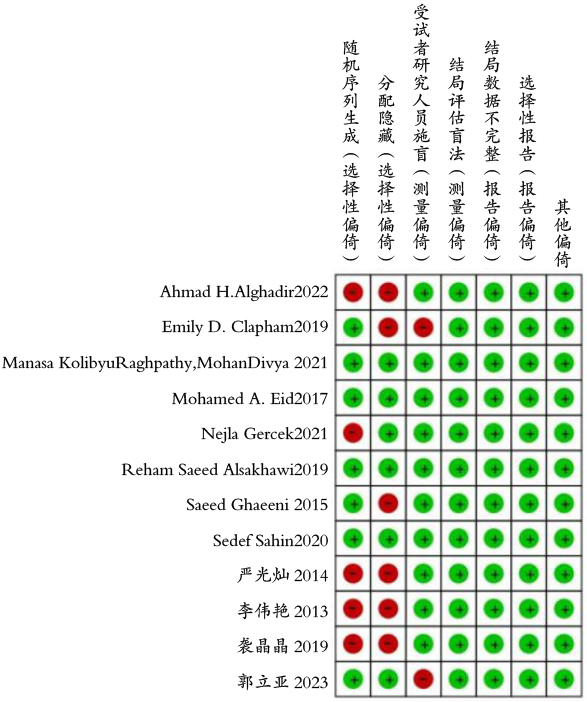
图 2 文献质量评价图
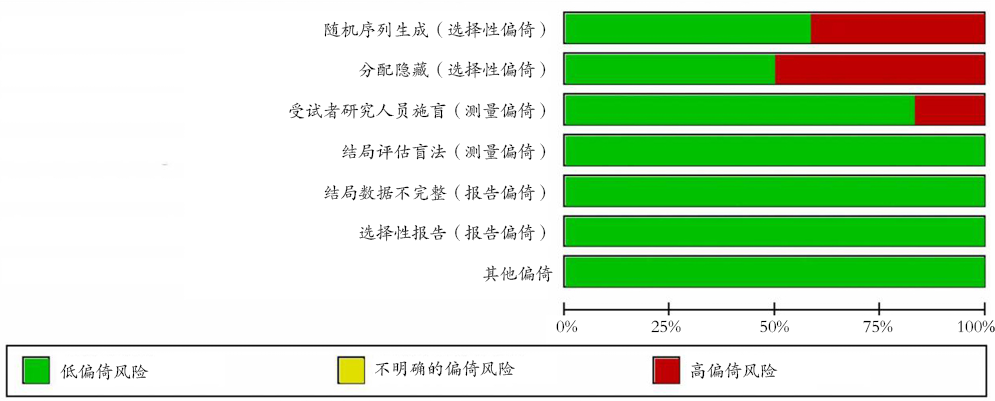
图 3 评估百分比
2 结果与分析
2.1 纳入文献基本特征
本次纳入的12篇文献分别来自中国、巴西、沙特阿拉伯、土耳其、美国、印度、伊朗和埃及8个国家,涉及405名受试者,研究设计均为对照实验,研究对象为5~18岁的NDDs儿童青少年。干预方式主要分为三类:体适能类,包括核心力量锻炼、中等强度有氧运动、等速训练、神经肌肉训练、Jeffrey核心稳定性训练、核心力量训练、跑步机训练;运动技能类,包括足球、健美操、冲浪、传统印度舞蹈;虚拟训练类,包括虚拟高尔夫训练、虚拟现实游戏训练。干预频率是每周2~3次,每次干预时长35~80min,干预周期为6~16周。纳入文献对健康和功能的结果,主要为身体与健康功能效益,研究内容包括NDDs儿童青少年的NDD类型、干预特点、组间比较和健康结果指标(如表2所示)。
表 2 纳入文献基本特征
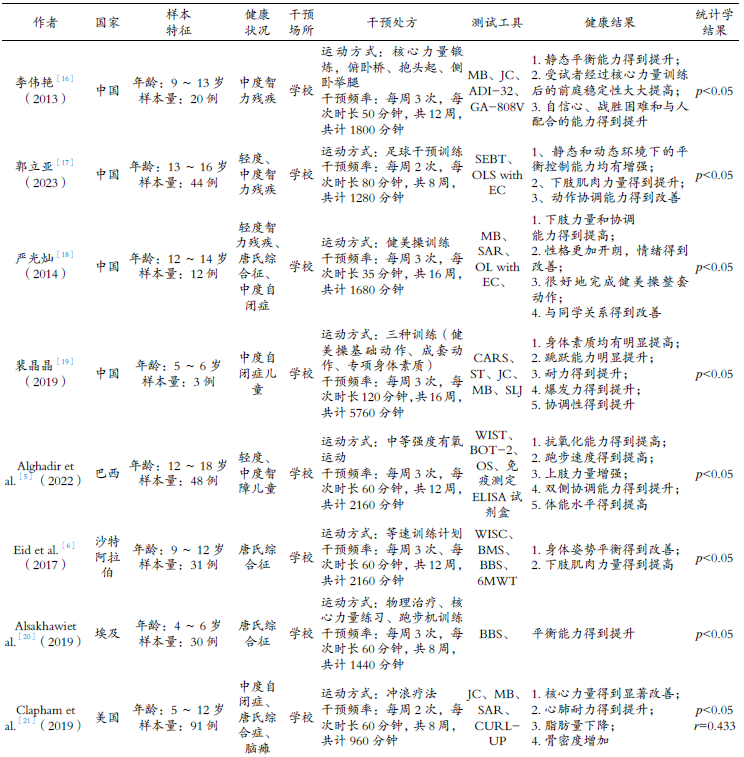
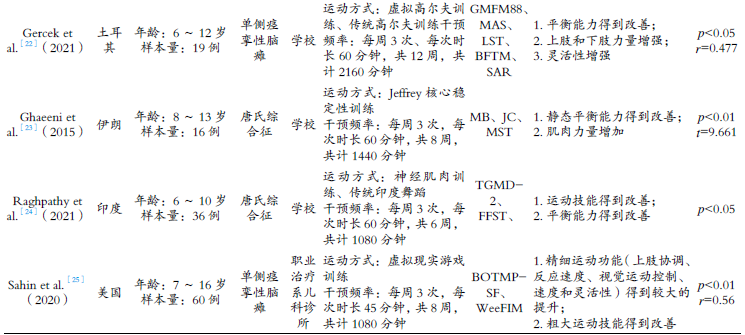
注:JC为卷尺;MB为秒表;ADI-32为三维测力台;GA-808V为前庭功能转椅;SEBT为星状伸展平衡测试;OLS with EC为闭眼单脚站立;SAR为坐位体前屈;CARS为儿童孤独症评定量表;ST为台阶试验测试;SLJ为立定跳远;WIST为韦氏智力量表测试;BOT-2为Bruininks-Oseretsky test运动能力测试;OS为氧游离测定系统;BMS为Biodex Medical System;BBS为Biodex Stability System;GMFM-88为Gross Motor Function Measure-88;MAS为改良Ashworth量表;LST为Lateral Step-up Test;BFTM为Brockport Fitness Test Manual;6MWT为6分钟步行试验;CURL-UP为卷腹;TGMD-2为大肌肉运动发展测试;FFST为四方步测试;MST为modified stork test;BOTMP-SF为运动熟练程度简表测试;WeeFIM为WeeFunctional Independence Measure。
2.2 Meta分析结果
由于运动干预指标为连续型变量,且各原始研究使用的评价工具存在差异,研究采用Revman 5.4软件对实验组和对照组干预前后评分数据进行Meta分析,计算各研究的均数(M)和标准差(SD),分析检验各项研究之间的异质性,以标准化均数差(SMD)和95%置信区间(95%CI)作为研究三种运动间的效应量。判定标准:当I2>50%,表明研究结果存在明显的异质性,采用随机效应模型分析;I2<50%,则认为研究结果不存在显著异质性,此时采用固定效应模型进行分析。效应量分级标准:SMD>0.8为大效应,0.5~0.8为中等效应,0.2~0.5为小效应。
1)体适能类运动对NDDs儿童青少年身体素质的影响
在纳入12篇文献中,有6篇[5,6,16,20,23,24]采用体适能类运动干预,对175名受试者进行身体素质影响的比较研究。如图4所示,各项研究间的异质性较高(χ2=59.68,I2=92%)因此选择随机效应模型。合并效应量结果显示,SMD=1.30,95%CI(0.02,2.57),p=0.05,效应量达到大效应水平,说明体适能类运动可以显著提升NDDs儿童青少年的静态平衡能力、动态平衡能力、上下肢协调性及综合体能水平。

图 4 体适能类干预对NDDs儿童青少年身体素质的Meta分析森林图
2)运动技能类运动对NDDs儿童青少年身体素质的影响
在纳入的12篇文献中,有4篇[17-19,21]采用运动技能类干预方案(足球训练、健美操训练、冲浪训练),对151名受试者进行身体素质影响的比较研究。如图5所示,各项研究之间的异质性较低(χ2=4.49,I2=33%),因此选择固定效应模型。合并效应量结果显示,SMD=3.54,95%CI(0.68,6.39),p=0.02<0.05,达到大效应水平,说明运动技能类干预可以显著提升NDDs儿童青少年的静态平衡能力、动态平衡能力、上下肢协调性及心肺耐力。

图 5 运动技能类干预对NDDs儿童青少年身体素质的Meta分析森林图
3)虚拟类运动对NDDs儿童青少年身体素质的影响
在纳入12篇文献中,有2篇[22,25]文献采用虚拟干预的方法对79名受试者进行身体素质影响的比较研究。如图6所示,各项研究之间的异质性较高(χ2=3.14,I2=68%),因此选用随机效应模型。合并效应量结果显示,SMD=5.93,95%CI(0.46,11.39),p=0.03<0.05,达到大效应水平,说明NDDs儿童青少年参与虚拟现实运动能显著提高身体素质,虚拟运动可以改善运动发育障碍儿童的静态平衡能力,提高肌肉力量。

图 6 虚拟运动干预对NDDs儿童青少年身体素质的Meta分析森林图
2.3 亚组分析
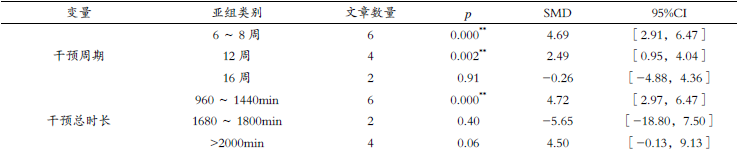
亚组分析结果如表3所示。
运动干预对NDDs儿童青少年身体素质的影响,可能受干预周期、干预总时长、干预频率及运动类型的影响。根据干预特点和文献数量,将各因素划分亚组:干预周期分为6~8周[17,20,21,23-25]、12周[5,6,16,22]、16周[18,19]三个亚组;干预总时长分为960~1440min[17,20,21,23-25]、1680~1800min[16,18]、>2000min[5,6,19,22]三个亚组,干预频率分别为每周2次[17,21]、每周3次[5,6,16,18-20,22-25]两个亚组;运动类型分为体适能类[5,6,16,20,23,24]、运动技能类[17-19,21]、虚拟类[22,25]三个亚组。亚组分析结果表明,6~8周的运动干预周期对NDDs儿童青少年身体素质的影响效果最强(SMD=4.69,p<0.0001),其次是12周(SMD=2.49,p=0.002),但16周干预对身体素质的影响效果不显著(SMD=-0.26,p=0.91)。干预总时长为960~1440min的运动干预对身体素质的影响效果最强(SMD=4.72,p<0.0001),干预总时长1680~1800min和>2000min的运动对NDDs儿童青少年身体素质的影响效果不显著,结果表明干预总时长越长,对NDDs身体素质的影响效果越弱。运动类型中的运动技能类干预对NDDs儿童青少年身体素质的影响效果最好(SMD=3.54,p=0.02),其次是虚拟类运动(SMD=5.93,p=0.03)和体适能类运动(SMD=3.11,p=0.04)。
表 3 亚组分析结果

注:**p<0.01,* p<0.05。
3 讨论
此研究纳入文献涉及的研究对象主要是NDDs儿童青少年,主要包括DID、DS、ASD及CP群体,这些障碍导致平衡和运动协调水平下降、肌肉力量下降、反应迟缓等症状,进一步导致运动量不足、身体脂肪比重增加和身体抵抗力下降[26]。Meta分析结果表明,运动技能类、体适能类和虚拟现实类运动,均可以显著提升NDDs儿童青少年的静态和动态平衡能力,提高上下肢协调性,还能促进受试者体能水平得到改善,该结论与刑玉[27]的研究结果一致。
从生理学角度来看,儿童参与体适能类运动可以提升心肺功能,加大血流量,促进血液循环[28],这与ICF框架中“身体功能”维度的“心脏功能”“关节稳定功能”和“肌肉力量功能”相对应。李伟艳[16]指出,中度智力残疾的儿童进行12周的核心力量锻炼后,静态平衡能力、前庭稳定性、自信心和沟通能力得到提升。Alghadir[5]
等发现,12周的中等强度有氧运动可以显著提高抗氧化能力和跑步速度,还能增强上下肢肌肉力量和双侧肌肉协调性。Eid[6]指出,12周的等速训练可以使身体姿势得到改善,下肢力量得到增强。上述作用与ICF中“身体功能”维度的“心脏功能”“关节稳定功能”和“肌肉力量功能”相对应。
运动技能类干预包含足球训练、健美操训练和虚拟训练,这些运动技能训练干预周期较长,干预频率为每周2次以上,每次不少于40分钟,分为前期(单一动作技能的学习)、中期(成套动作技能学习)和后期训练(完整技能+素质练训练)。运动技能的完成需要上下肢肌群协调配合,使NDDs儿童青少年关节灵活性增强,肌肉力量得到提升,同时改善该群体的本体觉、前庭功能、触觉及协调能力[12,29]。郭立亚[17]发现,8周的足球训练可以使下肢肌肉力量提升,静态和动态环境下平衡控制能力得到增强。足球训练主要是通过下肢肌肉进行,足球在较大的空间滚动,需要受试者进行停球、传球等技术动作,在此过程中姿势平衡得到较好锻炼[30]。严光灿[18]指出,12周的健美操训练使受试者的下肢力量和协调性得到显著改善;裴晶晶[19]发现,健美操基础训练可以使受试者跳跃能力、心肺耐力、下肢爆发力和肢体协调性得到较大的改善;Clapham[21]认为,冲浪疗法可以改善NDDs儿童青少年的核心力量、提升心肺耐力、降低脂肪量和增加骨密度。综上,运动技能类干预不仅可以帮助受试者学习运动技能,还能提高上下肢肌肉力量,增加肢体协调性,更好地优化姿势平衡控制能力。健美操和足球属于团队技能训练,为NDDs儿童提供了同伴互动与协作的场景,有助于改善其社交沟通与情绪调节能力,提升在学校、社区的社会参与水平。
此研究对2篇虚拟现实类运动干预文献进行Meta分析,结果表明虚拟现实类运动可以显著提高受试者的肢体协调性、反应速度、身体灵敏性和肢体平衡能力,该结论与韩晶[33]的研究结果一致。Gercek[22]发现,通过12周的虚拟高尔夫训练,受试者的身体平衡能力得到改善,上肢和下肢力量增强,原因是高尔夫运动需要上肢和下肢肌肉协调配合、共同完成,还需要髋关节转动,使髋关节灵活性得到提升。Sahin[25]指出,8周的虚拟现实游戏训练可以使精细运动技能得到改善,如上肢协调、反应速度、视觉运动控制能力和肢体灵活性。NDDs儿童青少年通过使用传感设备体验虚拟现实环境,得到身临其境的体验,最大限度地激发受试者兴趣和康复积极性[31]。同时,虚拟现实可提供多种感觉刺激包括视听触觉和本体感觉,为受试者提供正向反馈[32,33]。
与干预周期6~8周相比,12周与16周的干预研究的合并效应量整体呈下降趋势,且960~1440min的干预总时长效果显著优于其他总时长,表明运动干预并不是周期和总时长越长效果越佳,NDDs儿童青少年的运动干预与身体素质可能存在剂量反应关系。出现这些现象,可能是NDDs儿童青少年身体发育迟缓,活动能力要低于常人[34],运动时间较长机体会感到疲劳。此外,NDDs儿童青少年的身体发育不成熟,较长时间的高强度训练可能影响干预效果[35],亟需探究该群体运动干预的最佳效应区间,制定个性化运动干预方案,提高NDDs儿童青少年的身体素质。
4 研究局限性
本研究纳入亚组分析的文献数量较少,且大多数对NDDs儿童青少年进行干预的随机对照实验文献中,分配隐藏与盲法尚未提及,这对文献质量评价产生了不确定性。目前关于虚拟运动干预的研究存量不足,只有2篇涉及虚拟现实运动干预,得出的结论可能存在一定局限性,需要进一步扩大样本量及进行临床随机对照实验,证实三类运动对NDDs儿童青少年身体素质的影响。在后续的研究中可以结合该群体的生理和心理情况,设计多元化和个性化运动干预方案,提升其身体素质。
5 结论与建议
5.1 结论
(1)三种不同类型运动(体适能类、运动技能类、虚拟现实类)对NDDs儿童的身体素质均具有积极影响;(2)运动技能类干预对NDDs儿童青少年身体素质的影响效果优于体适能类和虚拟类干预;(3)6~8周的干预周期对身体素质的干预效果最强,16周的运动干预效果不显著;仅干预总时长960~1440min的运动干预方案,对身体素质的影响效果显著。
5.2 建议
NDDs儿童青少年可以通过运动技能类、体适能类和虚拟现实类干预来改善静态和动态平衡能力、上下肢协调性及心肺耐力。教师可以根据NDDs儿童青少年的个人生理特点(包括年龄、性别、协调能力、肌肉力量),选择个性化运动技能和训练手段,提高身体素质。与长期干预相比,短期体育锻炼(6~8周或12周)对NDDs儿童青少年的身体素质有显著的改善效果,过长的运动干预总时长会影响干预效果。因此教师在设计运动方案时,应考虑干预时长和周期问题,为NDDs儿童青少年提供适配的运动方案。
参考文献
[1] 朱红敏,袁纯辉,刘智胜.儿童神经发育障碍疾病研究进展[J].中国当代儿科杂志,2023,25(1):91-97.
[2] 陈静,Garralda M E,程文红.ICD-11精神与行为障碍(草案)关于神经发育障碍诊断标准的进展[J].中华精神科杂志,2017,50(6):411-413.
[3] Health Data Exchange.Global Burden of Disease Study 2019 (GBD 2019) Data Resources[EB/OL].(2019)[2026-03-19].https://ghdx.healthdata.org/gbd-2019.
[4] Garber C E,Blissmer B,Deschenes M R,et al.American College of Sports Medicine position stand. Quantity and quality of exercise for developing and maintaining cardiorespiratory,musculoskeletal,and neuromotor fitness in apparently healthy adults:guidance for prescribing exercise[J].Medicine and Science in Sports and Exercise,2011,43(7):1334-1359.
[5] Alghadir A H,Gabr S A.Physical activity impact on motor development and oxidative stress biomarkers in school children with intellectual disability[J].Revista Da Associacao Medica Brasileira,2020,66(5):600-606.
[6] Eid M A,Aly S M,Huneif M A,et al.Effect of isokinetic training on muscle strength and postural balance in children with Down’s syndrome[J].International Journal of Rehabilitation Research,2017,40(2):127-133.
[7] Gupta S,Rao B K,S D K.Effect of strength and balance training in children with Down’s syndrome:a randomized controlled trial[J].Clinical Rehabilitation,2011,25(5):425-432.
[8] Dupper M A.Effects of a 10-week aerobic exercise program on the physiological,cognitive and behavioral functioning of institutionalized retarded children[M]//In Motor Development,Adapted Physical Activity and Mental Retardation.Basel:Karger Publishers,1990:94-102.
[9] Maltais D B,Wiart L,Fowler E,et al.Health-related physical fitness for children with cerebral palsy[J].Journal of Child Neurology,2014,29(8):1091-1100.
[10] Top E.The effect of swimming exercise on motor development level in adolescents with intellectual disabilities[J].American Journal of Sports Science and Medicine,2015,3(5):85-89.
[11] 张耀方,陈丽兰.马术运动对自闭症儿童身体素质的影响[J].中国体育科技,2022,58(12):73-79.
[12] 舒瑶,张英波.动作技能干预对智力障碍儿童青少年基本动作技能影响的系统综述[J].中国儿童保健杂志,2022,30(7):770-774,791.
[13] World Health Organization.International Classification of Functioning,Disability and Health:ICF[M].Geneva:World Health Organization,2001.https://iris.who.int/bitstream/handle/10665/42407/9241545429.pdf?sequence=1.
[14] Schardt C,Adams M B,Owens T,et al.Utilization of the PICO framework to improve searching PubMed for clinical questions[J].BMC Medical Informatics and Decision Making,2007,7(1):16.
[15] Page M J,McKenzie J E,Bossuyt P M,et al.The PRISMA 2020 statement:an updated guideline for reporting systematic reviews[J].BMJ,2021,372:n71.
[16] 李伟艳,程其练,张丽花.核心力量锻炼对中度智力障碍儿童平衡能力的影响研究[J].北京体育大学学报,2013,36(2):55-59,65.
[17] 郭立亚,许翀,赵婉谷,等.中等强度足球运动干预对轻中度智力障碍儿童平衡能力影响研究[J].武汉体育学院学报,2023,57(11):84-92.
[18] 严光灿.健美操运动对智障学生运动能力的影响——以自闭症、Down综合征和普通智障学生为例[J].体育科学研究,2014,18(2):72-77.
[19] 裴晶晶,袁雷,李学恒,等.体育干预对自闭症儿童身体素质的影响[J].才智,2019(26):172-173.
[20] Alsakhawi R S,Elshafey M A.Effect of core stability exercises and treadmill training on balance in children with down syndrome: randomized controlled trial[J].Advances in Therapy,2019,36(9):2364-2373.
[21] Clapham E D,Lamont L S,Shim M,et al.Effectiveness of surf therapy for children with disabilities[J].Disability and Health Journal,2020,13(1):100828.
[22] Gercek N,Tatar Y,Uzun S.Alternative exercise methods for children with cerebral palsy:effects of virtual vs. traditional golf training[J].International Journal of Developmental Disabilities,2021,68(6):933-942.
[23] Ghaeeni S,Bahari Z,Khazaei A A.Effect of core stability training on static balance of the children with Down syndrome[J].Physical Treatments-Specific Physical Therapy Journal,2015,5(1):49-54.
[24] Raghupathy M K,Divya M,Karthikbabu S.Effects of traditional indian dance on motor skills and balance in children with down syndrome[J].Journal of Motor Behavior,2022,54(2):212-221.
[25] Sahin S,Kose B,Aran O T,et al.The effects of virtual reality on motor functions and daily life activities in unilateral spastic cerebral palsy:a single-blind randomized controlled trial[J].Games for Health Journal,2020,9(1):45-52.
[26] 库雪婷,王斌.智力和发展性残疾儿童青少年身体活动效益:基于ICF的系统综述[J].中国康复理论与实践,2022,28(12):1416-1425.
[27] 邢玉,柳皓严,吴雪萍.运动干预对智力障碍儿童青少年平衡能力影响的Meta分析[J].首都体育学院学报,2021,33(4):420-428.
[28] 解超,金成吉,张自云,等.中等强度有氧运动对我国学龄儿童执行功能影响的Meta分析[J].中国学校卫生,2017,38(1):65-68,71.
[29] 陈玉民,程亮.太极拳锻炼对注意力缺少多动障碍倾向儿童的影响[J].成都体育学院学报,2016,42(5):29-32.
[30] 李旭龙,陈洪鑫,吕思琪,等.足球运动对6~12岁儿童下肢本体感觉与平衡控制能力的影响及相关性研究[J].西安体育学院学报,2021,38(2):210-218.
[31] 梁明,窦祖林,王清辉,等.虚拟现实技术对脑卒中偏瘫患者上肢功能康复疗效的meta分析[J].中国康复医学杂志,2013,28(12):1146-1150.
[32] 梁明,窦祖林,邱雅贤.虚拟现实技术在脑损伤后运动障碍康复中的应用[J].中华脑科疾病与康复杂志(电子版),2012,2(4):219-224.
[33] 韩晶,梁明,谢荣.虚拟现实技术对脑瘫患儿下肢功能康复疗效的系统评价[J].中国康复,2020,35(10):541-546.
[34] Klavina A,Ostrovska K,Campa M.Fundamental movement skill and physical fitness measures in children with disabilities[J].European Journal of Adapted Physical Activity,2017,10(1).
[35] 赵茜,李凤新.幼儿体育运动干预幼儿身体素质的影响研究[J].当代体育科技,2018,8(20):2.