Current Views: 23923
 Current Downloads: 17174
New Exploration of Ideology and Politics
ISSN Print:2707-0638
ISSN Online:2707-0646
Contact Editorial Office



Subscribe to the latest published information from SCISCAN
Networked Ideological Formation in the Generative AI Era: Marxist Theory Innovation, Youth Cultural Agency, and Ideological-Political Education for Chinese Modernization


-
Information:
Department of Communication, Faculty of Humanities and Social Sciences, Beijing Normal-Hong Kong Baptist University, Zhuhai, China
-
Keywords:
Marxist Theory; Generative Artificial Intelligence; Ideological-Political Education; Chinese Modernization; Algorithmic Mediation; Youth Cultural Agency; Platform Governance
- Abstract: Generative artificial intelligence has altered the communicative environment in which young people encounter political values, educational narratives, and cultural authority. Existing research has examined artificial intelligence in education, algorithmic governance, and platformization, but the ideological-political implications of generative systems remain insufficiently theorized from a Marxist perspective. Drawing on qualitative interpretive analysis of policy texts, academic literature, and platform ecology, this article develops a Networked Ideological Formation Framework to explain how algorithmic mediation, youth cultural agency, pedagogical translation, and modernization-oriented value formation interact in digital China. The analysis argues that generative AI should not be treated only as an instructional tool. It is increasingly an infrastructural condition that reorganizes visibility, attention, credibility, and participation. For ideological-political education, the central challenge is therefore not simply how to digitize existing content, but how to translate Marxist theory into participatory, dialogic, and ethically governed forms that remain compatible with the broader project of Chinese modernization. The article contributes to Marxist theory innovation by conceptualizing ideology as a networked process of mediated practice rather than a one-directional transmission of doctrine. It also offers practical implications for curriculum design, platform governance, and youth-oriented value education in the generative AI era.
- DOI: 10.35534/neip.0802029
- Cite: He, H. Y. (2026). Networked Ideological Formation in the Generative AI Era: Marxist Theory Innovation, Youth Cultural Agency, and Ideological-Political Education for Chinese Modernization. New Exploration of Ideology and Politics, 8(2), 325–334.
1 Introduction
Generative artificial intelligence has intensified a long-standing question in ideological and political education: how can value formation remain intellectually persuasive, socially embedded, and pedagogically effective when the infrastructures of communication are increasingly algorithmic? In China, this question is especially consequential because ideological-political education is not a peripheral curriculum but a strategic field where political theory, youth development, cultural confidence, and national modernization intersect. The rise of large language models, synthetic media, recommendation systems, and conversational interfaces changes the conditions under which young people search, compare, narrate, and legitimize knowledge.
The analytical challenge is that generative AI does not operate as a neutral channel through which predetermined content is merely transmitted. It affects the ranking of attention, the form of explanation, the boundaries of cultural memory, and the credibility of competing narratives. Algorithmic systems can personalize educational encounters, provide new modes of access, and support dialogic learning; however, they can also increase opacity, fragment historical understanding, and detach political values from lived social practice.
Within Marxist theory, ideology is not merely a set of explicit propositions. It is embedded in material relations, institutional arrangements, cultural practices, and forms of subject formation. Marx and Engels (1970) connected ideas to social relations and material life, while Gramsci (1971) emphasized the pedagogical and cultural labor through which hegemony is organized.
Existing scholarship has offered powerful accounts of algorithms as social and political arrangements rather than merely technical procedures (Beer, 2017; Gillespie, 2014; Kitchin, 2017). Platform studies further show that public values, cultural participation, and institutional authority are increasingly negotiated through connective infrastructures (Van Dijck, et al., 2018). However, while studies of artificial intelligence in education often foreground efficiency, assessment, personalization, or teacher support (Kasneci, et al., 2023; Zawacki-Richter, et al., 2019), scholarship on ideological-political education frequently discusses digital transformation without fully theorizing algorithmic mediation as an infrastructural condition of value formation.
This article addresses that gap through two central questions. First, how does generative AI reshape the conditions under which youth encounter, interpret, and negotiate ideological-political content in digital media environments? Second, how can Marxist theory be extended to conceptualize algorithmic mediation, platformed visibility, and youth cultural agency in the context of Chinese modernization?
The contribution is threefold. Theoretically, the article develops a Networked Ideological Formation Framework that extends Marxist theories of ideology into algorithmic environments. Methodologically, it demonstrates how qualitative interpretive analysis can connect policy texts with platform, algorithm, and AI education scholarship without overstating the article’s evidentiary scope.
2 Literature Review
2.1 Marxist Theory, Ideology, and Practice in Contemporary China
Marxist approaches to ideology are premised on the understanding that ideas cannot be understood apart from material relations and social practice. Marx and Engels (1970) rejected the treatment of consciousness as an autonomous domain detached from production, everyday life, and historical struggle. This premise is crucial for digital-era ideological analysis, as algorithmic systems are not immaterial simply because they operate through code.
Gramsci’s (1971) concept of hegemony adds a cultural and pedagogical dimension to this problem. Hegemony is not secured solely through coercion or explicit instruction; rather, it requires the organization of consent, the cultivation of common sense, and the translation of political projects into everyday forms of meaning. Ideological-political education in China similarly cannot be reduced to curriculum content.
Althusser’s (1971) account of ideology and institutions is also relevant, although it must be adapted to contemporary digital conditions. Institutions still matter, but platforms, recommendation systems, and generative interfaces now mediate how institutional messages are encountered and reinterpreted. The school, media, family, and state are joined by platform infrastructures that operate across formal and informal learning environments.
Contemporary China adds a specific modernization horizon to Marxist theory innovation. The report to the 20th National Congress presents Chinese modernization as a comprehensive project involving material development, cultural confidence, common prosperity, harmony between humanity and nature, and peaceful development (Xi, 2022). Ideological-political education must therefore address how young people interpret modernization not as an abstract slogan but as a lived social project.
2.2 Ideological-Political Education and Chinese Modernization
Ideological-political education has long served as a key mechanism through which civic responsibility, historical consciousness, and value orientation are cultivated. In the new era, its task becomes more demanding because students encounter political and cultural meanings across fragmented, mobile, and participatory media ecologies. The challenge is not simply whether ideological-political education can be integrated into digital platforms, but whether it can preserve theoretical depth while adapting to new communicative grammars.
A modernization-oriented perspective avoids two reductive approaches. The first treats ideological-political education as a fixed content package that only needs digital distribution. The second treats digital youth culture as a sphere of spontaneous expression that should be left entirely outside normative education.
The rise of generative AI intensifies this terrain. Model-generated explanations can simplify complex theories, but they can also flatten historical contradiction, reproduce dominant data patterns, or provide decontextualized answers. Students may use conversational systems to ask about Marxist concepts, public policy, historical events, or social problems.
Chinese modernization provides a normative horizon for this task because it connects individual development to collective historical movement. The educational goal is not technological novelty for its own sake, but the formation of subjects capable of understanding social transformation, participating responsibly in public life, and interpreting China’s development within global conditions. Ideological-political education in the generative AI era must therefore combine theoretical explanation, digital literacy, ethical reasoning, and participatory cultural translation. This orientation is also consistent with national education modernization discourse that links educational quality, talent cultivation, and long-term development goals (State Council of the People’s Republic of China, 2025).
2.3 Digital Platforms, Algorithmic Mediation, and Youth Subject Formation
Critical algorithm studies have shown that algorithms are social arrangements, not merely computational procedures. Gillespie (2014) argues that algorithms shape public relevance by determining what information becomes visible and credible. Kitchin (2017) emphasizes the need to study algorithms as embedded within wider socio-technical assemblages, while Beer (2017) highlights their social power in shaping conduct, value, and everyday judgment. Burrell (2016) further shows that machine-learning systems can remain opaque not only technically but also institutionally, because their operations are difficult for ordinary users and educators to inspect.
Algorithmic mediation matters because youth do not encounter ideological-political content in a vacuum. Recommendation systems organize attention through metrics of engagement, watch time, search behavior, interaction history, and predicted preference. Platform visibility can make some narratives emotionally immediate while rendering others obscure.
Platformization also changes the authority structure of knowledge. Van Dijck et al. (2018) argue that platforms increasingly mediate public values and institutional processes.
Youth cultural agency is central to this process. Young people are not passive endpoints of algorithmic circulation. They remix, comment, parody, compare, and evaluate ideological narratives.
2.4 Generative AI and the Transformation of Civic-Pedagogical Communication
Generative AI differs from earlier educational technologies because it produces synthetic language, images, and explanations that appear conversational, adaptive, and context-sensitive. Research on AI in higher education has shown persistent uncertainty about how educators can meaningfully use AI rather than merely automate existing tasks (Zawacki-Richter, et al., 2019). Large language models create new opportunities for feedback, explanation, brainstorming, and accessibility, but they also raise risks concerning misinformation, bias, dependency, privacy, and academic judgment (Kasneci, et al., 2023).
From a civic-pedagogical perspective, generative AI changes the relationship between question, answer, and authority. Students may use AI to translate theoretical concepts into everyday language, compare ideological traditions, summarize policy texts, or produce reflective writing. Yet generated answers may detach concepts from their historical conditions, treat political positions as interchangeable viewpoints, or produce fluent but shallow synthesis.
Generative AI also makes pedagogical translation more important. Marxist theory contains concepts such as practice, contradiction, ideology, alienation, social formation, and historical materialism. These concepts require patient explanation and contextualization.
The literature suggests the need for an integrated framework. AI education research provides insight into opportunities and risks; platform studies explain infrastructural mediation; Marxist theory explains ideology as social practice; and Chinese modernization supplies the institutional and historical horizon of ideological-political education. The next section brings these strands together through the Networked Ideological Formation Framework.
3 Theoretical Framework: Networked Ideological Formation
Networked ideological formation is the process by which values, political narratives, historical consciousness, and subject positions are produced and negotiated across institutional, platformed, and interpersonal environments. It differs from a transmission model of ideology, in which educational authority transmits a stable message to a receiving subject.
The first dimension is algorithmic mediation. Algorithms shape what becomes visible, what appears relevant, what is repeated, and what forms of expression are rewarded. In generative AI systems, mediation also involves the production of plausible explanations.
The second dimension is youth cultural agency. Youth agency includes interpretation, appropriation, resistance, comparison, and creative participation. A Marxist approach to youth agency avoids romanticizing spontaneous expression while also rejecting the view that young people are passive objects of education.
The third dimension is pedagogical translation. Translation here refers to more than simplification. It means the movement of theory into communicable, situated, and practice-oriented forms without losing conceptual precision.
The fourth dimension is modernization-oriented value formation. Chinese modernization provides a normative horizon because it defines the developmental direction, value orientation, and collective mission that ideological-political education aims to cultivate among youth. This dimension links individual learning to collective development, cultural confidence, institutional trust, ethical technology governance, and social responsibility.
These dimensions function relationally rather than sequentially. As Figure 1 shows, networked ideological formation emerges through the reciprocal interaction between algorithmic mediation, youth cultural agency, pedagogical translation, and modernization-oriented value formation.
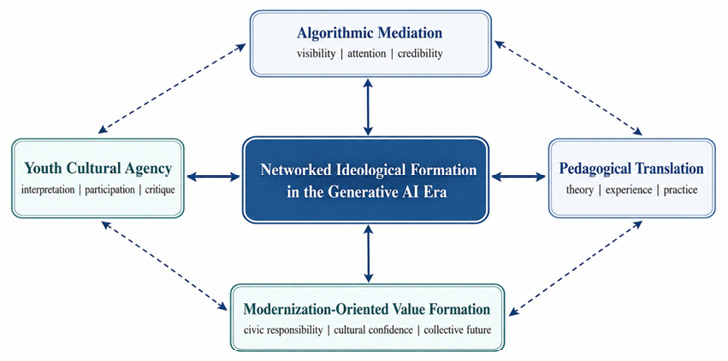
Figure 1 Networked Ideological Formation Framework in the Generative AI Era
To make the framework analytically operational, Table 1 specifies the core question, mechanism, and pedagogical implication associated with each dimension.
Table 1 Analytical Dimensions of Networked Ideological Formation
|
Dimension |
Core Question |
Mechanism |
Pedagogical Implication |
|
Algorithmic mediation |
How is relevance organized? |
Ranking, recommendation, synthesis, personalization |
Teach students to audit visibility and evaluate generated explanations. |
|
Youth cultural agency |
How do young people respond? |
Interpretation, remixing, skepticism, participation |
Design tasks that convert expression into reflective analysis. |
|
Pedagogical translation |
How does theory become communicable? |
Conceptual explanation, case connection, dialogic learning |
Use AI as a scaffold while preserving teacher-led judgment. |
|
Modernization-oriented value formation |
What social horizon guides learning? |
Cultural confidence, public responsibility and ethical governance |
Connect digital literacy to Chinese modernization and civic development. |
4 Methodology
The study adopts a qualitative interpretive research design, aimed not at measuring attitudes or generalizing from a statistical sample, but to develop a theoretically grounded framework for understanding ideological-political education under conditions of generative AI and platformization. This design is appropriate because the object of analysis is relational and conceptual, focusing on the interaction among policy discourse, digital infrastructure, youth cultural practice, and Marxist pedagogical theory.
The analysis draws on two categories of material. The first category consists of policy and governance texts, including China’s regulatory approach to generative AI, national education modernization discourse, and the report to the 20th National Congress. The second category consists of academic literature on Marxist theory, ideology, platform studies, algorithmic governance, and AI in education. This study does not draw on interview data, classroom observation records, survey responses, or unpublished teacher-student interaction materials, and it does not claim empirical evidence from specific teaching sites.
The selection criteria emphasized relevance, authority, and conceptual usefulness. Policy texts were selected when they explicitly addressed AI governance, educational modernization, ideological-political education, or Chinese modernization. Academic sources were selected when they offered durable theoretical concepts or recent evidence concerning AI, platforms, algorithms, and education.
Analytically, the study followed a three-stage interpretive procedure. First, key concepts were identified across the literature: ideology, mediation, hegemony, platformization, algorithmic opacity, AI education, youth agency, and modernization. Second, these concepts were compared with policy texts and relevant education scholarship to identify tensions between technological instrumentalism and ideological-pedagogical formation.
Trustworthiness was addressed through source triangulation, negative-case attention, and analytic transparency. Triangulation was achieved by comparing Marxist theory, platform scholarship, AI education research, and official policy discourse. Negative-case attention involved examining potential risks: AI may fragment attention, reproduce bias, create shallow fluency, or weaken historical contextualization.
5 Analysis
Before the detailed analysis, Table 2 clarifies the article’s analytical movement from instrumental digitalization to networked ideological-political education. It shows how content transmission, teacher authority, curriculum sequence, and assessment are reconfigured when generative AI is understood as part of a wider educational ecology.
Table 2 From Instrumental Digitalization to Networked Ideological-Political Education
|
Traditional approach |
Digital tool approach |
Networked formation approach |
Innovation value |
|
Content transmission |
Online distribution of existing materials |
Interactive interpretation across platforms, AI systems, and classrooms |
Moves from access to formation. |
|
Teacher-centered authority |
Teacher supported by digital resources |
Teacher as designer of critical AI and platform literacy |
Preserves human judgment while expanding inquiry. |
|
Stable curriculum sequence |
Flexible media supplements |
Ecology of policy, platform, classroom, and youth culture |
Builds coherence across learning environments. |
|
Assessment of knowledge recall |
Assessment of digital participation |
Assessment of theoretical reasoning, source critique, and value judgment |
Links digital ability to civic-pedagogical development. |
5.1 From Digital Tools to Ideological Infrastructure
The first analytical shift is from tool use to infrastructural understanding. Much educational discussion treats generative AI as an instrument that can assist teachers in writing materials, help students summarize texts, or support personalized feedback. These uses are real, but they are only part of the transformation.
For ideological-political education, this means that AI cannot be evaluated solely in terms of convenience or efficiency. A generated answer to a question about Marxist theory might be grammatically clear but conceptually thin, treating theory as a list of definitions rather than a method of historical and social analysis.
Conversely, an infrastructural view avoids technological pessimism. AI systems can widen access to complex materials, support multilingual explanation, produce preliminary conceptual maps, and help students formulate questions they might otherwise hesitate to ask. These affordances are significant for ideological-political education because theoretical confidence often begins with intelligibility.
The infrastructural nature of generative AI also requires governance. China’s interim measures connect generative AI to innovation, security, public interest, legal compliance, and ethical order (Cyberspace Administration of China, et al., 2023). This ethical orientation also resonates with international discussions of AI governance that emphasize human-centeredness, transparency, and social responsibility (UNESCO, 2022). In educational settings, these concerns become pedagogical questions.
5.2 Algorithmic Visibility and the Reconfiguration of Youth Attention
The second shift concerns attention. Ideological-political education historically depends on sustained engagement with texts, concepts, histories, and social problems. Platform environments organize attention differently.
This creates a tension for ideological-political education. Marxist theory often requires slow reading, dialectical reasoning, and historical contextualization, while platform attention frequently rewards compressed explanation and affective certainty. Generative AI may intensify this tension by providing instant synthesis.
Yet attention can also be reorganized productively. If educators design tasks that require students to compare model-generated summaries with primary texts, policy documents, case materials, and contemporary social issues, AI can become an object of critique rather than an invisible authority. For example, students might ask a generative system to explain alienation, then identify what social relations are missing from the answer.
The key pedagogical principle is that visibility must be accompanied by interpretation. Merely making ideological-political content available on digital platforms is insufficient if students are not trained to understand how visibility is produced. Algorithmic literacy should therefore become part of ideological-political education.
5.3 Pedagogical Translation and the Communicability of Marxist Theory
The third shift concerns communicability. Marxist theory has strong explanatory capacity, but its educational effectiveness depends on translation into forms that connect with students’ lived experiences without losing analytical rigor. Pedagogical translation is not a concession to entertainment culture.
Generative AI can support pedagogical translation by helping produce examples, analogies, discussion questions, and multilingual explanations. However, translation must remain under human pedagogical judgment. A strong ideological-political lesson should not ask AI to replace theory, but to create entry points for theoretical labor.
Pedagogical translation also requires sensitivity to youth cultural forms. Short videos, memes, forums, and AI chat interfaces are not automatically hostile to serious learning. They can serve as starting points for analysis if teachers help students connect them to historical and social structures.
The communicability of Marxist theory, therefore, depends on a dual movement. The first movement is downward, from abstract theory to concrete experience. The second is upward, from everyday experience back to systematic analysis.
5.4 Youth Cultural Agency Between Participation, Recognition, and Governance
The fourth shift concerns youth agency. Digital youth are often described either as vulnerable users needing protection or as creative participants generating new cultural forms. Both descriptions are partial.
Recognition is essential. Ideological-political education loses force when it speaks about youth without listening to youth. Generative AI environments make this more urgent because students increasingly encounter knowledge through dialogic interfaces that respond to their questions immediately.
Governance is equally essential. Youth participation in digital spaces occurs within platform architectures shaped by commercial incentives, data extraction, content moderation, and regulatory constraints. Cultural agency is therefore never pure spontaneity.
The most productive approach is to position youth as co-interpreters of digital society. Students can analyze how algorithms rank content, how AI systems produce explanations, how digital labor is valued, and how cultural narratives circulate. Through such analysis, youth agency becomes reflective rather than merely expressive.
5.5 Toward a Networked Ecology of Ideological-Political Education
The final analytical shift is ecological. Ideological-political education in the generative AI era cannot be confined to one course, one platform, or one technological application. It requires coordination among curriculum design, teacher training, platform governance, student digital literacy, and institutional value formation.
A networked ecology should be guided by four principles. First, theoretical depth must remain non-negotiable. Digital pedagogy should make Marxist theory more accessible without reducing it to slogans or fragmented facts.
This ecological approach also clarifies the limits of purely technological innovation. A visually appealing platform or AI chatbot cannot, by itself, solve the deeper problem of ideological relevance. Relevance arises when theory explains the world students inhabit and when students see themselves as participants in social transformation.
Networked ideological-political education should therefore be evaluated by qualitative indicators: Does it deepen students’ understanding of social contradiction? Does it strengthen their capacity to interpret digital media critically? Does it connect technological development to ethical and collective purpose?
6 Discussion
The analysis contributes to Marxist theory innovation by re-examining ideology within the infrastructures of algorithmic communication. Classical Marxist theory provides the starting point: ideology is connected to material life, institutional power, and subject formation. Yet generative AI adds a new mediating layer.
This argument extends, rather than abandons, foundational Marxist concepts. While Marx and Engels’s (1970) account of the relation between consciousness and social being remains crucial, social being now encompasses data infrastructures and platform-mediated practices. Similarly, Gramsci’s (1971) cultural leadership remains relevant, but common sense now circulates through recommendation systems and AI-generated explanations.
The article also contributes to platform and AI studies by foregrounding ideological-political education as a distinctive site of analysis. Much platform research examines governance, visibility, data extraction, or public values; much AI education research examines learning support, assessment, or academic integrity. Ideological-political education brings these concerns into a single field because it requires attention to knowledge, values, subjectivity, and governance at the same time.
Practically, the framework implies that educators should move from adoption to design. Adoption considers whether generative AI should be used, while design focuses on the conditions, tasks, educational ends, and governance principles involved.
There are also tensions. First, the opacity of AI systems limits educators’ ability to fully explain how outputs are produced. Second, the commercial infrastructures behind many platforms may conflict with educational values.
The limitations of this article should be stated clearly. The analysis is conceptual and interpretive; it does not claim to measure student attitudes or evaluate a specific AI teaching intervention. It draws on publicly available policy discourse and scholarly literature rather than private empirical data.
7 Conclusion
Generative AI is transforming the communicative conditions of ideological-political education. It reorganizes attention, produces a synthetic explanation, mediates cultural authority, and changes how young people encounter political and theoretical knowledge. Treating it merely as a teaching tool understates its significance, just as treating it solely as a risk obscures its pedagogical potential.
The Networked Ideological Formation Framework developed in this article identifies four interrelated dimensions: algorithmic mediation, youth cultural agency, pedagogical translation, and modernization-oriented value formation. Collectively, these dimensions elucidate why ideological-political education in the new era must move beyond instrumental digitalization. The task is to cultivate historically grounded, critically reflective, and socially responsible youth subjectivity under conditions of platformization and generative intelligence.
For Marxist theory innovation, the central implication is that ideology must be analyzed as mediated practice. For ideological-political education, the central implication is that theory must be translated into participatory and digitally literate forms without sacrificing conceptual rigor. For Chinese modernization, the central implication is that technological development must be guided by cultural confidence, ethical governance, and collective educational purpose.
References
[1] Althusser, L. (1971). Ideology and ideological state apparatuses. In Lenin and Philosophy and Other Essays (pp. 127-186). Monthly Review Press.
[2] Beer, D. (2017). The social power of algorithms. Information, Communication & Society, 20 (1), 1-13.
[3] Burrell, J. (2016). How the machine “thinks”: Understanding opacity in machine learning algorithms. Big Data & Society, 3 (1), 1-12.
[4] Cyberspace Administration of China, National Development and Reform Commission, Ministry of Education, Ministry of Science and Technology, Ministry of Industry and Information Technology, Ministry of Public Security & National Radio and Television Administration. (2023). Interim measures for the management of generative artificial intelligence services. https://www.cac.gov.cn/2023-07/13/c_1690898327029107.htm.
[5] Gillespie, T. (2014). The relevance of algorithms. In T. Gillespie, P. J. Boczkowski, & K. A. Foot (Eds.), Media technologies: Essays on communication, materiality, and society (pp. 167-193). MIT Press.
[6] Gramsci, A. (1971). Selections from the prison notebooks. International Publishers.
[7] Kasneci, E., Sessler, K., Küchemann, S., Bannert, M., Dementieva, D., Fischer, F., Gasser, U., Groh, G., Günnemann, S., Hüllermeier, E., Krusche, S., Kutyniok, G., Michaeli, T., Nerdel, C., Pfeffer, J., Poquet, O., Sailer, M., Schmidt, A., Seidel, T., Stadler, M., Weller, J., Kuhn, J., & Kasneci, G. (2023). ChatGPT for good? On opportunities and challenges of large language models for education. Learning and Individual Differences, 103, Article 102274.
[8] Kitchin, R. (2017). Thinking critically about and researching algorithms. Information, Communication & Society, 20(1), 14-29.
[9] Marx, K., & Engels, F. (1970). The German ideology. International Publishers.
[10] State Council of the People’s Republic of China. (2025). China unveils blueprint for building a strong education system by 2035. https://english.www.gov.cn/policies/latestreleases/202501/20/content_WS678d85c6c6d0868f4e8eef83.html
[11] UNESCO. (2022). Recommendation on the ethics of artificial intelligence. UNESCO. https://www.unesco.org/en/artificial-intelligence/recommendation-ethics.
[12] Van Dijck, J., Poell, T., & De Waal, M. (2018). The platform society: Public values in a connective world. Oxford University Press.
[13] Xi, J. P. (2022). Hold High the Great Banner of Socialism with Chinese Characteristics and Strive in Unity to Build a Modern Socialist Country in All Respects Report to the 20th National Congress of the Communist Party of China. State Council of the People’s Republic of China. https://english.www.gov.cn/2022special/20thcpccongress/.
[14] Zawacki-Richter, O., Marín, V. I., Bond, M., & Gouverneur, F. (2019). Systematic review of research on artificial intelligence applications in higher education: Where are the educators? International Journal of Educational Technology in Higher Education, 16, Article 39.