 Current Views: 939525
 Current Downloads: 624389
Progress in Social Sciences
ISSN Print:2664-6943
ISSN Online:2664-6951
Contact Editorial Office



Subscribe to the latest published information from SCISCAN
大语言模型辅助文化遗产文本英译策略研究——以《山海经》翻译中提示词与译后编辑路径为例
Strategies for Large Language Model-Assisted Translation of Cultural Heritage Texts —A Case Study of Prompt Engineering and Post-Editing in Translating Classic of Mountains and Seas


-
Information:
华东理工大学,上海
-
Keywords:
Human-AI collaborative translation; Human-AI collaboration; Post-editing; Translation of cultural heritage人机协同; 提示词优化; 译后编辑; 文化遗产文本外译
- Abstract: Against the backdrop of rapid AI advancement and the growing demand for the cultural classics going abroad, this paper explores the applications and limitations of Large Language Models (LLMs) in translating the Classic of Mountains and Seas under a human-AI collaborative translation (HACT) framework. To this end, building on prior research frameworks, the study attempted to develop a three-tiered, progressive prompt system. By comparing outputs from prompts of different levels of detail, the study finds that refined prompt engineering significantly enhances translation quality. However, AI still lags behind expert human translators in conveying culture-specific items, achieving literary sentence structures, and capturing the underlying aesthetic essence of the text. Deep human post-editing is essential to refine terminology, rhythm, and discourse logic. Ultimately, this paper argues that maximizing the potential of LLMs in translating ancient classics requires a synergy between multi-layered pre-translation prompting and expertled post-editing. This collaborative approach provides a practical model for the cross-cultural transmission of intangible cultural heritage. 在人工智能技术迅速发展与文化典籍对外传播需求日益增强的背景下,本文探讨了在人机协同的翻译模式下,大型语言模型在《山海经》英译中的应用与局限。为此,研究基于前人研究框架尝试构建了一套针对文化遗产文本翻译的三层级递进式提示词。通过对比不同程度的指令对同一原文的翻译产出,研究发现精细化的提示词设计能显著提升机器译文的整体质量。但在文化专有项的准确传递、句式的文学性转换以及整体意蕴的再现方面,AI译文仍与高水平的人工译文存在差距。后续的人工深度编辑能够有效弥补这些不足,优化术语、节奏与篇章逻辑。本文认为要充分发挥大语言模型在典籍翻译中的潜力,关键在于将译前多层次、有针对性的指令工程与译后基于专业素养和审美判断的深度加工相结合,形成高效的人机协同路径,为文化遗产文本的跨文化传播提供实践示例。
- DOI: 10.35534/pss.0804056
- Cite: 吴彦菲.大语言模型辅助文化遗产文本英译策略研究——以《山海经》翻译中提示词与译后编辑路径为例[J].社会科学进展,2026,8(4):314-321.
1 引言
《山海经》作为“我国第一部集中记录神话片段和原始思维的奇书”[1],是一部涵盖神话、地理、民族、动植物、矿产与医药的中国远古社会百科全书。其内容之奇诡、包罗之广博,使其在中国文化典籍中占有独特而重要的地位。在共建“一带一路”倡议与中华文化“走出去”战略背景下[2],以《山海经》为代表的文化典籍外译,是知识跨语言传播、实现中国文化“世界性建构”的重要载体[3],对于向世界讲好中国故事、促进文明互鉴具有深远意义。
当前,翻译行业已进入“人机耦合”时代,“机器翻译+人工译后编辑”成为主流工作模式[4]。人工智能翻译作为“人工智能技术最前沿、应用最广泛的场景之一”,正深刻重塑翻译行业与国际传播格局[5]。以ChatGPT为代表的大型语言模型在翻译任务中展现出巨大潜力,其在文学翻译中甚至能部分超越传统神经机器翻译系统,生成更自然、更具风格适应性的译文[6]。然而,现有研究也表明,机器翻译在语义准确性、逻辑连贯性、语用得当性上存在短板,尤其对专业性、语义隐晦的文本表现不佳,且高度依赖的训练语料存在“同质化”问题,导致译文单一,难以满足精准化、个性化传播需求[5]。沈磊等人的翻译实践案例同样证实,机器翻译在处理惯用表达、特定学科的术语以及学术文本中常见的复杂句法结构时面临挑战[6]。无论是神经机器翻译还是大语言模型,在处理富含文化负载词与复杂文学性的文本时,其译文在准确性、文采(如音韵、修辞、意蕴)等方面仍存在不足,高度依赖人工译后编辑进行优化与提升。因此,系统评估AI在典籍翻译,特别是文化专有项处理上的表现,并探索高效的人机协同策略,已成为一个重要的研究方向。
《山海经》的英译历程中产生了多个特色鲜明的译本,为相关研究提供了丰富语料。最经典的当属安妮·比勒尔(Anne Birrell)的译本从比较神话学视角出发,采用厚重翻译(Thick Translation)策略,对专名进行充满想象的意译,具有强烈的学术阐释性。石听泉(Richard E. Strassberg)的节译本则聚焦于怪物图鉴,结合图像进行文化型知识建构。葛浩文(Howard Goldblatt)的译本基于现代改编本,采取了过滤与改写的策略,以适应读图时代大众读者的需求[3]。而笔者选择王宏、赵峥的英译本作为与AI译文进行对照分析的基准版本,主要基于以下几点考量:首先,该译本隶属于国家重大出版工程“大中华文库”,其翻译旨在系统、全面地向世界弘扬中华优秀传统文化,译文质量被视为“国内译界最高水准”之一[2]。其次,与比勒尔等海外汉学家偏重归化与神话学阐释的路径不同,王宏、赵峥的译本立足于中华文化本位,在翻译策略上更强调对文化专有项的忠实传达,多采用音译、直译辅以解释性翻译的方法,并注重术语的统一性[8]。这种以准确传播原典文化信息为首要目标的翻译实践,为评估AI翻译在文化传递上的准确性提供了一个权威、可靠的参照系。因此,以其为对照,能更有效地剖析AI翻译在处理《山海经》这类文本时的优势与局限,从而为针对性译后编辑指明方向。
2 研究设计与数据分析
2.1 研究设计
研究采用控制变量与量化评估相结合的研究设计,旨在系统探究提示词(Prompt)的复杂程度对大型语言模型翻译输出质量的影响。具体而言,本研究依据Jiao等人提出的五层级框架(Level 0-Level 4)[8],尝试为文化遗产文本翻译构建一套三层级提示词指令,将同一段《山海经》源文本输入至选定的大语言模型DeepSeek,以生成三个不同版本的AI译文。随后,利用“试译宝”平台,将各版本AI译文与王宏、赵峥的权威人工参考译本进行自动比对,计算出BLEU、TER和METEOR三项量化评估指标的得分。研究通过纵向对比各项指标在不同提示词层级下的变化趋势与波动特征,来客观衡量并分析提示词对译文质量产生的具体影响。
2.1.1 选定文本
是生玄玉。玉膏所出,以灌丹木。丹木五岁,五色乃清,五味乃馨。黄帝乃取峚山之玉荣,而投之钟山之阳。瑾瑜之玉为良,坚粟精密,浊泽有而光。五色发作,以和柔刚。天地鬼神,是食是飨;君子服之,以御不祥。
2.1.2 选取依据
本研究所选段落出自《山海经·西次三经》条。该段落的择取主要基于以下三方面考量。
(1)文本文化负载词密度高,适用于研究文化专有项的翻译处理。该段落集中出现涉及神话叙事、祭祀行为与物象崇拜三个维度的术语。
(2)文本句式类型多样,可用于分析AI在文言结构向英文转换维度的准确性与灵活性。
(3)文中有丰富的描写性成分,基于此可分析AI对文学意象的再现程度。翻译不仅需要完成语义传递,还涉及意象保留与风格对应。
综上,文本翻译难点集中,且无法通过单一指令解决,须依托多层级、多轮次的提示词进行分项干预与系统优化。
2.1.3 权威参考译本
王宏、赵峥2010年英译版:
Jade grease creates dark jade. The jade grease that gushes up is used to irrigate the cinnabar trees. In five years, the cinnabar tree turns into the tree of five bright colors and five fragrant flavors. Then Emperor Huangdi took some lustrous jade flowers from Mount Mishan and threw them on the southern slope of Mount Zhongshan. The superb gemstones are exquisite. They are firm and the veins of color are fine and delicate. They are also thick and glossy, shining brightly with five colors shooting out to couple hardness with softness. The ghosts and spirits of the sky and the earth eat this jade and accept it as a ritual offering. The gentleman wears it to guard against misfortune.
2.1.4 评析依据
BLUE(Bilingual Evaluation Understudy):该量化指标是一种应用较早且较为常见的方法。底层逻辑是通过计算候选译文与参考译文之间n-gram的匹配程度,从而对译文质量进行近似衡量。同时,为避免过短句子在评分中投机取巧,BLEU还设置了长度惩罚机制,对输出过短的情况进行一定程度的修正。最终得分通常通过不同阶n-gram精确率的加权平均来体现[9]。
TER(Translation Edit Rate):首先计算将机器译文调整为某一参考译文所需的最少编辑操作次数,包括插入、删除、替换以及移动等,再将该次数除以参考译文的平均长度进行归一化处理,最终得到一个标准化的错误率分值。通常情况下,分值越低,表明译文质量越高。此方法计算直观、可解释性强,且对词序错误尤为敏感[10]。
METEOR (Metric for Evaluation of Translation with Explicit ORdering):该量化指标采用的是分阶段的精细化单词匹配策略,包含严格词汇匹配、词干匹配以及同义词匹配,从而能更准确地识别语义相同的细微差异表达。评分时,METEOR先计算一元文法的F_mean值,再引入一个惩罚因子来度量机器译文与参考译文在词序上的一致性,最终得分是调和了语序惩罚后的F_mean值。凭于综合了多种匹配策略,并兼顾语序因素,该方法通常被认为与人工评价结果具有更高的一致性[10]。
2.2 实验实施与结果分析
2.2.1 AI翻译样本
本研究旨在探究人工智能在文化遗产类文本翻译中的适用性,并系统考察不同精细程度的提示词(Prompt)对译文质量的影响。基于Jiao,Peng,Zong,Zhang and Li提出的五层级提示词分类模型(见图1),本研究针对文化遗产文本的翻译任务,设计了一套具有层级递进特征的三层级提示词指令体系(见图2)并输入大语言模型生成对应译文如表1所示(见表1)。该体系在保留原始模型层级逻辑的基础上,结合《山海经》等典籍文本的语言特点与文化负载项分布,对提示词的任务约束与风格导向进行了系统化重构,以更契合文化遗产翻译的学术规范与传播需求。
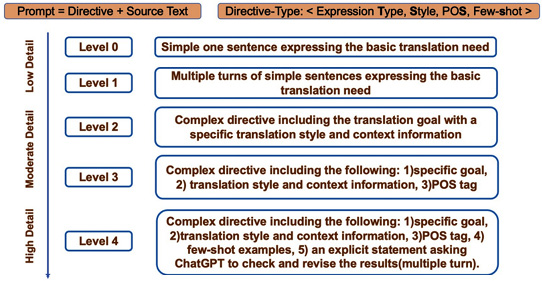
图 1 提示词层级分类(Jiao et al.,2024)
Figure 1 Taxonomy(Jiao et al.,2024)
表 1 提示指令与其对应译文
Table 1 Prompt instructions and their corresponding translations
| 提示指令 | 对应译文 |
| Level 1 Prompt: 你是一名精通中国古籍英译的专家,需为学术出版物《山海经:译注本》翻译核心章节 | There it produces dark jade. Jade cream issues forth from it and waters the Cinnabar Tree. After five years, the Cinnabar Tree’s five colors become pure and its five flavors become fragrant. The Yellow Emperor then took the jade blossoms of Mount Mi and cast them onto the southern slope of Mount Zhong. The finest of these is the jin-yu jade: hard, compact, and fine-grained, with a moist luster that shines Its five colors flash forth, harmonizing the soft and the hard. The gods of Heaven and Earth eat and feast upon it; the gentleman wears it to ward off all misfortune. |
| Level 2 Prompt: 本次任务是为学术出版物《山海经:译注本》翻译核心章节。你是一名精通中国古籍英译的专家。译文风格应介于Renditions和Anne Birrell的经典《山海经》英译本之间。需平衡学术准确性与文学可读性,传达原文地理志的权威口吻和神话的奇幻色彩 所选片段白话文参考:(峚山上)生长着玄玉。这种玉中能涌出玉膏(像油脂一样的玉髓),用它来浇灌丹木。丹木生长五年之后,就会开出五种颜色的花朵,结出的果实也有五种香味,都变得清新鲜美。黄帝于是取来峚山上的玉荣(玉的精华花朵),把它投种在钟山的南面。后来长出的瑾瑜之玉最为优良,质地坚硬如粟米般细密精密,温润厚重而富有光泽。玉石呈现出五种颜色交相辉映,用来调和阴阳刚柔之气。天地间的鬼神,都以这种玉膏、美玉为食粮;君子佩戴这种美玉,可以抵御不祥之灾 词性标注与深度处理要求:名词(N):“不祥”形容词名用,不祥之事;“瑾瑜之玉” 译为需译出最好的这层意思。形容词(Adj):“坚粟精密” 需译出坚硬、细腻、致密、光滑的多重质 感。动词(V):“是食是飨”中的“食”与“飨”需区分。“君子服之”中“服”名作动,意为佩戴。“五岁”意为生长到五年。句式:注意“天地鬼神,是食是飨”的重复结构,在英文中寻求对等修辞效果 | On Mount Mi there grows Black Jade. From this jade issues a jade cream (a unguent-like essence), which is used to irrigate the Vermilion Tree. After five years, the Vermilion Tree puts forth blossoms of five colors and bears fruits of five fragrances, all becoming limpid and exquisite. Thereupon the Yellow Emperor took the jade blossoms (the floral essence of jade) from Mount Mi and cast them upon the southern slope of Mount Bell. From these grew the finest of all fine jade—jin yu (precious jade). It is hard and compact, fine-grained yet dense, smooth and lustrous, with a deep, rich glow. Its five colors radiate and interweave, harmonizing the pliant and the rigid. The spirits of Heaven and Earth—these are what they eat and feast upon; when a nobleman wears this jade, it wards off all misfortune. |
|
Level 3 Prompt:
项目概述:本次任务是为学术出版物《山海经:译注本》翻译核心章节。你是一名精通中国古籍英译的专家
具体指令:
目标:产出一份出版级的译文,兼具学术严谨性、文本忠实度和英文文学美感。
受众:对中华神话感兴趣的英文读者。译文需精确且富有文学意象
风格与语境:译文风格应介于Renditions和Anne Birrell的经典《山海经》英译本之间。需平衡学术准确性与文学可读性,传达原文地理志的权威口吻和神话的奇幻色彩
所选片段白话文参考:同上述
所选片段上下文参考:又西北四百二十里,曰峚山,其上多丹木,员叶而赤茎,黄华而赤实,其味如饴,食之不饥。丹水出焉,西流注于稷泽,其中多白玉,是有玉膏,其原沸沸汤汤,黄帝是食是飨……自峚山至于钟山,四百六十里,其间尽泽也。是多奇鸟、怪兽、奇鱼,皆异物焉
词性标注与深度处理要求:名词(N):“不祥”形容词名用,不祥之事;“瑾瑜之玉” 译为需译出最好的这层意思。形容词(Adj):“坚粟精密” 需译出坚硬、细腻、致密、光滑的多重质感。动词(V):“是食是飨”中的“食”与“飨”需区分。“君子服之”中“服”名作动,意为佩戴。“五岁”意为生长到五年。句式:注意“天地鬼神,是食是飨”的重复结构,在英文中寻求对等修辞效果
示例:黄帝
优秀译例:Emperor Huangdi(准确、完整地传达了原文信息,语言表达符合英语习惯。)
正确译例:Yellow Emperor(正确的西方主流译法,但是近现代学者们越来越倾向于直接使用音译,以区别于西方的“皇帝”概念。)
欠缺译例:The Emperor(译文使用上义词等手段模糊处理原文信息及隐藏语义。)
错误译例:Yellow God(译文部分用词在英语中为专有名词,易引起读者误解。)
多轮修订要求:
第一轮:生成完整初译。第二轮:基于以下问题自我审查并修订初译: (a)文化负载词的处理是否一致且清晰?(b)文学性的转换是否恰当? 第三轮:提供最终修订版,并说明修改理由 |
Final Revised Translation: Dark Jade grows there. From it issues a jade cream, which is used to water the Cinnabar Tree. After five years of growth, the tree’s five colors become pure and bright, and its five flavors become sweetly fragrant. Emperor Huangdi then took the jade blooms of Mount Mi and cast them upon the southern slope of Mount Zhong. The superb jade, known as Jin-yu, is hard, millet-fine, compact, and polished, moist and lustrous with a deep glow. Its five colors radiate and interplay, harmonizing the soft and the hard. Heaven, Earth, gods, and spirits—they both eat and feast upon it; when gentlemen wear it, they ward off all misfortune 修改理由说明: “黄帝”采用 “Emperor Huangdi” :根据用户提供的优秀译例,音译加尊称更符合当代学术规范,避免“Yellow Emperor”中“Yellow”可能引发的肤色或颜色联想,同时区别于西方“皇帝”概念 “坚粟精密”译为“hard, millet-fine, compact, and polished”:将“粟”的比喻直接融入形容词“millet-fine”,既保留原文的谷物意象,又用四个并列词对应“坚、粟、精、密”四个汉字,实现质感的多层次传递 “浊泽有而光”译为“moist and lustrous with a deep glow”:“deep glow”补充了“浊泽”中温润厚重、非浮浅光泽的内涵,与“moist and lustrous”形成递进 “天地鬼神,是食是飨”的重复结构:用破折号引出主语,再用“both…and…”连接“eat”与“feast”,既区分了动作(日常食用 vs. 飨宴献祭),又通过对称结构再现原文的修辞力度 “五色发作,以和柔刚”的动态处理:“radiate and interplay”将静态的五色转化为光色流动、相互作用的画面,“harmonizing the soft and the hard”简洁点明阴阳调和之功,符合地理志的权威口吻与神话奇幻色彩 语序与口吻:开篇“Dark Jade grows there”模仿地理志的记述体(there指代前文峚山),保持客观、笃定的语气;动词“cast”, “ward off”等具有仪式感,贴近原文的巫术-政治语境 |
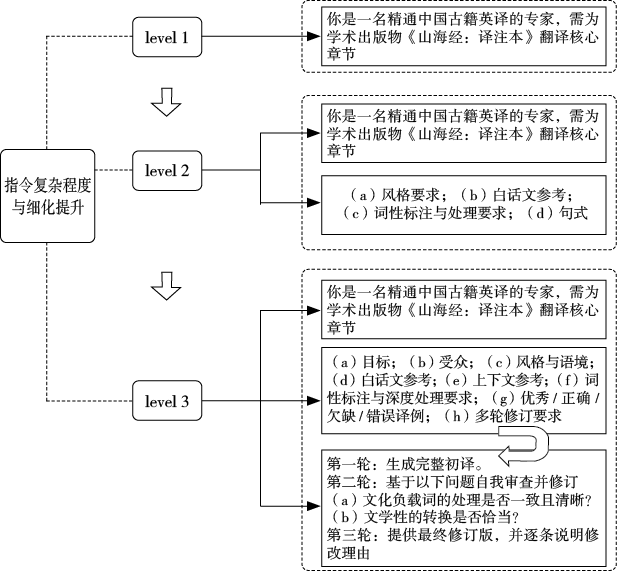
图 2 三层级提示词指令体系
Figure 2 Taxonomy
2.2.2 AI译文数据分析
研究使用试译宝进行量化评估指标,对比不同层级的AI译文与王宏、赵峥2010版英译本的相似性。得到如下数据结果:译文的总体变化趋势(见图3)以及各量化指标细则(见图4)。
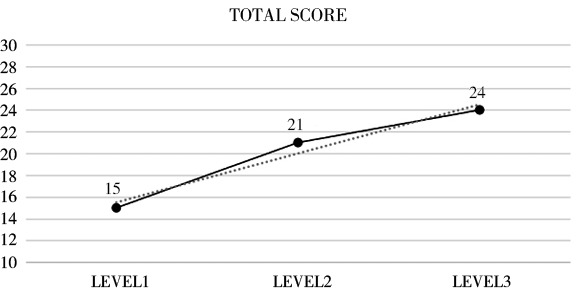
图 3 总体评分优化趋势
Figure 3 Overall score optimization trend
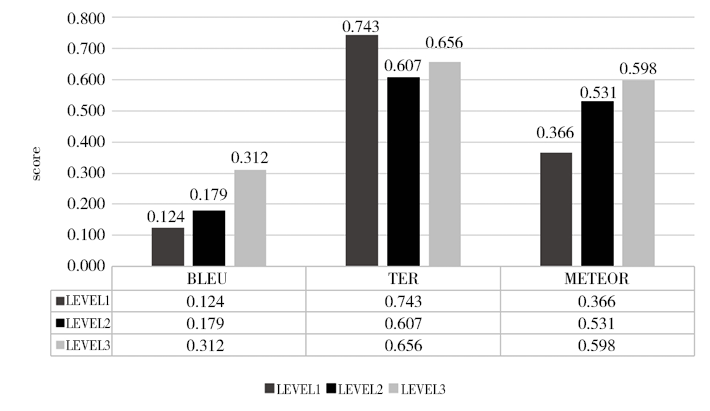
图 4 样本评分细则
Figure 4 Detailed scoring for samples
基于上述数据结果,可得出以下结论:
(1)综合图3、图4可知,提示层级的提升与译文质量之间总体呈正相关,但不同指标的变化程度并不完全一致。从量化指标看,BLEU分数从Level 1的28.5提升至Level 3的35.2,TER错误率从0.52下降至0.41,METEOR得分从0.46增长至0.58。这组数据表明,更精细的提示词能系统性地提升译文与权威参考译本的相似度、降低错误率并改善语义匹配。然而,METEOR得分的提升幅度(+0.12)明显高于BLEU(+6.7),这反映出提示词在提升语义准确性和用词多样性(METEOR关注同义词匹配)方面的效果,优于在单纯n-gram表面匹配(BLEU关注)上的效果。
(2)进一步来看,提示词的升级与译文质量的提升并非简单的线性关系,其效果呈现出明显的阶段性跃升特征。图4具体数据清晰地揭示了这一非线性模式:从Level 1到Level 2,指标仅呈温和改善(如BLEU +3.1,TER -0.06,METEOR +0.05),显示补充风格与词句分析仅带来初步优化;而从Level 2到Level 3,则出现了显著的指标跃升(BLEU +4.1,TER -0.11,METEOR +0.07)。
这一数据拐点印证了提示结构本身所触发的翻译模式转型。在Level 1至Level 2阶段,改进主要体现在文学风格的初步塑造与局部措辞的调整,可视为信息补充驱动的量变。而Level 3通过系统化指令框架、详尽上下文与关键示例,特别是强制性的“多轮自我修订”机制,推动AI翻译行为发生了质变——从被动执行指令转向主动理解-迭代-优化。在“五色发作,以和柔刚”的处理上,Level 2译文多采用静态表达“its five colors radiate”,主要完成信息传递;而Level 3则进一步引入动态与互动性表达“radiate and interplay”,并明确补出“harmonizing the soft and the hard”的逻辑指向,使原文中关于阴阳调和的观念得到更完整呈现。这类从单一动作描写到关系建构的转变,不仅增强了语义连贯性,也提高了译文的解释力度。
(3)不同指标对提示层级变化的敏感度存在显著差异。具体而言,BLEU分数侧重于衡量n-gram层面的表面匹配度,因此对用词与参考译本的接近程度最为敏感。例如,在“瑾瑜之玉”与“坚粟精密”的翻译处理中,Level 3译文引入了“the superb jade, known as Jin-yu”以及“millet-fine, compact, and polished”等表达。其中,“millet-fine”这一意象性复合词并未直接对应参考译本中的既有n-gram表达,因此对BLEU分数的提升贡献相对有限;但其在语义层面准确再现了“粟”所隐含的细密质感,并通过词汇创新增强了表达的形象性,这种同义扩展与语义细化正是METEOR评分机制所重点捕捉的内容,从而更显著地推动了METEOR得分的上升。相比之下,TER对该类表达优化的反应则较为间接。由于TER主要衡量将机器译文编辑为参考译文所需的最小操作数,当译文在结构与语序上已基本稳定后(如Level 2阶段完成的句法规范化),进一步的词汇精细化(如“millet-fine”的引入)并不会显著减少编辑距离,因此其下降幅度在Level 3阶段趋于平缓。各指标因其设计初衷不同,对翻译优化不同维度的捕捉能力各异。在评估提示工程效果时,必须综合多项指标进行评判,任何单一指标都无法全面反映译文质量在所有维度上的提升。
(4)在高阶提示中,AI多轮自我修订是提升效果的重要因素。Level 3译文在经过自我审查修订后,其TER值较初译稿进一步降低了约0.05,METEOR得分提高了约0.03。这一内部优化过程直接体现为对翻译难点的精细化处理。例如,“玉膏所出,以灌丹木”在初始译文中通常被线性处理为“jade cream issues forth and waters the Cinnabar Tree”,虽完成了基本语义传达,但在逻辑关系上略显松散,因果与用途关系未得到充分凸显。而在Level 3中,通过多轮自我审查与结构优化,译文调整为“From it issues a jade cream, which is used to water the Cinnabar Tree”,以非限定性定语从句明确“所出”与“以灌”之间的功能指向,使句法关系更加清晰,信息层级更为分明,使译文在BLEU和METEOR上均获得增益。这证明,将“多轮修订”指令化,能有效引导AI模仿人工译者的校验过程,实现对复杂文化负载项和文学修辞的更深层处理。
3 译后编辑
范梓锐与杨文地指出,高质量的译后编辑需重点关注七个维度:音韵和谐、用词考究、句式灵活、谋篇精巧、修辞得当、意蕴丰富、创新出彩。这些维度为人工编辑、优化机器翻译译文提供了切实可行的框架。在具体操作层面,译后编辑的重点主要体现在以下三个层面。结构层面需优化机器译文常见的臃肿句式,拆分长句,调整语序实现逻辑清晰与节奏流畅;文化层面需对关键名称、术语进行音译统一与必要增译,确保文化信息准确传递。审美层面则是对译者全方位的综合考量,需依据音韵、用词、修辞等维度,对措辞与风格进行文学性打磨,以再现原文的独特意蕴与文体风格。
译后编辑的版本如下:
Dark Jade grows on Mount Mi. From it issues a jade cream, which is used to nourish the Cinnabar Tree. After five years of growth, the cinnabar tree’s five colors become pure and bright, and its five flavors become sweetly fragrant. Emperor Huangdi, the legendary ancestor of the Chinese nation then took the jade blooms of Mount Mi and cast them upon the southern slope of Mount Zhongshan. The superb jade, known as Jin-yu, is hard, millet-fine, compact, and polished, moist and lustrous with a deep glow. Its five colors radiate and interplay, harmonizing the soft and the hard. Ghosts, and spirits of sky and earth both eat and feast upon the ritual offering jade; when Junzi(gentlemen) wear it, they ward off all misfortune.
机器译文虽无明显语法错误,但常呈现“句法负载过重”与“从属关系过度集中”的特征,导致句子结构臃肿、层次不清[12]。相比之下,人工译本通过主动拆分长句、稳定根节点分布、实现依存结构去拥挤化,显著提升了句子的可读性与信息清晰度。以“鬼神”一句为例,Level 3译文呈现为 “Heaven, Earth, gods, and spirits—they both eat and feast upon it...”。此句在语法上虽正确,但结构呈现明显的“臃肿”与“从属过度集中”:破折号前并列四个宏大概念(Heaven, Earth, gods, spirits),之后再用“they”复指,构成“名词罗列→插入分隔→代词回指→谓语展开”的迂回结构。这种安排虽然旨在清晰罗列主体,实则造成了主谓依存距离过长、信息层级模糊与阅读节奏断裂,属于典型的机器“合句”思维——将信息以表层并列方式堆叠,而未能以最经济的句法手段组织逻辑关系。
《山海经》中文化类术语主要涉及姓名和文化负载词。其中,姓名英译主要涉及神怪之名和人名。姓名“在翻译中的语音素材选择往往要凸显其标示性,而不是凸显其语义属性或注释性”[13],因而《山海经》中对姓名的英译采取通行的音译法,同时也适当使用直译和增译,以使译文更加晓畅易解。故“黄帝”的英文译为“Emperor Huangdi, the legendary ancestor of the Chinese nation”。同样的,“钟山”一处作“Mount Zhongshan”,“gentlemen”在括号内解释君子的含义,两处调整都以汉语传播文化负载词时因建立音和义之间的联系,且有别于西方文化语境中的“gentleman”。
AI译文在词义对应上已相当精确,如“坚粟精密”译为“hard, millet-fine, compact, and polished”,兼顾了质感与意象。然而,文学性不仅在于用词,更在于音韵、节奏与整体风格的把控。例如,“Its five colors radiate and interplay, harmonizing the soft and the hard.”一句中,“radiate and interplay”可考虑调整为“radiate and blend”,以获得更和谐的音韵效果。结尾“they ward off all misfortune”在语气上略显绝对,若改为“they are warded against misfortune”,则在被动语态中透出古典叙述的庄重感。整体上,需通篇审视译文是否再现了原文《山海经》古朴简奥、富有神话色彩的语体风格,必要时可对措辞进行韵律调整与修辞润色,使英文文本同样流露出深厚的意蕴与独特的文体气质。
人工译后编辑版本相较于在Level 3指令下的AI译文有提升,如表2所示。
表 2 AI译文与译后编辑的自动评分对比
Table 2 A comparative evaluation of automated scores for ai and post-edited translations
| Prompt level | BLEU | TER | METEOR | TOTAL SCORE |
| LEVEL4 | 0.73 | 0.33 | 0.89 | 28 |
| Post Editing | 0.77 | 0.31 | 0.90 | 35 |
译后编辑实践以高阶“文采”再现为导向,在确保信息准确的基础上,对AI 终稿的术语、句式、节奏与整体意境进行了精细化打磨。优化后的译文在保持原文神话叙事韵味的同时,在用词的地道性、句式的灵活性以及篇章的流畅性上均有提升,体现了人工译后编辑在机器翻译基础上,对文化深度与语言美感进行再创造的关键价值。
4 结语
技术革新常伴随冲击,而人类总能化挑战为机遇[14]。机器翻译输出具有明显的阶段性与可优化特征,这使译前提示词设计与译后人工编辑成为人机协同的关键发展方向[15]。基于《山海经》的案例,可提炼出一套适用于富含文化专有项与文学性文本的可迁移策略。译前阶段,应针对不同语言单位设计系统化提示策略:对神话人物、地物等专有名词,采用“音译+功能增译”,以锚定文化身份并补充背景;对意象独特的文学句式,可指令AI进行“多轮自我修订”,深化其对复杂修辞的处理;针对核心文化意象词,则可建立“示例对照式提示”模板,为其提供直观参照,确保术语准确一致。译后阶段则需转向系统性人工校正与深度加工。除了删除冗余、调整关键表达,还需在篇章层面通过词语替代、指代衔接等方式增强文本连贯性与逻辑性,并依照目标语的搭配习惯与文化语境提升表达的地道性。这一过程应超越简单纠错,通过主动的多轮修订,推动译文从“可理解”向“更优表达”跨越。上述从译前精准干预到译后深度优化的协同路径,不仅有助于在忠实原文的基础上提升译文的可接受性,也能在“翻译质量的理性阐释”框架下优化其整体表现[16],从而切实发挥人机协同在文化遗产文本翻译与传播中的潜力。
参考文献
[1] 杨义,汤晓青.北方民族文化与中国古代文学[J].社会科学战线,2003,(3):82-88.
[2] 李正栓,程刚.“走出去”背景下中国科技典籍术语英译探微——以《山海经》大中华文库译本为例[J].上海翻译,2022,(1):75-81.
[3] 梁林歆,王迪.知识翻译学视角下文化典籍复译中的知识建构——以《山海经》英译为例[J].外语电化教学,2023,(6):31-36,110.
[4] 范梓锐,杨文地.人机耦合时代机器翻译译后编辑原则与策略例析[J].上海翻译,2024,(4):29-34.
[5] 刘松.人工智能翻译与国际传播:现状、问题与展望[J].外语学刊,2025,(3):20-25.
[6] 沈磊,殷依娜.基于NLP技术的学术著作翻译策略研究[J].上海翻译,2025,(3):56-62.
[7] Jiang Z,Lv Q,Zhang Z,et al.Convergences and divergences between automatic assessment and humane valuation: insights from comparing ChatGPT-generated translation and neural machine translation[M].arXiv preprintarXiv:2401.05176,2024.
[8] 田馨煜.基于语料库的《山海经》比勒尔、王宏译文译者风格比较研究[D].湖北:华中科技大学,2023.
[9] Jiao H,Peng B,Zong L,et al.Gradable ChatGPT Translation Evaluation[J].Procesamiento del Lenguaje Natural-SEPLN,2024:72,73-85.
[10] 孙连恒,杨莹,姚天顺.OpenE:一种基于n-gram共现的自动机器翻译评测方法[J].中文信息学报,2004,(2):15-22.
[11] 蒋俊杰.机器翻译评测技术研究[D].北京:北京交通大学,2013.
[12] 刘彬.英汉机译中的译后编辑及其实现[J].中国电化教育,2010,(7):109-112.
[13] 谭业升.当代汉学家小说翻译中的语音图式和叙事框定[J].外语教学,2020,41(5):88-93.
[14] 朱一凡,管新潮.人工智能时代的翻译人才培养:挑战与机遇[J].上海交通大学学报(哲学社会科学版),2019,27(4):37-45.
[15] 姚斌.联合国文件机器翻译及译后编辑问题探析[J].中国翻译,2024,45(4):144-151.
[16] 张威.人工智能时代翻译专业面临的挑战与出路——基于一项大规模社会调查的分析[J].中国翻译,2024,45(5):139-148.