 Current Views: 349648
 Current Downloads: 202821
Study on China Physical Science
ISSN Print:2707-1936
ISSN Online:2707-1944
Contact Editorial Office



Subscribe to the latest published information from SCISCAN
不同训练频率对高中生短跑速度与下肢力量水平的影响
The Effects of Different Training Frequencies on Students’ Sprint Speed and Lower Limb Strength Level


-
Information:
四川农业大学,雅安
-
Keywords:
Training frequency; Sprint speed; Lower-limb explosive power; High school students; Track and field training训练频率; 短跑速度; 下肢爆发力; 高中生; 运动训练
- Abstract: Objective: Under the condition of keeping the training content and cycle consistent, to explore the influence of different training frequencies on the sprint speed and lower limb explosive power of high school students, and to provide a basis for the scientific arrangement of training frequencies. Method: A pre-test - post-test control group experimental design was adopted. Taking 60 male students from the track and field specialized training team of Nanyang No. 5 Middle School as the research subjects, they were randomly divided into a high-frequency group (4 times a week) and a low-frequency group (2 times a week). Under the premise that only the training frequency was different and the training content was the same, a 12-week intervention was carried out. The speed level of short-distance running is evaluated by 30-meter and 50-meter runs, and the explosive power level of the lower limbs is evaluated by standing long jump and vertical jump in place. Statistical analysis was conducted using paired sample t-tests and independent sample t-tests, and the Hedges ‘g effect size was calculated. The effect sizes reached -2.08 and -2.64 respectively, showing a large effect. Result: After the intervention, the improvement amplitudes of the 30-meter and 50-meter running scores in the high-frequency group were significantly greater than those in the low-frequency group (p <0.001), with effect sizes of g = -2.08 and g = -2.64, respectively. In terms of lower limb explosive power, the improvement amplitude of the highfrequency group in standing long jump and vertical jump in place was also significantly better than that of the lowfrequency group (p <0.001), with effect sizes of g = 2.36 and g = 1.52, respectively. The effect sizes reached -2.08 and -2.64 respectively, showing a large effect. Conclusion: Under the premise of the same training content and period, a higher training frequency (4 times a week) can more effectively promote the development of sprint speed and lower limb explosive power of high school students, with significant effects and great practical significance. 目的:在控制训练内容与周期一致的条件下,探究不同训练频率对高中生短跑速度与下肢爆发力的影响,为训练频率的科学安排提供依据。方法:采用前测-后测对照组实验设计。以南阳五中田径专项训练队60名男生为研究对象,随机分为高频组(每周4次)与低频组(每周2次),在仅训练频率不同,训练内容相同的前提下进行为期12周干预。以30m跑、50m跑评价短跑速度水平,以立定跳远和原地纵跳评价下肢爆发力水平。采用配对样本t检验和独立样本t检验进行统计分析,并计算Hedges’g效应量。结果:干预后,高频组在30m和50m跑成绩上的提升幅度均显著大于低频组(p<0.001),效应量分别为g=−2.08和g=−2.64,表现为大效应。在下肢爆发力方面,高频组在立定跳远和原地纵跳上的提升幅度亦显著优于低频组(p<0.001),效应量分别为g=2.36和g=1.52。效应量分别达到−2.08和−2.64,表现为大效应。结论:在训练内容与周期相同的前提下,较高的训练频率(每周4次)能更有效地促进高中生短跑速度与下肢爆发力的发展,效应显著且具有较大的实践意义。
- DOI: 10.35534/scps.0801005
- Cite: 王长健,皮鹏,梁宇婷,等.不同训练频率对高中生短跑速度与下肢力量水平的影响[J].中国体育研究,2026,8(1):28-34.
在“健康中国”“体教融合”等国家战略推动下,中学体育教学与训练正由以专项技术为中心的传统模式,逐步转向以体能发展为基础、以运动能力提升为导向的综合培养路径[1,2]。在这一背景下,速度能力作为反映神经肌肉系统功能与动作输出效率的重要体能要素,构成田径等速度主导项目运动表现的基础能力[3]。而高中阶段是青少年体能结构与专项能力定型的关键时期,其训练负荷结构的科学安排直接影响体能适应效果的形成及运动风险的控制[4]。从运动训练学视角看,短跑速度的提升依赖于下肢力量与神经肌肉快速动员能力的协同发展,而训练频率作为训练负荷调控的关键变量,可通过影响训练刺激的累积方式与恢复节律,调节机体的训练适应过程[5]。在此条件下,不同训练频率可能引发青少年对短跑与力量训练刺激的差异化适应反应,有必要通过对照实验加以系统检验。
在明确速度能力是高中生短跑表现的重要体能基础,并且训练负荷结构对体能适应具有调节作用的前提下。既有研究主要从力量与速度训练方法的角度,对短跑速度及其体能基础的提升进行了探讨。相关研究普遍认为,短跑速度表现与下肢力量水平、爆发力特征,以及神经肌肉系统的快速动员能力密切相关。抗阻训练和爆发力训练作为提升下肢力量与神经驱动能力的重要手段,已被证实能够有效改善短跑加速阶段的运动表现,并对立定跳远、纵跳高度及力输出速率等相关体能指标产生积极影响[6]。在青少年与学生群体中,系统综述与立场声明指出,在科学负荷控制前提下实施力量与速度训练,有助于提升运动表现,且不会对生长发育产生不良影响[7,8]。此外,从训练学参数设置的角度出发,部分研究围绕训练强度、训练量及训练方法组合等关键变量展开了系统探讨,阐明了不同负荷结构对下肢力量与速度相关能力发展的影响规律,为短跑专项训练与下肢力量训练的科学实施提供了重要的训练学依据[9]。由此可见,现有研究已较为充分地揭示了力量与速度训练对短跑表现的促进作用,并为相关训练实践提供了基本依据。
尽管既有研究从训练方法与负荷参数等多个角度探讨了力量与速度训练对短跑表现的影响,并为青少年体能训练的安全性与有效性提供了重要依据,但从训练负荷结构的完整性来看,相关研究仍存在一定不足。具体而言,训练频率往往作为训练方案的背景条件或整体负荷要素之一被设定,其独立作用较少被单独加以检验。在此情境下,不同训练频率条件下训练刺激的累积方式与恢复节律可能存在差异,进而影响速度与下肢力量的适应过程。然而,在控制训练内容与训练周期一致的前提下,针对不同训练频率对高中生短跑速度及下肢力量影响的直接对照证据仍然有限。从训练负荷调控角度看,亟需在保证训练科学性的前提下,进一步明确不同训练频率条件下短跑与下肢力量训练的适应特征,以形成结构清晰、路径明确且具有可操作性的训练安排方案,回应高中田径教学与训练实践中的现实需求。
基于此,本研究在运动训练学相关理论与既有训练实践的基础上,围绕不同训练频率这一训练负荷调控要素,构建面向高中生的短跑与下肢力量训练实施方案,并通过文献资料法、实验法和数理统计法,对不同训练频率条件下学生短跑速度与下肢力量水平的变化效果进行系统检验,以期为高中田径教学与训练中训练频率的科学设置提供可靠的循证支持。
1 研究方法
1.1 研究设计
本研究围绕不同训练频率对高中生短跑速度与下肢力量水平的影响展开,采用前测—后测对照实验设计。研究采用整群随机分组方式设置实验组与对照组。在干预过程中,实验组在既定训练内容与周期条件下实施不同训练频率方案,对照组维持常规训练安排。研究以短跑速度与下肢力量表现作为主要结局指标,采用30m跑、50m跑、立定跳远和原地纵跳测试对被试在干预前后进行测量。通过比较两组被试在各指标上的前后变化及组间差异,系统分析不同训练频率对高中生短跑速度与下肢力量水平的影响效果。
1.2 研究对象
研究对象来源于南阳五中田径专项训练队体育生,共招募男生70名。纳入标准为:身体健康,无运动禁忌症,能够正常参加体育教学与测试,并自愿参与本研究。实验过程中,共有10名学生因缺勤等原因未能完成全部训练与测试流程,最终纳入统计分析的学生为60名。
1.3 测量指标与测量方法
实验测试与训练过程中所使用的设备与材料主要包括短跑测试器材、下肢力量测试器材以及数据记录与计量工具。短跑速度测试采用标准直线跑道,并配备秒表或电子计时设备,用于记录被试完成规定距离所需时间。
专项体能测试指标包括短跑速度与下肢力量水平。其中,30m跑与50m跑测试用于评价被试的短距离加速能力与速度表现,测试过程中被试采用站立式起跑,在统一起跑口令下完成测试,计时从起跑信号发出时开始,至被试躯干通过终点线时结束;使用经校准的秒表对每项测试均进行两次测量,取最好成绩作为最终结果。立定跳远测试用于评价下肢爆发力水平,被试双脚自然分开站立于起跳线后,双脚同时起跳并向前落地,记录起跳线至最近落地点的垂直距离;原地纵跳测试用于评价下肢垂直爆发力,被试在立式摸高装置条件下完成原地纵向起跳,记录起跳高度差值作为测试成绩。各测试项目均按照统一测试规范进行。
所有测试项目均在相同场地条件下完成,测试前对被试进行统一的热身指导,测试顺序与操作流程在前测与后测中保持一致,以减少外界干扰因素对测试结果的影响。测试过程中由同一组测试人员负责计时与记录,确保测量过程的规范性与一致性。
数据记录与整理采用统一设计的测试记录表完成,各项指标计量结果分别以秒或厘米为单位进行记录。所有测试器材在实验前均进行检查与校准,确保前测与后测测试条件保持一致,从而提高实验数据的可靠性与有效性。
1.4 实验程序
在实验开展前,对所有被试进行基本健康状况筛查,采用健康筛查问卷排除不适合参与实验训练与测试者,并向被试统一说明实验目的与流程,明确测试项目、动作规范及注意事项。测试当日统一安排热身活动,并对测试场地、测试器材及数据记录方式进行布置与检查,确保前测与后测测试条件的一致性。
前测阶段在实验干预开始前进行。按照既定测试顺序,对实验组与对照组分别进行短跑速度与下肢力量测试,包括30m跑、50m跑、立定跳远和原地纵跳测试。各测试项目均在相同场地条件下完成,由经过培训的测试人员负责计时、测量与记录,所得数据作为实验干预前的基线数据。实验干预阶段在前测完成后正式开始。实验周期为12周,单次训练时间约90min,训练安排在课后时段进行。根据训练频率设置的不同,将被试划分为高训练频率组与低训练频率组:高训练频率组每周训练4次(高频组),低训练频率组每周训练2次(低频组)。如表1所示,在训练内容与训练周期保持一致的前提下,高训练频率组按照设定的训练频率实施短跑与下肢力量训练,低训练频率组维持学校原有常规训练频率。实验期间,两组训练教学内容、训练环境及课时安排保持一致,并对训练出勤与训练完成情况进行记录。
后测阶段在实验干预结束后进行。按照与前测相同的测试顺序、场地条件及测量标准,对实验组与对照组再次进行30m跑、50m跑、立定跳远和原地纵跳测试。所得数据与前测数据统一整理后用于后续统计分析。
1.5 数据处理与统计分析
采用Excel软件进行数据整理与建库,使用SPSS统计软件进行统计分析。计量资料以均数±标准差(x̄±s)表示。组内干预前后比较采用配对样本t检验,组间差异比较采用独立样本t检验;必要时采用协方差分析(ANCOVA)控制基线差异。统计检验显著性水平设定为α=0.05。
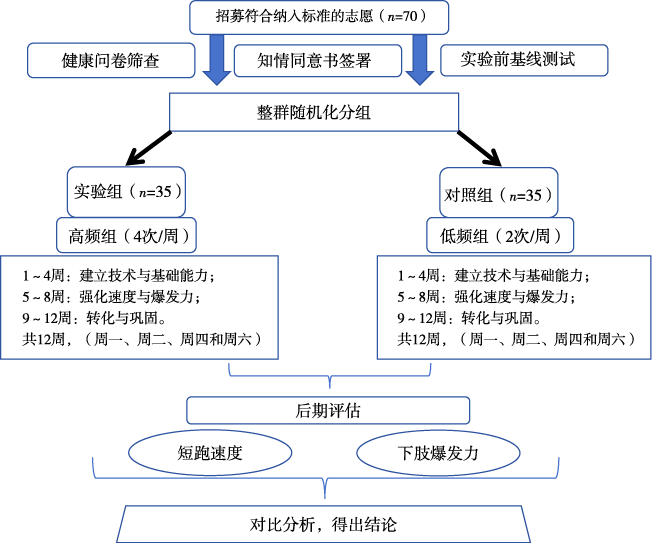
图 1 不同训练频率对高中生短跑速度与下肢爆发力影响的实验流程图
Figure 1 Experimental flowchart of the effects of different training frequencies on sprint speed and lower limb explosive power in high school students
表 1 不同训练频率短跑与下肢力量训练的12周干预方案
Table 1 12-week intervention program for sprinting and lower limb strength training at different training frequencies
| 阶段 | 周次 | 训练目标 | 训练内容(两组内容一致) | 强度与进阶控制 |
| 第一阶段 | 第1~4周 | 建立技术与基础能力 (加速动作、基础跳跃) | ①加速技术:A/Bskip、摆臂、墙推、10-20m加速; ②短跑:10-20m×6-10组; ③跳跃:低强度跳跃/跳绳、立定跳远技术练习、纵跳基础; ④基础力量:徒手深蹲、弓步、臀桥、提踵 | RPE4-6;以动作质量为先;每周小幅增加组数或距离;同一周强度不超过一次明显提高 |
| 第二阶段 | 第5~8周 | 强化速度与爆发力 (加速能力、水平/垂直爆发) | ①短跑:20-30m×6-10组; ②速度力量:阻力冲刺(轻阻)或上坡短冲;③跳跃:立定跳远/连续跳、纵跳/反应跳; ④力量:中等负荷深蹲/分腿蹲 | RPE5-7;逐步提高强度或专项比例;强调充分恢复(间歇2-3min);跳跃量按周递增但控制总次数 |
| 第三阶段 | 第9~12周 | 转化与巩固(专项速度表现+测试准备) | ①短跑:30-50m专项速度; ②速度耐力:40-60m少量; ③跳跃:立定跳远/纵跳高质量少量; ④降低非专项训练比重 | RPE6-8;总量逐步下降、质量上升;测试前一周减量(taper)避免疲劳影响 |
注:(1)RPE,主观用力等级(Rating of Perceived Exertion),采用0~10级量表评估训练强度,其中RPE4~6表示中低强度,5~7表示中等强度,6~8表示中高强度。(2)高频组与低频组在训练内容、训练周期及单次训练时长一致的前提下,仅在每周训练频率上存在差异。高频组每周训练4次(周一、周二、周四和周六),低频组每周训练2次(周二和周六)。两组训练安排均保证至少1天完全休息,并避免相邻高强度训练课连续进行。
2 结果与分析
本研究最终纳入60名参与高中田径专项教学的学生,其中实验组30人,对照组30人在实验干预开始前,对两组被试的短跑速度(30m、50m)与下肢爆发力(立定跳远、原地纵跳)指标进行基线测量,并进行组间比较。
2.1 不同训练频率对高中生短跑速度指标的影响
由表2数据可知,不同训练频率对高中生短跑速度指标具有显著影响。干预后,实验组在30m和50m短跑成绩上均较干预前出现明显改善,且其变化幅度显著高于对照组。具体而言,实验组30m短跑用时显著缩短,组间差异达到统计学显著水平(t=-8.16,p<0.001);50m短跑用时同样显著下降(t=-10.35,p<0.001),表明训练干预在不同距离的短跑项目中均产生了稳定而一致的促进效应。从效应量角度看,30m和50m短跑的
Hedges’g(Δ)分别为-2.08和-2.64,均达到大效应水平,提示实验组相较于对照组在短跑速度提升方面具有显著优势。由于短跑成绩以用时表示,效应量为负值反映的是用时缩短,即运动表现的实质性提高。总体而言,上述结果表明,较高或优化的训练频率能够显著提升高中生的短跑速度能力,其作用不仅具有统计学意义,而且具有较强的实践意义。
表 2 短跑速度指标干预前后变化及组间差异
Table 2 Changes in sprint speed indicators before and after intervention and differences between groups
| 指标(s) | 实验组前(M±SD) | 实验组后(M±SD) | 对照组前(M±SD) | 对照组后(M±SD) | t(Δ) | p(Δ) | g(Δ) |
| 30m | 4.50±0.19 | 4.36±0.19 | 4.54±0.19 | 4.51±0.19 | -8.16 | <0.001 | -2.08 |
| 50m | 7.57±0.27 | 7.36±0.28 | 7.62±0.25 | 7.58±0.25 | -10.35 | <0.001 | -2.64 |
注:效应量采用Hedges’g(Δ)表示,其中Δ为干预后减去干预前的变化量,g(Δ)为实验组与对照组变化量的标准化差异。效应量大小判定参考Cohen(1988)的经验标准,即g≈0.2为小效应,g≈0.5为中等效应,g≥0.8为大效应;Hedges’g的计算与校正方法参照赫奇斯和奥尔金(Hedges & Olkin,1985)[10]。对于时间类指标,负效应量表示用时缩短,即运动表现提高。
2.2 不同训练频率对高中生下肢爆发力指标的影响
由表3数据可知,不同训练频率对高中生下肢爆发力指标具有显著影响。干预后,实验组在立定跳远和原地纵跳摸高两项指标上的成绩均较干预前出现明显提升,且其变化幅度显著高于对照组。具体而言,实验组立定跳远成绩显著提高,组间差异达到统计学显著水平(t=9.28,p<0.001);原地纵跳摸高成绩同样显著增加(t=5.96,p<0.001),表明训练干预在水平与垂直两个方向的下肢爆发力指标上均产生了稳定且一致的促进效应。从效应量角度来看,立定跳远和原地纵跳摸高的Hedges’g(Δ)分别为2.36和1.52,均达到大效应及以上水平,提示实验组相较于对照组在下肢爆发力提升方面具有显著优势。由于上述指标均以数值增大表示运动表现改善,正向效应量反映的是实验组干预后爆发力水平的实质性提升。
表 3 下肢爆发力指标干预前后变化及组间差异
Table 3 Changes in lower limb explosive power indicators before and after intervention and differences between groups
| 指标(s) | 实验组前(M±SD) | 实验组后(M±SD) | 对照组前(M±SD) | 对照组后(M±SD) | t(Δ) | p(Δ) | g(Δ) |
| 立定跳远 | 225.37±9.00 | 232.90±9.20 | 224.43±9.15 | 226.00±9.30 | 9.28 | <0.001 | 2.36 |
| 原地纵跳 | 41.59±2.10 | 43.20±2.20 | 41.50±3.14 | 41.80±3.10 | 5.96 | <0.001 | 1.52 |
注:效应量采用Hedges’g(Δ)表示,其中Δ为干预后减去干预前的变化量;g(Δ)为实验组与对照组变化量的标准化差异。参考Cohen的经验判定标准:g≈0.2为小效应,g≈0.5为中等效应,g≥0.8为大效应。本研究中立定跳远和原地纵跳摸高均为“数值越大表示表现越好”的指标,正向效应量表示实验组干预后提升幅度大于对照组。
总体而言,上述结果表明,较高或优化的训练频率能够显著促进高中生下肢爆发力的发展,其干预效果不仅具有统计学意义,而且具有较强的实践意义。
3 讨论
本研究以不同训练频率干预为研究情境,在控制训练内容与教学周期一致的前提下,系统考察了其对高中生短跑速度与下肢爆发力等关键体能指标的影响。结果显示,实验组在干预后两项体能指标均出现显著改善,且整体提升幅度高于对照组,提示在学校体育教学与专项训练中,训练频率的合理安排不仅关系训练刺激的有效积累,也直接影响速度与爆发力的同步发展。相较于单纯增加训练内容,优化训练频率更有助于在既定教学条件下提升训练效率,为构建更具可操作性的训练实施方案提供了经验支持。
3.1 不同训练频率下高中生短跑速度变化特征的分析
本研究表明,在控制训练内容与周期一致的前提下,训练频率的差异对高中生短跑成绩产生了显著影响。与低频组相比,高频组在30 m与50 m两项测试中均呈现更大的用时缩短,且提升方向一致。这种跨距离的一致性反映出速度能力整体结构的改善,而非单一项目的偶然波动,提示训练频率优化可能同时促进了加速阶段与途中跑阶段的动作效率。在高中体育教学情境下,训练时段受课业安排与场地条件的限制较为明显,训练内容的调整空间往往有限。此时,训练频率的本质作用体现在对“刺激连续性”的把控上。高频组的优势在于,两次训练之间的间隔相对较短,使得每次训练都能在前期适应基础上进行叠加,从而维持神经肌肉系统对高速动作模式的“记忆”状态。罗斯(Ross)等认为适度提高训练频率可强化速度相关的神经肌肉适应[11],本研究则进一步显示,即使在课堂化、周期固定的教学框架内,这种适应依然可以被激发。鲁姆夫(Rumpf)等强调结构化、频率适宜的安排更利于成绩的持续改善[12],本研究中高频组在两项距离指标上的表现更为一致,符合“训练刺激节律稳定→适应得以累积”的逻辑。相比之下,低频组虽也呈现一定提升,但改善幅度较小,跨距离的一致性较弱。这提示频率不足可能导致刺激累积不充分——过长的间隔使得每次训练前神经系统的兴奋性回落过大,难以在“高质量输出”的层面上形成有效刺激,从而削弱了训练的边际收益。德勒克吕兹(Delecluse)认为频率适中的重复刺激有利于中枢神经系统对高速动作模式的适应[13],但这一效果的前提是刺激能够形成连续积累,而非断点式重复。此外,稳定的训练频率还有助于巩固起跑、加速跑及途中跑等关键技术环节。高频训练带来的反复练习,使学生在不同距离的短跑中能够保持较为一致的动作节奏与发力模式[14],将单纯的力量增益转化为专项速度表现。这一发现提示,在高中教学实践中,当训练内容难以大幅调整时,通过优化训练频率(如从每周2次调整为每周4次)来维持刺激的连续性,比单纯堆叠训练内容更具现实操作性。
3.2 不同训练频率下高中生下肢爆发力变化特征的分析
本研究结果表明,在教学内容与总周期保持一致的前提下,训练频率的差异对高中生下肢爆发力的提升幅度产生了显著影响。高频组在反映水平爆发力(立定跳远)与垂直爆发力(原地纵跳摸高)的两项测试中,其增值幅度均显著优于低频组。高频组在两类不同发力模式任务中表现出的同步提升,表明较高的训练频率能够对神经肌肉系统施加更为密集的有效刺激,从而为下肢爆发力的多维发展提供稳定条件。从神经肌肉适应的角度来看,爆发力的提升高度依赖于运动单位的快速募集能力与肌肉间协调效率。科米(Komi)等指出,合理安排训练刺激的频率与恢复周期,有助于促进神经肌肉系统对快速用力任务的适应[15]。本研究中高频组的优势,印证了这一机制:更为密集的训练节奏强化了神经驱动系统的可塑性变化,使运动单位的募集速度和同步化水平得到更充分的激发。马尔科维奇(Markovic)在综述中强调,青少年跳跃能力的提升不仅依赖训练内容本身,更与训练刺激的重复频率和累积效应密切相关[16]——低频组提升幅度相对有限,正是由于刺激间隔过长打断了这一累积过程。从作用机制层面深入分析,下肢爆发力的提升通常与肌腱—肌肉复合体的快速力发展能力以及多关节协同发力模式的优化密切相关。科姆里(Cormie)等指出,合理的训练频率有助于通过反复的高质量刺激,提高个体在短时间内产生较大力输出的能力[18]。本研究中高频组在立定跳远(水平发力)与纵跳(垂直发力)两项测试中的同步获益,正源于二者共享相同的神经肌肉基础——无论是水平还是垂直方向的爆发用力,均依赖于下肢三关节(髋、膝、踝)的快速伸展协同,而高频刺激恰好放大了这一基础动作模式的适应性重构。结合高中体育教学情境进行分析,采用相对优化的训练频率有助于在保证刺激连续性的同时,促进学生逐步形成较为稳定的下肢快速发力模式。相比之下,训练频率不足可能仅引发有限的短期变化,难以在立定跳远和纵跳等指标中形成持续而稳定的提升趋势。综上所述,高频训练通过更为密集的刺激分布,有效促进了高中生下肢爆发力的神经肌肉适应与动作模式巩固,在水平与垂直发力维度上均表现出更优的训练效果。这一发现表明,在课时安排允许的前提下,适度提高训练频率是提升下肢爆发力训练效益的有效策略。
3.3 研究不足
本研究仍存在一定局限。首先,干预周期相对有限,难以全面反映不同训练频率对短跑速度与下肢爆发力长期发展效果的影响。其次,本研究主要关注训练频率这一单一负荷要素,未系统考察其与训练强度、训练量及恢复方式之间的交互作用。再次,研究对象集中于特定高中生群体,样本同质性较高,研究结论的外推性仍有待在不同人群中进一步验证。最后,本研究主要基于体能与运动表现指标进行评价,未纳入神经肌肉或生理层面的客观指标,对训练频率作用机制的解释仍有一定局限。上述不足有待在后续研究中进一步完善。
3.4 未来展望
未来研究可在延长干预周期的基础上,进一步考察不同训练频率对高中生速度与下肢爆发力长期发展及保持效果的影响,以验证其持续性与阶段性特征。同时,有必要将训练频率与训练强度、训练量及恢复方式等负荷要素进行综合设计,探讨多要素交互作用下的最优训练组合。此外,后续研究可扩大研究对象范围,纳入不同性别、年龄阶段及训练背景人群,以提升研究结论的外推性。在评价手段方面,结合神经肌肉、生理或生物力学指标,有助于更深入揭示训练频率作用于速度与爆发力发展的内在机制。在实践层面,未来研究还可探索研究结果在学校体育教学与专项训练中的应用路径,为构建更加科学、高效的训练实施模式提供依据。
4 结论
本研究通过12周干预实验,系统考察了不同训练频率对高中生短跑速度与下肢爆发力的影响。在控制训练内容与教学周期一致的前提下,研究发现:(1)在短跑速度方面,高频组30 m和50 m成绩的提升幅度均显著大于低频组,且两项距离改善方向一致,表明每周4次的高频训练更有利于促进短跑速度的整体发展。(2)在下肢爆发力方面,高频组立定跳远和原地纵跳摸高的提升幅度同样显著优于低频组,在水平与垂直两种发力模式上表现出同步改善,提示高频训练能够为下肢爆发力的多维发展提供更稳定的促进条件。上述结果表明,训练频率是训练负荷调控的重要变量,对高中生速度与爆发力的发展具有显著调节作用。在训练内容与周期相同的前提下,每周4次的高频训练比每周2次的低频训练更能有效提升短跑速度与下肢爆发力表现。因此,在课时安排允许时,建议优先采用每周4次的训练频率,通过优化训练节律而非单纯增加训练量,实现训练效益的最大化。
参考文献
[1] 季浏.新版义教课标:构建以核心素养为纲的体育与健康课程体系[J].上海体育学院学报,2022,46(6):1-9.
[2] 钟秉枢.问题与展望:体教融合促进青少年健康发展[J].上海体育学院学报,2020,44(10):5-12.
[3] Cormie P,McGuigan M R,Newton R U.Developing maximal neuromuscular power:part 1—biological basis of maximal power production[J].Sports Medicine,2011,41(1):17-38.
[4] Kraemer W J,Ratamess N A.Fundamentals of resistance training:progression and exercise prescription[J].Medicine & Science in Sports & Exercise,2004,36(4):674-688.
[5] Suchomel T J,Nimphius S,Stone M H.The importance of muscular strength in athletic performance[J].Sports Medicine,2016,46(10):1419-1449.
[6] Behm D G,Faigenbaum A D,Falk B,et al.Canadian Society for Exercise Physiology position paper:resistance training in children and adolescents[J].Applied Physiology,Nutrition,and Metabolism,2008,33(3):547-561.
[7] Qipo O,Gajauskaitė G,Vints W A J,et al.Dose-response relationship of resistance training and the effects on circulating biomarkers of inflammation or neuroplasticity in older adults:a systematic review and meta-analysis[J].Ageing Research Reviews,2026,113:102917.
[8] Rumpf M C,Lockie R G,Cronin J B,et al.Effect of different sprint training methods on sprint performance over various distances:a brief review[J].Journal of Strength and Conditioning Research,2016,30(6):1767-1785.
[9] Delecluse C.Influence of strength training on sprint running performance[J].Sports Medicine,1997,24(3):147-156.
[10] Hedges L V,Olkin I.Statistical methods for meta-analysis[M].New York:Academic Press,1985.
[11] Ross A,Leveritt M.Long-term metabolic and skeletal muscle adaptations to short-sprint training:implications for sprint training and tapering[J].Sports Medicine,2001,31(15):1063-1082.
[12] Rumpf M C,Lockie R G,Cronin J B,et al.Effect of different sprint training methods on sprint performance over various distances:a brief review[J].Journal of Strength and Conditioning Research,2016,30(6):1767-1785.
[13] Delecluse C.Influence of strength training on sprint running performance[J].Sports Medicine,1997,24(3):147-156.
[14] Bezodis I N,Kerwin D G,Salo A I T.Lower-limb mechanics during the support phase of maximum-velocity sprint running[J].Medicine & Science in Sports & Exercise,2008,40(4):707-715.
[15] Komi P V,Bosco C.Utilization of stored elastic energy in leg extensor muscles by men and women[J].Medicine and Science in Sports,1978,10(4):261-265.
[16] Markovic G.Does plyometric training improve vertical jump height? A meta-analytical review[J].British Journal of Sports Medicine,2007,41(6):349-355.
[17] Meylan C,McMaster T,Cronin J,et al.Single-leg lateral,horizontal,and vertical jump assessment:reliability,interrelationships,and ability to predict sprint and change-of-direction performance[J].Journal of Strength and Conditioning Research,2009,23(4):1140-1147.
[18] Cormie P,McGuigan M R,Newton R U.Developing maximal neuromuscular power:part 2 - training considerations for improving maximal power production[J].Sports Medicine,2011,41(2):125-146.
[19] Suchomel T J,Nimphius S,Stone M H.The importance of muscular strength in athletic performance[J].Sports Medicine,2016,46(10):1419-1449.