
 Current Views: 361562
 Current Downloads: 210880
Study on China Physical Science
ISSN Print:2707-1936
ISSN Online:2707-1944
Contact Editorial Office



Subscribe to the latest published information from SCISCAN
四姑娘山山地旅游移民群体地方认同感建构的质性研究
A Qualitative Study on the Construction of Place Identity of Mount Siguniang Mountain Tourism Immigrants


-
Information:
1. 成都大学体育学院,成都;
2. 成都体育学院运动休闲学院,成都;
3. 四川旅游学院旅游文化产业学院,成都
-
Keywords:
Mountain tourism; Immigration; Place identity; Mount Siguniang山地旅游; 移民; 地方认同感; 四姑娘山
- Abstract: The rapid development of mountain tourism has spawned a group of mountain tourism migrants, whose relationship with the place has gradually shifted from instrumental survival to emotional identity. Focusing on Mount Siguniang mountain tourism destinations, this study constructs a dynamic construction model of place identity from “Making a living to living” by qualitative grounded text analysis based on first-hand textual data obtained through field investigation. It is found that the formation of their sense of place identity goes through three stages: the instrumental “Livelihood Period”, with economic foothold as the core, physical and mental alienation from the place; the practical “Embedding period”, through social interaction, cultural participation and strategic management, multidimensional integration can be achieved, and the emotional “Dwelling period” can sublimate the place to the spiritual home of Huawei in the process of meaning-giving, identity reconstruction and long-term planning. The discussion further clarifies that the process is the result of a multidimensional combination of economic embeddedness, social capital, and cultural adaptation; at the same time, through the construction of physical, social, and digital “Anchors”, the process of cultural adaptation can be transformed into a multi-dimensional process, maintaining stability in continuous mobility presents a new feature of “Mutual construction and symbiosis of mobility and residence”. The constructed storyline model map reveals the dynamics and complexity of place identity in the context of mobility, and deepens the understanding of the evolution process of man-land relationship, it provides a certain sense of theoretical reference and practical enlightenment for social integration and immigration governance in ethnic areas. 山地旅游的快速发展催生了以经济迁移为主的山地旅游移民群体,其与地方的关系逐步从工具性生存转向情感性认同。本研究聚焦于四姑娘山山地旅游地,通过田野调查获取一手文本资料,以质性扎根文本分析,构建了“从谋生到栖居”的地方认同感动态建构模型。研究发现,其地方认同感的形成经历三个阶段:工具性“谋生期”,以经济立足为核心,身心与地方疏离;实践性“嵌入期”,通过社会互动、文化参与与策略性经营,实现多维融入;情感性“栖居期”,在意义赋予、身份重构与长期规划中,将地方升华为精神家园。讨论进一步阐明,该过程是经济嵌入、社会资本与文化调适多维联合的结果;同时,通过构建物理、社会与数字“锚点”,在持续的流动性中维系稳定性,呈现出“流动与栖居的互构共生”的新特征。所构建的故事线模型图,揭示了地方认同感在流动性背景下的动态性与复杂性,深化了对人地关系演进过程的理解,为民族地区社会融合与移民治理提供了一定意义上的理论参考与实践启示。
- DOI: 10.35534/scps.0802025
- Cite: 贾茨宝,余志豪,王冰,等.四姑娘山山地旅游移民群体地方认同感建构的质性研究[J].中国体育研究,2026,8(2):172-181.
1 引言
我国山地旅游蓬勃发展,以四姑娘山镇为代表的典型山地旅游目的地,随着农业用地减少,全镇居民的生产和就业方式已发生转变,正经历从传统农牧业向现代旅游服务业的结构性转型。目前,四姑娘山镇已成为集旅游、商贸为一体的四川省重点旅游集镇[1]。旅游业的兴起不仅重塑了地方产业形态,也催生了以劳工移民为代表的新型流动人口[2]。该群体多以“谋生”为主要目的迁入旅游地,以此寻求旅游经济背后蕴含的商业机遇与就业机会。伴随时间推移和在地实践的推动,其迁移动机逐步超越单纯的经济动机,逐渐形成对山地旅游地的归属感与认同感。地方认同是人对某个地方作为社会角色自我感知的一部分,是地方回忆与文化认同的产物,是人对地方的情感认可,能够给予人安全感与归属感[3]。它既影响个体的定居意愿与生活品质,也关乎山地旅游地的社会变迁与人地关系。现有研究多侧重于劳工移民的迁移动因[4]、地方依恋与幸福感[5]、地方融入[6]等,但对山地旅游移民群体在山地特定情景下逐步建构地方认同感的动态形成过程,缺乏系统性研究。尤其在地理环境特殊、文化背景多元的四姑娘山山地旅游地,其地方认同感的建构路径更具复杂性与情境性。为此,本研究以四姑娘山山地旅游地为案例地,通过田野调查实践,采用质性研究方法,梳理提炼原始文本资料,进而构建具有动态性、阶段式的山地旅游移民群体地方认同理论模型,旨在探究地方认同建构的内在演进过程。
2 文献综述
2.1 山地旅游地移民
从人口流动和社会现象的视角,移民是指一种人或一类人群,二是指一种行为或社会现象,前者是指参与迁移活动的人或人群,后者是较大数量的人口从一个地区向另一个地区的迁移,从而定居地发生变化的一种行动或社会现象[7]。国外对移民相关研究起步较早,研究对象多数为劳工移民,且关注重点是旅游移民迁移空间及时间、迁移动因、迁移的人类学特征等方面[8]。而国内学者杨钊等主要研究了西方的旅游劳工移民和旅游退休移民,预见旅游移民在我国逐渐成为重要的社会、经济与文化现象[9]。Lundmark的研究关注瑞典山地旅游地的季节性旅游就业,揭示了劳工移民的流动性和对当地经济的双重影响[10]。同样,Kollmair等针对喜马拉雅山区的研究指出,劳工移民是山区生计的重要策略,但需要政策支持以最大化其减贫潜力并减少社会文化冲击[11]。Piso分析乡村旅游中的移民劳工问题,强调全球化背景下劳动力流动的连续性和变化,以及移民对乡村旅游劳动力市场的塑造作用[12]。值得注意的是,经济政策是影响山地旅游移民群体迁移的重要因素,Olimova等聚焦于安第斯山区经济重构问题,认为农业衰退和旅游业兴起促使农村劳动力向旅游城镇迁移,但移民多集中于低薪服务岗位,加剧了城乡之间不平等[13]。综上所述,山地旅游移民群体是一个多维度现象,受经济、环境、文化及政策因素交织影响,侧重于季节性迁移与区域发展平衡和关注移民的生计策略与不平等问题。
2.2 移民地方认同感建构
山地旅游移民的地方认同感建构是复杂的社会心理过程。在经济融入与自我效能感层面,Liu等[14]以四川地区四姑娘山镇为调研地展开研究,认为藏族登山向导因旅游发展获得稳定收入,提升了自我效能感,佐证了移民可通过旅游就业获得经济收入,从而增强对地方的归属感和认同感。在社会互动层面,马少吟等认为生活方式型移民更倾向于将个人价值观与经营活动结合,形成基于共同兴趣的“交往圈子”,从而强化对旅游地的地方认同[15],袁超等认为与当地居民交往频繁的群体表现出更高的地方认同水平[16]。山地自然环境的独特性是移民情感依附的重要基础。方德敏等研究发现,企业主移民对自然环境的依赖和审美体验直接促进地方依恋和地方认同[17]。随着移民的定居时间的积累,身份转变易从客变主,李鹏等认为移民通过组建“新温汤人”社群,主动重构地方身份,实现从“外来者”到“新本地人”的转变[18]。从人文文化视角来看,ZHANG Z等证实侨乡文化符号能够强化侨胞与祖籍地的情感联结,实现旅游发展与地方认同的双向赋
能[19]。国外相关研究指出,移民可通过返乡旅行重构文化身份,满足情感归属需求,也促进跨国经济与文化交换[20],也可能引发认同冲突,例如土耳其移民后代在“根旅游”中面临文化隔阂[21]。同时,移民对旅游地的情感依附与本地居民的社会关系存在差异,但共同的地方依恋能提升社区的韧性[22]。因此,山地旅游移民群体的地方认同感是经济机遇、社会互动、环境体验和时间积累共同作用的结果。
2.3 旅游地与社会空间互动
旅游地是游客选择访问并花费时间的地理区域,该区域提供旅游吸引物、住宿和其他设施,并产生经济、社会和环境的影响,且强调旅游地可以是国家、地区、城市或岛屿等[23]。Iunius R F等从综合系统的角度认为旅游地是一个被游客视为独特实体的地理区域,具有旅游营销和规划的政治与立法框架。这突出了其作为复杂系统的特性[24]。余中元等从多角度综合性的认为旅游地是能为旅游者提供游览、观赏、度假、娱乐等活动的土地或区域,其核心功能包括吸引物、接待设施和服务体系[25]。从经济视角来看,空间不仅是物理容器,更是社会关系的产物,社会互动发生在抽象的社会空间中,其维度包括物理地理、种族、性别或教育等,这些维度可能重叠并影响互动模式[26]。Liu S等则认为社会空间互动强调物理空间与社会行为之间的双向影响关系,其核心观点是:空间不仅是社会互动的容器,更是塑造互动模式、强度和质量的关键因素[27],从移民的视角下来看是指移民群体与目的地社区通过经济交往、文化融合、权力博弈等行为,共同塑造动态空间格局的过程[28],主要涵盖了物质空间互动;社会关系网络;符号空间生
产[29-31]。综上所述,旅游地不仅是一个提供旅游功能的地理区域,更是一个由多方利益主体共同塑造的复杂社会空间系统,移民与目的地社区通过经济交往、文化融合与权力博弈共同参与空间的生产与再生产。
3 研究设计
3.1 案例地介绍
四姑娘山位于四川省阿坝藏族羌族自治州小金县,随着旅游业的快速发展,逐渐从传统农牧业经济转向以旅游服务为主导的产业结构,形成了以餐饮、住宿、导游服务、特产销售等为主的旅游就业体系。这一转型吸引了大量外来务工人员迁入,既有来自周边省市的短期务工者,也有从大城市迁入寻求生活方式转变的长期定居者。四姑娘山镇是一个具有鲜明民族文化特色的地区,当地藏族文化、节庆活动与移民文化交织,形成了复杂的社会文化空间。移民在此地的生计策略、社会互动、文化适应与地方认同建构过程,具有典型性与研究价值。
3.2 研究方法
扎根理论由Glaser和Strauss于1967年提出,旨在纠正定性研究依附于定量研究的认知偏差,突破实证主义研究局限,是一种系统的归纳性质性研究方法,旨在通过对原始数据的持续比较、编码与理论抽样,自下而上从原始资料中提炼概念与理论,区别于先设定假设再去验证[32]。其核心目标是构建能够解释社会过程或行为模式的抽象理论框架,而非预测性模型[33]。因此,本研究采用质性研究范式,以扎根理论作为核心研究方法,强调从原始资料出发,通过系统性的编码与分析,自下而上地构建理论,适用于探索性较强、尚未形成成熟理论框架的研究主题。
3.3 数据收集
本研究遵循理论抽样原则选取访谈对象,对当地从业群体开展深度访谈,问题示例:为什么选择在四姑娘山镇从业?现在生意怎么样?有没有幸福感与归属感等。调研团队于2025年9月4日—2025年9月8日到四姑娘山镇进行实地访谈,如表1所示,访谈包括餐饮住宿业、事业单位等其他从业者共计24人次,访谈时间绝大部分长于40分钟。在征得访谈对象许可后进行录音,访谈结束后将音频转换为文本。
表 1 受访者基本信息(部分)
Table1 Basic information of interviewees (part)
| 姓名 | 性别 | 年龄 | 职业 | 原住地 | 访谈时间 |
| 闵** | 男 | 46岁 | 餐饮住宿业老板 | 四川营山 | 120分钟 |
| 周** | 女 | 57岁 | 餐饮住宿合伙人 | 四川宜宾 | 70分钟 |
| 桑*** | 男 | 25岁 | 餐饮老板 | 四川小金县 | 70分钟 |
| 侯** | 男 | 58岁 | 餐饮住宿业老板 | 四川南充 | 70分钟 |
| 何** | 女 | 58岁 | 服务员 | 四川阆中 | 42分钟 |
| 杜** | 男 | 47岁 | 餐饮住宿业老板 | 云南贵州 | 80分钟 |
| 杨** | 男 | 40岁 | 酒吧/住宿负责人 | 新疆-四川广汉 | 49分钟 |
| 杨** | 男 | 51岁 | 户外运动中心主任 | 小金县新格乡 | 120分钟 |
| 周** | 男 | 45岁 | 海南住宿业老板 | 海南 | 60分钟 |
| ………… |
4 研究结果
4.1 词云图统计
词云图词频统计“生意”一词凸显,且符合研究主题山地旅游移民群体的范畴,贯穿整个文本数据集。Nvivo15软件为定性研究者提供了一种强有力的工具,以支持对大量文本数据的初步探索和概念化,在“编码与分析”的核心环节为本研究提供了强大系统性支持,使本文在庞杂的质性数据中,清晰梳理出山地旅游移民群体在地方认同感的建构过程。
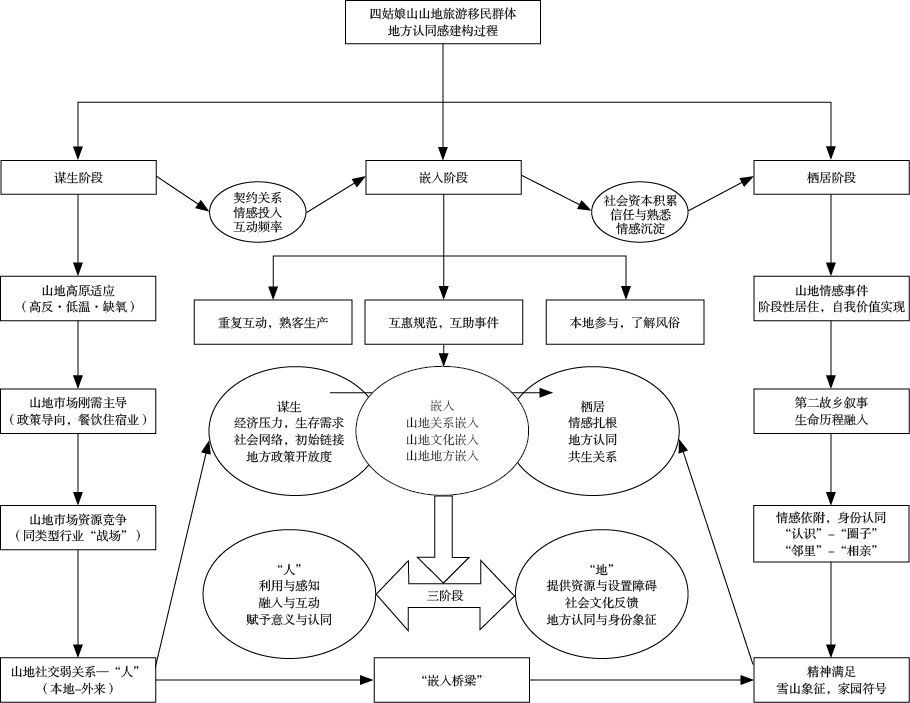
图 1 高频词云图统计情况
Figure 1 The statistics of high-frequency words
4.2 开放式编码
开放式编码承担着对原始数据进行一级编码的核心任务,具体表现为概念化与标签化处理。在对原始访谈资料深度阅读过程中,提炼出若干初始概念,进而梳理这些概念之间的逻辑关联,在此基础上,对初始概念进行归类整合,最终构建出多个更具概括性的范
畴[34]。本研究经过多次编码、合并和整理,并且契合山地旅游地特点,提取出了59个初始概念。根据初始概念之间的逻辑联系,最终确定13个初始范畴,具体如
表2所示。
表 2 开放式编码范畴化
Table 2 Categorization of open coding
| 初始范畴 | 初始概念 | 原始资料代表性语句举例 |
| A1. 山地旅游地迁移动机与类型 | 山地旅游地景观吸引迁入 | 同一个地点景点,我都可能要去四五次 |
| 山地旅游地商业机会驱动 | 为了挣钱,这儿海拔高,工资高一点,你到县城他就工资低,所以去县城最多就是3000多 | |
| 亲友网络带动 | 在这里做餐饮业是因为我妹妹在这里做生意,我和阿姨就跟到一起过来了 | |
| 山地生活方式改变 | 想离开城市,走进田野,其实有时候在城里边待嫌久了,有点厌倦 | |
| A2. 山地环境身体感知与适应 | 山地高反不适 | 之前才上来的时候,晚上睡不着,呼吸急促,有缺氧的现象 |
| 山地睡眠障碍 | 晚上睡觉不那么顺畅 | |
| 山地环境身体机能变化 | 高反现象没有。一直在这上面生活,习惯了 | |
| 山地适应性习惯 | 你们一定要保暖,不要冻到了,高反就有点严重 | |
| 山地环境身体标记 | 脸上都有血管出来了 | |
| A3. 山地旅游地生计依赖与策略 | 山地旅游地经济收入依赖 | 我回来的契机,因为觉得旅游发展有前景,其次觉得本地人就应该搞一些东西,才选择回来的 |
| 山地旅游地经营成本压力 | 房租,在四姑娘山5A级景区,一年都是2万8 | |
| 山地旅游地市场竞争感知 | 竞争大 | |
| 山地旅游地差异化经营 | 我们这个店只做中餐和晚餐,因为对面是吃早餐 | |
| 山地旅游地季节性策略 | 七月、八月旺季人多的时候就分担一点 | |
| A4. 山地旅游地社会互动与关系 | 山地旅游地本地-外地和谐 | 都互相理解,互相尊重,都是自愿 |
| 山地旅游地本地-外地冲突 | 如果我想发展更好的话,能和他们的联系就越少越好,关系越复杂,越难处理 | |
| 山地旅游地外地人内部网络 | 我们是一个团队,都是朋友 | |
| 山地旅游地关系维持策略 | 假如邻居请了我呢,我就去,这也是维持关系的一种方式 | |
| 山地旅游地社会隔离 | 我做我的,他们做他们的,这样就少了很多不必要的矛盾 | |
| A5. 山地旅游地地方情感与审美体验 | 山地景观美感体验 | 这里环境还可以,挺安静的 |
| 山地旅游地积极情感依附 | 看到蓝天白云,心情会变好,至少在这一段旅途中有所改变 | |
| 山地旅游地情感疏离与厌恶 | 不是好喜欢,因为转来转去都是山 | |
| 山地旅游地情感矛盾 | 这个地方你说我喜欢,我又不喜欢这个地方 | |
| 山地旅游地地方宁静感 | 这个位置非常安静,青山绿水 | |
| A6. 山地旅游地意义与叙事 | 山地旅游地地方品牌认知 | 现在地质公园,做的是中国圣山,肯定和阿尔卑斯山看点不一样 |
| 山地旅游地个人意义赋予 | 很多独特的想法都没实现,但客人选择了我,说实话有点幸运 | |
| 山地旅游地风险与负面叙事 | 四姑娘山的大峰、二峰的线路都很成熟,只要你自己不做安全须知之外的事 | |
| 山地旅游地地方比较叙事 | 海拔高,不像屋里那么热 | |
| 山地旅游地第二故乡叙事 | 可能现在就成了大家生活的第二个故乡 | |
| A7. 山地旅游地文化参与与习俗 | 山地旅游地节庆参与 | 实在是太忙了,抽不出时间。自己也想去参加 |
| 山地旅游地婚俗了解 | 酒席大多数情况主要是办三天 | |
| 山地旅游地文化隔阂 | 没有去过,因为晚上吃饭的时候人多,走不开 | |
| 山地旅游地信仰与仪式 | 藏族的信仰它不是屈于个人,他是为众生为天下所有人,包括去转山也好,跪拜也好,都是祈祷众生 | |
| A8. 山地旅游地区域资源 | 山地旅游地资源排他性占有 | 只能这个村上的人才能牵马 |
| 山地旅游地规则制定与服从 | 几个管控的就三条沟,其他地方也没怎么管控,但是最好是不要去 | |
| 山地旅游地文化话语权 | 本地的风俗特色 | |
| 山地旅游地合法性建构 | 湖广填四川,也不是小金县的人 | |
| A9. 山地旅游地流动性与锚点 | 山地旅游地循环流动实践 | 在四姑娘山一般待半个月就回老家一趟。 有事就回去,没事情的话就去其他地方溜达 |
| 山地旅游地物理空间锚点 | 这个店面是租的 | |
| A9. 山地旅游地流动性与锚点 | 山地旅游地社会关系锚点 | 主要是过来帮忙,旺季人多的时候就分担一点,加之男朋友也在这边干餐饮工作,我就过来了 |
| 山地旅游地数字技术锚点 | 这个老板的兄弟叫我们帮做运营,其实是很累的,但是关系好,看能不能做成 | |
| A10. 山地旅游地生命周期与规划 | 山地旅游地家庭分离与责任 | 两个女儿的教育我是全力支持,最后也考到成都去读书了,对两个女儿的照顾还是有点缺失 |
| 山地旅游地代际支持与期望 | 两个娃娃喊我不做种植了,把房子也买了,跟着他们,不准我做这些 | |
| 山地旅游地养老规划 | 再过两年就往外面去,春天时候我就回来 | |
| 山地旅游地阶段性居住预期 | 暂时计划是长期在这待着 | |
| A11.山地旅游地地方归属与自我实现 | 山地旅游地归属感 | 我觉得在家有归属感。而且离家更近 |
| 山地旅游地自我价值实现 | 哪怕不成功,你有机会 | |
| 山地旅游地城市逃离 | 没有什么看上这个位置的说法,就是来玩儿 | |
| 山地旅游地理想生活追求 | 当你能去做一些具体决定,也没必要干涉他们,专心干自己的事就好了 | |
| 山地旅游地精神满足 | 我怕在成都变掉,回来看看山看看水 | |
| A12.山地旅游地变化感知与应对 | 山地旅游地历史发展感知 | 没人愿意来,因为运气恰恰开发四姑娘山 |
| 对地方发展的消费降级感知 | 现在就是越便宜他也越想便宜……他们也不算一下老板得成本 | |
| 山地旅游地同质化经营的批判 | 我们这的人不会去多想,他们只会想我弄的时尚一点,弄的潮流一点,游客就会来消费 | |
| 短视差异化经营策略 | 加盟一家或者是像汉族开一家店,你的成本是游客是能看到 | |
| A13.山地旅游地政策与市场感知 | 山地旅游地高铁预期 | 通车了,流量肯定会变大,后续很多的基础设施要建设 |
| 山地旅游地租金与合同 | 房子的老板开的民宿,自己家房子,本地搬迁过来的,后来出租一年几十万 | |
| 山地旅游地封山与安全事故 | 要有一个长时间的准备过程。不能说来了就爬,就算有向导,首先也要看身体能不能适应 | |
| 山地旅游地疫情冲击 | 疫情那两年门一锁就走了,直接给房东打电话,不开了 | |
| 山地旅游地政府监管与举报 | 因为我开店也是比较波折,从地摊然后又租铺面,之后又被人举报,有各种原因 |
4.3 主轴编码
主轴编码的主要任务是发现和建立概念类属之间的各种联系,以表现资料中各个部分之间的有机关联,这些联系可以是因果关系、语义关系和相似关系等[35]。本研究基于对文本资料深入分析并进行开放式编码形成13个初始范畴,进而将其整合为6个主范畴。同时,通过分析主范畴之间的逻辑关系,揭示山地旅游移民群体地方认同感的形成过程的关键因素及其理论逻辑。主轴编码的具体结果如表3所示。
表 3 主轴编码实例表
Table3 Example of spindle coding
| 主范畴 | 副范畴(初始范畴) | 核心内涵 |
| 1.山地旅游地迁移驱动与在地适应 | A1.山地旅游地迁移动机与类型 | 因旅游吸引、商业机会、亲友网络或生活方式改变等因素迁入旅游地 |
| A2.山地环境身体感知与适应 | 面临高反、睡眠障碍等生理挑战,通过适应性习惯逐步实现身体适应 | |
| 2.山地旅游地经济嵌入与市场响应 | A3.山地旅游地生计依赖与策略 | 依赖旅游业收入,面临成本压力与市场竞争,通过差异化经营和季节性策略维持生计 |
| A13.山地旅游地政策与市场感知 | 高铁预期、租金政策、疫情冲击、政府监管等外部因素影响经济决策与长期规划 | |
| 3.山地旅游地社会资本与文化调适 | A4.山地旅游地社会互动与关系 | 与本地居民之间既有和谐互动,也存在冲突 |
| A7.山地旅游地文化参与与习俗 | 参与节庆、了解婚俗、接触信仰等方式融入地方文化,但也面临文化隔阂 | |
| A8.山地旅游地区域资源 | 资源排他性、规则服从、文化话语权与合法性建构影响在地方社会结构中的位置 | |
| 4.山地旅游地地方依恋与意义生产 | A5.山地旅游地地方情感与审美 | 对地方自然环境的审美体验引发积极情感依附、情感矛盾或疏离,形成情感基础 |
| A6.山地旅游地地方意义与叙事 | 通过个人叙事、地方品牌认知与风险叙事,赋予地方以个人化、情感化的意义 | |
| A11.山地旅游地地方归属与自我实现 | 在地方中找到归属感,实现自我价值,追求理想生活与精神满足,完成从“谋生”到“栖居”的升华 | |
| 5.山地旅游地流动实践与扎根机制 | A9.山地旅游地流动性与锚点 | 通过循环流动、物理空间锚点、社会关系锚点和数字技术锚点维持流动中的稳定性 |
| A10.山地旅游地生命周期与规划 | 家庭责任、代际支持、养老规划与阶段性居住预期影响长期定居意愿与认同建构 | |
| 6.山地旅游地地方性响应与策略调适 | A12.山地旅游地变化感知与应对 | 对地方发展历史、消费降级、经营同质化等现象具有批判性 |
4.4 选择性编码
选择性编码是扎根理论编码的最终环节,核心是整合各类概念,提炼出更具概括能力、统领性的核心范畴,以“故事线”的形式叙述行为现象、梳理脉络框架,进而建构理论模型[36]。山地旅游地移民群体最初因旅游吸引、商业机会、亲友网络等迁移驱动因素迁入四姑娘山,进入以经济立足和身体适应为主的“谋生”阶段。在此阶段,移民与地方的关系是工具性的,表现为经济交换与功能性合作,身心仍处于疏离状态。随着时间推移,通过经济嵌入与文化调适等,逐步进入“嵌入”阶段,开始参与地方社会互动,接触本地文化习俗,构建社会网络。在此过程中,与地方的关系发展为实践性的互动与互惠。最终,部分移民在意义生产、流动实践与地方性响应等的共同作用下,进入“栖居”阶段。
表 4 范畴关系及其本质关联示例表
Table 4 Examples of categorical relations and their essential relations
| 发展阶段 | 阶段核心特征 | 关系内涵 | 与地方的关系 |
| 阶段一: 工具性 “谋生”期 | 经济立足 身心疏离 | 以经济交换和功能性合作为基础 | 疏离的、暂时的契约关系 |
| 阶段二: 实践性 “嵌入”期 | 社会融入 地方熟悉 | 通过日常互动和共同实践得以深化 | 互惠的、生成的互动关系 |
| 阶段三:情感性 “栖居”期 | 情感扎根 精神家园 | 充满了情感寄托与身份认同 | 依恋的、共生的生命关系 |

图 2 四姑娘山山地旅游移民群体地方认同感建构过程的扎根理论模型图
Figure 2 The grounded theory model of the process of place identity construction of Mount Siguniang mountain tourism migrants
4.5 理论饱和度检验
为保证理论模型的信度和效度,将提前预留的1/3的原始资料进行理论饱和度检验。编码结果显示,所选取调研获取的文本资料中均未产生新的重要概念和范畴,表明理论模型已达到饱和。
5 模型阐释
5.1 阶段一:工具性“谋生”期——经济立足与身心疏离
该阶段山地旅游移民群体的决策与行动主要由经济驱动,其迁移动机源于对山地旅游地所呈现的商业机会、景观吸引等外部因素的响应,核心目标是实现经济上的立足。此时,与四姑娘山的关系呈现出鲜明的工具性特征,地方被视作一个可实现经济收益的场所,其价值在于其使用功能。常年在四姑娘山生计的移民群体面临着山地环境身体感知与适应的初始挑战,其身心状态与地方之间存在一种疏离感。在社会互动中,关系多表现为浅层的功能性往来或竞争关系。
5.2 阶段二:实践性“嵌入”期——多维互动与地方融入
随着时间推移与日常实践的深入,逐渐超越单纯的经济动机,进入实践性“嵌入”阶段。在此过程中,生计策略呈现出显著的在地化转向,通过精细化调整经营方式主动应对市场竞争与政策环境变化,实现了从生存型向策略型的经济嵌入。同时,通过持续的社会互动构建起地方性关系网络,与本地居民形成互助共融的社群联结,并通过参与文化习俗、理解地方规则,逐步实现社会资本积累与文化适应。在此基础上,对地方的认知从陌生走向熟悉,与地方的关系也从单向索取发展为双向互惠的实践联结,使得地方成为一个社会关系与文化意义被共同再生产的社会空间。
5.3 阶段三:情感性“栖居”期——意义赋予与身份重构
该阶段,对自然环境的深刻情感体验与个人化意义赋予,将自身的生命历程与地方价值紧密联结,使地方从单纯的物理空间升华为承载情感与记忆的符号性存在。进而其流动实践趋于稳定,形成了以物理空间、社会关系和数字技术为依托的多元“锚点”,并将养老规划、代际支持等长期考量纳入生命周期框架,展现出从“流动性”向“稳定性”的明确转变。最终,整个过程汇聚升华为核心的地方归属感与自我实现,强化对四姑娘山的地方认同感,在人地关系上建立起一种依恋共生、不可分割的生命关系。
6 讨论与结论
6.1 讨论
6.1.1 地方认同感建构中的动态过程
本研究系统梳理人地关系演化逻辑,构建山地旅游移民群体从“谋生”到“栖居”的地方认同感三阶段演进模型。该研究结论与汪丽等关于本地居民与移民地方认同分异观点高度契合,突破了传统研究将地方认同视为静态心理特质的局限,揭示了其在时间维度上的动态演化规律[37]。研究发现,该地方认同感动态建构经历了从工具性利用到实践性互动,最终发展为情感性共鸣的渐进式转变过程,在“谋生期”,该移民群体与地方的关系主要表现为工具性特征,印证了Wang J等基于乡村旅游背景下,本地居民回流返乡,以获取经济导向的“谋生”阶段,通过参与旅游业发展提高了家庭收入的观
点[38],深化了对旅游移民地方认同形成过程的理解,为山地旅游移民相关研究提供了新的视角。“嵌入期”作为承上启下的关键阶段的重要作用。在这一阶段,通过持续的地方实践和社会互动,实现了从经济理性到社会理性的认知跃迁。同时,文本资料:“为了挣钱,这儿海拔高,工资高一点,你到县城他就工资低,所以去县城最多就是3000多。真有感情有情感,跟着这些人相处,非常喜欢我。现在过来之后,一下子回到了田园生活的感觉。”印证了转变过程地方认同感建构的复杂性和渐进性特征。
6.1.2 地方认同感建构中的多维交织
在经济维度,其生计策略经历了从生存导向到发展导向的显著转变。文本资料:“是属于偶然的机会。在这里做餐饮业是因为我妹妹在这里做生意,我和阿姨就跟到一起过来了。”这种经济嵌入的深化为地方认同提供了持续的物质保障,验证了Vargas-Sanchez A等关于经济因素会影响个人对居住地的认同感这一观点[39]。在社会维度,通过构建地方性关系网络,实现了社会资本的有效积累。研究发现,山地旅游移民群体与本地居民的互动质量直接影响其地方认同的强度,且与Ujang N关于指出人-地互动是形成地方依恋、认同和归属感的主要驱动因素相一致[40],同时进一步揭示了社会关系网络在移民地方认同建构中的中介作用。在文化维度,对四姑娘山当地文化的适应和参与呈现出明显的阶段性特征。初期主要表现为对节庆活动的观察和了解,后期则发展为主动参与,融入其中。文本资料:“藏族的信仰它不是屈于个人,他是为众生为天下所有人,包括去转山也好,每天去跪拜也好,都是祈祷众生。”契合了藏汉文化调适这一方面,促进了山地旅游移民群体对本地文化的尊重。
6.1.3 地方认同感建构中的流动与栖居实践
在现代流动性背景下,山地旅游地移民的地方认同呈现出“流动中的栖居”新特征,移民通过构建多元“锚点”系统,在流动性与稳定性之间寻求动态平衡。物理空间的持续投资、社会关系的地方化建构、数字技术的空间联结,共同构成了一个稳定的认同基础。文本资料:“我在四姑娘山一般待半个月就回老家一趟。有事就回去,没事情的话就去其他地方溜达。”反映了当代山地旅游移民群体地方认同的灵活性,突破了传统研究中将地方认同等同于空间固定的认知局限,与Proshansky H M等的观点:若把地方认同仅看作“固定空间中的认知标签”,会忽视个体在时间、情境与社会互动中不断重构自我的过程,强调认同是动态的、情境化的自我社会化而非静态的空间记号相一致[41]。此外,山地旅游移民群体的地方认同强度与其流动性模式之间存在密切关联,建立了稳定“锚点”的移民,即使保持一定程度的流动性,仍然能够维持较强的地方认同。这一发现挑战了传统理论中关于持续的跨区域流动会削弱固定居所的情感连结,导致地方认同的弱化[42],为理解当代社会中的地方认同感现象提供了新的思路。
6.2 结论
本研究系统构建山地旅游移民“谋生”到“栖居”的地方认同感三阶段动态建构模型,其地方认同感形成经历了清晰的演进路径:(1)在工具性“谋生期”,主要表现为经济立足与身心疏离,将地方视为实现经济收益的工具性场所,反映出其初期与地方的关系呈现明显的工具性特征。(2)在实践性“嵌入期”,山地旅游移民群体通过持续的社会互动、文化参与与策略性经营,逐步构建起地方性关系网络,开始参与朝山会等本地节庆活动,了解藏族婚俗与信仰文化,实现从“外来者”向“参与者”的角色过渡,实现地方嵌入。(3)在情感性“栖居期”,由于长期的地方实践,可以完成情感扎根与身份重构,将其视为“第二个故乡”,更在情感上升华为精神家园,在生命周期规划中,表现出从流动性向稳定性的转变。
参考文献
[1] 四姑娘山景区官方网站.生态旅游[EB/OL].[2025-10-28].https://www.sgns.cn/understand/ecology.
[2] 洪颖,王晨娜.城市新移民:旅游劳务移民及相关理论方法[J].云南师范大学学报(哲学社会科学版),2011,43(3):144-150.
[3] 王帅,范蒙,邬友,等.地方性感知、地方认同与好客行为——以内蒙古敖鲁古雅乡生态移民为例[J].干旱区资源与环境,2024,38(9):199-208.
[4] 崔芳芳,徐红罡.西递旅游劳工移民迁移动因研究[J].资源开发与市场,2012,28(10):908-912,916.
[5] 王舒媛,白凯.西安回坊旅游劳工移民的地方依恋与幸福感[J].旅游学刊,2017,32(10):12-27.
[6] 李志鹏,白凯,王晓娜.拉萨八廓街旅游劳工移民地方融入研究[J].人文地理,2021,(363):175-184.
[7] 陈孔立.有关移民与移民社会的理论问题[J].厦门大学学报(哲学社会科学版),2000,(2):48-57,144.
[8] 黎慧,苏勤.国内外旅游移民研究比较与展望[J].云南地理环境研究,2012,24(6):16-21,34.
[9] 杨钊,陆林.国外旅游移民研究综述[J].地理与地理信息科学,2005,(4):84-89.
[10] Lundmark L.Mobility,migration and seasonal tourism employment:Evidence from Swedish mountain municipalities[J].Scandinavian Journal of Hospitality and Tourism,2006,6(3):197-213.
[11] Kollmair M,Hoermann B.Labour migration in the Himalayas:opportunities and challenges[EB/OL].[2026-06-08].https://www.cabidigitallibrary.org/doi/full/10.5555/20113361769.
[12] Piso A.Migrant labour in rural tourism:Continuity and change[J].International Journal of Tourism Research,2016,18(1):10-18.
[13] Olimova S,Olimov M.Labor migration from mountainous areas in the Central Asian region:good or evil?[J].Mountain Research and Development,2007,27(2):104-108.
[14] Liu Y,He J,Chen Q,et al.Mountain outdoor tourism and tibetan mountain guides’ place identity:the case of Mt.Siguniang Town[J].Sustainability,2022,14(22):14926.
[15] 马少吟,徐红罡.从消费到生产:大理古城生活方式型旅游企业主移民的生存特征[J].旅游学刊,2016,31(5):81-88.
[16] 袁超,陈志钢.不同类型旅游移民的地方认同建构研究——以丽江古城为例[J].浙江大学学报(理学版),2017,44(2):235-242.
[17] 方德敏,杨钊.自然观光地旅游企业主移民地方感研究——以九寨沟为例[J].云南地理环境研究,2017,29(5):28-37.
[18] 李鹏,曹慧玲,田思雨.旅游移民驱动的旅游地地方塑造机制——以江西明月山温汤镇为例[J].人文地理,2023,38(4):186-192.
[19] Zhang Z,Bao J,Jia W.The scality impact and mechanism of “Qiaochan” resources on the tourism development of overseas Chinese hometown:A case study of Chikan,Kaiping[J].Journal of Natural Resources,2023,38(12):3058-3073.
[20] Li T E,McKercher B,Chan E T H.Towards a conceptual framework for diaspora tourism[J].Current Issues in Tourism,2020,23(17):2109-2126.
[21] Liu A T,Williams A M,Liu A,et al.A systematic analysis of diaspora tourism:Geographical perspectives and superdiversity[J].Journal of Hospitality & Tourism Research,2025,49(1):146-159.
[22] Guo Y,Zhang J,Zhang Y,et al.Catalyst or barrier? The influence of place attachment on perceived community resilience in tourism destinations[J].Sustainability,2018,10(7):2347.
[23] Aleksanyan G P.The concept of tourism destination in the context of geographical space[J].Proceedings of the YSU c:geological and geographical sciences,2020,54(3):203-210.
[24] Iunius R F,Cismaru L,Foris D.Raising competitiveness for tourist destinations through information technologies within the newest tourism action framework proposed by the European commission[J].Sustainability,2015,7(9):12891-12909.
[25] Yu Z Y,Li B,Zhang X S.The concept and classification of tourism land from a social ecological system perspective[J].Shengtai xuebao/Acta Ecologica Sinica,2019,39(7):2331-2342.
[26] Tibesigwa B.An economic perspective on the influence of social interaction on risky behaviours[EB/OL].[2026-06-08].http://hdl.handle.net/11427/5684.
[27] Liu S.Social spaces:from Georg Simmel to Erving Goffman[J].The Journal of Chinese Sociology,2024,11(1):13.
[28] Ru Z,Dongping L,Jing L,et al.Ecological migrants’ socio-spatial integration in Yinchuan City,China[J].PloS one,2022,17(10):e0275853.
[29] Li F,Feng Z,Li P,et al.Measuring directional urban spatial interaction in China:A migration perspective[J].PloS one,2017,12(1):e0171107
[30] Kukk K,Van Ham M,Tammaru T.EthniCity of leisure:A domains approach to ethnic integration during free time activities[J].Tijdschrift voor economische en sociale geografie,2019,110(3):289-302.
[31] Jiuxia S,Yongxia X,Xueji W.The ternary interactive practice of the production of traditional ritual space in the tourism context[J].Acta Geographica Sinica,2020,75(8):1742-1756.
[32] Glaser B,Strauss A.Discovery of grounded theory:Strategies for qualitative research[M].Routledge,2017.
[33] Creamer E G.Advancing grounded theory with mixed methods[M].Routledge,2021.
[34] 钟丽萍,宋宛星,龙寰宇.基于扎根理论的体育短视频用户满意度影响因素研究[J].广州体育学院学报,2024,44(3):13-20.
[35] 陈向明.扎根理论的思路和方法[J].教育研究与实验,1999,(4):58-63,73.
[36] 王建明,王俊豪.公众低碳消费模式的影响因素模型与政府管制政策——基于扎根理论的一个探索性研究[J].管理世界,2011,(4):58-68.
[37] 汪丽,张拓,胡玲玲.“村改居”后中小城市居民与迁入移民地方认同差异及其影响因素——以灵宝市Y村为例[J].热带地理,2021,41(5):1034-1045.
[38] Wang J,Lan H,Chen J.Defend and remould–residents’ place identity construction in traditional villages in the rural tourism context:a case study of Cuandixia village,Beijing[J].Tourism Critiques:Practice and Theory,2024,5(1):21-43.
[39] Vargas-Sanchez A,Porras-Bueno N,de los Ángeles Plaza-Mejía M.Explaining residents’ attitudes to tourism:Is a universal model possible?[J].Annals of tourism research,2011,38(2):460-480.
[40] Ujang N.Defining place attachment in Asian urban places through opportunities for social interactions[J].Environment-Behaviour Proceedings Journal,2016,1(1):28-35.
[41] Proshansky H M,Fabian A K,Kaminoff R.Place-identity:Physical world socialization of the self (1983)[M]//The people,place,and space reader.Routledge,2014:77-81.
[42] Edwards M,Cordray S,Dorbolo J.Sociology beyond societies:Mobilities for the twenty-first century[J].Teaching Sociology,2000,28(4):392.