Current Views: 1234797
 Current Downloads: 770522
Education Study
ISSN Print:2707-0611
ISSN Online:2707-062X
Contact Editorial Office



Subscribe to the latest published information from SCISCAN
生成式人工智能赋能数学概念理解的设计型研究——以定积分内容为例
Design-Based Research on Generative Artificial Intelligence Empowering Mathematical Concept Understanding — Taking Definite Integral Content as an Example


-
Information:
1.重庆工贸职业技术学院,重庆;
2.鸭江中学,重庆
-
Keywords:
Generative artificial intelligence; Higher vocational mathematics; Definite integral; Conceptual understanding; Design-based research生成式人工智能; 高职数学; 定积分; 概念理解; 设计型研究
- Abstract: A pervasive problem in concept teaching in higher vocational mathematics is that students can “compute but not understand”. Although generative artificial intelligence (GenAI) can provide dialogic support and immediate feedback, the uncertainty of its outputs and the risk of learner dependence shift the key issue of classroom application to “how to use it in a controllable way”. Taking the learning of the definite integral concept in higher vocational mathematics as the carrier, this study adopts a design-based research method to carry out three rounds of iteration in real classrooms, and continuously refine a controllable integration scheme comprising “teacher-guided collaboration — task packages — dialogue scaffolds — classroom norms”. Guided by the logic of “interaction – mechanism – understanding”, the study constructed a minimal evidence chain centered on a conceptual understanding test and process data from classroom interactions. Operational indicators were specified for interaction quality, conceptual processing, and risk governance, and key process mechanisms were examined, including representational transformation, verification via units or counterexamples, error-source diagnosis, and metacognitive monitoring. The results indicate that, under governance mechanisms such as task constraints, verification requirements, process-evidence recording, and teacher gatekeeping, classroom discourse is more likely to shift from answer checking to explanation and verification. Representational transformation and verification behaviors occur steadily, thereby promoting the meaning construction, boundary discrimination, and transfer application of the definite integral concept, while reducing adverse outcomes such as computational errors, task noncompliance, and overreliance on GenAI. The study further summarizes the instructional design principles of generative artificial intelligence for conceptual content in higher vocational mathematics, providing an operational framework and practical reference for controllable classroom integration and governance. 高职数学概念教学中普遍存在“会算但不懂”的现象。生成式人工智能虽能提供对话支持与即时反馈,但其输出不确定性与学习依赖风险,使课堂应用的关键转向“如何可控地用”。本研究以高职数学中定积分概念学习为载体,采用设计型研究方法,在真实课堂中开展三轮迭代,构建并持续优化“教师引导型协同—任务包—对话脚手架—课堂规训”的可控融合方案。研究以“互动—机制—理解”为逻辑主线,建立以概念理解测验与课堂互动过程数据为核心的最小证据链,围绕互动质量、概念加工与风险治理设置可操作指标,分析表征转换、单位或反例验证、错因定位与元认知监控等过程机制。结果表明,在任务约束、验证要求、过程证据记录与教师把关的治理机制支持下,课堂话语更易由答案核对转向解释与验证,表征转换与验证行为得以稳定发生,从而促进定积分概念的意义建构、边界辨析与迁移应用,并降低计算错误、任务不遵循与依赖等风险后果。研究进一步提炼面向高职数学概念性内容的生成式人工智能教学设计原则,为课堂可控融入与治理提供可操作框架与实践参考。
- DOI: 10.35534/es.0803033
- Cite: 张宏杰,蒋丹.生成式人工智能赋能数学概念理解的设计型研究——以定积分内容为例[J].教育研讨,2026,8(3):175-180.
高职数学教学长期面临“会算但不懂”的结构性困境:不少学生能够模仿例题完成运算,却难以用语言解释概念含义、说明适用条件或在新情境中迁移。以定积分为例,学生常将其等同于“套公式求面积”,忽视其作为“累积量”的本体意义(密度×微小增量的累加)及“代数面积—几何面积”“上下限方向”等概念边界。与此同时,高职课堂互动往往以步骤纠错和答案核对为主,缺少围绕“为何如此、何时成立、如何验证”的解释性对话,导致概念建构与意义生成不足。幸运的是,生成式人工智能(Generative AI,以ChatGPT为代表)提供了新的教学可能,其具备对话式交互与内容生成能力,可面向个体差异输出学习材料、练习、解题步骤与学习建议,能在学习过程中提供即时反馈与作业反馈,从而支撑个性化学习与课堂互动拓展。同时,相关研究指出,ChatGPT可用于问答交互、引导式练习与即时反馈、分步引导、可视化教学与个性化教程等多种模式,并呈现从“基础支持—学习优化—创新拓展”的递进结构。但必须强调,GenAI并不天然等同于“有效学习”。已有研究在教育应用中,发现其存在事实错误、数学错误、推理错误等多类输出偏差,并伴随隐私与安全风险、知识产权不确定性等问题[1-5]。在数学学习场景下,系统“计算出错导致答案错误”并非个案,且可能出现“解释不够清晰、纠错失败”等现象[6,7]。另有研究表明,即便题目明确要求呈现图像,系统也可能仅以文字作答,需二次提示才输出可视化结果,显示其对任务要求的自适应仍有限,因此在教学中不宜“完全放手”,应对其输出提出明确要求并设置约束。这些发现共同指向高职数学引入GenAI的关键,不在“能不能用”,而在“如何可控地用”,即通过协同模式、任务设计、提示脚手架与课堂规训,将交互优势转化为概念理解增益,同时降低GenAI输出算错、内容幻觉与学生学习依赖等风险。
据此,本研究以高职高等数学定积分概念学习为载体,旨在构建面向概念理解的课堂任务体系与GenAI对话脚手架,以强化解释性互动与形成性反馈;通过测验、对话日志、课堂观察与学习作品等多源证据,检验该融合方案对意义解释、表征转换、概念边界辨析与迁移应用等关键维度的促进效果;总结适用于高职情境的可控人机协同模式。研究重点探讨三个问题:其一,在定积分单元引入GenAI后,学生学习互动质量(提问层级、解释性话语、追问链与反馈链)将如何变化;其二,GenAI通过哪些可观察的过程机制(如表征转换、反例/验证、错因定位、元认知监控)促进定积分概念理解;其三,在高职课堂中,何种人机协同方式更能兼顾学习效果与风险可控(如教师在场引导、教师再加工等),并应配套哪些课堂规训,以实现可控融合。
1 理论基础与设计启示
1.1 高职数学概念理解与互动学习的理论依据
高职数学学习的主要瓶颈,常表现为“程序性熟练大于概念性理解”[8,9]。在学情层面,高职学生在基础水平、学习动机、自我调控与元认知能力方面存在显著差异,若教学组织长期采取统一进度、统一要求与单一资源供给,容易造成理解断裂与错误概念固化。差异化教学研究指出,高职数学学情差异显著、精准分组困难、资源单一且缺乏个性化适配,教学过程固化且缺少动态调适,因而需要以学习者画像与智能分层为基础,构建可动态更新的支持体系。在概念学习层面,以定积分为例,学生常将“∫”简化为公式符号或面积计算工具,而忽视其作为“累积量”的意义结构(密度×微小增量的累加)及代数面积/几何面积、上下限方向、单位量纲等概念边界。要突破上述困境,需要将课堂目标从“得到正确答案”,升级为“能够解释、能够验证、能够迁移”。互动学习理论提供了关键抓手,即高质量互动并非增加问答频率,而是形成“解释—追问—验证”的对话链条,通过形成性反馈及时暴露隐含假设、定位错因并促成修正。与此一致,人工智能赋能教学研究强调应强化过程评价与发展性评价,建立“评价—反馈—优化”的闭环,以支撑学习路径的持续改进。因此,对高职数学概念理解而言,最需要的不是更多练习题,而是一套能够在课堂内持续触发解释、追问与验证的支架机制,并能为差异化学情提供更及时、更个性化的反馈。
1.2 GenAI融入高职数学的协同模式与风险治理
生成式人工智能(GenAI)在数学教育中的潜在价值,集中体现在对话式交互、分步提示、即时反馈、多表征解释与个性化资源生成等方面。相关研究已将ChatGPT等工具的教学用法归纳为问答交互、引导式练习与即时反馈、分步引导、可视化教学、数据驱动的个性化教程等类型。高职数学改革研究进一步指出[10-12],AI可支持学情诊断、个性化反馈与抽象概念的可视化呈现,并推动评价闭环重构,从而为规模化因材施教提供条件。但文献同样明确指出,GenAI在教育应用中存在事实错误、数学错误与推理错误等风险,并伴随隐私安全、知识产权与学术诚信等问题。在数学学习案例中,系统计算出错与纠错失败并不罕见,这意味着课堂不能将AI输出视为“权威答案”,而应将其置于可检验、可纠偏的教学流程中。另外,高职学生自律与自我监控相对薄弱,课堂引入GenAI可能诱发分心与依赖,从而削弱独立思考与深度加工,需要以教学规训加以约束。围绕“谁发起交互、谁把关输出”,研究将人机协同概括为学生直用、教师引导下使用、教师备课再加工三类模式,教师引导与教师再加工更能降低错误误导与依赖风险,更适用于课堂在场情境。因此,高职数学的GenAI融合应遵循“可控协同”的设计取向:一是以任务约束替代“直接要答案”,将输出目标固定为“意义解释—表征转换—验证说明”;二是以验证机制抑制幻觉与算错,要求单位/量纲检查、特殊值或反例检验、与图像/情境一致性核对;三是以过程证据抑制依赖与不当使用,保留对话记录与修订轨迹并纳入形成性评价;四是以教师把关兜底,完成内容审核与关键节点纠偏。基于上述理论基础与启示,本研究在高职定积分概念学习单元中采用DBR开展迭代设计,围绕“任务包—Prompt脚手架—课堂规训”形成可复用设计产物,并以概念理解测验与互动过程数据构成最小证据链,检验GenAI支架对互动学习与概念理解的促进作用及其风险治理效果。
2 研究设计
2.1 研究范式、情境与总体思路
本研究采用设计型研究(Design-Based Research,DBR)范式,在真实高职课堂中围绕“设计—实施—评价—再设计”循环迭代,目标是在高等数学定积分概念学习单元中,形成可复用的生成式人工智能(GenAI)融合方案,并检验其对互动学习与概念理解的促进效果。选择“定积分”单元,是因为该内容既是微积分学习的关键概念节点,又是学生易发生“公式化、面积化理解”的高风险概念区,适合用于观察GenAI是否能通过对话支架促成意义建构、表征转换与概念边界澄清。本研究将GenAI定位为“互动支架”,而非“答案生成器”,要求学生在完成任务过程中必须形成“解释—表征—验证”的学习闭环;教师在课堂中承担任务组织、过程调控与输出核验职责,通过规训与节点把关将生成式输出纳入可检验、可纠偏的教学流程,从而控制计算错误、幻觉与依赖等风险对学习与研究结论的干扰。具体研究框架图如图1所示。
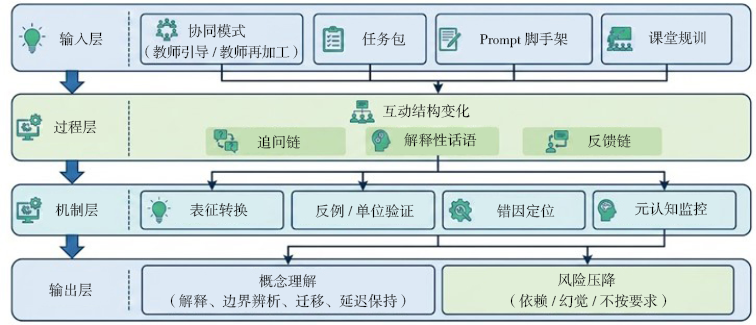
图 1 生成式人工智能支持下高职定积分概念学习的“互动—机制—理解”框架图
Figure 1 An “Interaction – Mechanism - Understanding” framework for learning the concept of definite integrals in higher vocational education with the support of generative artificial intelligence
2.2 DBR三轮迭代与设计
为兼顾方案的可行性、有效性与可复用性,本研究设置三轮迭代,每轮均围绕同一核心目标推进:提升互动质量并将互动增益转化为概念理解增益,同时实现风险可控。第1轮侧重可行性,解决GenAI能否稳定嵌入课堂流程的问题,主要完成协同方式确定(以教师在场引导为主)、对话证据与学习产出提交规范确立,并通过课堂观察与退出测定位学生在“定积分意义—单位量纲—概念边界”方面的常见障碍;第2轮侧重机制强化,重点将“互动增多”转化为“理解变深”,在任务层面将概念学习强制绑定到表征转换与验证活动(语言/符号/Riemann和近似/单位检验/反例或特殊值检验),在提示层面采用分级支架限制“直要答案”,在评价层面加入前测—后测—延迟测以捕捉即时增益与保持度,并对对话过程编码以形成机制证据;第3轮侧重稳定与迁移,固化任务模板与Prompt脚手架,在平行班级或平行任务中复用,检验设计的可推广性与边界条件,并通过访谈/反思日志补充“何处有效、何处失效、为何失效”的情境解释。三轮迭代的总体安排如表1所示。
表 1 DBR三轮迭代设计概览
Table 1 Overview of the three iterative cycles in the DBR process
| 迭代轮次 | 设计目标(聚焦点) | 关键设计改动(相对上一轮) | 主要数据来源 | 判据(达到即进入下一轮) |
| 第1轮:可行性嵌入 | GenAI进入课堂流程;学生能按规范完成任务 | 明确协同方式(教师引导);建立对话记录与提交格式;任务包初版 | 课堂观察、对话日志、退出测、学生作品 | ≥80%小组按规范提交;出现解释性对话与基本单位检验 |
| 第2轮:机制强化 | 互动“变有效”,促进概念理解 | 强制表征转换(语言/符号/Riemann和/单位);引入反例/特殊值验证;分级提示限制直要答案 | 前测/后测/延迟测;对话编码;修订轨迹 | 概念理解后测提升且延迟保持改善;验证行为频次提升 |
| 第3轮:稳定与迁移 | 设计可复用、可迁移 | 固化任务模板与Prompt;跨班级/平行任务复用;完善规训细则 | 跨群体数据;编码一致性;访谈/反思 | 关键效果在复用场景仍稳定;提炼可推广设计原则 |
围绕上述迭代,本研究形成并持续打磨三类核心设计产物(design artifacts),共同构成“可控融合”的实现载体:其一为“定积分概念任务包”,结构上覆盖概念建构、表征转换与错误诊断迁移三类活动,保证学生不仅能得到答案,还能完成意义建构与边界澄清;其二为“Prompt脚手架与分级提示策略”,规定与GenAI对话必须遵循“复述与单位—意义建模—近似求和—验证”的推理路径,并由教师按最小提示到完整步骤分级释放支架以抑制依赖;其三为“课堂规训与风险治理规则”,以“约束—验证—证据—把关”的课堂机制压降幻觉、算错、任务不遵循与依赖风险,并将错误输出转化为可教学的错因诊断资源。三类设计产物的结构化要素如表2所示。
表 2 设计产物及其要素
Table 2 Design artifacts and their key elements
| 设计产物 | 核心构成 | 作用机理 | 输出物(可复用内容) |
| 任务包 | 概念建构;表征转换;错误诊断与迁移 | 触发解释性对话与认知冲突;推动边界辨析与迁移 | 任务模板(每类2~3题);评分Rubric |
| Prompt脚手架 | 复述与单位→意义建模→近似求和→验证 | 促使对话从求答案转为求理解;形成验证习惯 | Prompt清单;分级提示卡片 |
| 课堂规训与治理 | 禁止直要答案;强制验证;证据记录;教师把关 | 压降幻觉/算错/依赖;将错误转为诊断资源 | 使用规范;提交规范;课堂检查清单 |
2.3 数据来源、测量指标与分析策略
为回答“互动是否增强、理解是否提升、风险是否可控”的问题,本研究构建结果数据与过程数据相结合的最小证据链。结果数据以概念理解测验为主,采用前测、后测与延迟测结构,题型覆盖意义解释、表征转换、单位量纲、概念边界辨析与迁移应用,并使用Rubric进行评分以保证可比性;过程数据以课堂对话日志、课堂观察记录与学生学习产出(含修订版本)为主,对话编码聚焦互动质量与概念性加工两个维度:互动质量主要考察提问层级、解释性话语比例、追问链长度与反馈链完整性,概念性加工主要考察表征转换是否发生、验证行为是否出现(单位检查、特殊值/反例检验)及错误修正链是否闭合。分析层面,学习效果以“前后差异+延迟保持”为主线(必要时控制前测差异),过程证据以“指标对比+典型片段”呈现,用于解释效果产生的机制并定位失效点;风险治理则以“错误类型—触发条件—规训对策”的对应表方式在结果章节统一报告。关键指标与操作性定义汇总如表3所示,以便实现研究的可复现性。
表 3 关键指标与操作性定义
Table 3 Key indicators and their operational definitions
| 指标类别 | 指标名称 | 操作性定义(如何判定) | 数据来源 |
| 互动质量 | 解释性话语比例 | 话语中出现“原因/条件/意义/为何”等解释性内容的占比 | 对话日志、课堂记录 |
| 互动质量 | 追问链长度 | 围绕同一概念点连续追问的轮次数(≥2记为形成追问链) | 对话日志 |
| 概念加工 | 表征转换发生 | 同一对象至少以两种表征呈现(语言/符号/近似求和/情境/图像) | 学生作品、对话 |
| 概念加工 | 验证行为出现 | 出现单位量纲检查或特殊值/反例检验,并用于判断正确性 | 学生作品、对话 |
| 学习结果 | 概念解释得分 | 对“定积分表示什么量、为何如此”的解释按Rubric评分 | 前/后/延迟测 |
| 风险治理 | 错误类型频次 | 幻觉/算错/不按要求输出/依赖性提问等次数统计 | 对话日志、观察 |
据此,本研究基于DBR开展三轮迭代,旨在真实高职课堂中形成并不断完善“任务包—Prompt脚手架—课堂规训”三类设计产物,同时以“概念理解测验+课堂互动过程数据”为核心建立最小证据链,用于检验干预的有效性,并为后续结果分析提供可操作的评价框架。
3 结论与展望
本研究以高职高等数学定积分概念学习为载体,采用DBR三轮迭代构建并优化“教师引导型协同+任务包+Prompt脚手架+课堂规训”的生成式人工智能可控融合方案。综合课堂过程证据与学习产出表现,可以形成较为一致的结论:GenAI在高职数学中的有效性并不来自其“生成答案”的能力,而来自其在规则约束下作为互动支架重构课堂话语结构,使学习互动由步骤核对转向解释与验证,从而稳定触发表征转换、单位/反例检验、错因定位与元认知监控等关键机制,推动定积分概念理解从“公式化”走向“结构化”,并提升概念边界辨析与迁移应用的稳定性。简而言之,互动结构的功能性转向(解释—追问—验证闭环)是可控融合产生学习收益的外显表征,而表征转换与验证行为则构成“从互动到理解”的核心桥梁。基于上述结论,本研究从高职数学GenAI融合的教学实践得到三条可操作启示。首先,教学目标应将“可解释、可验证”置于“求解正确”之前,即将定积分的累积意义与边界条件(单位量纲、上下限方向、代数面积与几何面积等)作为任务必达点,再组织算法与技巧训练;其次,任务设计需强制表征转换,使学生在语言解释、符号表达与Riemann和近似情境建模之间建立一致对应,借此避免符号操作与意义脱钩,并为后续性质理解与迁移应用提供结构支撑;最后,课堂实施必须以“约束—验证—证据—把关”的规训机制实现可控融合,通过分级提示抑制直要答案与浅层复制,借助单位量纲检查与特殊值/反例检验提高结论的可证伪性,并将对话记录与修订轨迹纳入形成性评价,以降低生成式输出不确定性及学生依赖风险,必要时由教师在关键概念点实施抽查纠偏,将典型错误转化为错因诊断与反例教学资源,从而促进学生形成自证与辨伪习惯。
后续本研究仍需在更广泛情境中检验与拓展其外部效度与可迁移性。一方面,应在多教师、多班级与跨院校场景下开展重复验证,以识别不同学情结构与教师调控风格下的适配边界,并进一步量化“规训强度—学习收益—风险压降”的关系;另一方面,可将本研究的可控融合框架从定积分扩展至导数、微积分基本定理与应用建模等更复杂单元,考察表征转换与验证习惯能否转化为稳定的数学学习品质,并评估其在高职职业场景任务(工程测算、经济边际分析、质量控制等)中的赋能价值。同时,考虑到生成式模型与工具迭代迅速,后续研究应结合学习分析与对话序列分析等方法,提升过程证据的客观性与自动化水平,持续更新“任务类型—协同方式—规训策略”的匹配原则,从而为高职数学中生成式人工智能的规模化、可持续应用提供更稳健的证据基础与设计指南。
参考文献
[1] 卢宇,余京蕾,陈鹏鹤,等.生成式人工智能的教育应用与展望:以ChatGPT系统为例[J].中国远程教育,2023,43(4):24-31,51.
[2] 朱永新,杨帆.ChatGPT/生成式人工智能与教育创新:机遇、挑战以及未来[J].华东师范大学学报(教育科学版),2023,41(7):1-14.
[3] 王洪才,龙宝新,毛菊,等.ChatGPT对教育带来的挑战与机遇(笔会)[J].苏州大学学报(教育科学版),2023,11(2):11-24.
[4] 罗志佳,陈韦宏.ChatGPT介入教育领域的技术运用、风险洞悉与发展路径[J].重庆理工大学学报(社会科学),2023,37(6):119-128.
[5] 冯雨奂.ChatGPT在教育领域的应用价值、潜在伦理风险与治理路径[J].思想理论教育,2023(4):26-32.
[6] 林燕红,张丽清,林燕云.人工智能驱动职业院校数学差异化教学体系构建与实践探索[J].现代职业教育,2026(2):165-168.
[7] 游佳婧.基于ChatGPT的初中数学学习初探[J].中学数学月刊,2023(5):63-67.
[8] Skemp R R.Relational understanding and instrumental understanding[J].Mathematics Teaching,1976(77):20-26.
[9] Hiebert J,Lefevre P.Conceptual and procedural knowledge in mathematics:An introductory analysis[A].Hiebert J.Conceptual and Procedural Knowledge:The Case of Mathematics[C].Hillsdale,NJ:Lawrence Erlbaum Associates,1986:1-27.
[10] 向雅捷,黄桂花,庄晓.探索生成式人工智能在高职数学教学中的实践路径[J].科技风,2025(29):125-127.
[11] 石燕.人工智能背景下高职院校数学教学方法的研究[J].中国电子商情,2026(1):1-3.
[12] 唐瑶.人工智能与高职高等数学课程融合创新的教学改革探究[N].河北经济日报,2025-09-25(009).