Current Views: 2598865
 Current Downloads: 1614540
Psychology of China
ISSN Print:2664-1798
ISSN Online:2664-1801
Contact Editorial Office



Subscribe to the latest published information from SCISCAN
精准分诊与资源优化:基于UPI 决策树模型的医校协同路径构建
Toward a Medical-school Collaborative Pathway: A UPIBased Decision Tree Model for Precise Psychological Triage and Resource Optimization


-
Information:
1.浙江国际海运职业技术学院学生处,舟山;
2.舟山市第二人民医院精神科,舟山
-
Keywords:
University student mental health; University personality inventory (UPI); Decision tree analysis; Medicalschool collaboration; Risk stratification大学生心理健康; UPI量表; 决策树分析; 医校协同; 风险分层
- Abstract: Objective: To systematically evaluate the efficacy of the University Personality Inventory (UPI) in psychological screening among university students, identify key items with significant predictive value, and develop an optimized screening strategy for precise triage and resource allocation that can serve the medical-school collaboration mechanism. Methods: A UPI survey was administered to all incoming first-year students at a university from 2023 to 2025. Students with a UPI total score≥25 or a positive response to item 25 (suicidal ideation within the past month) underwent semistructured clinical interviews for risk level assessment. Key predictive items were identified using binary logistic regression and cross-tabulation analysis, followed by systematic analysis incorporating Receiver Operating Characteristic (ROC) curves and decision tree algorithms. Results: The UPI total score demonstrated excellent predictive ability for high psychological risk status (Area Under the Curve [AUC] = 0.948, N=7,767), with the current cutoff score of 25 being statistically optimal. Binary logistic regression selected 14 key items into the final model, among which items Q62 (Have you ever felt that you had psychological problems) and Q63 (Have you ever received psychological counseling or psychological treatment) showed the strongest predictive power (p<0.001). Decision tree analysis (conducted on the initial screening-positive subsample, N=1,065) identified Q63 as the most important predictor, forming effective predictive pathways in combination with other items. Conclusion: The constructed two-stage screening model (“Total Score Initial Screening + Multidimensional Triage”), when applied to the UPI initial screening-positive group, not only maintained a high detection rate for high-risk students (sensitivity = 87.10%) but also reduced the number of students requiring one-on-one in-depth interviews by approximately 70.58%. This significantly improves the efficiency of interview resource allocation and provides empirical evidence for enhancing the scientific approach to university psychological screening and establishing a medical-school collaborative support mechanism. 目的:系统评估UPI量表在高校心理筛查中的效能,探索关键条目的预测价值,构建一套可服务于医校协同机制的精准分诊与资源优化策略。方法:对某高校2023—2025三年间的所有大一新生进行UPI普查,对UPI总分≥25分或第25题(近一个月有自杀意念)阳性的学生进行专业心理访谈并确定风险等级,采用二元Logistic回归、交叉表分析筛选关键条目,结合ROC曲线、决策树等方法进行系统分析。结果:UPI总分对心理高危状态具有优秀预测能力(AUC=0.948,N=7767),现行25分标准为统计最优值。二元Logistic回归筛选出14个关键条目进入最终模型,其中Q62(是否曾觉得自己存在心理问题)、Q63(是否曾接受心理咨询或心理治疗)等条目预测力最强(p<0.001)。决策树分析(在初筛阳性子样本N=1065中)发现Q63为最重要的预测因子,能结合其他条目形成有效预测路径。结论:基于此构建的“总分初筛+多维分诊”双阶段筛查模型在UPI初筛阳性群体的应用中,不仅能兼顾对高危学生较高的覆盖率(敏感度87.10%),而且能将需进行一对一深度访谈的学生数量减少约70.58%,从而显著提升访谈资源的配置效率,为高校心理筛查工作的科学化与医校协同机制的构建提供实证依据。
- DOI: 10.35534/pc.0803044
- Cite: 干瑜璐, 马露瑶, 袁松. (2026). 精准分诊与资源优化: 基于UPI决策树模型的医校协同路径构建. 中国心理学前沿, 8 (3), 286-293.
1 引言
大学生心理健康问题已成为高校育人工作的重大挑战。《2022年中国国民心理健康报告》显示,大学生抑郁和焦虑风险检出率分别为21.48%和45.28%。
为应对这一挑战,教育部等十七部门印发了《全面加强和改进新时代学生心理健康工作专项行动计划(2023—2025年)》的通知。该通知指出高校要开展覆盖全体新生的心理健康测评,注重对测评结果的科学分析和合理应用,分类制定心理健康教育方案。该通知还指出高校要持续强化学校与精神卫生医疗机构的协同合作,畅通转介干预就医通道,及时转介、诊断、治疗。这表明构建高效的“医校协同”机制已成为当前高校心理工作的核心政策导向与实践要求。
科学有效的心理健康测评是落实“医校协同”的起点与关键枢纽。对新生开展心理健康测评的核心价值在于识别出三个关键群体:需立即危机干预的高危学生、需专业评估与治疗的潜在心理疾病学生以及需发展性支持的普通困扰学生。这使得测评不再仅是识别个体困扰的工具,更是启动校内分级响应与校外专业转介的操作入口,其科学性与效率直接影响“医校协同”闭环的运转效能。
现阶段大学生人格问卷(UPI)在大学新生心理普查中得到广泛应用[1],其筛查标准通常设定为总分≥25分或第25题(近一个月有自杀意念)阳性。符合标准者需接受专职心理教师的一对一访谈评估。随着高校扩招和学生心理服务需求的日益增长[2],达到筛查阳性的学生基数不断扩大,导致后续一对一访谈工作量激增。原有的筛查策略虽然在一定程度上保障了安全底线,但在实践中面临着巨大挑战。大量访谈资源被消耗在低风险学生群体中,导致对高风险学生群体启动干预的关键窗口期被延误、长期干预的资源被稀释。因此,探索一种能在保障安全底线的前提下显著提升校内资源配置效率的精准筛查方案具有紧迫的现实
意义。
数字赋能为大学生心理健康教育提供了新的视角和工具,也为构建以大数据为基础的大学生心理危机预警机制赋予了高效性与实效性[3]。但现有研究大多关注总分效能,较少系统探索各条目的独立预测价值及组合效应,特别是缺乏从大样本数据中筛选关键条目的实证研究[4]。因此,本研究试图从实证数据出发,通过决策树模型探索UPI量表中高效预测高危状态的核心条目,构建一个既能优化校内资源分配、又能为“医校协同”转介提供客观、量化依据的精准筛查与分诊模型,从而为“医校协同”支持机制的科学化、标准化与可操作化提供数据驱动的方法学支持。
2 研究方法
2.1 研究对象
采用普查方法向某高校2023—2025三年间的全体大一新生共7829人发放问卷,最终回收有效问卷7767份,有效回收率为99.21%。其中男生4991人(64.26%),女生2776人(35.74%),平均年龄18.33±0.35岁(15~26岁)。
2.2 研究工具
采用大学生人格问卷(University Personality Inventory,UPI)[5],问卷共有64个条目,包括两部分内容。第一部分共60个条目,采用“是”计1分、“否”计0分的二级计分。其中4个条目为测谎题,不计入总分,最终总分范围为0~56分,得分越高表明心理困扰程度越严重。第二部分4个条目为辅助题,旨在了解大学生对自身身心健康状况的评价及对心理健康服务的需求。其中Q61为“是否感到自己在自身健康方面存在问题”,Q62为“是否曾觉得自己存在心理问题”,Q63为“是否曾接受心理咨询或心理治疗”,Q64为“如果你有心理健康或心理咨询的需求,请写出你想咨询的问题”。为将UPI所有条目纳入统一的二元预测模型进行分析,本研究将Q61-Q63进行了二值化处理,原始选项中涉及肯定性描述的选择被归为“是”计1分,“否”计0分。为探索所有条目的独立预测价值,本研究在构建预测模型时将包括4个测谎题在内的全部63个条目均纳入分析,并对测谎题(Q5、Q20、 Q35、Q50)进行了反向计分处理,使其得分越高代表心理困扰越严重。本研究中该问卷的Cronbach’s α系数为0.93。
2.3 研究程序
(1)初筛评估
新生入学后1个月内完成UPI量表的在线测评,测评在统一指导语下进行,确保学生理解条目含义。
(2)专业访谈
对UPI总分≥25分或第25题阳性的学生进行一对一半结构化访谈,访谈提纲涵盖情绪状态、认知功能、行为表现、社会功能及风险因素(如自伤或自杀意念)五个维度。所有访谈由该校4名具备国家心理咨询师资质且具有五年以上高校心理咨询经验的专职心理教师
进行。
(3)评估分级
根据访谈结果及学院跟踪反馈,依据统一的心理健康教育分级分类标准将学生分为四个关注等级:
①1级:无需关注(无明显心理困扰,功能良好)
②2级:一般关注(存在轻度困扰,但不影响主要功能)
③3级:重点关注(存在中度困扰,影响部分功能)
④4级:密切关注(存在严重困扰,明显影响功能或存在风险)
(4)校标定义
为构建一个具有足够统计稳健性的高危状态预测模型,为确保模型能有效识别需要专业介入的核心群体,将“无需关注”和“一般关注”合并为“非高危组”,将“重点关注”和“密切关注”合并为“高危组”,作为后续分析的校标变量。
2.4 统计分析
采用SPSS 26.0进行数据的分析和整理。通过ROC曲线分析评估UPI总分的预测效能并确定最佳临界点;使用二元Logistic回归分析筛选对心理高危状态具有独立预测作用的关键条目;基于初筛阳性样本采用决策树算法(CHAID)构建风险分层模型。所有检验均为双侧,p<0.05视为有统计学意义。
2.5 伦理声明
本研究所有数据在分析前进行匿名化处理且仅用于群体科学研究。
3 研究结果
3.1 样本基本情况与心理风险分布
本研究共纳入7767名大一新生,其中接受专业访谈的初筛阳性学生1065人。访谈结果显示79.15%的学生(843人)属于无需关注类别,这表明尽管达到了UPI初筛标准,但多数学生实际心理状态良好。真正需要重点关注的高危学生相对较少(11.64%),这为优化筛查标准提供了现实必要性,如表1所示。
UPI总分差异分析显示,四组学生的UPI总分具有显著差异(F=19.12,p<0.001)。事后比较显示无需关注组总分显著低于其他三组(p<0.001),但一般关注、重点关注与密切关注三组之间两两比较均未发现统计学差异(p>0.05),这说明专职心理教师在区分学生关注等级时不仅依赖UPI总分,更综合考虑了临床访谈中的定性信息,体现了心理评估的专业性和多维性。
表 1 不同关注等级学生的UPI总分比较(N=1065)
Table 1 Comparison of UPI total scores among students with different levels of attention (N=1065)
| 风险等级 | 频数 | 百分比 | UPI总分(M±SD) | 95%CI | F/t值 | p值 |
| 1.无需关注 | 843 | 79.15% | 31.58±7.94 | [31.08,32.15] | 19.12 | <0.001 |
| 2.一般关注 | 98 | 9.20% | 35.62±8.58 | [33.90,37.34] | ||
| 3.重点关注 | 60 | 5.63% | 35.20±8.43 | [33.02,37.38] | ||
| 4.密切关注 | 64 | 6.00% | 37.69±9.25 | [35.38,40.00] | ||
| 非高危组 | 941 | 88.36% | 32.03±8.10 | [31.51,32.55] | 32.33 | <0.001 |
| 高危组 | 124 | 11.64% | 36.48±8.92 | [34.90,38.07] |
3.2 UPI总分与自杀意念的预测效能分析
(1)全体新生的预测效能
为量化原有筛查工具(UPI总分)的预测效度,寻找统计学上的最佳临界值,以校标(0=非高危组,1=高危组)为状态变量,以UPI总分为检验变量,使用受试者工作特征曲线(Receiver Operating Characteristic Curve,ROC)计算UPI得分区分心理正常和需关注学生的敏感性和特异性。
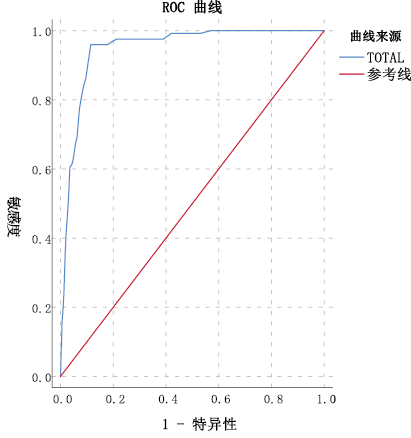
图 1 UPI总分预测高危状态的ROC曲线
Figure 1 ROC Curve for the prediction of high-risk status using total upi score
结果显示,UPI总分预测学生高危状态的ROC曲线下面积(AUC)为0.948(95% CI[0.935,0.962]),p<0.001。进一步分析ROC曲线的坐标点,当选取约登指数最大化的临界值25分时,模型的预测能力达到数学最优(敏感性 =95.97%,特异性=88.49%),约登指数0.85。这意味着将总分25分作为单一筛查标准能识别出绝大多数高危学生(漏检率4.03%),同时能正确排除近九成的健康学生。这从统计学上强有力地支持了将25分作为全校普查初始切分的合理性,如图1所示。
(2)不同亚组的预测效能比较
为深入理解UPI的预测机制,需比较不同亚组的预测效能,其中自杀意念阳性组因样本量较小且全部进入访谈流程,未进行ROC分析。结果显示,在自杀意念阴性学生中,UPI总分表现出更优的预测效能(AUC=0.963)且敏感度达到100%,这为后续精细化筛查策略提供了关键依据:对于无自杀意念的学生,单凭总分即可非常可靠地识别风险,如表2所示。
表 2 UPI总分在不同亚组中的预测效能比较
Table 2 Comparison of predictive utility of total UPI score across different subgroups
| 学生亚组 | 样本量 | AUC | 最佳临界值 | 敏感度 | 特异性 |
| 全体新生 | 7,767 | 0.948 | 25分 | 95.97% | 88.49% |
| 自杀意念阴性 | 7,575 | 0.963 | 25分 | 100.00% | 89.52% |
3.3 现行筛查策略的资源配置效率分析
基于25分临界值,筛查出UPI总分≥25分的阳性学生999人,阴性学生6768人。999人中只有119人(占11.91%)被确认为真正需要重点关注的高危学生。这意味着每访谈8.39名学生才能发现1名高危学生,访谈资源利用率较低。此外,漏检的5名假阴性学生皆为自杀意念阳性但总分未达标者,这提示必须将自杀意念作为独立的强制干预信号,如表3所示。
表 3 基于UPI总分的筛查分类结果(N=7767)
Table 3 Classification results based on total UPI scores (N=7767)
| 分类 | 定义 | 人数 | 百分比 | 构成分析 |
| 真阳性 | 筛查阳性且高危 | 119 | 1.53% | 占阳性者11.91% |
| 假阳性 | 筛查阳性但非高危 | 880 | 11.33% | 占阳性者88.09% |
| 假阴性 | 筛查阴性但高危 | 5 | 0.07% | 需特殊关注 |
| 真阴性 | 筛查阴性且非高危 | 6763 | 87.07% | 正确排除 |
| 阳性合计 | 总分≥25分 | 999 | 12.86% | 需访谈学生 |
| 阴性合计 | 总分<25分 | 6768 | 87.14% | 常规关注 |
3.4 关键预测因子的识别
为构建两阶段筛查模型,本研究采用分阶段数据分析策略。首先基于全体新生样本(N=7767)评估现行筛查标准效能并筛选关键预测条目,随后以其专业访谈后的分级结果(高危/非高危)为校标,使用决策树算法(CHAID)构建精准分诊模型。
为从63个UPI条目中筛选出对心理高危状态最具预测价值的条目,采用系统筛选策略,对63个UPI条目与心理高危状态进行χ2检验,发现所有条目都与心理高危状态显著相关(p<0.05)。随后以心理高危状态(0=非高危,1=高危)为因变量,以63个UPI条目为自变量,进行向前逐步二元Logistic回归分析。结果显示,共有14个关键条目进入最终模型,其中13个条目在总分之外展现出了独立区分高、低危学生的潜力,构成了后续建立预测模型的基础,如表4所示。
表 4 二元Logistic回归分析结果(N=7769)
Table 4 Results of binary logistic regression analysis (N=7769)
| 预测变量 | B | SE | Wald | p值 | Exp(B) | EXP(B)的95%CI |
| Q1 | 0.48 | 0.24 | 4.00 | 0.045 | 1.61 | [1.01,2.58] |
| Q8 | 0.64 | 0.24 | 7.29 | 0.007 | 1.90 | [1.19,3.04] |
| Q11 | 0.54 | 0.25 | 4.79 | 0.029 | 1.71 | [1.06,2.78] |
| Q16 | 0.49 | 0.25 | 3.78 | 0.052 | 1.63 | [1.00,2.68] |
| Q24 | 0.65 | 0.25 | 6.52 | 0.011 | 1.92 | [1.16,3.15] |
| Q25 | 0.70 | 0.28 | 6.10 | 0.013 | 2.01 | [1.15,3.49] |
| Q35 | 0.89 | 0.29 | 9.21 | 0.002 | 2.43 | [1.37,4.32] |
| Q36 | 1.30 | 0.40 | 10.45 | 0.001 | 3.66 | [1.67,8.05] |
| Q46 | 1.15 | 0.39 | 8.61 | 0.003 | 3.16 | [1.46,6.80] |
| Q50 | 0.76 | 0.30 | 6.26 | 0.012 | 2.13 | [1.18,3.85] |
| Q55 | -0.60 | 0.26 | 5.09 | 0.024 | 0.55 | [0.33,0.92] |
| Q60 | 0.78 | 0.37 | 4.50 | 0.034 | 2.18 | [1.06,4.49] |
| Q62 | 1.57 | 0.31 | 25.42 | < 0.001 | 4.79 | [2.60,8.80] |
| Q63 | 2.10 | 0.25 | 73.90 | < 0.001 | 8.20 | [5.08,13.26] |
| 常量 | -10.04 | 0.61 | 269.92 | < 0.001 | 0.00 | — |
注:仅列出最终模型(步骤14)的结果。Exp(B)>1表示正向预测,<1表示负向预测。
3.5 基于决策树的分层筛查模型构建
以初筛阳性学生(N=1065)为研究对象,以其专业访谈后的分级结果(高危/非高危)为校标,利用二元Logistic回归分析筛选出的关键条目构建决策树分诊模型。由于采用决策树默认的50%概率阈值进行二元预测时模型的敏感性为0%,无法有效识别高危个体,因此本研究将样本根据决策规则分配到各个终端节点,并以该节点的高危样本比例作为该节点的预测概率。随后以所有样本的节点预测概率作为检验变量,采用ROC曲线分析来科学确定最佳分类阈值。最终决策树模型的AUC值为0.858(95% CI[0.825,0.892],p<0.001),表明其具有优秀的整体预测能力。通过分析ROC曲线坐标点发现,当预测概率阈值设定为0.098时约登指数达到最大值0.600。在该阈值下模型的敏感性为87.10%,特异性为72.88%。这意味着本模型理论上能在保证87.10%高危学生覆盖率的同时,正确排除72.88%的非高危学生,这显著提升了筛查效率。
决策树模型清晰地揭示了风险分层逻辑,如图2所示。第一层级分裂变量为Q63(曾接受心理咨询或心理治疗):有求助史的学生高危率(31.51%)是无求助史学生(4.14%)的7.61倍。在有求助史的群体中,Q62(曾觉得自己存在心理问题)是第二层级的关键分裂变量,具备自知力的学生高危率飙升至40.19%,构成了核心高危群体。在核心高危群体中,Q35(心情不佳)成为关键变量,承认心情不好的学生高危率高达47.33%,而声称心情好的学生为22.03%。
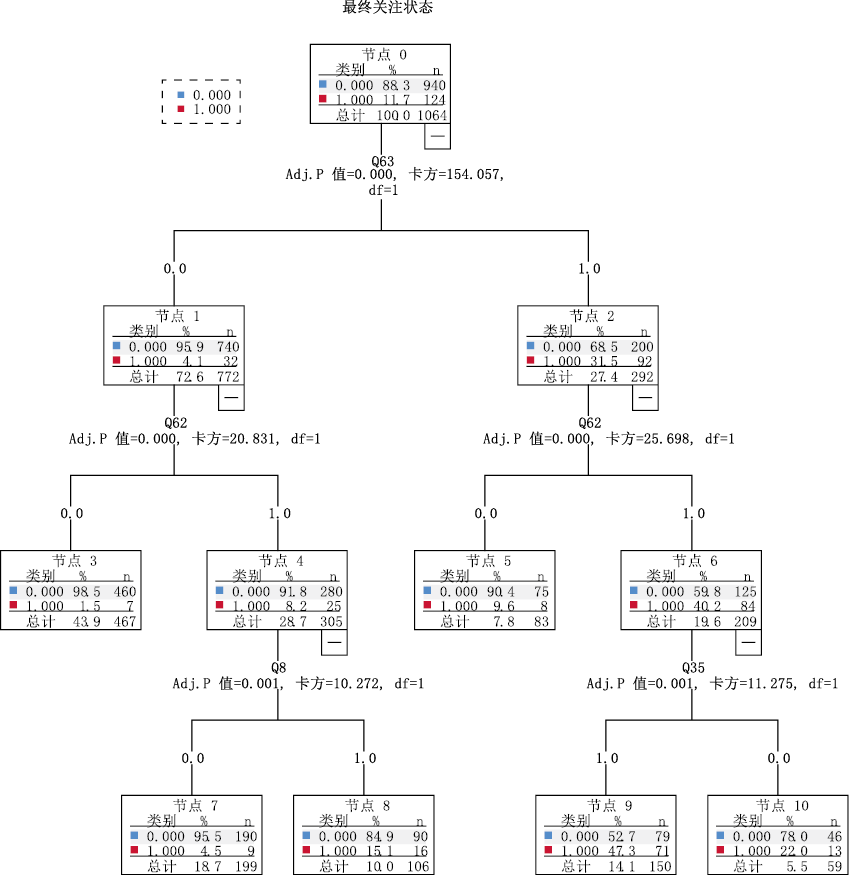
图 2 基于关键UPI题项预测高危状态的CHAID决策树模型
Figure 2 CHAID decision tree model for predicting high-risk status based on key UPI items
3.6 决策树分层筛查模型的实践效能
为评估模型在实际分诊中的应用价值,以0.098为阈值对1065名初筛阳性学生进行分类。结果显示,模型预测需优先进行深度访谈的学生为313人(占29.39%),这意味着与原有策略相比,现有策略的访谈负荷降低了70.58%。在模型判定的需访谈学生中,阳性预测值提升至33.23%(即约每访谈2.52人可发现1名高危学生),相较于原有策略有显著改善。同时模型对全部124名高危学生的检出敏感度为83.87%,即绝大多数真实高危学生被成功识别,如表5所示。
表 5 在初筛阳性样本中的分类结果(N=1065)
Table 5 Classification results in the screening-positive subsample (N= 1065)
| 分类 | 定义 | 人数 | 百分比 (占总样本N=1065) | 构成分析 |
| 真阳性 | 模型预测高危且实际高危 | 104 | 9.77% | 占预测高危者 33.23% |
| 假阳性 | 模型预测高危但实际非高危 | 209 | 19.62% | 占预测高危者 66.77% |
| 假阴性 | 模型预测非高危但实际高危 | 20 | 1.88% | |
| 真阴性 | 模型预测非高危且实际非高危 | 732 | 68.73% | |
| 预测高危合计 | 313 | 29.39% | 需深度访谈学生 | |
| 预测非高危合计 | 752 | 70.61% | 可分流至较低强度干预 |
4 讨论
4.1 主要发现与核心价值
本研究基于大样本数据证实了UPI总分对大学生心理高危状态具有优秀的预测能力,支持了当前25分临界值的合理性。同时研究超越了总分视角,系统识别出包括Q63(曾接受心理咨询或心理治疗)、Q62(曾觉得自己存在心理问题)在内的14个关键预测条目,揭示了心理风险的多维结构。在此基础上构建的“总分初筛+决策树分诊”双阶段模型,其核心价值在于为解决当前高校心理筛查中“广撒网”式访谈导致的资源效率瓶颈提供了科学工具。模型通过精细化风险分层实现了在不显著降低高危学生覆盖率的前提下,大幅减少需要一对一深度访谈的学生数量,从而将有限的专业资源从低效的普遍访谈中解放出来,为投向真正需要的高危学生提供了可能。
4.2 关键预测因子的临床与实践意义
二元Logistic回归与决策树分析共同凸显了Q63与Q62的核心预测地位。Q63的高预测力(OR=8.20)表明,既往的求助行为本身就是一个极强的风险信号。它可能标志着学生已经经历了较长时间的显著痛苦或功能受损,并已尝试寻求外部解决。Q62则反映了学生对自身心理状态的洞察力。两者结合(Q63=是且Q62=是)的群体构成了风险最高、干预需求最明确的核心人群。此外,决策树揭示的“有求助史(Q63=是)且有自知力(Q62=是),但未报告心情不佳(Q35=否)”这一矛盾路径,指向了可能存在的“高求助-低情绪痛苦”模式。对于这类学生,需警惕其可能存在心理防御、述情障碍或将困扰躯体化、行为化的可能,在评估时需超越情绪自评,更关注其人际关系、学业压力或行为表
现等。
4.3 模型的局限与校园多层防御体系
本研究构建的决策树模型在显著提升筛查效率的同时,客观存在对部分“隐匿性高危”学生的未识别问题(即模型判定为非高危但专业访谈确认为高危的共20例)。本研究的核心目标并非追求完美无缺的单一识别率,而是旨在建立一套更高效的初始风险排序系统。追求绝对完美的筛查工具既不现实,也可能因过度干预而导致资源耗竭与预警疲劳。在有限校园心理服务资源的约束下,筛查工作必须在敏感性(尽可能识别所有高危个体)与特异性(减少对非高危个体的不必要干预)之间寻求最优平衡,将最宝贵的专业访谈资源精准导向风险最显著的群体。
一个健全的校园心理安全体系决不能依靠单次的心理普查,而应构筑一个多层次、动态化、全员参与的综合防御体系。本研究模型应作为该体系的高效“第一道滤网”,后续工作中需辅以:对模型中低风险节点内高危比例仍较高群体的针对性团体干预与主动关怀;对UPI原始总分极高但模型判定低风险学生的自动复核机制;融入辅导员、班主任、任课教师、心理委员日常观察的定性预警网络;在关键时间点对重点关注学生的动态情绪复查等。通过这种“技术筛检+人文观察+制度保障”的多层体系,以系统性机制弥补单一工具的固有局限,方能实现对心理风险最大限度地覆盖与
管控。
4.4 模型驱动下的分级筛查与医校协同路径
基于本研究构建的决策树模型可以建立一套数据驱动、责任明确的分级响应体系。该体系的核心逻辑在于:依据量化的风险等级,系统性地衔接校内心理支持资源与校外专业医疗资源。
模型首先将初筛阳性群体精准划分为不同风险层级,为差异化响应提供了直接依据。模型确保极高风险的个案被即刻识别,并在专职心理教师判别为高危后触发与协作医疗机构的转介流程,实现无延迟的专业医疗介入。对于高风险但暂无即时危险的学生,模型将其定位为校内心理咨询服务的最优先对象,确保专业资源向其集中。对于中低风险群体,模型则指导将其纳入由辅导员、朋辈支持主导的发展性关注与预防性干预轨道,从而将宝贵的临床资源从普遍性访谈中释放出来,如表6所示。
表 6 基于决策树风险分层的“医校协同”职责分工与闭环路径
Table 6 Division of responsibilities and closed-loop pathway in university-hospital collaboration based on decision tree risk stratification
| 风险层级 | 命名 | 核心判定标准 | 校内主导 (“校”的职责) | 医疗协同 (“医”的接口) | 闭环路径目标 |
| CX | 危机干预层 | Q25阳性 | 在筛查后48小时内完成首次面对面危机评估访谈。如访谈结果为高危,则立即启动危机预案,通知学院/家属。 | 如访谈结果为高危,立即通过“医校协同”绿色通道转介至合作精神卫生机构。 | 确保学生人身安全,评估并管理即刻风险。 |
| L1 | 优先访谈层 | 决策树判定最高风险路径: Q63=是且Q62=是且 Q35=是 | 在筛查后1周内完成首次一对一评估访谈。访谈时需特别关注其心理防御机制,如有需要共同商定短期心理咨询或治疗计划。 | 根据评估选择性转介至精神科进行诊断与治疗。 | 早期专业干预,防止恶化,促进功能恢复。 |
| L2 | 主动关注层 | 决策树判定中风险路径Q63=是且 Q62=是且Q35=否 或Q63=否且 Q62=是且 Q8=是 | 主动关怀(团体辅导、短期咨询、定期随访)。 | 通常无需直接医疗介入;如情况加剧,升级至L1或CX流程。 | 预防性干预,提升心理弹性,建立信任关系。 |
| L3 | 观察教育层 | 决策树判定低风险路径Q63=是且Q62=否且Q35=是 或Q63=否且Q62=是且 Q8=否 | 普及性教育(课程、活动、资源推送),营造支持氛围。 | 无需医疗介入,鼓励主动求助。 | 普及心理健康知识,营造积极氛围,促进全体学生心理素质发展 |
这一路径清晰地诠释了“医校协同”的实践内涵:以客观数据为枢纽,明确界定了“校”方(提供发展性支持、心理咨询与危机转介)与“医”方(承接急重症诊治)在心理服务链条上的分工界面与协作节点,推动了双方从理念联合走向工作联动。
5 总结
本研究通过决策树模型实现了对UPI初筛阳性学生风险结构的精细化拆解,构建了一个能显著提升高校心理筛查资源配置效率的“总分初筛+多维分诊”双阶段模型。尽管模型存在一定局限,但将其置于一个多层校园心理防御体系中便能成为实现“医校协同”的操作框架。它通过数据驱动的分级标准将校内心理支持系统与校外精神卫生服务专业地衔接起来,为构建响应迅速、分工明确、衔接顺畅的高校学生心理健康联合保障体系提供了关键的实证支持与方法依据。
展望未来,后续研究与实践可朝三个方向推进:一是开发整合此模型的校园心理工作信息化平台,实现筛查、分诊、干预、转介与跟踪的全流程数字化管理;二是基于本模型制定的分级标准,编制详细的“医校协同”工作手册与培训课程,规范不同风险学生的校内处理流程与跨机构转介操作;三是在更广泛的应用中持续评估并迭代优化此模型及配套体系的效果,探索其与学业数据、日常行为数据等多源信息融合的可能性,以构建更为灵敏、智能的自适应心理监测与支持系统。
参考文献
[1] 张敏婷, 赵久波, 张小远. (2018). 大学生心理健康发展与领悟社会支持的关系. 中国学校卫生, 39(2), 232-235.
[2] 柳静, 王铭, 孙启武. (2022). 我国大学生心理咨询与危机干预的管理现状调查. 中国临床心理学杂志, 30(2), 477-482.
[3] 刘莉. (2024). 基于医校合作的大学生心理危机预警机制构建. 东华理工大学学报 (社会科学版), 43(5), 478-483.
[4] 陶进, 马建青. (2024). 新时代我国高校心理健康教育的新发展. 学校党建与思想教育, (11), 84-88.
[5] 刘玉新, 黎丽, 何秋敏. (1996). 大学生人格问卷 (UPI) 的应用研究. 中国电力教育, (2), 43-45.