Current Views: 2556435
 Current Downloads: 1590102
Psychology of China
ISSN Print:2664-1798
ISSN Online:2664-1801
Contact Editorial Office



Subscribe to the latest published information from SCISCAN
小学高年级学生隐性自恋与心理健康的关系及干预研究
The Relationship between Vulnerable Narcissism and Mental Health in Upper Elementary School Students and Its Intervention Study


-
Information:
深圳市南山外国语学校(集团)科华学校,深圳
-
Keywords:
Vulnerable narcissism; Mental health; Emotion regulation ability; Group counseling; Upper elementary school students隐性自恋; 心理健康; 情绪调节能力; 团体辅导; 小学高年级
- Abstract: Objective: To explore the relationship between narcissism and mental health in upper elementary school students, and to examine the mediating role of emotion regulation ability as well as the effect of group counseling intervention. Methods: In Study 1, a cluster sampling method was used to survey 611 fifth and sixth graders, investigating the relationship between grandiose/vulnerable narcissism and mental health indicators (depression, social anxiety, aggression, academic stress, life satisfaction). In Study 2, another 590 students were surveyed to test the mediating effect of emotion regulation ability. In Study 3, 92 students with high vulnerable narcissism were selected from 341 students and randomly assigned to an intervention group (n=40) or a control group (n=52). The intervention group received an 8-week emotion regulation group counseling program. Assessments were conducted at pre-test, post-test, and follow-up. Results: (1) Vulnerable narcissism was significantly positively correlated with depression, social anxiety, aggression, and academic stress (r=0.46~0.61, p<0.001), and significantly negatively correlated with life satisfaction (r=-0.36, p<0.001); grandiose narcissism was only weakly correlated with aggression. (2) Emotion regulation ability mediated the relationship between vulnerable narcissism and mental health, with mediating effects accounting for 25%~50% of the total effect. (3) After the intervention, the intervention group scored significantly lower than the control group on depression, social anxiety, and aggression (p<0.001), and significantly higher on emotion regulation ability and life satisfaction (p<0.001); the effects were maintained at the follow-up test. Conclusion: Vulnerable narcissism is an important risk factor for mental health in upper elementary school students, and emotion regulation ability is a key mediating mechanism. The targeted emotion regulation group counseling can effectively improve the mental health of students with high vulnerable narcissism. 目的:探讨小学高年级学生自恋与心理健康的关系,并检验情绪调节能力的中介作用及团体辅导的干预效果。方法:研究1采用整群抽样,对611名小学五、六年级学生开展问卷调查,考察隐性自恋、显性自恋与心理健康指标(抑郁、社交焦虑、攻击性、学业压力、生活满意度)的关联;研究2另选取590名学生进行问卷调查,检验情绪调节能力的中介作用;研究3从341名学生中筛选出92名高隐性自恋学生,随机分为干预组(40人)和控制组(52人),对干预组进行8周情绪调节团体辅导,并在前测、后测及追踪测评估效果。结果:(1)隐性自恋与抑郁、社交焦虑、攻击性、学业压力均呈显著正相关(r=0.46~0.61,p<0.001),与生活满意度呈显著负相关(r=-0.36,p<0.001);显性自恋仅与攻击性弱相关。(2)情绪调节能力在隐性自恋与心理健康之间起中介作用,中介效应占比25%~50%。(3)干预后,干预组的抑郁、社交焦虑、攻击性得分显著低于控制组(p<0.001),情绪调节能力和生活满意度显著高于控制组(p<0.001),且干预效果在追踪阶段得以维持。结论:隐性自恋是小学高年级学生心理健康重要风险因素,情绪调节能力为二者关系的关键中介机制;定向情绪调节团体辅导可有效改善高隐性自恋学生心理健康水平。
- DOI: 10.35534/pc.0806144
- Cite: 曾丽. (2026). 小学高年级学生隐性自恋与心理健康的关系及干预研究. 中国心理学前沿, 8 (6), 974-980.
1 引言
青少年早期是个体自我概念发展的关键期,心理健康问题日益受到关注。研究表明,全球范围内青少年心理健康状况呈恶化趋势,我国中小学抑郁检出率高达40%(《2023年度中国精神心理健康》蓝皮书)。在影响心理健康的诸多因素中,自恋人格特质近年来引起广泛关注。自恋包含两种典型表征:显性自恋(Grandiose Narcissism)表现为自负、外向、渴望成为焦点;隐性自恋(Vulnerable Narcissism)则表现为内心脆弱、对他人评价过度敏感、伴有低自尊和不安全感(Pincus et al.,2009)。尽管两者都表现出特权感和自我中心,但隐性自恋与抑郁、焦虑、内化问题更密切相关(Miller et al.,2011)。然而,目前关于自恋的研究多集中在成人群体,对青少年早期个体的考察不足,且缺乏对隐性自恋机制的深入探究。情绪调节能力是指个体监控、评估和调整情绪反应的能力(Thompson,1994)。隐性自恋者常因过度在意他人评价而陷入情绪波动,却缺乏有效的情绪调节策略,易出现情绪失调(Krizan & Herlache,2018)。已有研究表明,情绪调节困难是隐性自恋导致心理问题的重要中间环节(Zhang et al.,2015)。因此,本研究提出假设:情绪调节能力在隐性自恋与心理健康之间起中介作用。
青少年阶段大脑神经发育对外界刺激敏感度高,是开展情绪调节干预的关键窗口(Luby et al.,2020)。针对隐性自恋者的干预研究十分匮乏,尤其缺少针对未成年群体的实践探索。因此,本研究还拟开发一套情绪调节团体辅导方案,并检验其对高隐性自恋学生心理健康的提升效果。综上,本研究通过三个子研究,考察不同自恋类型与心理健康的关系,验证情绪调节能力的中介机制,并通过干预研究探索有效的实践路径。
2 对象与方法
2.1 研究对象
研究1:采用整群抽样法,选取深圳市三所小学650名五、六年级学生,回收有效问卷611份,问卷有效率94%。其中男生299人(48.9%),女生312人(51.5%);五年级284人(46.5%),六年级327人(53.5%);平均年龄10.84岁(SD=0.65)。
研究2:以同样方法另选三所小学650名学生,回收有效问卷590份(有效率90.77%)。其中男生331人(56.1%),女生259人(43.9%);五年级296人(50.2%),六年级294人(49.8%);平均年龄10.97岁(SD=0.69)。
研究3:从一所小学341名五六年级学生中,根据儿童自恋量表隐性自恋维度得分前27%筛选出92名高隐性自恋学生,随机分为干预组(40人)和控制组(52人)。两组在性别、年级、年龄上无显著差异(p>0.05)。
所有研究均获得学校、家长及学生知情同意。
2.2 研究工具
(1)儿童自恋量表(Derry et al.,2017):共计15个条目,划分隐性自恋(8题)和显性自恋(7题)两个维度,采用4点计分。本研究中各分量表Cronbach’s α系数介于0.71~0.74之间。
(2)流调中心抑郁量表(CESD-10):10题,5点计分,得分越高抑郁越重。Cronbach’s α系数0.71~0.86。
(3)社交焦虑量表(SASC):10题,3点计分,分为害怕否定评价和社交回避及苦恼两个维度。Cronbach’s α系数0.85~0.90。
(4)Buss-Perry攻击量表:30题,5点计分,包括身体攻击、言语攻击、愤怒、敌意、指向自我的攻击。Cronbach’s α系数0.91~0.96。
(5)小学生学业压力量表(路静,2013):16题,5点计分,含同伴压力、课业压力、师生互动压力、父母压力。Cronbach’s α系数0.88~0.93。
(6)总体生活满意度量表(SWLS):5个条目,7点计分,得分越高满意度越高。Cronbach’s α系数0.78~0.81。
(7)青少年情绪调节能力量表(嵇家俊,2010):25题,6点计分,含情绪知觉、评价、控制、策略应用、自我效能感、反思六维度。Cronbach’s α系数0.93。
(8)罗森伯格自尊量表(RSES):10题,4点计分,用于研究2作为协变量。Cronbach’s α系数0.83。
2.3 干预方案
干预组开展为期8周的情绪调节团体辅导,每周1次,每次60分钟。团辅设计基于情绪调节六维模型(情绪知觉、评价、控制、策略应用、自我效能感、反思),内容涵盖:建立团体连接、情绪知觉(情绪ABC理论)、情绪评价(接纳负性情绪)、情绪控制(应对负面评价、愤怒实验、忧郁孤岛)、策略应用(积极自我对话、ACCEPTS清单)、自我效能感(情绪逃脱室、平静的瓶子、高山冥想)、反思能力(象与骑象人、情绪手账)及结课总结。控制组不进行任何干预。
2.4 统计方法
运用SPSS 25.0完成描述性统计、相关分析、回归分析及重复测量方差分析;借助Mplus 8.3搭建结构方程模型检验中介效应;采用Bootstrap法(5000次)估计置信区间。所有分析均控制性别、年龄、年级、是否独生(及研究2中自尊)。
3 结果
3.1 相关分析
如表1所示,隐性自恋与抑郁、社交焦虑、攻击性、学业压力均呈显著正相关(r=0.46~0.61,p<0.001),与生活满意度呈显著负相关(r=-0.36,p<0.001);显性自恋仅与攻击性弱相关(r=0.30,p<0.001)。情绪调节能力与隐性自恋呈显著负相关(r=-0.36,p<0.001),与各心理健康指标均显著相关(|r|=0.35~0.53,p<0.001)。
表 1 各变量描述统计与相关矩阵(N = 650)
Table 1 Correlation analysis of narcissism and mental health among upper primary school students (N = 650)
| 变量 | M | SD | 1 | 2 | 3 | 4 | 5 | 6 | 7 |
| 1隐性自恋 | 18.27 | 4.50 | 1 | ||||||
| 2显性自恋 | 17.61 | 4.45 | 0.23*** | 1 | |||||
| 3抑郁 | 6.66 | 3.59 | 0.46*** | 0.03 | 1 | ||||
| 4社交焦虑 | 8.12 | 4.88 | 0.61*** | -0.01 | 0.48*** | 1 | |||
| 5攻击性 | 78.27 | 21.80 | 0.60*** | 0.30*** | 0.44*** | 0.47*** | 1 | ||
| 6学业压力 | 38.87 | 13.59 | 0.54*** | 0.08 | 0.46*** | 0.58*** | 0.61*** | 1 | |
| 7生活满意度 | 20.80 | 7.15 | -0.36*** | 0.10* | -0.38*** | -0.39*** | -0.28*** | -0.42*** | 1 |
| 8情绪调节 | 96.51 | 26.54 | -0.36*** | 0.09* | -0.53*** | -0.35*** | -0.42*** | -0.37*** | 0.45*** |
注:*p<0.05,**p<0.01,***p<0.001。
3.2 中介作用分析
以隐性自恋为自变量、情绪调节能力为中介变量,分别将抑郁、社交焦虑、攻击性、学业压力、生活满意度设为因变量,控制性别、年龄、年级、是否独生子女及自尊水平后,构建结构方程模型。模型拟合良好(χ٢/df=5.048~5.272,CFI>0.88,RMSEA<0.085)。
路径结果表明(图1),隐性自恋显著负向预测情绪调节能力(β=-0.33,p<0.001),情绪调节能力可显著负向预测抑郁(β=-0.33,p<0.001)、社交焦虑(β=-0.20,p<0.001)、攻击性(β=-0.32,p<0.001)、学业压力(β=-0.23,p<0.001),正向预测生活满意度(β=0.32,p<0.001)。隐性自恋经由情绪调节能力作用于各心理健康指标的中介效应显著,中介效应占比在25.00%~50.00%之间。显性自恋对情绪调节能力无显著预测作用。
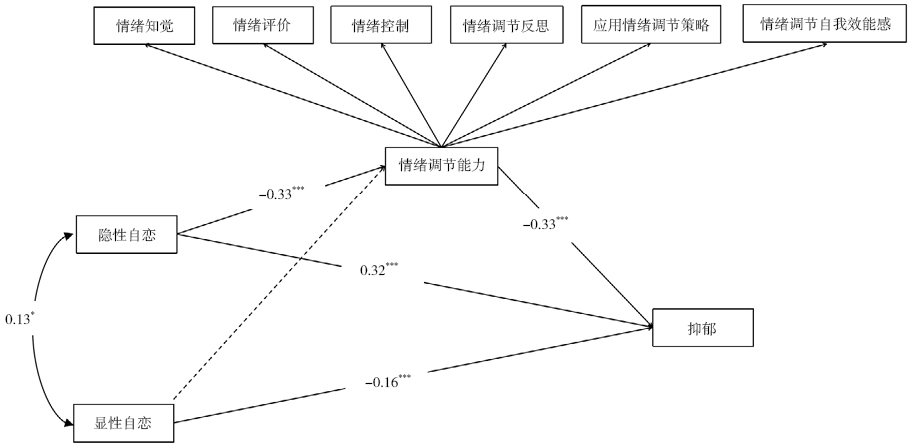
图 1 情绪调节能力在隐性自恋与心理健康之间的中介路径图(以抑郁为例)
Figure 1 Path diagram of the mediating effect of emotion regulation ability on the relationship between vulnerable narcissism and mental health (using depression as an example)
3.3 干预效果分析
对干预组和控制组在三个时间点(前测、后测、追踪测)的心理健康指标进行2(组别)×٣(时间)重复测量方差分析,控制性别、年龄、年级、是否独生及自尊。结果如表2、图2、图3、图4所示。
(1)抑郁:组别×时间交互作用显著,F=12.53,p<0.001,η٢=٠.٢٣。干预组后测及追踪测抑郁得分显著低于前测(p<0.05),控制组无显著变化。
(2)社交焦虑:交互作用显著,F=18.69,p<0.001,η٢=٠.٣١。干预组后测及追踪测得分显著低于前测,且追踪测显著低于后测(p<0.01);控制组无变化。
(3)攻击性:交互作用显著,F=23.57,p<0.001,η٢=٠.٢٢。干预组后测及追踪测得分显著低于前测(p<0.01);控制组后测及追踪测得分显著高于前测(p<0.001)。
(4)学业压力:交互作用显著,F=3.23,p<0.05,η٢=٠.٠٧。控制组后测得分显著高于前测和追踪测;干预组无显著变化。
(5)生活满意度:交互作用显著,F=30.33,p<0.001,η٢=٠.42。干预组后测及追踪测得分显著高于前测,且追踪测显著高于后测(p<0.001);控制组无变化。
(6)情绪调节能力:交互作用显著,F=12.20,p<0.001,η٢=٠.٢٣。干预组后测及追踪测得分显著高于前测,且追踪测显著高于后测(p<0.01);控制组无变化。
表 2 干预组与控制组各变量前测、后测、追踪测得分(M±SD)
Table 2 Pre-test, post-test, and follow-up scores of all variables in the intervention and control groups (M ± SD)
| 变量 | 组别 | 前测 | 后测 | 追踪测 |
| 抑郁 | 干预组 | 8.25±7.64 | 2.73±2.94 | 2.10±3.22 |
| 控制组 | 6.31±4.59 | 8.33±7.11 | 8.42±7.99 | |
| 社交焦虑 | 干预组 | 7.25±6.35 | 1.88±2.39 | 0.63±1.69 |
| 控制组 | 5.54±3.91 | 7.00±5.28 | 7.00±6.19 | |
| 攻击性 | 干预组 | 64.45±27.30 | 50.68±20.41 | 48.48±19.75 |
| 控制组 | 61.29±15.82 | 75.23±22.70 | 76.08±29.35 | |
| 生活满意度 | 干预组 | 19.20±9.65 | 31.25±4.55 | 34.13±2.57 |
| 控制组 | 21.69±7.68 | 20.90±8.23 | 20.81±9.20 | |
| 情绪调节能力 | 干预组 | 96.53±33.95 | 122.43±24.84 | 130.23±21.11 |
| 控制组 | 104.87±21.75 | 101.04±28.46 | 102.85±29.39 |
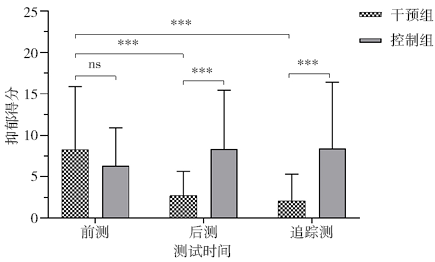
图 2 干预组与控制组抑郁得分变化趋势
Figure 2 Change trends in depression scores of the intervention and control groups across three time points (pre-test, post-test, and follow-up)
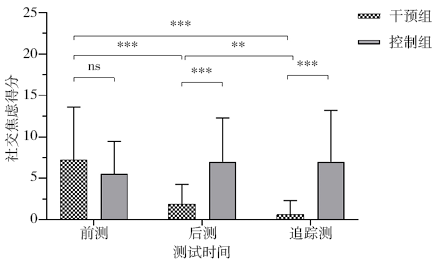
图 3 干预组与控制组社交焦虑得分变化趋势
Figure 3 Change trends in social anxiety scores of the intervention and control groups across three time points (pre-test, post-test, and follow-up)
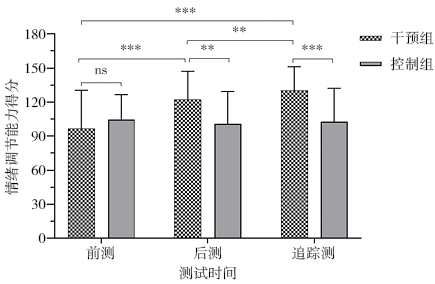
图 4 干预组与控制组情绪调节能力得分变化趋势
Figure 4 Change trends in emotion regulation ability scores of the intervention and control groups across three time points (pre-test, post-test, and follow-up)
4 讨论
4.1 隐性自恋是心理健康的重要风险因素
本研究通过大样本调查发现,隐性自恋与小学高年级学生的抑郁、社交焦虑、攻击性、学业压力呈显著正相关,与生活满意度呈显著负相关,而显性自恋与心理健康各指标关联微弱。这一结果与成人研究一致(Rose,2002),表明在青少年早期,隐性自恋已表现出明显的不适应特征。隐性自恋者内心脆弱、对评价敏感,易将自我价值依附于他人评价,因而在人际交往中常体验到焦虑和挫败,进而产生抑郁、敌意等问题(Krizan & Johar,2015)。因此,学校心理工作应重点关注这类“隐形”的孩子,而非仅关注外显行为
问题。
4.2 情绪调节能力是关键中介机制
本研究进一步揭示,情绪调节能力在隐性自恋与心理健康之间起中介作用 。隐性自恋者因过度关注外界评价,常陷入情绪波动,却缺乏有效调节策略,导致情绪失调,进而引发心理问题(Zhang et al.,2015)。中介效应占比在25%~50%之间,说明情绪调节困难是隐性自恋导致不良心理后果的核心路径。这一发现将情绪调节能力定位为干预的靶点,为后续干预提供了明确方向。
4.3 情绪调节团体辅导有效提升心理健康
研究3表明,针对高隐性自恋学生的8周情绪调节团体辅导显著降低了抑郁、社交焦虑和攻击性,提升了情绪调节能力和生活满意度,且效果在追踪测中保持。这一结果证实了情绪调节训练的有效性,也呼应了以往关于情绪调节干预的元分析结论(Durlak et al.,2011)。值得注意的是,学业压力改善有限,可能与干预期间临近期末、外部学业压力增大有关,提示干预需结合学业支持。
4.4 实践启示与不足
本研究对教育实践具有直接启示:首先,学校和教师可通过“三看”识别法(看反应:对评价过敏;看交往:社交退缩;看情绪:波动大)初步发现隐性自恋倾向学生,避免将其误解为性格内向、情绪敏感或行为退缩。其次,心理教师可将情绪调节能力培养纳入心理健康课程,采用体验式活动(如情绪套杯、平静的瓶子、积极自我对话等)帮助学生掌握调节策略。最后,本研究开发的8次团辅方案可低成本推广,为资源有限的学校提供现成干预资源。
本研究存在一定局限:样本仅限深圳,结论推广需谨慎;干预时长较短,学业压力改善有限;后续在新学校验证时需进一步优化。未来研究可扩大样本范围,延长干预时间,并探索家校协同干预模式。
参考文献
[1] 高爽, 张向葵. (2018). 儿童期自恋人格的形成、发展及展望. 应用心理学, 24(2), 123-131.
[2] 侯娟, 朱英格, 方晓义. (2021). 手机成瘾与抑郁: 社交焦虑和负性情绪信息注意偏向的多重中介作用. 心理学报, 53(4), 362-373.
[3] 胡雍筠. (2020). 自尊和自恋的关系探析. 心理月刊, 15(12), 23-25.
[4] 嵇家俊. (2010). 青少年情绪调节能力及其与家庭功能的关系研究 (硕士学位论文) . 上海师范大学.
[5] 路静. (2013). 小学高年级学生学业压力与攻击性之间关系的研究 (硕士学位论文) . 天津师范大学.
[6] 汤冬玲, 董妍, 俞国良, 文书锋. (2010). 情绪调节自我效能感: 一个新的研究主题. 心理科学进展, 18(4), 598-604.
[7] 汪玥, 张豹, 周晖. (2022). 中小学生正念注意觉知与心理健康: 情绪调节和积极重评的跨时间中介作用. 心理发展与教育, 38(5), 692-702.
[8] 张振. (2021). 自恋与攻击行为的关系: 观点采择和共情关注的调节作用. 心理与行为研究, 19(1), 131-138.
[9] 郑涌, 黄藜. (2005). 显性自恋与隐性自恋: 自恋人格的心理学探析. 心理科学, 28(5), 1259- 1262.
[10] 周浩, 龙立荣. (2004). 共同方法偏差的统计检验与控制方法. 心理科学进展, 12(6), 942- 950.
[11] Barry C T & Malkin M L. (2010). The relation between adolescent narcissism and internalizing problems depends on the conceptualization of narcissism. Journal of Research in Personality, 44(6), 684-690.
[12] Brummel man E, Thomaes S, Nelemans S A, Orobio de Castro B, Overbeek G & Bushman B J. (2015). Origins of narcissism in children. Proceedings of the National Academy of Sciences, 112(12), 3659-3662.
[13] Compas B E, Jaser S S, Bettis A H, Watson K H, Gruhn M A, Dunbar J P, … & Thigpen J C. (2017). Coping, emotion regulation, and psychopathology in childhood and adolescence: A meta-analysis and narrative review. Psychological Buletin, 143(9), 939-991.
[14] Derry K L, Ohan J L & Bayliss D M. (2017). Toward understanding and measuring grandiose and vulnerable narcissism within trait personality models. European Journal of Psychological Assessment, 36(2), 1-12.
[15] Dickinson K A & Pincus A L. (2003). Interpersonal analysis of grandiose and vulnerable narcissism. Journal of Personality Disorders, 17(3), 188-207.
[16] Durlak J A, Weissberg R P, Dymnicki A B, Taylor R D & Schellinger K B. (2011). The impact of enhancing students’ social and emotional learning: A meta-analysis of school-based universal interventions. Child Development, 82(1), 405-432.
[17] Given-Wilson Z, McIlwain D & Warburton W. (2011). Metacognitive and interpersonal difficulties in overt and covert narcissism. Personality and Individual Di ferences, 50(7), 1000-1005.
[18] Gratz K L & Roemer L. (2004). Multidimensional assessment of emotion regulation and dysregulation: Development, factor structure, and initial validation of the difficulties in emotion regulation scale. Journal of Psychopathology and Behavioral Assessment, 26(1), 41-54.
[19] Gross J J. (2015). Emotion regulation: Current status and future prospects. Psychological Inquiry, 26(1), 1-26.
[20] Hendin H M & Cheek J M. (1997). Assessing hypersensitive narcissism: A reexamination of Murray’s Narcism Scale. Journal of Research in Personality, 31(4), 588- 599.
[21] Krizan Z & Herlache A D. (2018). The narcissism spectrum model: A synthetic view of narcissistic personality. Personality and Social Psychology Review, 22(1), 3-31.
[22] Krizan Z & Johar O. (2015). Narcissistic rage revisited. Journal of Personality and Social Psychology, 108(5), 784-801.
[23] Miller J D, Hoffman B J, Gaughan E T, Gentile B, Maples J & Keith Campbell W. (2011). Grandiose and vulnerable narcissism: A nomological network analysis. Journal of Personality, 79(5), 1013-1042.
[24] Miller J D, Lynam D R, Hyatt C S & Campbell W K. (2017). Controversies in narcissism. Annual Review of Clinical Psychology, 13, 291-315.
[25] Morf C C & Rhodewalt F. (2001). Unraveling the paradoxes of narcissism: A dynamic self-regulatory processing model. Psychological Inquiry, 12(4), 177-196.
[26] Pincus A L, Ansell E B, Pimentel C A, Cain N M, Wright A G & Levy K N. (2009). Initial construction and validation of the Pathological Narcissism Inventory. Psychological Assessment, 21(3), 365-379.
[27] Pincus A L & Lukowitsky M R. (2010). Pathological narcissism and narcissistic personality disorder. Annual Review of Clinical Psychology, 6, 421-446.
[28] Rose P. (2002). The happy and unhappy faces of narcissism. Personality and Individual Di ferences, 33(3), 379-391.
[29] Thomaes S & Brummel man E. (2016). Narcissism. In D. Cicchetti (Ed.), Developmental psychopathology (3rd ed., pp. 1-47). John Wiley & Sons.
[30] Thomaes S, Stegge H, Bushman B J, Olthof T & Denissen J. (2008). Development and validation of the Childhood Narcissism Scale. Journal of Personality Assessment, 90(4), 382-391.
[31] Thompson R A. (1994). Emotion regulation: A theme in search of definition. Monographs of the Society for Research in Child Development, 59(2/3), 25-52.
[32] Wink P. (1991). Two faces of narcissism. Journal of Personality and Social Psychology, 61(4), 590-597.
[33] Zeigler-Hill V & Vonk J. (2015). Dark personality features and emotion dysregulation. Journal of Social and Clinical Psychology, 34(8), 692-704.
[34] Zhang H, Wang Z, You X, Lü W & Luo Y. (2015). Associations between narcissis and emotion regulation difficulties: Respiratory sinus arrhythmia reactivity as a moderator. Biological Psychology, 110, 1-11.
[35] Zemojtel-Piotrowska M, Clinton A & Piotrowski J. (2014). Agentic and communal narcissism and subjective well-being: Are narcissistic individuals unhappy? A research report. Current Issues in Personality Psychology, 2(1), 10-16.