Current Views: 2654532
 Current Downloads: 1657147
Psychology of China
ISSN Print:2664-1798
ISSN Online:2664-1801
Contact Editorial Office



Subscribe to the latest published information from SCISCAN
角色扮演对大学生心理求助的社会容认度和态度的影响
The Influence of Role Play on College Students’ Social Acceptance and Attitude towards Psychological Help-seeking


-
Information:
1.湖北大学,武汉;
2.北京师范大学,珠海
-
Keywords:
Role play; College students; Psychological help-seeking; Social acceptance of psychological help-seeking; Attitudes角色扮演; 大学生; 心理求助; 社会容认度; 态度
- Abstract: Objective: To explore the effect of role play intervention designed according to the As If Principle on the social acceptance of psychological help-seeking and their attitude towards seeking professional psychological help, and to explore a new method to improve graduate students’ psychological help seeking awareness and mental health literacy. Methods: Using the quasi-experimental method, 161 graduate students were recruited in the daily propaganda process of mental health education, and were divided into 4 role playing groups (experimental group) and 1 routine propaganda group (control group) for comparative study. The pre and post tests were conducted with the Social Tolerance Questionnaire and the Attitude Questionnaire for Seeking Professional Psychological Help (ATSPPH). Results: After intervention, the postgraduates in the experimental group had higher social acceptance and more positive attitude towards seeking professional help, reaching a very significant level [(-5.68947 ± 10.34194) vs. (-6.38095 ± 11.53408), all p<0. 01]; Before the intervention, there was no difference between the five groups in their social acceptance of psychological help seeking behavior and their attitude toward seeking professional psychological help (F acceptance=2.142 vs. F attitude=2.021; all p>0.05). After the intervention, there were significant differences between the five groups in two dependent variables (F acceptance=2.708 p<0. 05; F attitude=7.851; p<0.01); Different treatments had significant interaction with gender and age. Conclusion: The role play intervention based on the “performance principle” can significantly improve the internal social acceptance and attitude of the subjects by changing their external behaviors. The different methods of role play are different at different levels of gender and age. 目的:探讨根据“表现”原理设计的角色扮演干预方式对于改变大学生“心理求助行为的社会容认度”和“寻求专业心理帮助的态度”的作用,探索提高大学生心理求助意识及心理健康素养的新方法。方法:采用准实验设计,招募161名大学生被试,分成4个角色扮演组(实验组)和1个常规宣传组(对照组)进行比较研究。使用社会容认度问卷和寻求专业性心理帮助的态度问卷(ATSPPH)进行前后测。结果:干预后,实验组大学生的社会容认度变高,对寻求专业帮助的态度也更加积极,达到了极显著的水平[(-5.689±10.342)vs.(-6.381±11.534),均p<0.01)];干预前5个组对于心理求助行为的社会容认度和寻求专业心理帮助的态度之间都没有差异(F容认度=2.142vs.F态度=2.021;均p>0.05),干预后这5组在两个因变量上都发生了显著差异(F容认度=2.708,p<0.05;F态度=7.851;p<0.01);不同处理方式与性别和年龄发生了显著的交互作用。结论:依据“表现原理”实施的角色扮演干预方法,可以通过先改变被试外在的行为,进而显著地改善其内在的社会容认度和态度。角色扮演的不同方法在性别和年龄的不同水平上表现不同。
- DOI: 10.35534/pc.0804076
- Cite: 柳珺珺, 张澜. (2026). 角色扮演对大学生心理求助的社会容认度和态度的影响. 中国心理学前沿, 8 (4), 491-498.
1 引言
心理求助是指个体在遇到心理困扰或障碍的时候,向专业人员寻求帮助以达到解决困扰的过程(赵丽 等,2011)。国外对求助行为的研究已经有50年左右的历史。早期的研究起于医学和社会学领域对一般人“生病行为”的探讨(Mechanic,1968),较后的学者比较关注心理问题的求助(李盈,2015)。近10年来,针对影响心理求助的因素,研究者们陆续尝试各种途径和方法对个体的心理求助态度、意识等进行干预,以期提高个体心理求助行为的发生概率。
心理求助受多种因素影响,针对性别、年龄这些既定的人口学变量(Flisher,2002;肖世君,2017),研究者的干预有限;针对社会文化因素方面的影响因素,例如污名等,主要通过宣传教育,视频干预等方式进行干预(Tucker et al.,2013;张经纬,2020),虽然会起到作用,但远低于预期(许艾静,2020;Amy et al.,2012);针对个性心理方面因素的影响,研究者们也做了较多的尝试,例如通过干预当事人的自尊和自我效能感水平来增强其心理求助的态度(李盈,2015),取得了一定效果。
所有这些干预变量和方式的选择,都遵循主流心理学理念——促使内在心理因素改变才能引发外在行为的改变,例如理性行为理论模型(TRA)、计划行为理论(TPB)、健康信念理论模型等(郝志红,2009)。那么,我们能否反其道而行之?即,先通过一定的方法促使当事人在可接受范围内改变行为,再由此引发内在心理信念和态度的改变。这种思路得到了19世纪80年代末美国心理学家威廉·詹姆斯提出的“表现原理”的支持(怀斯曼,R,2012)。
表现原理提出后,因与当时的主流心理学观念发生冲突,被束之高阁长达六十年,如今再次被新生代心理学研究者发现,并陆续被大量的实验研究加以证实(Hill et al.,2010;Koch S C,2011)。它的基本内容极为简单:人的行为影响人的思想和感觉,改变人的行为就能够轻松改变他的想法和情绪(Richard Wiseman,2012)。正如威廉·詹姆斯一个世纪前所说的:“如果你想拥有一种品质,那就表现得仿佛你已经拥有它一样。(James W,1899).”这个原理告诉我们,对情绪、思维、态度甚至习惯的改变不一定要充满挑战性,确实存在一系列简单易行但卓有成效的方法,帮助改变生活的各个方面,发掘前所未有的能量。由此可知,当人们表现出某种行为时,他们的思想会朝着与行为一致的方向改变,那么当人们表现得认同心理求助时,他们的心理求助意愿也会提升。
符号互动论的创始者乔治·赫伯特·米德(G. H. Mead)在其角色理论中指出“角色扮演”是互动得以进行的基本条件,人与人之间之所以能够进行互动,就因为人们能够辨认和理解他人所使用的交往符号的意义并通过角色而预知对方的反应(余敏,2012)。角色扮演最早的运用是在社会心理治疗上,后来在教学中被广泛使用(方丽,2016)。
本研究利用角色扮演提高参与者的求助意识,既是一种社会心理治疗活动也是一种教学活动,旨在特定的情景中为学生提供机会扮演特定角色,与他人进行互动活动,从而达到在关系中换位思考,改变自己对专业助人行为的看法和态度。这种操作方式,也能很好地满足表现原理的要求——让他们的行为表现得认同心理求助。角色扮演的理论也告诉我们“当我们扮演一种新的社会角色时,起初我们可能觉得虚假,但很快我们就会适应”“社会角色规定的行为铸造了角色扮演者的态度”(David G. Myers,2016)。
基于此,本研究以表现原理为依据,尝试让大学生扮演心理健康活动指导者、带领者、求询者等角色参与到心理健康相关宣传活动中,可以形成假设:大学生们在角色扮演过程中,会根据角色要求表现出对心理求助行为的接纳和认可,从而(1)他们对心理求助行为会的社会容认度会显著增大,(2)他们对心理求助的态度会朝着更愿意寻求专业帮助的方向转化。
2 研究程序与方法
2.1 取样
2024年5月至6月湖北省某高校心理健康月活动期间,由校研会向各个学院学生会、学校各类微信平台推送心理健康月活动志愿者的招募广告。招募广告推送5天之后,报名达到一百八十多人,后经筛选留下161人,样本构成情况,如表1所示。筛选标准为:能够保证全程参与活动并完成相关问卷调查。
根据志愿者个人的兴趣选择进入不同的活动组,分组情况如表2所示。其中组1至组4为角色扮演实验组,组5为对照组。
表 1 样本构成情况
Table 1 Sample composition
| 划分标准 | 人数分布及有效百分比 |
| 性别 | (1)男60人(37.3%);(2)女101人(62.7%) |
| 年龄 | 平均年龄24岁,最小21岁2人,最大35岁1人; (1)21~24岁121人(75.2%),(2)25~35岁40人(24.8%) |
| 年级 | (1)本科高年级(大三、大四)146人(90.7%);(2)硕士研究生(研一、研二)15人(9.3%) |
| 专业类型 | (1)文科91人(56.5%);(2)理科48(29.8%);(3)工科22人(13.7%) |
| 学生来源地 | (1)大城市17人(10.6%) (2)中小城市52人(32.3%) (3)乡镇农村92人(57.1%) |
注:样本构成的大学生均为非心理学专业。
表 2 分组情况
Table 2 Grouping information
| 组别 | 人数(百分比) | ||
| 实验组 | 组1-现场咨询 | 24人(14.9%) | 68人(42.2%) |
| 组2-团体辅导 | 17人(10.6%) | ||
| 组3-常识宣讲 | 17人(10.6%) | ||
| 组4-咨询体验 | 10人(6.2%) | ||
| 对照组 | 组5-常规宣传 | 93人(57.8%) | 93人(57.8%) |
2.2 实验步骤
本研究在心理健康教育的日常宣传过程中进行,不能完全采用随机化原则分配被试,所以采用了准实验方法,将被试分为角色扮演组(实验组)和常规宣传组(对照组)进行比较研究。其中实验组,根据不同的干预条件,又分为四个亚组。因变量为“心理求助行为的社会容认度”和“寻求专业性心理帮助的态度”两个变量,自变量为不同的角色扮演的干预方式。4个实验组的干预步骤及1个对照组的实施情况
如下:
(1)现场咨询(实验组1):先由实验者为本组成员提供3个学时“朋辈心理咨询常识”培训。然后,志愿者以朋辈心理辅导员的身份,在全校举办“师兄师姐对你说”的户外朋辈心理咨询,为大学生提供心理
支持。
(2)团体辅导(实验组2):先由实验者为本组成员提供3个学时的“结构式团体辅导”培训。然后,根据老师提供的单次成长式团体辅导方案,每2个志愿者合作带领一个本科生团体做一次团体心理辅导
活动。
(3)常识宣讲(实验组3):先由实验者为本组成员提供3个学时的“心理健康常识”培训。然后,每个志愿者随机分配到某个本科生班级,根据实验者提供的资料及这个本科班的现实需要,做一次心理健康常识的宣传讲座。
(4)咨询体验(实验组4):先由实验者为本组成员讲解接受心理咨询的基本要求和流程。然后,要求志愿者认真思考自己近期面临的个人问题、苦恼、困惑等。接着,将他们随机分派给学校的专家心理咨询师进行个体心理咨询体验。
(5)常规宣传(对照组5):本组成员可以在心理健康月活动期间自由选择(1)听心理学校组织的心理健康系列讲座,或(2)观看每周一次的心理健康电影,或(3)阅读学校发放的心理健康常识纸质宣传单或微信推文。
每个实验组和对照组在整体活动开始前和结束后实施相同量表的前测和后测。
2.3 测量工具
2.3.1 心理求助行为的社会容认度
心理求助行为的社会容认度是指在当事人心目中,公众对于自己寻求心理帮助的接受———排斥程度(夏勉,江光荣,2007)。社会容认度问卷采用语义差别量表的形式,题干是“假如这段时间内,您经历了一些心理困扰,并且想向心理咨询员求助,那么您觉得‘您的求助行为’在社会上大多数人的眼里是———”。评价部分由14对双极形容词组成。如“懦弱的—勇敢的”。两极间距离从-3到3,共分为7级。问卷为单维结构,α信度系数为0.91。总分越高表示对心理求助行为的接受程度
越高。
2.3.2 寻求专业性心理帮助的态度
Fischer和Turner于1970年编制的寻求专业性心理帮助的态度问卷(Attitudes to-ward Seeking Professional Psychological Help,ATSPPH),由我国的郝志红进行了翻译和修订(郝志红,梁宝勇,2007)。问卷的内部一致性信度从 0.562~0.810,信度良好。各个维度与总问卷分的相关在 0.695~0.838 之间,表现出较好的内容效度。各个维度分间的相关系数在 0.301~0.499 之间,略低于各维度与总问卷的相关,表现出较好的结构效度。问卷由“信任性”“耻辱”“需要”和“开放性”四个维度构成,总分数越高说明寻求帮助的态度越是积
极的。
2.4 数据处理
本研究采用IBM SPSS Statistics21进行统计分析,主要的分析方法为配对样本T检验和多元方差分析。
3 结果
3.1 角色扮演干预效果
实验组与对照组实施角色扮演干预前后的样本相关极显著,如表3所示,因此进行配对样本T检验,发现实验组大学生对心理求助行为的社会容认度变高,对寻求专业帮助的态度也更加积极,并且这种转变达到了极显著的水平,如表4所示。
表 3 角色扮演干预前后成对样本统计量及相关系数
Table 3 Paired sample statistics and correlation coefficients before and after role-playing intervention
| 均值 | N | 标准差 | r | Sig. | ||
| 实验组(组1+组2+组3+组4) | 容认度-前 | 76.145 | 68 | 13.101 | 0.660 | 0.000 |
| 容认度-后 | 81.835 | 68 | 11.800 | |||
| ATSPPH-前 | 103.799 | 68 | 13.296 | 0.643 | 0.000 | |
| ATSPPH-后 | 110.180 | 68 | 13.981 | |||
| 对照组(组5-常规宣传) | 容认度-前 | 77.489 | 93 | 13.379 | 0.702 | 0.000 |
| 容认度-后 | 77.491 | 93 | 13.070 | |||
| ATSPPH-前 | 97.887 | 93 | 11.072 | 0.634 | 0.000 | |
| ATSPPH-后 | 98.414 | 93 | 11.806 |
表 4 角色扮演干预前后配对样本T检验
Table 4 Paired-samples t-test before and after role-playing intervention
| 均值±标准差 | T | p | ||
| 实验组(组1+组2+组3+组4) | 容认度(前-后) | -5.689±10.342 | -4.537 | 0.000 |
| ATSPPH(前-后) | -6.381±11.534 | -4.562 | 0.000 | |
| 对照组(组5-常规宣传) | 容认度(前-后) | -0.001±10.218 | -0.001 | 0.999 |
| ATSPPH(前-后) | -0.527±9.814 | -0.518 | 0.606 |
3.2 干预前后组间差异
控制性别、年龄、年级、专业类型、学生来源地等人口变量为协变量,以社会容认度和寻求专业心理帮助的态度(ATSPPH)为因变量,进行多元方差分析(MANOVA),考察5个组的不同处理方式(组1-现场咨询,组2-团体辅导,组3-常识宣讲,组4-咨询体验,组5-对照组-常规宣传)在实施前后的差异。Box’M检验结果均未达到显著水平,如表5所示,说明干预前后各组方差齐性。对5种不同处理组之间的效应检验(表6)发现,干预前5个组的成员对于心理求助行为的社会容认度和寻求专业心理帮助的态度之间都没有差异,但是干预后这5组在两个因变量上都发生了显著差异。
表 5 协方差矩阵齐性的Box’M检验结果
Table 5 Results of Box’s M test for homogeneity of covariance matrices
| 干预前 | 干预后 | ||
| Box’M | 20.023 | Box’M | 14.031 |
| F | 1.581 | F | 1.108 |
| df1 | 12 | df1 | 12 |
| df2 | 13241.437 | df2 | 13241.437 |
| Sig. | 0.089 | Sig. | 0.348 |
表 6 5种处理组之间的效应检验
Table 6 Tests of effects among five treatment groups
| 干预前 | 干预后 | ||||||||
| 均方 | F | Sig. | 偏 Eta 方 | 均方 | F | Sig. | 偏 Eta 方 | ||
| 容认度 | 346.355 | 2.142 | 0.078 | 0.053 | 容认度 | 421.391 | 2.708 | 0.032 | 0.067 |
| ATSPPH | 289.944 | 2.021 | 0.094 | 0.051 | ATSPPH | 1247.180 | 7.851 | 0.000 | 0.171 |
表 7 处理组之间的成对比较(列出差异显著比较组)
Table 7 Pairwise comparisons between treatment groups (only significantly different comparisons are listed)
| 因变量 | 成对比较组 (I) (J) | 均值差异(I-J) | 标准误差 | Sig. |
| 容认度 | 团体辅导—常识宣讲 | 9.099 | 4.442 | 0.042 |
| 对照组—团体辅导 | -9.413 | 3.364 | 0.006 | |
| 对照组—咨询体验 | -8.053 | 4.201 | 0.057 | |
| ATSPPH | 对照组—现场咨询 | -10.774 | 2.930 | 0.000 |
| 对照组—团体辅导 | -12.676 | 3.399 | 0.000 | |
| 对照组—常识宣讲 | -7.596 | 3.460 | 0.030 | |
| 对照组—咨询体验 | -14.715 | 4.245 | 0.001 |
通过事后比较(表7)发现,各角色扮演小组无论是在社会容认度还是专业求助态度方面都表现出比常规宣传组更显著的提升,尤其是在对专业性心理求助行为的态度上,四个实验组与对照组相比都极显著地变得更加积极。在社会容认度提升方面,“对照组—常识宣讲组”与“对照组—现场咨询组”并没有显著差异,反而在实验组中的“团体辅导—常识宣讲”表现出显著的差异。
3.3 不同干预方式与人口变量的交互作用
如表8所示,在MANOVA分析中,将5种不同处理方式分别与性别、年级、来源地、专业类型、年龄等人口学变量进行2阶、3阶交互作用分析,同时将剩余的人口学变量控制为协变量。结果发现,在因变量ATSPPH上,处理方式与性别之间存在显著交互作用;在因变量容认度上处理方式与年龄(21~24岁标为等级1,25~35岁标为等级2)之间存在显著交互作用。未发现显著的3阶交互作用。
表 8 不同干预方式与人口变量交互作用的组间效应
Table 8 Between-subjects effects of the interaction between different intervention methods and demographic variables
| 交互组对 | 因变量 | 自由度 | 均方 | F | 显著性 | 偏 Eta 平方 |
| 分组×性别 | 容认度 | 4 | 149.657 | 0.954 | 0.435 | 0.025 |
| ATSPPH | 4 | 442.456 | 2.950 | 0.022 | 0.074 | |
| 分组×年级 | 容认度 | 3 | 113.740 | 0.722 | 0.541 | 0.014 |
| ATSPPH | 3 | 106.150 | 0.669 | 0.573 | 0.013 | |
| 分组×来源地 | 容认度 | 8 | 84.661 | 0.528 | 0.834 | 0.029 |
| ATSPPH | 8 | 124.891 | 0.786 | 0.616 | 0.042 | |
| 分组×专业类型 | 容认度 | 7 | 86.563 | 0.541 | 0.802 | 0.026 |
| ATSPPH | 7 | 156.313 | 0.982 | 0.447 | 0.046 | |
| 分组×年龄 | 容认度 | 4 | 438.392 | 2.941 | 0.022 | 0.074 |
| ATSPPH | 4 | 303.974 | 1.977 | 0.101 | 0.051 |
进一步分析处理方式与性别在ATSPPH上的交互作用发现,在团体辅导组和咨询体验组中,女性大学生比男性大学生对寻求专业帮助的态度更加积极,反之,在常识宣讲组中,男性大学生比女性大学生对寻求专业帮助的态度更加积极
(图1)。
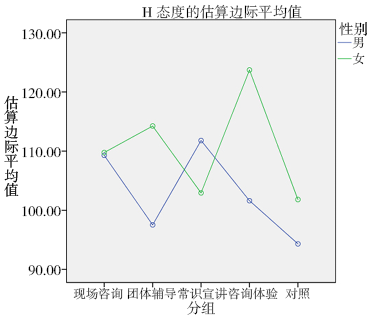
注:按下列值对模型中出现的协变量进行求值:年龄等级=1.25,来源=2.47,专业类型=1.58,年级=1.09。
图 1 处理方式与性别的交互作用
Figure 1 Interaction between treatment method and gender
进一步分析处理方式与年龄在社会容认度上的交互作用发现,在团体辅导组和咨询体验组中,年轻一些的大学生比年长一些的大学生对心理求助行为的容认度更大些,反之,在现场咨询组和常识宣讲组中,年长一些的大学生比年轻一些的大学生对心理求助行为的容认度更大些(图2)。
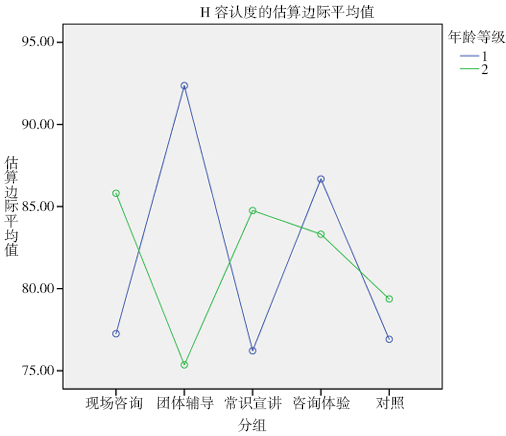
注:按下列值对模型中出现的协变量进行求值:性别=1.63,年级=1.09,来源=2.47,专业类型=1.58。
图 2 处理方式与年龄的交互作用
Figure 2 Interaction between treatment method and age
4 讨论
在本研究中,从总体的干预效果来看,实验组大学生对心理求助行为的容认度显著增强,对寻求专业心理帮助的积极态度也显著提高。这表明,依据“表现原理”实施的角色扮演干预方法确实可以通过先改变被试外在的行为,使其表现出对专业求助的认同接纳,进而显著地改善其内在的社会容认度和态度。
对不同处理方式的5个组(4个实验组与1个对照组)前后测方差分析结果除了印证配对样本T检验的结果之外,更直观地向我们展示出:4个实验组与1个对照组在活动开始之前,在对心理求助行为的社会容认度方面和对寻求专业心理帮助的态度方面都没有显著差异。接受为期1个月的实验干预之后,这一切就发生了明显的改变,实验组大学生的社会容认度和态度都发生了显著积极改变,特别是对寻求专业心理帮助的态度与对照组形成了显著或极显著的差异。
需要注意的是,在实施干预之后,现场咨询组(均值差异3.138±2.965,Sig.=0.292)与常识宣讲组(均值差异.419±3.473,Sig.= 0.904)与对照组相比,虽然在社会容认度方面确实有一定提升,但并没有达到统计显著水平。现场咨询组可能是因为样本量(n=24)不够或测量过程中的某些失误所致,可是常识宣讲组的提升就非常有限,几乎与对照组没有什么差别,分析原因可能有两个:一是常识宣讲就是一种常规的宣传方式,只是从听者的角色转变为讲授者角色,这种角色互换对于大学生来说并没有太大的角色改变感,从而导致实验效果不明显;二是,从后面的交互效应可以看出,女性大学生在常识宣讲干预方式上反应几乎与她们在对照组的反应相同,然而常识宣讲组成员17人中有11人为女生,从而影响了数据的整体效应。正是因为常识宣讲组对于社会容认度的提升效果几乎接近对照组,所以在实验组中的团体辅导与常识宣讲组之间表现出显著的差异就可以理解了。
有关不同干预方式与人口变量的交互作用分析中,我们发现在寻找专业心理帮助的态度方面,处理方式与性别发生了显著的交互作用,这同时说明在态度方面是存在显著性别差异的,这一发现与以往的研究结果一致(Amy L & Demyan ,2012)。深入分析发现,对于这4中角色扮演干预方式,女大学生对“团体辅导”和“咨询体验”这类情感感受卷入较多的角色更加敏感,容易投入并发生相应的内在改变,而男性大学生则对于“常识宣讲”这类理性思维卷入较多的角色更加敏感,容易投入并发生相应的内在改变。
研究还发现,心理求助行为的社会容认度方面,处理方式与年龄也发生了显著的交互作用。接受“团体辅导”干预的年长者的社会容认度不仅显著低于年长者在其他干预方式下的表现,甚至低于年长者在对照组中的接纳度。相反,年轻者接受“团体辅导”干预后,对心理求助行为的接纳度远高于其他年轻者在其他组的反应。这可能与“团体辅导”干预方案的游戏性、感受性、活动性这些特点有关,年长者(25~35岁)可能认为‘团体辅导’干预方案中的活动形式较为简单或偏重体验性,参与积极性相对较低,甚至可能产生与自身年龄不符的感受。然而,“团体辅导”干预方式的这些特点正好符合年轻者(21~24岁)的口味。交互作用分析的结果明确告诉我们,对于不同性别和年龄段的大学生,需要根据其特点实施更有针对性的角色扮演方式去提高他们的心理求助意识。
本研究结果虽然很好地验证了研究假设,但还是存在一些局限。首先,被试是通过招募心理健康月活动志愿者得到的,同时通过个人选择的方式分配到4个实验组和1个对照组,这些都没能保证实验的随机性原则,使结果的推广性受到限制。其次,各实验组样本量过少,特别是在进行两两对比分析时,常会因为样本量不足而导致结果不显著。还有,仅仅研究了角色扮演方式在一个月的间隔期内对内在的社会容认度和态度转变的影响,没有进行更长时间的追踪研究。后续的研究,需要尽量采取办法实现随机取样,并加大样本量,提升研究的效果和推广度。同时进一步考察运用表现原理方法的变式,根据不同的性别和年龄等要素灵活采用更有效的方法。还要进行追踪研究设计,探讨表现原理用于提高大学生心理求助意识的稳定性。
参考文献
[1] 赵丽, 江光荣, 王英. (2011).大学生心理咨询信任度及与专业求助意向的关系. 中国心理卫生杂志, 25(4), 249-253.
[2] Mechanic D N. (1968). General medical Practice in Englandand Wales:Its organization and future. Engl J Med, 279(13), 680-689.
[3] 李盈. (2015). 大学生专业心理求助态度的影响因素及干预研究——自尊的中介作用 (硕士学位论文). 华中师范大学.
[4] Flisher A J &DeBeer J P. (2002).Characteristics of students receiving counseling services at the university of CaPe Town, South Africa. British Journal of Guidance & CounSelling, 30(3), 299-320.
[5] 肖世君. (2017). 大学生心理疾病污名、自我效能感和专业心理求助态度的关系研究 (硕士学位论文). 四川师范大学.
[6] Tucker J R,Hammer J H,Vogel D L,Bitman R L,WadeN G & Maier E J. (2013). Disentangling self-stigma: Are mental illness and help-seeking self-stigmas different. Journal of counseling psychology, 60(4), 520.
[7] 张经纬. (2020). 大学生心理求助污名与心理求助态度的关系及干预研究 (硕士学位论文). 天津医科大学.
[8] 许艾静. (2020). 基于心理健康课程的大学生心理健康素养干预研究 (硕士学位论文). 华中师范大学.
[9] Amy L Demyan, Timothy Anderson. (2012). Effects of a Brief Media Intervention on Expectations, Attitudes,and Intentions of Mental Health Help Seeking. Journal of Counseling Psych- ology, 59(2), 222-229.
[10] 郝志红. (2009). 寻求专业性心理帮助的预测模型与干预实验 (博士学位论文). 天津师范大学.
[11] (英) 理查德·怀斯曼. (2012). 正能量 (李磊 译). 湖南文艺出版社.
[12] Hill A,Rand D,Nowak M& Christakis N.(2010). Emotions as infectious diseases in a large social network: the SISa model. Proceedings of the Royal Society B: Biological Sciences, 277(1701), 3827-35.
[13] Koch S C.(2011). Basic body rhythms and embodied intercorporality: From individual to interpersonal movement feedback. In W Tschacher & C Bergomi (eds.).The implications of embodiment: Cognition and communication, 151-171.Exeter: Imprint Academic.
[14] Richard Wiseman. (2012). Rip it up. Macmillan Publishers Limited. London.
[15] JamesW. (1899). The Gospel of Relaxation. Scribner’s.
[16] 余敏. (2012). 《政治生活》模块角色扮演教学研究 (硕士学位论文). 南京师范大学.
[17] 方丽.(2016). 角色扮演教学法及其有效策略的研究 (硕士学位论文). 南京师范大学.
[18] (美) 戴维·迈尔斯. (2016).社会心理学 (侯玉波 等译). 人民邮电出版社.
[19] 夏勉, 江光荣. (2007). 归因, 自我效能和社会容认度对心理求助行为的影响. 心理学报, 39 (5), 892 -900.
[20] 郝志红, 梁宝勇. (2007). 关于寻求专业性心理帮助的态度问卷的修订.中国临床心理学杂志, (15), 1-9.