Current Views: 2518115
 Current Downloads: 1566130
Psychology of China
ISSN Print:2664-1798
ISSN Online:2664-1801
Contact Editorial Office



Subscribe to the latest published information from SCISCAN
金钱能买来幸福?炫耀性消费视角下社会排斥与居民幸福感的关系研究
Can Money Buy Well-being? Research on the Relationship between Social Exclusion and Residents’ Well-being from the Perspective of Conspicuous Consumption


-
Information:
1.济南市长清第一中学,济南;
2.曲阜师范大学 心理学院,曲阜
-
Keywords:
Social exclusion; Subjective well-being; Sense of belonging; Conspicuous consumption; Moderated mediation effect社会排斥; 主观幸福感; 归属感; 炫耀性消费; 有调节的中介效应
- Abstract: Social exclusion has long been regarded as a negative factor affecting individuals’ subjective well-being. To explore the mechanism through which social exclusion influences subjective well-being, this study surveyed 497 residents in Shandong Province, examining variables such as social exclusion, sense of belonging, subjective well-being, and conspicuous consumption. The results showed a significant negative correlation between social exclusion and subjective well-being. Social exclusion not only further affected subjective well-being by reducing the sense of belonging, but conspicuous consumption also negatively moderated the negative impact of social exclusion on the sense of belonging. Specifically, conspicuous consumption negatively moderated the first half of the mediation process. This study indicates that conspicuous consumption can enhance residents’ subjective well-being by mitigating the negative effect of social exclusion on the sense of belonging, suggesting that conspicuous consumption plays a positive moderating role in the process through which social exclusion affects residents’ subjective well-being. 社会排斥一直被认为是影响个体幸福感的消极因素。为了探讨社会排斥对人们主观幸福感的影响机制,本研究以497名山东居民为研究样本,调查了社会排斥、归属感、主观幸福感以及炫耀性消费等相关变量。研究结果显示,社会排斥与主观幸福感之间呈显著负相关,社会排斥不仅会通过降低归属感进一步影响主观幸福感,而且炫耀性消费负向调节了社会排斥对归属感的负向影响,即炫耀性消费负向调节了这一中介过程的前半路径。本研究表明炫耀性消费可以通过降低社会排斥对归属感的消极影响来提高居民的主观幸福感,即炫耀性消费在社会排斥影响居民主观幸福感的过程中扮演着积极的调节作用。
- DOI: 10.35534/pc.0805095
- Cite: 曹修凤, 张誉桦, 陈薪米, 魏祥迁. (2026). 金钱能买来幸福?炫耀性消费视角下社会排斥与居民幸福感的关系研究. 中国心理学前沿, 8 (5), 633-641.
1 引言
自古以来,人类一直在探索和追求幸福。无论是古代智者对幸福本质的讨论,还是现代人被问及“你幸福吗”的多元诉求,都表明幸福是人类永恒的追寻目标。在当代心理学研究中,幸福感已经被确立为衡量个体适应状态与生活质量的关键指标之一,同时作为跨文化研究的有效指标,被广泛应用于国民生活质量与社会发展水平的国际比较研究中(蔡华俭 等,2020)。
幸福感是指个体基于自身生存状态与发展需求的认知评估而产生的一种综合性的积极心理体验,是满意感、快乐感与价值感三个核心维度的有机统一(邢占军,张干群,2019)。为了更好地提高人们的主观幸福感,有必要对人们主观幸福感的影响因素及其作用机制进行探讨。当前社会虽然更加强调人与人之间应当和谐相处,但在日常生活中,人们还是会遇到多种形态的社会排斥,如忽视、歧视、辱骂、欺凌、同侪排斥等。社会排斥是一个多维度、跨领域的综合性概念,其涵盖社会、经济、政治等多个层面,是社会学、社会政策研究者都非常关注的话题(王静,范秀成,2017;杨晓莉,魏丽,2017)。心理学的研究表明社会排斥是主观幸福感的重要影响因素之一,如感知到社会排斥会导致居民主观幸福感水平下降,且社会排斥还可以通过社会认同和控制感的链式中介作用间接影响个体的主观幸福感(邵蕾 等,2017)。
然而,目前鲜有研究从社会心理学视角下的社会补偿理论来讨论社会排斥与主观幸福感的关系。为此,本研究拟从社会排斥对居民主观幸福感的影响入手,探讨社会排斥、归属感、炫耀性消费与主观幸福感的关系,重点探讨炫耀性消费的调节作用,即炫耀性消费是否可以在一定程度上削弱社会排斥对个体主观幸福感的负面影响,从而有助于理解居民采用炫耀性消费行为以提升其主观幸福感的合理性。
2 理论基础与研究假设
2.1 社会排斥与主观幸福感
社会排斥是指个体或群体由于遭受外部社会成员或社会团体的主动拒绝或消极忽视,导致其归属需求与关系需求无法满足、需求获得受到阻碍的一个社会互动现象与过程(杨晓莉,魏丽,2017;杜建政,夏冰丽,2008)。基于社会规范理论,这一现象具有适应性功能,即通过规范强化机制对偏离群体期望的个体施加社会压力,从而促使其行为重新符合群体的规范,并回到原先归属的群体中,具有一定的进化价值(邵蕾 等,2017)。不过值得注意的是,长期遭受社会排斥会导致个体的群体认同降低,并引发一些消极后果。例如,个体为了满足归属需求而加入某个极端组织(如邪教),或者采取报复行为,威胁社会安全(Scott & Duffy,2015)。此外,社会排斥还会损害个体的基本心理需求(如归属感、存在感、控制感、自尊等),增加个体的负面情绪,并对心理健康、人际关系、社会适应等产生消极影响(蔡强 等,2011;彭苏浩 等,2019;Mendes et al.,2008)。
主观幸福感指的是个体基于自身内在评价标准对其生活中的主观或客观因素进行的整体性认知评估,是一个综合性与稳定性并存的心理指标,包括生活满意度、积极情绪和消极情绪三个动态关联、交互作用的成分(Diener & Ryan,2009)。社会排斥对个体的主观幸福感具有显著的负向影响,如师保国等(2009)针对流动儿童群体的研究发现,个体感知到的社会排斥水平能够显著负向预测其幸福感水平。这一发现在更广泛的人群样本中得到了验证;邵蕾等(2020)针对我国居民的研究进一步证实了社会排斥直接负向预测个体的主观幸福感水平。
基于以上论述,提出研究假设H1:社会排斥负向预测居民的主观幸福感。
2.2 社会排斥与主观幸福感:归属感的中介作用
作为一种消极的人际互动经历,社会排斥会对被排斥者的身心健康产生负面影响(陈建 等,2018);若工作中的员工感受到社会排斥,那么其工作幸福感较低(刘长在 等,2020)。Williams等人整合大量社会排斥的心理与行为实证研究,根据排斥后个体心理行为变化的阶段性与差异性,提出了“需要—威胁的时间模型”。其核心是社会排斥能降低个体的四种基本需要:归属感、控制感、自尊和存在意义感(Williams,2009),这直接削弱了个体获得幸福感的心理基础。只有当个体的需要得到满足或目标得以实现时,个体的主观幸福感才会提升。
人是一种社会性物种,天生就具有社会归属的需求(Baumeister & Leary,2017),表现为渴望归属某一社会团体、希望被社会团体接纳、且能够与他人形成积极、稳定、持久的社会关系(杜建政,夏冰丽,2008)。当个体遭遇社会排斥时,其关系需求和归属感就无法得到满足,这不仅会导致自我怀疑,给个体的行为和情绪带来消极影响,更会直接使人们感到社会归属感受损(王静,范秀成,2017)。有研究表明,缺乏归属感的学生,对其生活感到不满,无法体验到幸福感(王曦 等,2016);相反,当个体感知到被社会接纳或支持时,如社交媒体帖子获得较多点赞,其主观幸福感会显著提升(衡书鹏 等,2020),强烈的归属感能促进积极社交关系的形成,进而提升个体的主观幸福感(袁文萍 等,2021)。
基于以上文献分析,归属感可能是社会排斥与居民主观幸福感之间的一个中介变量。因此,提出研究假设H2:归属感在社会排斥与主观幸福感的关系中起中介作用,即社会排斥通过降低个体的归属感而影响其主观幸福感。
2.3 社会排斥与归属感:炫耀性消费的调节作用
社会排斥会导致受排斥者产生心理失调,受排斥者可以通过不同的行为反应来缓解感受到威胁的心理需求(Lee & Shrum,2012)。为此,对社会排斥能够引发个体行为反应的探讨,逐步延伸到消费者行为领域(丁瑛,宫秀双,2016),该领域认为消费行为是个体应对威胁的关键途径之一(金晓彤 等,2017)。当面对自我威胁(如丧失归属感,遭受社会排斥)时,个体选择通过消费行为逃避自我威胁或进行自我修复(孙洪杰 等,2021),比如当个体遭受到社会排斥时,会选择通过炫耀性消费(如奢侈品消费)来进行自我修复(Mazzocco et al.,2012)。
基于补偿性消费理论,炫耀性消费是个体对自身内在心理缺失(如低归属感)的一种补偿方式,通过购买和展示昂贵的商品来获得心理上的平衡与满足(郑晓莹,彭泗清,2014)。当社会排斥损害个体的归属感时(Williams,2009),为了降低归属感缺失带来的自我威胁,被拒绝的个体会优先采取关系补偿行为,这促使他们采取以重建归属感为核心的关系补偿行为,比如炫耀性消费(Lee & Shrum,2012)。炫耀性消费行为之所以能够帮助个体应对自我威胁(Ma et al.,2019),是因为人们将物品视为自我延伸的一部分(Belk,1988),具有彰显和修复自我的象征性和符号性价值(Koles et al.,2018)。因此,作为一种补偿性消费,炫耀性消费能够弥补社会排斥对个体造成的消极影响。
综上所述,炫耀性消费可能在社会排斥和归属感之间起调节作用。具体而言,当个体遭受社会排斥时,炫耀性消费能够缓冲社会排斥对归属感的负面影响。因此,提出研究假设H3:炫耀性消费在社会排斥与归属感之间起负向调节作用,即在高水平炫耀性消费水平下,社会排斥对归属感的负面影响会显著减弱;在低水平炫耀性消费水平下,社会排斥对归属感的负面影响会显著增强。
综合上述文献分析,提出有调节的中介效应假设,即研究假设H4:炫耀性消费负向调节归属感在社会排斥对主观幸福感影响的中介作用,如图1所示。
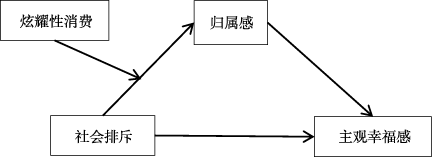
图 1 有调节的中介效应模型
Figure 1 The moderated mediation model
3 研究方法
3.1 研究被试
采用分层随机抽样方法对山东省户籍居民进行样本采集。根据鲁东、鲁中、鲁西北、鲁西南四个区域,将山东省16个地级市划分为四个片区,本研究从这四个区域中分别选择威海、潍坊、滨州、济宁四个城市的户籍居民为样本群。利用问卷星共计收集到了632份样本问卷。根据“平均每题作答时长不少于2s”、指令性测谎题、有无规律性作答等标注(Curran,2016),剔除了135份无效问卷,最终获得497份有效数据,有效率78.64%。其中威海户籍居民173人(34.809%),潍坊户籍居民102人(20.523%),滨州户籍居民116人(23.340%),济宁户籍居民106人(21.328%);男性250人(50.302%),女性247人(49.698%);城镇户口人数302人(60.765%),农村户口人数195人(39.235%);未婚人数212人(占42.656%),已婚人数256人(占51.509%),其他婚姻状况29人(5.835%)。
3.2 研究工具
3.2.1 社会排斥
社会排斥的测量是采用Carter-Sowell于2010年编制的社会排斥体验量表。该量表由邵蕾等人进行了精细的翻译和本土化修订(邵蕾 等,2020),量表包含8个题目,每个题目采用Likert 7点计分1代表“从未如此”,7代表“总是如此”。量表得分越高,表明个体感受到的社会排斥感越强烈。该量表在本研究中的克隆巴赫α系数为0.913。
3.2.2 主观幸福感
主观幸福感的测量采用美国心理学家Diener及其同事开发的多项目总体满意感量表(Diener et al.,1985)。该量表包含5个项目,旨在综合评估个体对生活各方面(如工作、家庭、健康、社会关系等)的满意度。本研究采用Likert 7点计分法,1代表“非常不满意”,7代表“非常满意”。量表得分越高,表明个体感受到的幸福感越高。该量表在本研究中的克隆巴赫α系数为0.861。
3.2.3 归属感
归属感的测量采用Leary和Baumeister编制的归属需要量表。该量表中文修订版已在我国广泛使用(刘霞 等,2013),共包括10个项目,其中有3个题目为反向计分题,如“如果别人拒绝我,我不会因此而烦恼”。本研究使用Likert 7点计分法,从1“完全不符合”到7“完全符合”,量表得分越高,表示个体的归属需要程度越高。量表在本研究中的克隆巴赫α系数为0.919。
3.2.4 炫耀性消费
炫耀性消费的测量采用陈旭编制的炫耀性消费倾向量表(陈旭,2009),包含13个题目,旨在评估个体在消费行为中展示财富和地位的倾向。这一倾向可能源于个体对社会地位的渴望,或是希望通过消费行为来获得他人的认可和赞赏。本研究采用Likert 5点计分法,1代表“完全不同意”,5代表“完全同意”。量表得分越高,表明被试越倾向于进行炫耀性消费,即在消费时更可能选择可以展示财富和地位的商品。该量表在本研究中的克隆巴赫α系数为0.938。
3.3 统计方法与共同方法偏差检验
采用SPSS 27.0统计软件及PROCESS 4.2插件对数据进行分析。首先,通过Harman单因素检验,对所有变量进行探索性因素分析。分析采用主成分分析法。结果显示,特征根大于1的因子共提取出4个,其中第一主成分的方差解释率为24.057%,低于40%的临界标准,表明不存在严重的共同方法偏差问题。随后,运用Bootstrap抽样法(重复抽样5000次)分别检验简单中介效应和简单调节效应的显著性。最终,基于PROCESS 4.2插件对有调节的中介效应模型进行检验,所有分析均采用偏差校正的95%置信区间进行统计推断。
4 研究结果
4.1 描述性统计分析
各研究变量的均值、标准差和相关系数如表1所示。社会排斥与归属感之间存在显著的负相关(r = -0.333,
p < 0.01),社会排斥与主观幸福感之间也呈显著的负相关(r = -0.449,p < 0.01),而归属感与主观幸福感之间呈显著的正相关(r = 0.411,p < 0.01)。但是,炫耀性消费与社会排斥(r = 0.013,p > 0.05)、归属感
(r = -0.075,p > 0.05)以及主观幸福感(r = -0.031,p > 0.05)的相关均不显著。
表 1 各研究变量的平均数、标准差与相关系数(n = 497)
Table 1 Means, SDs and correlations among study variables (n = 497)
| 1 | 2 | 3 | 4 | 5 | 6 | 7 | 8 | 9 | 10 | |
| 1性别 | 1 | |||||||||
| 2户口 | -0.075 | 1 | ||||||||
| 3婚姻状况 | -0.055 | -0.033 | 1 | |||||||
| 4学历 | 0.058 | -0.012 | -0.109* | 1 | ||||||
| 5月收入 | 0.002 | 0.044 | 0.399** | 0.221** | 1 | |||||
| 6职业 | 0.004 | -0.051 | 0.391** | -0.244** | 0.535** | 1 | ||||
| 7社会排斥 | -0.043 | -0.049 | 0.007 | 0.006 | -0.006 | 0.057 | 1 | |||
| 8归属感 | -0.006 | -0.028 | -0.023 | -0.041 | 0.041 | 0.046 | -0.333** | 1 | ||
| 9主观幸福感 | -0.014 | -0.021 | -0.045 | -0.059 | -0.003 | -0.001 | -0.449** | 0.411** | 1 | |
| 10炫耀性消费 | -0.006 | -0.035 | 0.001 | -0.073 | -0.012 | 0.036 | 0.013 | -0.075 | -0.031 | 1 |
| 平均值 | 1.497 | 1.608 | 1.632 | 3.064 | 3.694 | 3.501 | 3.809 | 4.272 | 4.238 | 2.718 |
| 标准差 | 0.500 | 0.489 | 0.592 | 1.190 | 1.342 | 1.314 | 1.233 | 1.153 | 1.198 | 0.839 |
注:*p < 0.05,**p < 0.01,***p < 0.001,下同。
4.2 归属感的中介效应检验
为了排除性别、户口类型、婚姻状况、教育水平、月收入以及职业等潜在因素对结果变量的影响,本研究将这些变量纳入控制变量进行统计控制,考察预测变量(社会排斥与归属感)对结果变量(主观幸福感)的影响。对所有研究变量进行中心化处理后,使用PROCESS插件的Model 4模型检验归属感的中介作用,结果如表2和图2所示。
在表2的模型一中,社会排斥对主观幸福感的负向预测作用显著(β= -0.453,p < 0.001),H1得到了验证。纳入中介变量(归属感)后,表2模型二的结果显示:归属感显著正向影响主观幸福感(β= 0.287,p < 0.001),而社会排斥对主观幸福感的直接作用仍显著(β= -0.356,p < 0.001)。这说明归属感起到部分中介作用,其中介效应为21.41%。
表 2 归属感的中介效应检验(n = 497)
Table 2 Testing the mediating effect of sense of belonging (n = 497)
| 因变量 | 主观幸福感 | 归属感 | ||||
| 模型一 | 模型二 | 模型三 | ||||
| β | SE | β | SE | β | SE | |
| 性别 | -0.038 | 0.081 | -0.030 | 0.092 | -0.026 | 0.085 |
| 户口 | -0.049 | 0.083 | -0.035 | 0.094 | -0.049 | 0.088 |
| 婚姻状况 | -0.071 | 0.077 | -0.052 | 0.075 | -0.069 | 0.081 |
| 学历 | -0.064* | 0.039 | -0.052 | 0.038 | -0.044 | 0.041 |
| 月收入 | 0.029 | 0.041 | 0.015 | 0.038 | 0.049 | 0.043 |
| 职业 | 0.019 | 0.041 | 0.004 | 0.041 | 0.053 | 0.043 |
| 社会排斥 | -0.453*** | 0.040 | -0.356*** | 0.039 | -0.339*** | 0.043 |
| 归属感 | 0.287*** | 0.042 | ||||
| R2 | 0.212 | 0.284 | 0.122 | |||
| △R2 | 0.072*** | |||||
| F | 18.765*** | 24.214*** | 9.731*** | |||
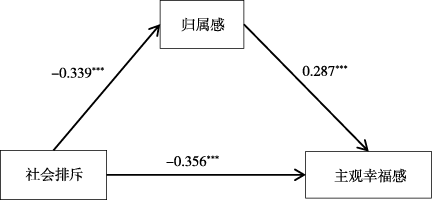
图 2 归属感的中介作用
Figure 2 The mediating role of sense of belonging
基于5000次Bootstrap法抽样的中介效应检验结果如表3所示。总效应在95%的置信区间为[-0.532,-0.374]。由于该偏差矫正的百分位置信区间未包含零值,说明总效应存在,即社会排斥对主观幸福感存在负相关关系,效应量为-0.453;中介效应(社会排斥→归属感→主观幸福感)在95%的置信区间为[-0.134,-0.066],没有包含0,说明间接效应存在,即归属感是社会排斥和主观幸福感的一个中介变量,效应量为-0.097;直接效应在95%的置信区间为[-0.436,-0.275],也没有包含0,说明直接效应也存在,效应量为-0.356。综上,归属感在社会排斥对主观幸福感的影响中起部分中介作用,即社会排斥通过降低个体的归属感来影响其主观幸福感,验证了H2。
表 3 Bootstrap对归属感的中介效应的检验结果
Table 3 Bootstrap test results for the mediating effect of sense of belonging
| Effect | SE | t | LLCI | ULCI | |
| 总效应 | -0.453 | 0.040 | -11.219*** | -0.532 | -0.374 |
| 直接效应 | -0.356 | 0.041 | -8.688*** | -0.436 | -0.275 |
| 间接效应 | -0.097 | 0.017 | \ | -0.134 | -0.066 |
4.3 炫耀性消费的调节作用检验
本研究采用PROCESS插件中的Model 1检验炫耀性消费在社会排斥和归属感之间的调节效应。本研究将性别、户口类型、婚姻状况、教育水平、月收入,以及职业等人口学变量纳入控制变量进行统计控制。运用PROCESS程序处理数据时,在选项中选择对全部数据进行中心化处理,统计结果如表4
所示。
表 4 炫耀性消费的调节作用(n = 497)
Table 4 The moderating effect of conspicuous consumption (n = 497)
| 预测变量 | 归属感 | |||||
| 模型一 | 模型二 | 模型三 | ||||
| β | SE | β | SE | β | SE | |
| 性别 | -0.009 | 0.090 | -0.026 | 0.085 | -0.023 | 0.085 |
| 户口 | -0.034 | 0.093 | -0.051 | 0.088 | -0.056 | 0.087 |
| 婚姻状况 | -0.066 | 0.086 | -0.070 | 0.081 | -0.072 | 0.081 |
| 学历 | -0.060 | 0.044 | -0.049 | 0.041 | -0.052 | 0.041 |
| 月收入 | -0.073 | 0.046 | 0.049 | 0.043 | 0.052 | 0.043 |
| 职业 | -0.017 | 0.046 | 0.055 | 0.043 | 0.053 | 0.043 |
| 社会排斥 | -0.338*** | 0.043 | -0.338*** | 0.042 | ||
| 炫耀性消费 | -0.077 | 0.042 | -0.078 | 0.042 | ||
|
社会排斥*炫耀性消费 |
0.095* | 0.042 | ||||
| R2 | 0.009 | 0.128 | 0.137 | |||
| △R2 | 0.009 | 0.120*** | 0.009* | |||
| F | 0.717 | 8.971*** | 8.606*** | |||
从表4模型二的数据来看,炫耀性消费本身对归属感的直接效应在统计上并不显著(β= -0.077,p > 0.05),但是表4模型三显示社会排斥与炫耀性消费的交互项对归属感的影响是显著的,其标准化回归系数显著(β= 0.095,p < 0.05),这说明炫耀性消费在社会排斥与归属感的关系中起着负向调节作用。这一结果表明,个体的炫耀性消费会减弱社会排斥对归属感的负面影响。据此,H3得到了研究数据的
支持。
为了进一步揭示调节效应的实质,本研究采用27%极端分组法对调节变量进行分组。具体而言,将被试在该变量上的得分按升序排列,将得分分布前27%的被试划分为高分组,得分分布后27%的被试划分为低分组。这样把社会排斥分成高社会排斥组与低社会排斥组,把炫耀性消费分成高炫耀性消费组与低炫耀性消费组,然后进行两因素方差分析,方差分析的结果显示交互项的交互效应显著(F=5.928,p < 0.05)。炫耀性消费的调节效应图如图3所示。
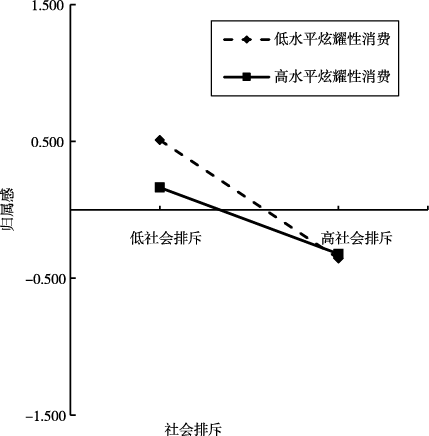
图 3 炫耀性消费对社会排斥和归属感间调节作用
Figure 3 The moderating role of conspicuous consumption on social exclusion and sense of belonging
图3中高炫耀性消费组与低炫耀性消费组的两条线斜率不同,高炫耀性消费组的斜率绝对值更小
(k = -0.234),低于低炫耀性消费组的斜率绝对值(k = -0.700),说明高水平炫耀性消费比低水平炫耀性消费更能有效抑制社会排斥对归属感的负向影响。而通过LSD法进行简单效应分析,结果显示:在低炫耀性消费下,低社会排斥组的归属感得分显著高于高社会排斥组,两者的差异值为1.406(p < 0.001);在高炫耀性消费下,低社会排斥组与高社会排斥组的归属感得分差异不显著,两者的差异值为0.471(p > 0.05)。这一结果说明了,尽管在高低两种炫耀性消费情况下,炫耀性消费都会抑制社会排斥对归属感的负向影响,但是只有在高炫耀性消费水平下,炫耀性消费可以有效降低社会排斥对归属感的消极影响,即高社会排斥组的归属感得分与低社会排斥组的归属感得分没有差异。因此,炫耀性消费有助于减弱社会排斥对个体归属感的消极影响,尤其是高炫耀性消费可以有效抑制社会排斥对归属感所产生的负面影响。
总之,本研究进一步证明了炫耀性消费是个体对自身内在心理缺失的一种补偿方式,可以通过购买和展示昂贵商品来获得心理上的满足和平衡(郑晓莹,彭泗清,2014)。这一研究结果说明了炫耀性消费在社会排斥对个体心理产生负面影响中所扮演的积极意义。
4.4 有调节的中介效应检验
为了进一步检验炫耀性消费对归属感这一中介效应的调节作用,本研究采用PROCESS插件中的Model 7进行数据分析。控制变量为性别、户口类型、婚姻状况、教育水平、月收入,以及职业等人口学变量。为了降低多重共线性的潜在影响,本研究对所有预测变量(社会排斥、归属感、炫耀性消费)实施了中心化处理,统计结果如表5所示。
表 5 不同炫耀性消费水平下的间接效应及其差异
Table 5 Indirect effects and their differences at different levels of conspicuous consumption
| 炫耀性消费 | 间接效应 | Boot SE | 95% CI下限 | 95% CI上限 |
| 高炫耀性消费 | -0.070*** | 0.021 | -0.115 | -0.034 |
| 低炫耀性消费 | -0.124*** | 0.023 | -0.171 | -0.082 |
| 差异 | 0.055*** | 0.026 | 0.003 | 0.108 |
由表5可知,在高炫耀性消费水平下,社会排斥通过归属感对主观幸福感的间接效应显著,间接效应值为-0.070(p<0.001),95%的置信区间为[-0.115,
-0.034];在低炫耀性消费水平下,社会排斥通过归属感对主观幸福感的间接效应是显著的,间接效应值为-0.124(p<0.001),95%的置信区间为[-0.171,-0.082]。另外,高低两水平之间的间接效应差异显著,差异值为0.055(p<0.001),95%的置信区间为[0.003,0.108],表明炫耀性消费调节社会排斥对主观幸福感的间接影响。H4得到了验证,即归属感在社会排斥与主观幸福感的关系中充当中介变量的角色,而炫耀性消费在这一中介过程中起到了调节作用。换言之,炫耀性消费通过改变社会排斥对归属感的影响强度,间接地影响了居民的主观幸福感。根据上述研究结果,绘制了有调节中介效应图如图4所示。
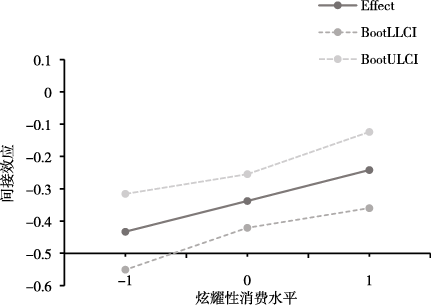
图 4 有调节的中介效应
Figure 4 The moderated mediation effect
5 研究意义与展望
社会排斥作为一种负性的社会互动体验,会对被排斥者的基本心理需求产生显著的负面影响。当个体遭遇社会排斥时,可能会因无法建立或维持良好的人际关系而产生心理困扰,为应对这种社会排斥情境,被排斥者往往会通过主动调整自身行为或社会表现策略,以提升其社会吸引力和人际接纳度,从而促进社会关系的修复和群体再融入。
本研究从补偿性消费理论的视角出发,考察了社会排斥对居民主观幸福感的影响及其作用机制。值得注意的是,该影响机制既可以通过直接路径实现,亦可经由中介路径来实现(邵蕾 等,2020)。具体来说,社会排斥可以通过降低居民的归属感而降低其主观幸福感,而炫耀性消费不仅负向调节社会排斥与归属感之间的关系,即简单的调节效应结果显示是高炫耀性消费能抑制社会排斥对归属感的负面影响;而且在社会排斥通过归属感影响主观幸福感的中介机制中起到负向调节作用,即相较于高炫耀性消费的个体,这一间接效应对低炫耀性消费水平的个体影响更大。
5.1 研究意义
首先,本研究的理论意义在于从炫耀性消费的视角,明确了社会排斥对居民主观幸福感的影响机制,尤其是居民的炫耀性消费可以通过提升个体的归属感减少社会排斥对居民幸福感的消极影响。因此,本研究不仅深入揭示了居民受到的社会排斥对其幸福感的消极影响,而且进一步说明了居民进行炫耀性消费的积极意义。炫耀性消费可能是个体对自身内在心理缺失(如低自尊、低社会地位感等)的一种补偿方式(郑晓莹,彭泗清,2014)。作为一种重要的补偿性消费形式,居民实施炫耀性消费行为具有重要的心理价值。居民通过实施炫耀性消费可以重塑其心理归属感,进而提升其幸福感,有效补偿来自外界的社会排斥对其幸福感的消极影响。
其次,本研究具有重要的实践价值。本研究的实证结果揭示了心理补偿是消费行为背后的重要动机,为解释非功能性消费行为提供新的理论视角,有助于改变人们对炫耀性消费的偏见,应从更正面的视角认识炫耀性消费对个体心理所带来的积极意义。(1)从个体的角度来看,研究有助于个体提升自身的归属感和幸福感。长期处于社会排斥状态不利于居民的身心健康,本研究为人们提供了一种降低社会排斥负面影响的外在行为方式,即炫耀性消费。炫耀性消费行为不仅仅是花钱消费那么简单,而且可以有效帮助人们减轻社会排斥所带来的心理负担,提高个人归属感,进而提升生活的幸福感。(2)从营销角度来看,研究有助于商家了解居民的消费喜好,尤其是商品为消费者带来的心理价值(归属感)。例如,针对特定群体的定制化产品,或是建立能够增强社区联结的活动和平台,都能够帮助人们获得更强的归属感。
5.2 研究展望
本研究从补偿消费理论的视角,探究了炫耀性消费对居民基本心理需要的积极影响,检验了炫耀性消费是降低居民受到的社会排斥对其幸福感产生消极影响的边界条件。但是,本研究依然存在如下问题需要在今后研究中改进:(1)本研究采用横断研究方法探讨变量间的关系,无法确定研究变量之间的因果关系。未来研究可以采用纵向研究设计,追踪个体在不同时间点的变化,以探究社会排斥、归属感以及主观幸福感等变量间的因果关系。(2)本研究只选取了部分山东省居民作为研究被试,研究结论的外部效度不高,结论的推广还需要谨慎。未来研究可以考虑从全国范围内选择研究被试进行调查。(3)本研究只考察了炫耀性消费在社会排斥与归属感对主观幸福感影响的有调节的中介效应。未来研究可以探究其他调节变量的影响效应,例如人格特征、应对方式、社会支持等。
参考文献
[1] 蔡华俭, 黄梓航, 林莉, 等. (2020). 半个多世纪来中国人的心理与行为变化——心理学视野下的研究. 心理科学进展, 28(10), 1599-1618.
[2] 邢占军, 张干群. (2019). 社会凝聚与居民幸福感. 南京社会科学, (7), 52-60.
[3] 王静, 范秀成. (2017). 社会排斥及其对消费行为影响的研究述评与展望. 消费经济, 33(6), 88-95.
[4] 杨晓莉, 魏丽. (2017). 社会排斥总是消极的吗?——影响排斥不同行为反应的因素. 中国临床心理学杂志, 25(6), 1179-1183, 1159.
[5] 邵蕾, 董妍, 冯嘉溪, 张登浩. (2020). 社会排斥对居民主观幸福感的影响: 社会认同和控制感的链式中介作用. 中国临床心理学杂志, 28(2), 234-238.
[6] 杜建政, 夏冰丽. (2008). 心理学视野中的社会排斥. 心理科学进展, (6), 981-986.
[7] Scott K L & Duffy M K. (2015). Antecedents of workplace ostracism: New directions in research and intervention. Research in Occupational Stress and Well Being, 13, 137-165.
[8] 蔡强, 吴寅, 刘金婷. (2011). 社会排斥及其神经机制. 心理研究, 4(5), 3-9.
[9] 彭苏浩, 陶丹, 冷玥, 邓慧华. (2019). 社会排斥的心理行为特征及其脑机制. 心理科学进展, 27(9), 1656-1666.
[10] Mendes W B, Major B, McCoy S, et al. (2008). How attributional ambiguity shapes physiological and emotional responses to social rejection and acceptance. Journal of Personality and Social Psychology, 94(2), 278-291.
[11] Diener E & Ryan K. (2009). Subjective well-being: A general overview. South African Journal of Psychology, 39(4), 391-406.
[12] 师保国, 徐玲, 许晶晶. (2009). 流动儿童幸福感、安全感及其与社会排斥的关系. 心理科学, 32(6), 1452-1454, 1458.
[13] 陈建, 赵轶然, 陈晨, 时勘. (2018). 社会排斥对生活满意度的影响研究: 社会自我效能感与社会支持的作用. 管理评论, 30(9), 256-267.
[14] 刘长在, 吕贺港, 孟慧. (2020). 社会自我效能感与工作幸福感和工作绩效的关系: 职场排斥的中介作用. 心理科学, 43(1), 172-179.
[15] Williams K D. (2009). Ostracism: Effects of being excluded and ignored. Advances in Experimental Social Psychology, 41, 275-314.
[16] Baumeister R F & Leary M R. (2017). The need to belong: Desire for interpersonal attachments as a fundamental human motivation. In Interpersonal development (pp. 57-89).
[17] 王曦, 于蕴淼, 陈明琪, 马靖松. (2016). 大学生学校归属感与主观幸福感关系. 中国公共卫生, 32(11), 1550-1552.
[18] 衡书鹏, 赵换方, 牛更枫, 周宗奎. (2020). 朋友圈点赞与主观幸福感的关系: 一个有中介的调节模型. 心理发展与教育, 36(3), 341-349.
[19] 袁文萍, 黎雪琼, 马磊. (2021). 高职生积极心理品质与主观幸福感的关系: 领悟社会支持和学校归属感的链式中介作用. 中国健康心理学杂志, 29(4), 615-619.
[20] Lee J & Shrum L J. (2012). Conspicuous consumption versus charitable behavior in response to social exclusion: A differential needs explanation. Journal of Consumer Research, 39(3), 530-544.
[21] 丁瑛, 宫秀双. (2016). 社会排斥对产品触觉信息偏好的影响及其作用机制. 心理学报, 48(10), 1302-1313.
[22] 金晓彤, 赵太阳, 崔宏静, 徐尉, 李广政. (2017). 地位感知变化对消费者地位消费行为的影响. 心理学报, 49(2), 273-284.
[23] 孙洪杰, 刘菲菲, 冯文婷, 崔丙群. (2021). 个体如何以消费行为应对自我威胁?基于导向—路径整合模型的分析. 心理科学进展, 29(5), 921-935.
[24] Mazzocco P J, Rucker D D, Galinsky A D, et al. (2012). Direct and vicarious conspicuous consumption: Identification with low-status groups increases the desire for high-status goods. Journal of Consumer Psychology, 22(4), 520-528.
[25] 郑晓莹, 彭泗清. (2014). 补偿性消费行为: 概念、类型与心理机制. 心理科学进展, 22(9), 1513.
[26] Ma H, Bradshaw H K, Janakiraman N, et al. (2019). Spending as protection: The need for safety increases preference for luxury products. Marketing Letters, 30(1), 45-56.
[27] Belk R W. (1988). Possessions and the extended self. Journal of Consumer Research, 15(2), 139-168.
[28] Koles B, Wells V & Tadajewski M. (2018). Compensatory consumption and consumer compromises: A state-of-the-art review. Journal of Marketing Management, 34(1/2), 96-133.
[29] Curran P G. (2016). Methods for the detection of carelessly invalid responses in survey data. Journal of Experimental Social Psychology, 66, 4-19.
[30] Diener E D., Emmons, R. A., Larsen, R. J., et al. (1985). The satisfaction with life scale. Journal of Personality Assessment, 49(1), 71-75.
[31] 刘霞, 赵景欣, 申继亮. (2013). 歧视知觉对城市流动儿童幸福感的影响: 中介机制及归属需要的调节作用. 心理学报, 45(5), 568-584.
[32] 陈旭. (2009). 虚荣特性、金钱态度对大学生炫耀性消费倾向影响的实证研究(硕士学位论文). 厦门大学.