Current Views: 2634080
 Current Downloads: 1640196
Psychology of China
ISSN Print:2664-1798
ISSN Online:2664-1801
Contact Editorial Office



Subscribe to the latest published information from SCISCAN
大学生自我控制对睡眠拖延的影响:反刍思维与负性情绪的链式中介作用
The Influence of Self-control on Sleep Procrastination among College Students: The Chain Mediating Role of Rumination and Negative Emotions


-
Information:
西南民族大学,成都
-
Keywords:
College students; Self-control; Sleep procrastination; Rumination; Negative emotions大学生; 自我控制; 睡眠拖延; 反刍思维; 负性情绪
- Abstract: This study aimed to investigate the direct impact of self-control on sleep procrastination and the chain mediating mechanism of rumination and negative emotions among college students. A total of 952 college students in Sichuan Province were investigated using the Self-Control Scale, Ruminative Response Scale, Depression Anxiety Stress Scales (DASS-21), and Sleep Procrastination Scale. The results showed that: (1) Self-control was significantly negatively correlated with rumination, negative emotions, and sleep procrastination; rumination, negative emotions, and sleep procrastination were significantly positively correlated with each other. (2) Self-control could not only directly negatively predict sleep procrastination but also exert indirect effects through three paths: the independent mediating effect of rumination, the independent mediating effect of negative emotions, and the chain mediating effect of rumination and negative emotions. The total indirect effect value was -0.066, accounting for 22.45% of the total effect. Conclusion: Low self-control can directly aggravate sleep procrastination, and also indirectly increase sleep procrastination through the chain path of “increased rumination - elevated negative emotions”. 本研究旨在探究大学生自我控制对睡眠拖延的直接影响,以及反刍思维与负性情绪在二者间的链式中介机制,采用自我控制量表、反刍思维量表、简版抑郁—焦虑—压力量表(DASS-21)、睡眠拖延量表对四川省952名大学生进行问卷调查。结果:(1)自我控制与反刍思维、负性情绪、睡眠拖延均呈显著负相关;反刍思维、负性情绪、睡眠拖延两两呈显著正相关。(2)自我控制既可直接负向预测睡眠拖延,也可通过三条间接路径产生作用:反刍思维的单独中介作用、负性情绪的单独中介作用、反刍思维与负性情绪的链式中介作用。总间接效应值为-0.066,占总效应的22.45%。结论:低自我控制可直接加剧大学生睡眠拖延,也可通过“反刍思维—负性情绪”的链式路径间接增加睡眠拖延行为。
- DOI: 10.35534/pc.0805111
- Cite: 赖益. (2026). 大学生自我控制对睡眠拖延的影响: 反刍思维与负性情绪的链式中介作用. 中国心理学前沿, 8 (5), 745-750.
1 引言
在大学生群体中,睡眠拖延已成为普遍且突出的健康行为问题。睡眠拖延(Bedtime Procrastination)指个体在不存在外部客观阻碍的前提下,仍自主推迟预先计划的入睡时间的行为现象(Kroese et al.,2014)。国内研究进一步结合本土情境将其界定为无不可抗因素干扰下的入睡时间延迟,区别于由失眠、环境突变、紧急任务等引发的被动晚睡(许宴菁,2017)。《2024中国居民睡眠健康白皮书》数据显示,超过五成大学生入睡时间晚于零点,近两成拖延至凌晨两点以后,长期睡眠拖延不仅导致睡眠时长不足、睡眠质量下降,还会加剧日间疲惫、注意力涣散、情绪低落与学习效率降低,甚至提升焦虑、抑郁等心理问题的发生风险,对大学生身心健康与学业发展构成持续性威胁(中国睡眠研究会,2024)。在此背景下,系统探究大学生睡眠拖延的影响因素与内在作用机制,进而构建科学有效的干预路径,具有重要的理论价值与现实意义。
自我控制被视为影响睡眠拖延的核心心理特质(Kamphorst et al.,2018)。自我控制是个体在缺乏外部监督时,主动抵制诱惑、抑制冲动、管理情绪与行为、坚持执行计划以实现长远目标的综合能力(杨丽珠,1995)。依据自我控制资源模型,自我控制资源具有有限性,个体日间在学习、社交、情绪调节等活动中持续消耗资源,夜间自控资源处于相对枯竭状态,行为调控能力显著下降(Kamphorst et al.,2018;曹云飞,王鑫泽,2023),更难抵御手机娱乐、短视频、夜间娱乐活动等即时诱惑,进而难以落实既定就寝计划,表现出稳定的睡眠拖延行为。大量实证研究证实,自我控制水平与睡眠拖延呈显著负相关,高自我控制个体能够更有效地规划作息、抵制睡前干扰、坚持健康作息,从而减少拖延行为;而低自我控制个体更倾向追求即时满足,更容易陷入习惯性晚睡(Kroese et al.,2014;黄佳豪,2023)。据此提出假设1:自我控制能够显著负向预测大学生的睡眠拖延。
自我控制水平可直接影响个体反刍思维的发生频率与强度。Hofmann等(2012)提出,高自我控制个体更擅长将注意力聚焦于目标相关信息,而低自我控制者更难调节重复性消极思维,易表现出更高水平的反刍思维(Heatherton & Wagner,2011)。实证研究亦佐证二者负向关联:自我控制能力越高,反刍思维水平越低;自我控制损耗或不足时,消极反刍会显著增加(詹鋆,任俊,2012)。Denson等人(2011)通过实验进一步证实,提升自我控制能够直接抑制反刍思维的出现。与此同时,Flett,Haghbin和Pychyl(2016)的研究指出,反刍思维水平越高,个体出现各类拖延行为的可能性也越大,处于反刍状态的个体更容易将按时入睡带来的长期健康收益看作遥远且低效的情绪调节方式,反而倾向于用娱乐、使用电子设备等即时愉悦活动来缓解当下的负面感受(Sirois,2014)。由此,本研究提出假设2:反刍思维在自我控制与睡眠拖延之间起中介作用。
负性情绪是个体在面对压力、挫折与冲突时产生的不愉快主观体验,主要包含抑郁、焦虑、压力等典型形式(涂阳军,郭永玉,2011)。Caplan等人(2010)的研究指出,高自我控制个体能够更灵活地调整情绪反应,以更积极、理性的认知方式重新解读负性事件,从而有效减少负性情绪的累积;反之,自我控制水平较低的个体,情绪调节资源相对匮乏,难以对冲动情绪进行有效管控,更容易陷入焦虑、抑郁、烦躁等负性情绪状态中。李尚儒、李洁和刘晓芹(2016)以及单泓博(2016)的研究均发现,消极情绪会显著提升拖延行为的发生概率。根据拖延的概念模型,情绪作为重要的状态类影响因素,有效的情绪调节能够明显降低拖延倾向。因此当个体处于较高水平的负性情绪时,可能会在无意识中推迟就寝时间,最终表现为睡眠拖延行为。由此本研究提出假设3:负性情绪在自我控制与睡眠拖延之间起中介作用。
根据反应风格理论的核心观点,反刍思维自身具备放大并延续负性情绪的内在特性(Nolen-Hoeksema,1991)。当个体遭遇压力事件时,若长期采用反刍式反应风格,可能会不断聚焦负性事件的原因与后果,使负性情绪被持续强化并泛化至其他生活领域,进而加剧情绪恶化的风险。张丛丽、周宗奎(2018)的研究结果表明,反刍思维对青少年的负性情绪具有显著的正向预测作用,高反刍思维水平的个体更容易因过度思虑而加重消极情绪体验。郭素然、孙文梅(2016)经研究证实,习惯于产生反刍思维的大学生在遭遇压力场景时,更易沉浸在负性情绪中,而较少主动采取问题解决策略。宣之璇(2017)借助团体辅导干预开展研究后发现,在反刍思维的出现频率有所降低后,大学生的负性情绪水平也能够得到相应缓解与改善,为反刍思维对负性情绪的预测作用提供了初步支持。基于此可推断,自我控制不足会首先导致反刍思维上升,反刍思维继而加剧负性情绪,导致睡眠拖延行为的增加,因此,本研究提出假设4:反刍思维与负性情绪在自我控制与睡眠拖延之间起链式中介作用。
综上,本研究以大学生为研究对象,旨在探究自我控制与睡眠拖延两者之间关系,结合现有相关理论研究影响大学生睡眠拖延的因素,拟建构链式中介模型。
2 研究方法
2.1 研究对象
采用方便抽样,通过问卷星对四川省某大专院校学生施测。共发放问卷1050份,剔除规律作答、矛盾作答等无效问卷后,获得有效问卷952份,有效回收率90.67%。其中男生132人(13.87%),女生820人(86.13%);大一554人(58.19%),大二275人(28.89%),大三123人(12.92%)。
2.2 研究工具
2.2.1 自我控制量表
采用谭树华、郭永玉(2008)修订的自我控制量表(SCS),包含冲动控制、健康习惯、抵御诱惑、专注学习、节制娱乐五个维度,共19题。采用李克特5点计分(1=完全不符合,5=完全符合),第1、5、11、14题为正向计分,其余为反向计分。总分越高表示自我控制能力越强。本研究中量表Cronbach’sα系数为0.89。
2.2.2 反刍思维量表
采用韩秀、杨宏飞(2009)修订的反刍思维量表(RRS),包含症状反刍、强迫思考、反省深思3个维度,共22题。采用1到4级计分(1=从不,4=总是),所有题目正向计分。总分越高表示消极反刍思维越严重。本研究中量表Cronbach’sα系数为0.95。
2.2.3 简版抑郁—焦虑—压力量表
采用龚栩等(2010)修订的简版抑郁—焦虑—压力量表(DASS-21),包含抑郁、焦虑、压力3个维度,共21题。采用0到3级计分(0=不符合,3=完全符合)。总分越高表示负性情绪越强烈。本研究中量表Cronbach’sα系数为0.92。
2.2.4 睡眠拖延量表
采用马晓涵等(2021)修订的中文版睡眠拖延量表,单维度结构,共9题。采用李克特5点计分(1=从不,5=总是),第2、3、7、9题为反向计分。总分越高表示睡眠拖延行为越频繁。本研究中量表Cronbach’s α系数为0.81。
2.3 数据处理
采用SPSS 27.0进行数据处理。采用Hayes(2018)PROCESS宏程序Model 6进行链式中介效应检验,Bootstrap抽样5000次,以95%置信区间(CI)不包含0为效应显著标准。控制变量为性别、年级。
3 研究结果
3.1 共同方法偏差分析
本研究采用Harman单因子检验法,对全部71个测量题项进行未旋转的探索性因子分析。结果显示,特征值大于1的因子共11个,首个因子解释的变异量为29.99%,低于40%的判别标准。由此可见,共同方法偏差在本研究中并不显著,对研究结果的影响较小。
3.2 描述统计及相关分析
各变量的描述性统计与相关分析结果如表1所示。根据表1结果可以看出,自我控制与反刍思维、负性情绪及睡眠拖延均呈显著负相关,同时反刍思维、负性情绪和睡眠拖延三个变量之间彼此均呈显著正相关。
表 1 各变量描述统计和相关分析结果(N=952)
Table 1 Descriptive statistics and correlation analysis results of all variables (N=952)
| M | SD | 1 | 2 | 3 | 4 | |
| 1.自我控制(X) | 59.29 | 10.52 | 1 | |||
| 2.反刍思维(M1) | 44.47 | 11.45 | -0.58** | 1 | ||
| 3.负性情绪(M2) | 17.67 | 9.10 | -0.46** | 0.69** | 1 | |
| 4.睡眠拖延(Y) | 28.10 | 5.54 | -0.56** | 0.46** | 0.38** | 1 |
注:*p<0.05,**p<0.01,***p<0.001,下同。
3.3 反刍思维和负性情绪的中介效应检验
本研究运用SPSS 27.0软件中的PROCESS插件,参照Hayes(2018)提出的Bootstrap法对链式中介效应开展检验。研究选用模型6,将抽样次数设定为5000次,在95%置信区间水平上进行分析;其中自变量为自我控制,因变量为睡眠拖延,反刍思维为中介变量,负性情绪为中介变量,并在分析过程中对人口学变量加以控制,标准化路径模型如图1所示。回归分析结果如表2所示,自我控制显著负向预测反刍思维(β = -0.59,p< 0.001)、负性情绪(β = -0.09,p < 0.01)和睡眠拖延(β = -0.43,p < 0.001);反刍思维显著正向预测负性情绪(β = 0.63,p < 0.001)和睡眠拖延(β = 0.15,p< 0.001);负性情绪可以显著正向预测睡眠拖延(β = 0.09,p < 0.05)。
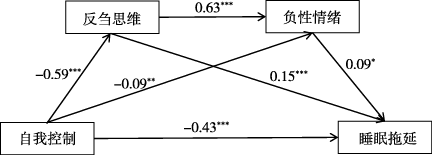
图 1 反刍思维与负性情绪在自我控制与睡眠拖延间的链式中介模型图
Figure 1 Chain mediating model of rumination and negative emotion between self-control and sleep procrastination
表 2 链式中介模型中变量关系的回归分析
Table 2 Regression analysis of variable relationships in the chain mediating model
| 回归方程 | 整体拟合指数 | 回归系数及显著性 | ||||||
| 结果变量 | 预测变量 | R | R2 | F | β | t | BootLLCI | BootULCI |
| 反刍思维 | 自我控制 | 0.59 | 0.35 | 125.6 | -0.59 | -22.24*** | -0.69 | -0.58 |
| 性别 | -0.12 | -3.33*** | -6.21 | -1.61 | ||||
| 年级 | -0.07 | -2.12* | -2.32 | -0.09 | ||||
| 负性情绪 | 自我控制 | 0.69 | 0.48 | 172.02 | -0.09 | -3.11** | -0.13 | -0.03 |
| 反刍思维 | 0.63 | 21.66*** | 0.46 | 0.55 | ||||
| 性别 | -0.04 | -1.29 | -2.73 | 0.56 | ||||
| 年级 | -0.04 | -1.36 | -1.35 | 0.24 | ||||
| 睡眠拖延 | 自我控制 | 0.59 | 0.34 | 82.50 | -0.43 | -13.21*** | -0.26 | -0.19 |
| 反刍思维 | 0.15 | 3.67*** | 0.03 | 0.11 | ||||
| 负性情绪 | 0.09 | 2.39* | 0.01 | 0.10 | ||||
| 性别 | 0.05 | 1.39 | -0.33 | 1.92 | ||||
| 年级 | 0.05 | 1.31 | -0.18 | 0.91 | ||||
表 3 中介效应和置信区间
Table 3 Mediating effects and confidence intervals
| 效应 | 路径 | 效应值 | 效果量(%) | 95%置信区间 | |
| 下限 | 上限 | ||||
| 直接效应 | 自我控制—睡眠拖延 | -0.228 | 77.55 | -0.262 | -0.194 |
| 中介效应 | 自我控制—反刍思维—睡眠拖延 | -0.045 | 15.31 | -0.072 | -0.020 |
| 自我控制—负性情绪—睡眠拖延 | -0.004 | 1.36 | -0.010 | -0.001 | |
| 自我控制—反刍思维—负性情绪—睡眠拖延 | -0.017 | 5.78 | -0.032 | -0.003 | |
| 总间接效应 | -0.066 | 22.45 | -0.088 | -0.046 | |
| 总效应 | -0.294 | 100.00 | -0.322 | -0.266 | |
如表3所示,自我控制—反刍思维—睡眠拖延路径的效应量为-0.045(95%CI[-0.072,-0.020]),95%置信区间不包括0,表明反刍思维在自我控制与睡眠拖延之间的中介效应显著;自我控制-负性情绪-睡眠拖延路径的效应量为-0.004(95%CI[-0.010,-0.001]),95%置信区间不包括0,表明负性情绪在自我控制与睡眠拖延之间的中介效应显著;自我控制—反刍思维—负性情绪—睡眠拖延路径的效应为-0.017(95%CI[-0.032,
-0.003]),95%置信区间不包括0,表明反刍思维和负性情绪在自我控制与睡眠拖延之间的链式中介效应显著。该链式中介作用占总效应的5.78%。
4 讨论
首先,研究结果显示自我控制能够显著负向预测睡眠拖延,假设1得到支持。该结果与自我控制资源模型(杨晓莉 等,2024)的预期一致,可从资源耗竭、冲动抑制与行为调控三个层面予以阐释。日间学习与社交活动会持续消耗自我控制资源,夜间资源处于相对匮乏状态时,个体对短视频、游戏等即时奖赏的抵御能力下降,更难维持既定就寝计划(杨晶晶,2025)。低自我控制者对即时冲动的抑制能力较弱,长期健康目标的权重被短期愉悦体验取代,入睡节点被不断后移(苏聪辉,2024)。与此同时,自我控制水平偏低者在作息节律、睡前行为规划与时间管理上的稳定性更差,睡眠拖延更易被维持(张瑞洁,2024)。上述机制共同构成自我控制对睡眠拖延的约束效应。
其次,本研究验证了反刍思维在自我控制与睡眠拖延之间的中介作用,假设2成立。自我控制资源的充足程度直接决定负性思维的抑制效率,资源不足时,个体对学业挫折、人际摩擦等负性事件的反复加工难以被主动终止,反刍水平随之上升(龚劲超 等,2024)。睡前安静环境进一步降低外部信息输入,内部思维占据主导,反刍所带来的高认知唤醒与情绪紧张延长入睡准备过程(冯娟,2017),并促使个体以媒体使用等方式逃避负性体验,最终加剧睡眠拖延。与此同时,反刍过程占用大量认知资源(张娣 等,2023),睡前时间规划与行为切换能力被削弱,进一步推动拖延行为的
固化。
再次,本研究验证了负性情绪在自我控制与睡眠拖延之间起显著中介作用,假设3得到验证。自我控制资源不足会削弱认知重评与情绪调节策略的执行效率,负性情绪更易被激发与维持。高涨的焦虑、抑郁与压力体验提升睡前认知唤醒(郭艺璇 等,2025),促使个体持续沉浸于担忧与反刍状态,难以进入放松阶段。为缓解情绪不适,个体更倾向于通过睡前娱乐实现短暂情绪修复,进而推迟入睡时间。负性情绪与自我控制之间还存在双向损耗关系:负性情绪持续占用认知资源(赵艺 等,2022),进一步降低晚间自控资源,使得作息失控更易发生。
最后,自我控制可以依次通过反刍思维和负性情绪影响大学生睡眠拖延行为,假设4成立。自我控制资源不足削弱对负性思维的抑制,引发更高水平的反刍;依据反应风格理论(国锐 等,2026),反刍通过反复聚焦负性事件及其后果(周惠玉 等,2026),延长并放大负性情绪,使焦虑、沮丧等体验更强烈、更持久。被强化的负性情绪提升睡前唤醒水平,增强逃避动机,推动睡前娱乐与入睡延迟,最终加剧睡眠拖延(李琼 等,2024)。该路径揭示从认知到情绪再到行为的连续传导机制,为睡眠拖延的发生提供了更完整的解释
框架。
本研究结果对大学生睡眠健康干预具有重要实践价值。高校心理健康教育可从三方面切入:第一,加强自我控制训练,提升作息执行力与冲动抑制能力;第二,开展反刍思维干预,通过正念、认知解离等技术降低睡前思虑;第三,强化负性情绪疏导,缓解压力、焦虑对睡眠的破坏。链式路径提示,干预可遵循先改善认知、再调节情绪、最后规范行为的递进思路,实现更稳定、长效的改善。
同时,本研究存在若干局限:第一,采用横断设计,难以进行严格的因果推断,未来可开展纵向追踪研究进一步验证模型;第二,样本来自四川地区高校,性别与年级分布不够均衡,结果推广性受限;第三,未纳入宿舍环境、手机使用、社会支持等情境因素,未来可构建多因素模型以更全面地解释睡眠拖延。
5 结论
本研究构建并验证了自我控制影响大学生睡眠拖延的链式中介模型,得出以下结论:
(1)大学生自我控制可显著负向预测睡眠拖延;
(2)反刍思维在自我控制与睡眠拖延之间起显著中介作用;
(3)负性情绪在自我控制与睡眠拖延之间起显著中介作用;
(4)反刍思维与负性情绪在自我控制影响睡眠拖延的过程中构成显著链式中介路径。
综上所述,大学生睡眠拖延是自我控制、认知因素与情绪因素共同作用的结果,为高校开展睡眠健康促进、认知干预与情绪调节工作提供了重要的实证依据与实践方向。
参考文献
[1] Kroese F M, Evers C, Adriaanse M A & De Ridder D T. (2014). Bedtime procrastination: Introducing a new area of procrastination. Frontiers in Psychology, 5, 611.
[2] 许宴菁. (2017). 大学生睡眠时间拖延行为的概念探讨及机制研究(硕士学位论文). 浙江师范大学.
[3] 中国睡眠研究会. (2024). 2024中国居民睡眠健康白皮书.中医健康养生, (4), 3-6.
[4] Kamphorst B A, Bruyneel G & Van der Laan H L. (2018). Too depleted to turn in: The relevance of end-of-the-day resource depletion for reducing bedtime procrastination. Frontiers in Psychology, 9, 252.
[5] 杨丽珠. (1995). 儿童自我控制发展的研究. 心理发展与教育, 11(3), 1-6.
[6] 曹云飞, 王鑫泽. (2023). 大学生手机依赖与睡眠拖延的关系: 自我控制的中介作用. 中国健康心理学杂志, 31(7), 1071-1075.
[7] 黄佳豪. (2023). 大学生自我控制与睡眠拖延的关系: 一个有调节的中介模型(硕士学位论文). 西华师范大学.
[8] Hofmann W, Schmeichel, B J & Baddeley A D. (2012). Executive functions and self-regulation. Trends in Cognitive Sciences, 16(3), 174-178.
[9] Heatherton T F & Wagner D D. (2011). Cognitive neuroscience of self-regulation failure. Trends in Cognitive Sciences, 15(3), 132-139.
[10] 詹鋆, 任俊. (2012). 自我控制与反刍思维: 抑制控制的中介作用. 心理科学, 35(2), 432-437.
[11] Denson T F, Pedersen W C & Miller N. (2011). Understanding impulsive aggression: Angry rumination and reduced self-control capacity are mechanisms underlying the provocation-aggression relationship. Personality and Social Psychology Bulletin, 37(6), 850-862.
[12] Flett A L, Haghbin M & Pychyl T A. (2016). Procrastination and depression from a cognitive perspective: An exploration of the associations among procrastinatory automatic thoughts, rumination, and mindfulness. Journal of Rational-Emotive Cognitive-Behavior Therapy, 34(3), 169-186.
[13] Sirois F M. (2014). Out of sight, out of time? A meta-analytic investigation of procrastination and time perspective. European Journal of Personality, 28(5), 511-520.
[14] 涂阳军, 郭永玉. (2011). 生活事件对负性情绪的影响: 社会支持的调节效应与应对方式的中介效应. 中国临床心理学杂志, 19(5), 652-655.
[15] Caplan S E. (2010). Theory and measurement of generalized problematic Internet use: A two-step approach. Computers in Human Behavior, 26(5), 1089-1097.
[16] 李尚儒, 李洁, 刘晓芹. (2016). 大学生自我控制在拖延与焦虑关系间的中介效应. 中国心理卫生杂志, 30(8), 624-628.
[17] 单泓博. (2016). 大学生负性情绪与拖延行为的关系: 自我控制的中介作用. 中国健康心理学杂志, 24(12), 1861-1864.
[18] Nolen-Hoeksema S. (1991). Responses to depression and their effects on the duration of depressive episodes. Journal of Abnormal Psychology, 100(4), 569-582.
[19] 张丛丽, 周宗奎. (2018). 被动性社交网站使用、社交焦虑、反刍思维与青少年抑郁的关系: 有调节的中介效应分析. 中国临床心理学杂志, 26(3), 490-493.
[20] 郭素然, 孙文梅. (2016). 大学生反刍思维对消极情感和积极情感的影响: 以孤独感和情绪智力为例. 心理发展与教育, 32(3), 329-336.
[21] 宣之璇. (2017). 大学生反刍思维、反刍思维和抑郁、焦虑的关系及干预(硕士学位论文). 浙江大学.
[22] 谭树华, 郭永玉. (2008). 大学生自我控制量表的修订. 中国临床心理学杂志, 16(5), 468-470.
[23] 韩秀, 杨宏飞. (2009). 反刍思维量表在中国大学生中的信效度检验. 中国临床心理学杂志, 17(6), 690-692.
[24] 龚栩, 谢熹瑶, 徐蕊, 罗跃嘉. (2010). 抑郁—焦虑—压力量表简体中文版 (DASS-21) 在中国大学生中的测试报告. 中国临床心理学杂志, 18(4), 443-446.
[25] 马晓涵, 王艳, 刘爱书. (2021). 中文版睡眠拖延行为量表在大学生中的信效度检验. 中国临床心理学杂志, 29(4), 717-720.
[26] Hayes A F. (2018). Introduction to mediation, moderation, and conditional process analysis: A regression-based approach (2nd ed.). Guilford Press.
[27] 杨晓莉, 冯琳, 邹妍, 刘晶莎. (2024). 社会排斥对跨期决策的影响: 自我控制的中介作用和归属需求的调节作用. 中国临床心理学杂志, 32(4), 908-911.
[28] 杨晶晶. (2025). 又累又不想睡?正念对睡眠拖延的影响机制研究(硕士学位论文). 四川师范大学.
[29] 苏聪辉. (2024). 短视频诱发的脑活动特征及其与自我控制关系的研究(博士学位论文). 浙江大学.
[30] 张瑞洁. (2024). 高中生心理韧性与睡眠质量的关系: 自我控制的中介作用及干预研究 (硕士学位论文) . 青海师范大学.
[31] 龚劲超, 郭思文, 胡平, 赵彦云, 汤欣. (2024). 拖延和睡眠质量的关系: 反刍思维和抑郁情绪的中介作用及其性别差异. 中国临床心理学杂志, 32(1), 207-212.
[32] 冯娟. (2017). 基于自动思维条件下, 心理生理性失眠大学生的注意偏向及其对睡眠质量的影响(硕士学位论文). 福建师范大学.
[33] 张娣, 陈芷柔, 刘旭. (2023). 反刍思维与大学生认知失败的关系: 抑郁的中介作用. 心理技术与应用, 11(8), 484-491.
[34] 郭艺璇, 薛阳阳, 李航. (2025). 大学生社交媒体过度使用引发错失焦虑的影响及干预措施综述. 心理月刊, 20(16), 217-219.
[35] 赵艺, 刘毅, 焦江丽. (2022). 熟练双语者负性情绪干扰下的认知优势效应: 来自2-back的证据. 心理学探新, 42(5), 416-421.
[36] 国锐, 杨宏飞, 梁社红. (2026). 大学生反刍思维与情绪的动态网络关系. 中国心理卫生杂志, 40(2), 139-145.
[37] 周惠玉, 丁艳孜, 梁圆圆, 雷一茗, 孔风. (2026). 负性生活事件对大学生自杀意念的影响: 反刍思维和宽恕的中介作用. 信阳师范大学学报(哲学社会科学版), 1-8.
[38] 李琼, 刘蒙, 陈星宇, 姚佳宁. (2024). 消极反刍与大学生睡眠质量: 负性情绪和睡眠拖延行为的作用. 中国临床心理学杂志, 32(1), 203-206.