Current Views: 2636283
 Current Downloads: 1641688
Psychology of China
ISSN Print:2664-1798
ISSN Online:2664-1801
Contact Editorial Office


Subscribe to the latest published information from SCISCAN
AI辅助设计中人机协作模式对心理所有权与创造力的影响
The Impact of AI-assisted Design on Psychological Ownership and Creativity


-
Information:
1. 湖北美术学院视觉艺术设计学院,武汉;
2. 湖北美术学院艺术人文学院,武汉
-
Keywords:
Artificial intelligence generated content(AIGC); Human-machine collaboration; Psychological ownership; Creativity; Design subjectivity; Mediation effect生成式人工智能; 人机协作; 心理所有权; 创造力; 设计主体性
- Abstract: This paper examines the growing use of generative artificial intelligence in design practices, where the humanmachine relationship is shifting from mere tool utilization to collaborative co-creation. It introduces the theory of psychological ownership to investigate designers’ subjective sense of ownership over creative outcomes under three distinct collaboration modes: fully human, human-led with AI assistance, and AI-led with human support. Through a three-level inter-group experiment, the study tests the mediating pathway of “collaboration mode—psychological ownership—creativity.” Findings reveal that the extent of AI involvement indirectly influences creative performance by modulating designers’ sense of control and psychological investment, offering theoretical guidance for designing humancentered AI collaboration systems. 随着生成式人工智能深度进入设计实践,人机关系正由工具使用转向协作共创。然而,当AI参与甚至主导创作过程时,设计师是否仍会将作品视为“自己的”,以及这种归属感变化是否进一步影响创造力,仍缺乏系统解释。基于心理所有权理论,本文构建“协作模式—心理所有权—创造力”分析框架,通过三水平组间实验比较纯人工创作、人主导AI辅助创作与AI主导人类参与创作三种模式。结果表明,随着AI主导性增强,设计师的心理所有权显著下降,作品在新颖性、适切性和精致度等维度上的创造力评分亦显著降低;心理所有权在协作模式影响创造力的过程中发挥了显著的部分中介作用。研究为理解AI辅助设计中创造力变化的心理过程提供了实证依据。
- DOI: 10.35534/pc.0805113
- Cite: 李嘉琦, 胡佳艺, 吴琦, 罗超. (2026). AI辅助设计中人机协作模式对心理所有权与创造力的影响. 中国心理学前沿, 8 (5), 758-766.
1 引言
随着生成式人工智能(Artificial Intelligence Generated Content,AIGC)在设计、创作等领域的深度融合,人机协作模式正从“人类使用工具”演变为“人类与AI共同创造”。这种协作范式在提升任务效率与产出可能性的同时,也引发了一个根本性的主体性困惑:当AI的贡献与人类的创意深度交织时,当设计师不再确信“这是我的作品”时,创造力是否还能成立?当设计师对作品的主观归属感减弱时,其创造力表现是否会受到影响?
现有研究开始揭示人机协作中的心理机制。研究表明,AI定制化能让用户通过调整AI的“声音”或风格来增强对产出物的“所有权感”,从而提高其对结果的责任归因;而AI可解释性则通过揭示AI的贡献,增强对AI本身的责任归因(Yu et al.,2025)。进一步地,他们发现,定制化能通过对AI助手及其输出物的“双重心理所有权”路径,提升用户满意度并影响责任判断。这些研究指出了“通过定制化实现”,是影响心理所有权与后续归因的关键前因。
然而,一个尚未充分探索的核心问题是:在不同程度的用户与AI的权责分配的协作模式下,设计师对作品的心理所有权如何形成与变化?而这种心理所有权的差异,又如何作为关键中介,影响其最终的创造力表现?
创造力指的是通过创造性过程发展出既新颖又有用的想法和解决方案的能力(Sternberg & Lubart,1993)。它不仅体现在最终的创意产品或解决方案上,也蕴含于其产生的复杂认知过程之中,该过程通常涉及发散性思维以生成多种可能性,以及后续的收敛性思维以评估、选择这些想法(Eysenck,1993;Kaufman & Sternberg,2019;Sawyer & Henriksen,2023)。生成式AI既能作为“思维跳板”激发更多样化的构思,也可能因锚定效应导致思维过早收敛,限制创意深度(Zhou & Lee,2024)。这表明,AI的参与方式可能从过程层面深刻重塑创造力的生成机制。
而心理所有权,即个体感觉目标物属于自我一部分的心理状态(Pierce et al.,2001)。这一概念与“延伸自我”理论一脉相承,认为人们通过占有物来建构与表达自我(Belk,1988)。在传统创作中,创作者通过控制过程、深入了解和投入自我,将作品内化为延伸自我的一部分,从而产生强烈的所有权感,并由此激发内在动机、责任感与深度投入(Avey et al.,2009;Van Dyne & Pierce,2004)。然而在AI辅助设计中,用户对创作过程的控制感与自我投入感可能被显著削弱,这直接挑战了心理所有权赖以形成的经典路径。因此,探究心理所有权在AI时代是否、以及如何继续发挥作用,对于理解人机协作的本质至关重要。
尽管已有研究开始关注AI参与创作过程中用户的责任归因、信任等问题,但对于设计成果属于谁这一根本的主观体验是如何在不同协作模式下形成的,仍缺乏系统性的探讨(Glikson & Woolley,2020;Yu et al.,2025)。尤其是在设计实践中,AI不再仅作为被动工具,而是逐渐承担生成、决策乃至风格主导的角色,这种变化可能从根本上重塑设计师与创作成果的心理联结方式。
同时,现有研究较少将人类与AI的主导关系作为核心自变量进行操控,心理所有权虽被证明能够影响责任感、投入度与绩效表现,但其在AI辅助设计情境中是否仍然成立,以及如何作用于创造力生成过程,尚未得到充分验证(Avey et al.,2009;Van Dyne & Pierce,2004)。
因此,为填补上述研究空白,本研究旨在系统探讨人机协作模式、心理所有权与创造力三者之间的关系。具体而言,我们将通过一项受控实验检验以下核心假设:
H1:人机协作模式将显著影响用户的心理所有权;
H2:人机协作模式将显著影响最终作品的创造力表现;
H3:心理所有权在人机协作模式与创造力表现之间起中介作用。
通过检验这些假设与问题,本研究不仅能够深化对AI时代创作主体性、责任与创造力三者关系的理论理解,也能为未来设计旨在激发人类创造力与责任感的人机协作系统提供坚实的实证依据。
2 文献综述
2.1 核心概念与理论起源
心理所有权(Psychological Ownership)被系统性地定义为一种个体感觉目标物或目标物的一部分属于其自我的一部分的心理状态(Pierce et al.,2001)。这一概念的突破性在于,它将“所有感”从法律契约中剥离出来,强调其是一种根植于个体认知与情感的体验。其产生源于人类对效能感、自我认同与归属空间的基本需求(Pierce et al.,2001)。当个体能够通过某一目标物满足这些需求时,强烈的心理所有权便随之建立。早期研究主要聚焦于组织情境,证实心理所有权能有效预测员工的组织归属感、责任感及公民行为,为理解个体与工作成果之间的心理纽带奠定了基础(Pierce et al.,2001;Van Dyne & Pierce,2004)。然而,若将视野从一般性的“工作成果”转向更具人格注入特征的“创作成果”,心理所有权的解释力则显得尤为关键且尚未被充分发掘。创作活动本质上是创作者将观念、情感与技能外化并凝结为特定客体的过程,这一过程完美契合了心理所有权所描述的“将目标物融入自我概念”的核心机制。相较于其他主要描述态度倾向如满意度或一般动机的心理变量,心理所有权直接触及了创作者与作品之间“物我合一”的深层联结,从而为理解创作主体性、内在驱动以及最终成果的归属与质量,提供了一个更为根本的理论视角。遗憾的是,这一视角在设计与创意研究领域长期未被置于核心地位,使其成为一个尚未被充分用以剖析人机协作如何重塑创作本质的、强有力的理论工具。因此,在创意生产情境中,心理所有权不仅关乎个体对成果的情感依附,还通过个体参与程度与控制感影响其创造投入,这一点在用户参与导向的设计研究中亦得到验证。首先,心理所有权强化作品与自我的关联,使创作由外在任务转化为自我表达,从而提升内在动机,促进更多发散性探索。其次,将作品视为“自我延伸”会增强责任感与控制感,促使个体进行更深入的反复推敲与修正,推动发散与收敛过程的循环,从而提升创意的适切性与精致度。最后,心理所有权还增强个体在创作过程中的持续投入,使其在不确定情境中保持探索深度。由此,心理所有权不仅是“自我延伸”的体现,更是影响创造力生成的重要心理机制。
2.2 形成机制、理论拓展及其在AI情境下的挑战
心理所有权的形成被认为依赖于三个相互关联的核心路径,这三条路径共同构成了其生成的基本心理机制(Pierce et al.,2001),即控制感、亲密了解与自我投入。首先,控制感指个体能够对目标物施加影响并主导其使用与发展过程的能力。当个体在行动中持续体验到对目标物的支配与决策权时,其对该对象的“归属于自我”的认知会显著增强。其次,亲密了解强调个体通过反复接触、认知加工与经验积累,对目标物的属性、结构与细节形成深入理解。这种基于认知嵌入的熟悉性,使目标物逐渐被纳入个体的认知框架之中。最后,自我投入则指个体将时间、精力、情感乃至创造性资源注入目标物的过程,这一过程使目标物承载个体的“自我痕迹”,从而强化其作为“自我延伸”的心理属性。
上述三条路径并非彼此独立,而是在实际情境中相互作用、共同推动心理所有权的形成。个体通过对目标物的控制、理解与投入,将其逐步内化为自我概念的一部分,从而产生“这是我的”的主观体验。这一过程与Belk提出的“延伸自我”理论高度一致,即个体通过占有与使用外部对象来建构、表达并延展自我身份(Belk,1988)。杨简茹(2025)进一步指出,在生成式人工智能技术革命的背景下,人工智能不仅作为工具存在,更开始以算法辅助角色参与设计批评,其逻辑与人类思维的融合正在重塑创作与评价范式,这为设计批评中坚守人本价值提供了警示。在创意生产情境中,创作成果作为个体认知加工与情感投入的外化载体,是“延伸自我”的典型表现形式,其所引发的心理所有权往往更为显著。
基于这一理论框架,心理所有权已从最初的组织行为研究领域,逐步拓展至消费、创意及数字交互等多种情境。例如,在消费领域,心理所有权被用于解释消费者与品牌之间的情感联结(Belk,1988);在共创与协作情境中,个体对共同成果的所有权感则被认为能够显著影响其参与意愿与贡献质量。进一步地,Avey等人的实证研究表明,心理所有权能够显著提升个体的内在动机、责任意识以及持续投入行为,从而对绩效表现产生积极影响(Avey et al.,2009)。然而,在生成式人工智能深度介入的创作情境中,上述三条形成路径正面临新的挑战。具体而言,当AI在创作过程中承担更高程度的生成与决策功能时,个体对创作过程的控制感可能被削弱;同时,AI作为“黑箱”系统,其生成逻辑的不透明性也可能限制个体对创作细节的深入理解;此外,当用户仅对AI生成结果进行选择或微调时,其在创作过程中的自我投入程度亦可能下降。由此,AI的介入并非简单改变创作工具属性,而是可能通过重构控制权分配与参与结构,从根本上影响心理所有权的形成机制。
2.3 AI对设计创作流程的介入与理论新挑战
随着生成式AI深度介入设计流程,从概念发散到方案成型的各个环节均被重塑。AI不仅能作为“超级工具”提供海量灵感,更在事实上承担了部分乃至大部分的方案生成与风格决策工作。这种流程重塑直接改变了心理所有权客体的性质与形成情境。研究对象的范畴已从实体物品、组织延伸至虚拟商品、数字内容,甚至用户与AI智能体本身的互动关系(Atasoy & Morewedge,2018;Calahorra-Candao & Martín-de Hoyos,2024;Yu et al.,2025)。然而,在人机协作这一新兴范式中,心理所有权的形成面临独特挑战。AI的深度介入,尤其当AI从“辅助工具”转变为“主导性协作者”时,可能严重侵蚀用户在创作过程中的控制感,并削弱其对最终成果的自我投入感,这直接干扰了心理所有权赖以建立的根基。值得注意的是,Yu等人的研究揭示,通过对AI进行定制化,用户可以对AI助手及其输出产生“双重心理所有权”,这证实了在AI情境下所有权路径依然存在,但其强度高度依赖于用户被赋予的控制权(Yu et al.,2025)。这引出了本研究的核心关切:当协作模式从“人类主导”转向“AI主导”时,用户的心理所有权将如何被系统性地影响?
基于上述,现有研究存在两个关键衔接的空白:第一,尽管AI对设计流程的影响已被广泛观察,但其如何通过“控制权再分配”这一结构性变量,系统性影响创作者的核心心理状态,即心理所有权,尚缺乏实证检验;第二,心理所有权虽被证实能促进传统工作中的积极产出,但其在AI辅助的创造性任务中,是否及如何传导至最终的创造力表现,其机制仍未明晰,这两个空白的交汇点正好是本研究的理论切入点。
基于此,本研究提出,心理所有权是连接外部协作模式与内部创造力表现的关键心理中介变量。尽管直接检验这一完整路径的研究尚属空白,但近期前沿研究已从不同侧面为此提供了重要的理论铺垫。研究表明,人机协作中的控制权分配(如用户能否对AI进行定制)会显著影响用户对AI助手及其输出的心理所有权与归属感(Yu Y et al.,2025),这直接印证了“控制权再分配”对核心心理状态的塑造作用。同时,研究也证实,在AI辅助的创意任务中,用户的心理所有权是预测其创造性表现的关键因素,这与心理所有权所能驱动的内在动机与深度投入机制一致。更有研究明确指出,生成式AI既能作为“思维跳板”激发创意,也可能因削弱用户的深度加工而导致创意趋同,这暗示了AI的参与方式可能通过影响用户的心理状态来间接塑造创造力(Doshi & Hauser,2024)。
也就是说,现有研究分别触及了“协作模式→心理所有权”与“心理所有权→创造力”这两段关系,但却未在同一框架下系统检验三者构成的完整中介路径——心理所有权在AI协作情境下是否真正承担着从“外部协作”传导至“内部创造性产出”的关键中介角色,尚无直接实证证据支撑。而要回答这一问题,仅凭理论推演或对既有研究的碎片化拼接是不够的。心理所有权的形成依赖于具体的控制体验与自我投入过程,而这些过程恰恰是通过对人机协作中“谁在何时掌握何种决策权”的结构性安排来塑造的。因此,只有通过对协作模式进行系统性、可比较的实验操控,才能在控制其他变量的前提下,分离出“控制权再分配”对心理所有权的因果影响,进而分析其对创造力表现的中介作用。近年来,国内学者开始系统探索人机协同在设计实践中的应用。林儒凡和夏帆(2024)以民族传统服饰的数字时尚设计为研究对象,探讨了人机协同在文化基因提取、纹样生成与产品创新中的应用路径,指出人机协同设计的关键在于人类设计师与AI系统之间的权责分配与创造性整合,这一过程直接关系到设计成果的归属感与创新性。
于是,基于上述理论推演,本研究通过一项三水平组间实验,将人机协作模式操作化为三种具有明确控制权差异的条件:纯人工创作、AI主导的人类辅助、人为主导的AI辅助。实验旨在检验“协作模式——心理所有权——创造力”这一理论路径是否成立,即考察心理所有权在不同协作模式下是否呈现系统性差异,并进一步分析这种差异是否影响最终的创造力表现。通过这一实验设计,本研究试图在行为层面为理解AI协作如何影响设计者的心理所有权及其后续效应提供初步的实证证据。
3 实验设计
3.1 参与者
本研究通过线下方式招募参与者,招募标准设定为:年满18周岁,具备基本设计理解能力(如设计类、艺术类、新媒体等相关专业背景或曾完成过完整设计项目),且自愿参与实验。我们有意避免将样本限定于特定年龄组或专业背景,这是因为AI辅助设计工具正被不同背景的创作者广泛使用,而本研究关注的心理所有权与创造力机制,是跨群体的基本心理过程,并不假定其仅限于特定人群。本研究已通过湖北美术学院科研伦理委员会审查,伦理审查编号为KYLL2026001。最终共纳入150名参与者。所有参与者均在充分知情并签署知情同意书后自愿参加实验,实验过程中未出现任何不适或中途退出情况,所有数据均匿名处理并仅用于学术研究。
实验过程中嵌入了注意力检查题项(例如“请选择‘有点不同意’以表明您正在认真阅读”),以确保数据质量,未通过注意力检查的参与者将被排除在最终分析之外。最终本研究共招募有效样本150名,年龄M=19.52±1.37;男性28人,占18.7%;女性122人,占81.3%。所有纳入分析的参与者均满足预设纳入标准,并完成全部实验流程,其数据被纳入后续统计分析。
根据先验功效分析,本研究基于单因素三水平组间设计,在显著性水平 α = 0.05、统计功效 1-β = 0.80,以及中等效应量(f = 0.25)的设定下,所需最小样本量为 159 人。本研究最终纳入有效样本150人,略低于该建议值。为评估当前样本量的检验能力,我们进一步进行了事后功效与敏感性分析。在相同参数设定下(α = 0.05,f = 0.25),当前样本量对应的统计功效为 0.79,接近常用标准(0.80)。同时,敏感性分析结果表明,在保持统计功效为 0.80 的前提下,本研究样本量能够检测到的最小效应量为 f = 0.26,仍处于中等效应范围。综合而言,尽管样本量略低于先验估计,本研究仍具备识别中等及以上效应的统计能力,分析结果具有基本的检验力支持。所有参与者在实验开始前均签署知情同意书,明确了解研究目的、流程及数据使用方式。
3.2 研究设计
本研究采用单因素三水平的组间实验设计。自变量为人机协作模式,包括:(1)纯人工创作(Human-only),(2)人为主导的 AI 辅助创作(Human-led AI-assisted),以及(3)AI 主导的人类参与创作(AI-led Human-involved)。因变量包括设计成果的心理所有权与创造力表现,参与者被随机分配至三种实验条件之一,如图1所示。
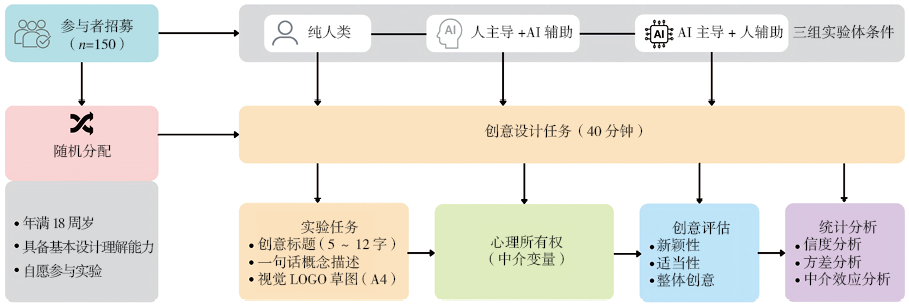
图 1 实验设计
Figure 1 Experimental design
为避免协作模式操控同时引入任务复杂度、流程结构或参与深度的系统性差异,三组条件在创作任务、流程步骤、时间要求与产出形式上均保持一致,协作模式的差异体现在 AI 在创意生成与决策中的主导权分配。
所有参与者均需完成为“未来图书馆”(Future Library)设计品牌视觉识别系统概念草图的任务。之所以选择这个作为视觉识别系统设计主题,是因为该主题兼具开放性、普适性与创造性空间,能够保证所有设计类学生都能在不依赖专业背景知识的情况下顺利开展创作。与高度技术化或行业限定的命题相比,“未来图书馆”属于高自由度的软场景(Soft-domain Task),其语义明确、生活经验普遍存在,可以让参与者自然联想到阅读、知识、文化、空间体验等元素,从而降低无想法(Idea Blockage)的风险。这种“兼具熟悉感与未来感的开放主题”被认为是激发创造性表达的最有效任务类型(Ward,1994)。
前人研究已广泛采用类似“未来学校”“未来图书馆”“未来公共服务中心”等命题来激发参与者构建新的视觉系统、符号语言或空间意象(Gero & Kannengiesser,2006)。更关键的是,该任务提供了清晰而适度的“意义边界”(Meaning Boundary),既不会因过度技术化或行业限定而限制创意,也不会因主题过于宽泛而导致思维涣散。这一结构正符合创造力研究中强调的“开放问题”(Open-ended Tasks)的特点,其核心目的是促使参与者生成多样化的构成方案,而非寻找唯一正确解(Runco & Jaeger,2012)。因此,该任务既能保证参与者顺利进入创作状态,也能确保最终产出的作品能够通过专家基于新颖性与适切性的评分体系进行有效比较。
任务要求包括:(1)拟定一个5~12字的概念标题;(2)撰写一句话概念描述;(3)在A4卡纸上绘制视觉LOGO草图。草图作为一种设计初期快速表达想法的方式,被广泛运用于设计认知与创造力研究之中(Goldschmidt,2003;Verstijnen et al.,1998)。
任务时长的设定为60分钟,这一时间设置符合设计认知与创意心理学的实验标准。大量研究表明,设计者的关键创意突破普遍发生在草图阶段的前10~15分钟,短时限制反而能够促使参与者更专注于概念生成而非渲染细节,从而更准确地反映创造力本质(Amabile & Teresa,1982;Goldschmidt,2003;Verstijnen et al.,1998)。已有多项设计创造力实验采用类似的时间结构,如McCormack等人使用15~20分钟的视觉概念草图任务(McCormack et al.,2019)。因此,60分钟既能够保障参与者完成Logo、主视觉与应用构图的概念表达,又能避免过度精绘造成的工具偏差与技能差异,是一种科学、合理且可比性强的时长设置。通过以上设计,本研究能够在控制其他变量的前提下,分离出人机协作模式对心理所有权与创造力的因果影响,为后续分析奠定坚实基础。
3.3 实验流程
本实验流程共分为五个阶段,预计整体实验时长约为60分钟。在实验开始前,研究者向参与者说明实验目的及基本流程,并取得其知情同意。参与者将被随机分配至三个实验条件之一,同时研究者会检查参与者的绘图工具是否齐全,并明确告知参与者本研究为自愿参与,实验数据将以匿名方式记录,不涉及姓名信息,也不会对其学业产生任何影响。此外,实验过程中产生的设计数据和作品参与者均可自行使用。
随后进入任务说明阶段。研究者将向所有参与者宣读统一版本的任务指导,以确保不同实验条件下参与者所接收到的任务信息保持一致,从而控制实验条件之间的潜在干扰变量。
在任务说明结束后,参与者进入设计任务执行阶段。实验任务为一项品牌 Logo 设计任务。所有参与者均需按照统一设定的四阶段创作流程完成设计活动:首先是任务理解阶段,参与者需要对给定品牌进行信息理解并提炼品牌关键词;其次是概念发散阶段,参与者需生成至少三个设计概念;第三阶段为方案收敛与迭代,参与者需在多个概念中选择一个设计方向并进行至少两轮修改;最后为最终定稿阶段,参与者需要提交最终的 Logo 视觉方案及相应的文字说明。通过设置统一的设计流程,可以在不同实验条件下保持设计活动在认知结构与产出要求上的可比性。
在具体实验条件方面,本研究设置了三种不同的人机协作模式。在纯人工创作条件下,参与者需要完全独立完成设计任务,在整个创作过程中不得使用任何生成式 AI 工具。在人为主导的 AI 辅助创作条件下,参与者可以在概念发散阶段借助 AI 获取设计灵感或元素建议,但 AI 不得直接生成完整设计方案,最终的方案选择、整合与修改均需由参与者完成。在AI 主导的人类参与创作条件下,参与者可以使用生成式 AI 工具生成完整的 Logo 设计方案,参与者主要对 AI 生成结果进行微调、选择或确认。
在设计任务完成后,参与者需填写相应的后测问卷,用于测量其心理所有权等相关变量。同时,所有提交的设计作品将按照顺序进行匿名编号,并由四位具有设计背景的专家进行盲评,以获得设计创造力的客观评分。
3.4 测量指标
为确保测量质量,本研究采用经过验证的中文版量表,所有多项目指标的信度将通过克隆巴赫α系数进行评估。关键构念通过改编既往验证研究的量表确立。
任务完成后,参与者立即填写后测问卷,测量其心理所有权。心理所有权量表采用Van Dyne 和 Pierce的原始量表(Van Dyne & Pierce,2004),以了解在完成作品后参与者对所生成作品的心理所有权感受。(例如“我对这件作品有很强的个人所有感”“我感觉这个作品是我的”)参与者采用5点李克特量表进行评分(1=非常不同意,5=非常同意)本研究进行信度分析后显示,该量表的克隆巴赫α系数= 0.836,表明量表具有良好的内部一致性,适合用于后续统计分析。
随后,我们按事先编好的序号按顺序交由四位具有设计背景的专家对作品在创造力客观评分方面进行盲评。采用O’Quin和Besemer开发的创造性产品语义量表(Creative Product Semantic Scale,CPSS)(Besemer & Treffinger,1981),从新颖性、适切性、精致度三个维度进行1~7分评分。专家在评阅时不知晓作品所属实验条件,以控制评分偏差。为检验专家评分的一致性,采用组内相关系数(ICC)进行评估。结果显示在新颖性维度ICC(A,K)= 0.928(95% CI [0.908, 0.945]);适切性维度ICC(A,K)=0.953(95% CI [0.939, 0.964]);且精致度维度ICC(A,K)=0.937(95% CI [0.919, 0.952])。三个维度均大于0.9,表明四位专家在各维度上的评分具有极高的一致性信度,后续分析使用各维度的平均分作为创造力指标。同时,为排除个体差异对实验结果的影响,本研究收集了参与者的性别、年龄、专业背景等,以便在分析中控制这些基本人口统计学因素。
3.5 数据分析
本研究采用SPSSAU在线数据分析平台进行统计分析。首先,通过Cronbach’s α系数检验心理所有权量表的内在一致性,采用组内相关系数(ICC)评估四位专家在创造力三维度评分上的信度。其次,采用单因素方差分析(ANOVA)检验不同协作模式对心理所有权和创造力各维度的主效应,并使用Bonferroni方法进行事后多重比较。为检验人机协作中 AI 参与程度的趋势效应,本研究将协作模式编码为有序变量(1~3),反映控制权由人向 AI 的递进变化,并基于此采用 PROCESS(Model 4)进行中介分析(Bootstrap = 5000)。
4 结果
4.1 初步分析与信度检验
在进行假设检验之前,我们首先对测量工具的信度进行了评估。心理所有权量表(4个条目)的Cronbach’s α系数为0.836,高于0.7的推荐标准,表明量表具有良好的内部一致性。对于创造力评分,我们采用组内相关系数(ICC)检验了四位专家评分者的一致性。结果显示,四位专家在各维度上的评分一致性极高,,其中新颖性维度ICC=0.928(95% CI [0.908,0.945]);适切性维度ICC=0.953(95% CI [0.939,0.964]);精致度维度ICC=0.937(95% CI [0.919,0.952])。所有ICC值均大于0.9,表明专家评分具有极高的信度,因此后续分析使用各维度的平均分作为创造力指标。
4.2 协作模式对心理所有权的影响分析
为检验不同人机协作模式下设计师心理所有权的差异,我们以组别为自变量,心理所有权为因变量进行单因素方差分析。结果显示,协作模式对心理所有权产生了显著的主效应,F(2,147)=58.75,p<0.001,ηp²=0.44,表明该效应量达到较大水平。通过Bonferroni方法的事后比较表明,纯人工创作组(M=4.63,SD=0.29)的心理所有权显著高于人主导AI辅助组(M=4.25,SD=0.37,p<0.001)和AI主导组(M=3.80,SD=0.48,p<0.001),且人主导AI辅助组显著高于AI主导组(p< 0.001)。结果使这一结论在本研究中得到进一步验证,即随着AI主导性的增强,设计师的心理所有权水平依次下降。
4.3 协作模式对创造力的影响
为检验协作模式对作品创造力的影响,我们分别以新颖性、适切性、精致度及创造力总分为因变量进行单因素方差分析。结果显示,协作模式对创造力各维度均有极显著影响。
在新颖性维度,F(2,147)=37.01,p< 0.001,ηp² =0.34。事后比较发现,纯人工创作组(M=4.95,SD=0.40)的新颖性评分显著高于人主导AI辅助组(M=4.62,SD= 0.41,p<0.001)和AI主导组(M=4.21,SD=0.46,p<0.001),且人主导AI辅助组显著高于AI主导组(p<0.001)。适切性,F(2,147)=40.58,p< 0.001,ηp² =0.36。纯人工创作组的适切性(M=4.66,SD=0.47)显著高于人主导AI辅助组(M=4.34,SD=0.43,p=0.003)和AI主导组(M=3.83,SD=0.48,p< 0.001),且人主导AI辅助组显著高于AI主导组(p<0.001)。精致度,F(2,147)=42.21,p< 0.001,ηp² =0.37。纯人工创作组的精致度(M=4.29,SD=0.41)显著高于人主导AI辅助组(M=4.00,SD=0.34,p=0.005)和AI主导组(M=3.50,SD=0.53,p<0.001),且人主导AI辅助组显著高于AI主导组(p<0.001)。创造力总分,F(2,147)=49.67,p<0.001,ηp² =0.40。纯人工创作组的创造力总分(M=4.63,SD=0.38)显著高于人主导AI辅助组(M=4.32,SD=0.34,p<0.001)和AI主导组(M=3.85,SD=0.45,p< 0.001),且人主导AI辅助组显著高于AI主导组(p<0.001)。结果表明,协作模式对创造力具有显著影响,在本研究所采用的任务情境与实验操作条件下,随着AI主导性的增强,作品在新颖性、适切性与精致度等维度上的评分均呈现显著下降趋势。
4.4 心理所有权的中介作用分析
为检验心理所有权在协作模式与创造力之间的作用机制,我们采用 Andrew F. Hayes(2017)提出的PROCESS宏(Model 4),进行中介效应检验(Hayes & Rockwood,2017)。由于自变量为三分类变量,我们将其编码为连续变量(1=纯人工创作,2=人主导AI辅助,3=AI主导)以检验整体趋势。因变量为创造力总分,中介变量为心理所有权均值,Bootstrap法5000次抽样计算间接效应的95%置信区间。
结果显示,协作模式对创造力的总效应显著
(c=-0.389,p<0.001),即随着AI主导性的增强,作品创造力总分显著下降。协作模式显著负向预测心理所有权(a=-0.417,p < 0.001),表明AI主导性越强,设计师对作品的心理所有权越低。心理所有权显著正向预测创造力(b=0.575,p < 0.001),即设计师对作品的归属感越强,其作品的创造力评分越高。Bootstrap分析显示,间接效应显著(ab = -0.240,SE = 0.039,95% CI [-0.324,-0.169]),置信区间不包含0,表明中介效应显著。在纳入心理所有权后,协作模式对创造力的直接效应仍显著(c’=-0.149,p=0.001),说明心理所有权在协作模式与创造力之间起到了部分中介作用。总的来说,AI的介入不仅直接对创造力产生负面影响,还通过削弱设计师对作品的心理所有权,间接损害了其创造力表现。
表 1 中介作用检验-横向格式(n=150)
Table 1 Test of mediating effect - horizontal format (n=150)
| 项 | 符号 | 意义 | 效应值Effect | 95% CI | 标准误SE值 | z 值/t 值 | p 值 | 结论 | |
| 下限 | 上限 | ||||||||
| x=>ownership_post=>Total_Avg | a*b | 间接效应 | -0.240 | -0.324 | -0.169 | 0.039 | -6.188 | 0.000 | 部分中介 |
| x=>ownership_post | a | X=>M | -0.417 | -0.493 | -0.342 | 0.038 | -10.863 | 0.000 | |
| ownership_post=>Total_Avg | b | M=>Y | 0.575 | 0.437 | 0.714 | 0.070 | 8.224 | 0.000 | |
| x=>Total_Avg | c’ | 直接效应 | -0.149 | -0.235 | -0.062 | 0.044 | -3.390 | 0.001 | |
| x=>Total_Avg | c | 总效应 | -0.389 | -0.467 | -0.311 | 0.039 | -9.872 | 0.000 | |
注:*p<0.05,**p<0.01,*** p<0.001,下同。
5 讨论
我们的研究通过实验操控三种人机协作模式,系统检验了心理所有权在人机协作中的变化及其对创造力的中介作用。
首先是协作模式显著影响了设计师的心理所有权。纯人工创作模式下设计师的心理所有权最高,而AI主导模式削弱了设计师的过程控制权与自我投入程度,导致心理所有权最低,人主导AI辅助模式居于二者之间。这一结果印证了心理所有权理论中控制感、亲密了解与自我投入三条形成路径在人机协作情境中的适用性:心理所有权依赖于控制感、亲密了解与自我投入三条形成路径(Pierce et al.,2001),当AI主导生成过程时,设计师对创作过程的掌控被削弱,对作品的“延伸自我”感随之下降(Belk,1988)。相比之下,人主导AI辅助模式虽然引入AI,但设计师仍保留了对创作过程的主导权,因此其心理所有权显著高于AI主导模式,控制权的分配比AI是否存在更为关键。这与Jansen & Sklar关于艺术家更倾向将AI视为协同创作伙伴的观点形成呼应(Jansen & Sklar,2021)。也说明本次实验研究的定量数据进一步证实了这种态度背后的心理机制:当AI主导时,设计师的归属感确实受到侵蚀。
协作模式对创造力的影响呈现系统性差异。本研究发现,随着AI主导性的增强,作品创造力三个维度均呈显著下降趋势。这一结果与部分强调生成式AI促进发散思维的研究并不完全一致,说明AI对创造力的影响具有显著的情境依赖性。生成式AI既可提供多样化线索激发灵感,但也可能导致个体过早收敛于相似解,从而抑制原创性表达(Zhou & Lee,2024)。在本研究情境下,AI虽提供素材,但其内容的模式化特征可能限制设计师突破常规构思。同时,依赖AI生成结果可能降低个体的认知加工深度,使创作更多停留于表层选择而非深度重构(Noy & Zhang,2023),进而削弱对任务语境的深入契合与细节打磨(Goldschmidt,2003)。
心理所有权在协作模式与创造力之间起部分中介作用。中介效应分析表明,协作模式不仅对创造力有显著的直接影响(c’=-0.149),还通过心理所有权产生显著间接影响(a*b=-0.240),中介效应占比达到61.77%。这一结果意味着,AI主导模式之所以损害创造力,有超过六成的效应是通过剥夺设计师对作品的归属感和控制感来实现的(Avey et al.,2009;Hayes & Rockwood,2017)。这一结果也与Yu等人(2025)关于“对AI定制化能够通过双重心理所有权提升用户满意度”的研究形成呼应,说明心理所有权不仅影响责任归因与投入程度,同样深刻影响创造性产出。
值得注意的是,本研究中关于“纯人工创作组创造力各维度评分均最高”的这一结果,与行业直觉相悖。深入分析这一反差,需结合任务特性、样本经验、认知机制与工具特征四个层面来理解。本研究采用的是短时、高概念密度的Logo创作任务,在这种情境下,设计师持续性的自我生成过程更容易形成完整而连贯的概念表达;而AI介入后,大量视觉参考可能带来“选项过载”与“意义碎片化”,反而削弱创意的一致性。此外,本研究参与者主要为设计专业低年级学生,其设计主体性与审美判断尚处于形成阶段,更容易对AI生成方案产生路径依赖与权威盲从,从而减少原本应经历的试错、反思与深度探索。因此,本研究并非否定AI的价值,而是揭示了一个重要边界条件:在缺乏深度加工与结构化引导的情况下,AI的介入未必能够真正提升创造力。
本研究的理论贡献在于,将心理所有权系统引入AI辅助设计领域,并验证了其在“协作模式—创造力”之间的中介作用。这意味着,创造力不仅取决于技术能力与认知资源,更深刻依赖于创作者是否仍将作品视为“自我的延伸”(Belk,1988)。研究结果也为AI辅助设计实践提供了启示:AI工具不应以替代人类为目标,而应支持“人主导、AI增强”的协作模式,在提升效率的同时保留设计师的控制感与主体性。
当然,本研究仍存在一定局限。首先,本研究采用单次后测设计,未能揭示心理所有权在创作过程中的动态变化;其次,参与者主要为设计专业学生,其结果与职业设计师之间可能存在差异;最后,本研究使用单一AI工具,其生成能力与交互方式也构成了研究结论的重要边界条件。未来研究可进一步采用纵向研究、多工具比较及真实项目情境,深入探讨不同设计阶段、不同个体差异与团队协作条件下心理所有权的变化机制。
总体而言,本研究表明,AI并不仅仅改变了创作方式,更在重新塑造创作者与作品之间的心理关系。未来AI辅助设计系统的关键,不只是提升生成能力,更在于如何在高效协作的同时,保留人类创作者对作品的控制感、投入感与归属感。
6 结语
本研究探讨了“人机协作如何影响创造力”这一核心问题,引入心理所有权作为关键心理机制,系统检验了协作模式、心理所有权与创造力之间的关系。结果表明,人机协作不仅通过技术能力改变创作结果,更通过重塑个体的控制感与自我投入,影响其对作品的心理归属,进而作用于创造力表现。随着AI在创作中的主导性增强,设计师的心理所有权显著下降,归属感的削弱在协作模式与创造力之间发挥了重要的中介作用。这表明,创造力的生成不仅依赖认知资源与外部工具,更深刻嵌入于个体与创作成果的心理联结之中。理论上,本研究将心理所有权拓展至AI辅助设计领域,弥补了“协作模式—心理机制—创造结果”这一完整路径的研究空白。实践上,AI协作系统的设计应重视通过控制权分配维持用户的心理所有权,以激发创造潜能。最后,在现如今AI深度介入的创作时代,影响创造力的关键不只是谁在生成,而是个体是否仍然感到这是自己的作品。
参考文献
[1] Yu Y, Yetim M A & Cocieru O. (2025). Whose voice is it anyway? Understanding AI customization and responsibility attribution in human-AI collaboration. International Journal of Human-Computer Interaction, 1-30.
[2] Sternberg R J & Lubart T I. (1993). Investing in creativity. Psychological Inquiry, 4(3), 229-232.
[3] Kaufman J C & Sternberg R J. (2019). The Cambridge handbook of creativity (2nd ed.). Cambridge University Press.
[4] Eysenck H J. (1993). Creativity and personality: An attempt to bridge divergent traditions. Psychological Inquiry, 4(3), 238-246.
[5] Sawyer R K & Henriksen D. (2023). Explaining creativity: The science of human innovation. Oxford University Press.
[6] Zhou E & Lee D. (2024). Generative artificial intelligence, human creativity, and art. PNAS Nexus, 3(3), 52.
[7] Pierce J L, Kostova T & Dirks K T. (2001). Toward a theory of psychological ownership in organizations. Academy of Management Review, 26(2), 298–310.
[8] Belk R W. (1988). Possessions and the extended self. Journal of Consumer Research, 15(2), 139-168.
[9] Avey J B, Avolio B J, Crossley C D & Luthans F. (2009). Psychological ownership: Theoretical extensions, measurement and relation to work outcomes. Journal of Organizational Behavior, 30(2), 173-191.
[10] Van Dyne L & Pierce J L. (2004). Psychological ownership and feelings of possession: Three field studies predicting employee attitudes and organizational citizenship behavior. Journal of Organizational Behavior, 25(4), 439-459.
[11] Glikson E & Woolley A W. (2020). Human trust in artificial intelligence: Review of empirical research. Academy of Management Annals.
[12] Atasoy O & Morewedge C K. (2018). Digital goods are valued less than physical goods. Journal of Consumer Research, 44(6), 1343-1357.
[13] Calahorra-Candao G & Martín-de Hoyos M J. (2024). The effect of anthropomorphism of virtual voice assistants on perceived safety as an antecedent to voice shopping. Computers in Human Behavior, 153, 108-124.
[14] Doshi A R & Hauser O P. (2024). Generative AI enhances individual creativity but reduces the collective diversity of novel content. Science Advances, 10(28), eadn5290.
[15] Ward T B. (1994). Structured imagination: The role of category structure in exemplar generation. Cognitive Psychology, 27(1), 1-40.
[16] Gero J S & Kannengiesser U. (2006). Key centre of design computing and cognition. University of Sydney.
[17] Runco M A & Jaeger G J. (2012). The standard definition of creativity. Creativity Research Journal, 24(1), 92-96.
[18] Goldschmidt G. (2003). The backtalk of self-generated sketches. Design Issues, 19(1), 72-88.
[19] Verstijnen I M, Van Leeuwen C, Goldschmidt G, Hamel R & Hennessey J. (1998). Sketching and creative discovery. Design Studies, 19, 519-546.
[20] Amabile T M. (1982). Social psychology of creativity: A consensual assessment technique. Journal of Personality and Social Psychology, 43(5), 997-013.
[21] McCormack J, Gifford T & Hutchings P. (2019). Autonomy, authenticity, authorship and intention in computer generated art. Springer.
[22] Besemer S P & Treffinger D J. (1981). Analysis of creative products: Review and synthesis. Journal of Creative Behavior, 15(3), 158-178.
[23] Hayes A F & Rockwood N J. (2017). Regression-based statistical mediation and moderation analysis in clinical research. Behaviour Research and Therapy.
[24] Jansen C & Sklar E. (2021). Exploring co-creative drawing workflows. Frontiers in Robotics and AI, 8.
[25] Noy S & Zhang W. (2023). Experimental evidence on the productivity effects of generative artificial intelligence. Science, 381(6654), 187-192.