Current Views: 2567188
 Current Downloads: 1594424
Psychology of China
ISSN Print:2664-1798
ISSN Online:2664-1801
Contact Editorial Office



Subscribe to the latest published information from SCISCAN
情境主导还是人格驱动?生成式人工智能信任与依赖对个体决策行为的影响
Situation-Driven or Personality-Driven? The Effects of Trust and Reliance on Generative Artificial Intelligence on Recommendation Adoption


-
Information:
江苏理工学院教育学院应用心理学系,常州
-
Keywords:
Generative artificial intelligence; AI trust; AI reliance; Recommendation adoption; Big Five personality; Risk perception生成式人工智能; 人工智能信任; 人工智能依赖; 建议采纳; 大五人格; 风险感知
- Abstract: Generative artificial intelligence (AI) has been increasingly integrated into decision-making across various domains, making human–AI collaborative decision-making more prevalent. This study investigated the factors influencing recommendation adoption in generative AI-assisted decision-making. Fifty-three undergraduate students participated in the study. Participants first completed a self-developed Generative AI Trust–Reliance Scale and were classified into high- and low-trust groups. They then completed a 2 (risk level: high vs. low) × 2 (AI recommendation accuracy: high vs. low) within-subject experiment. Openness and neuroticism were additionally measured using the Big Five Personality Inventory. The results showed that both risk level and AI recommendation accuracy had significant main effects on recommendation adoption, and their interaction was also significant. Specifically, individuals were more sensitive to AI recommendation accuracy under high-risk conditions. In contrast, neither trait AI trust and reliance nor openness and neuroticism showed significant effects. These findings suggest that recommendation adoption in the early stage of human–AI collaboration is primarily driven by situational factors rather than stable individual differences, providing empirical evidence for trust calibration in human–AI interaction. 生成式人工智能(AI)技术快速渗透多领域决策场景,人机协同决策日趋普遍。为探讨生成式AI辅助决策情境下建议采纳行为的影响因素,本研究以53名大学生为被试,首先采用自编生成式AI信任—依赖量表测量个体AI信任与依赖水平,并依据量表得分进行高、低信任组划分;随后采用2(风险水平:高、低)×2(AI建议准确率:高、低)被试内实验设计,考察风险水平和AI建议准确率对建议采纳行为的影响,并结合大五人格量表考察开放性和神经质人格的作用。结果发现:(1)风险水平和AI建议准确率对建议采纳率均具有显著主效应;(2)风险水平与AI建议准确率存在显著交互作用,高风险情境下个体对AI建议准确率更加敏感;(3)AI信任水平以及开放性、神经质人格的作用均未达到显著水平。本研究揭示了生成式AI场景下建议采纳的情境主导机制,补充了个体差异的阴性实证证据,可为人机信任校准设计提供参考依据。
- DOI: 10.35534/pc.0806150
- Cite: 姬昱辰, 姜诚, 廖思羽, 谭梦鸽. (2026). 情境主导还是人格驱动?生成式人工智能信任与依赖对个体决策行为的影响. 中国心理学前沿, 8 (6), 1018-1024.
1 引言
随着生成式人工智能(Generative Artificial Intelligence,Generative AI)的快速发展,以ChatGPT、DeepSeek等为代表的大语言模型逐渐应用于教育、医疗、金融、法律和职业规划等复杂决策场景,人工智能正由传统的信息检索工具逐步扩展为支持人类决策的重要协作系统。相较于传统自动化系统,生成式AI不仅能够理解自然语言、整合多源信息,还能够针对复杂任务生成具有一定推理能力的建议,使人机协同决策成为智能时代的重要决策模式(Glikson & Woolley,2020)。然而,AI提供的建议并非始终准确,其性能会受到模型能力、提示方式及任务复杂性的影响。当AI建议存在偏差时,个体是否仍然采纳其建议,以及哪些因素影响建议采纳行为,已成为当前人机交互与人工智能心理学研究关注的重要问题。
1.1 AI建议准确率与建议采纳行为
自动化信任理论认为,个体是否依赖自动化系统的重要依据在于其对系统能力和可靠性的判断(Lee & See,2004)。在人机协同决策过程中,AI建议准确率是反映系统能力的重要指标。已有研究发现,系统准确率越高,用户越容易形成积极的能力评价,并提高对系统建议的采纳程度(Dzindolet et al.,2003;Hancock et al.,2011)。Merritt和Ilgen(2008)进一步指出,相较于个体态度等内部因素,系统性能往往更能直接预测自动化依赖行为。随着生成式AI的发展,研究者开始关注AI建议质量对用户决策行为的影响。相关研究发现,用户对生成式AI建议的接受程度会随着其感知能力和输出质量的提升而增加(Huynh,2024)。因此,在生成式AI辅助决策情境中,相较于低准确率建议,个体更可能采纳高准确率AI提供的建议。
1.2 风险水平与建议采纳行为
风险水平是影响个体决策行为的重要情境因素。前景理论指出,个体在面对潜在损失时通常表现出较强的损失规避倾向,对负面结果的敏感性高于正面结果(Kahneman & Tversky,1979)。风险知觉研究进一步发现,高风险情境会改变个体的信息加工方式,使其更加关注决策结果及其潜在后果(Slovic,1987)。Weber等(2002)指出,在高风险任务中,个体倾向于寻求更多外部信息以降低决策不确定性。已有研究发现,当任务后果更加重要时,用户会更加重视决策支持系统提供的信息,并据此调整决策行为(Lee & See,2004)。因此,在生成式AI辅助决策场景中,高风险情境下个体可能表现出更高的AI建议采纳水平。
1.3 风险水平与AI建议准确率的共同作用
人机信任三因素模型认为,人机协同决策行为受到系统因素、环境因素和操作者因素的共同影响(Hancock et al.,2011)。其中,AI建议准确率属于系统因素,而风险水平属于环境因素,两类因素可能共同作用于建议采纳行为。已有研究发现,算法建议的接受程度不仅受到系统性能影响,也会随着任务风险和任务性质的变化而改变(Castelo et al.,2019)。当决策风险较高时,个体会更加关注信息来源的可靠性,并倾向于依据系统表现调整自身决策策略(Lee & See,2004)。Glikson和Woolley(2020)进一步指出,在高不确定性任务中,系统能力往往成为影响用户行为的重要依据。因此,高风险情境下个体可能更加关注AI建议的准确程度,从而使准确率对建议采纳行为的影响进一步增强。
1.4 AI信任与依赖的作用
信任被认为是人机协同决策的重要心理基础。Lee和See(2004)指出,信任能够降低用户对自动化系统的不确定性感知,并促进自动化依赖行为。Glikson和Woolley(2020)对AI信任研究进行系统综述后发现,AI信任是影响用户接受、依赖和持续使用AI的重要前因变量。已有研究表明,高信任水平用户通常表现出更高的技术接受度和自动化依赖倾向(Hoff & Bashir,2015)。在生成式AI情境下,用户对AI形成的总体信任与依赖态度可能进一步影响其对具体建议的采纳程度,并影响情境因素对决策行为的作用强度。
1.5 开放性与神经质人格的作用
人格特质是影响个体技术接受行为的重要内部因素。根据大五人格理论,开放性较高的个体通常具有更强的新事物接受倾向和认知灵活性,更愿意尝试创新技术(McCrae & Costa,1999;Devaraj et al.,2008);而神经质维度得分更高的个体情绪波动水平更强,对决策潜在不确定性、损失线索的情绪感知更为敏锐(McCrae & Costa,1999)。已有研究发现,人格特征不仅影响技术接受态度,也会影响个体对自动化系统的信任形成过程(Hoff & Bashir,2015)。因此,开放性和神经质人格可能进一步影响AI信任与建议采纳行为之间的关系。
已有研究分别从系统特征、任务情境和个体差异等角度探讨了影响AI建议采纳行为的因素,但对于生成式AI辅助决策情境下,系统因素、环境因素与操作者因素如何共同作用于建议采纳行为仍缺乏系统的实证检验。基于自动化信任理论、人机信任三因素模型和前景理论,本研究以大学生为研究对象,采用问卷测量与行为实验相结合的方法,系统考察AI建议准确率、风险水平对建议采纳行为的影响,并进一步分析AI信任与依赖以及开放性、神经质人格在其中的作用,以期进一步丰富生成式AI辅助决策的心理机制研究,并为人机协同决策系统的优化设计提供实证依据。
2 方法
2.1 研究工具
2.1.1 自编生成式AI信任度与依赖度量表
基于Hancock等人(2011)提出的人机信任三因素模型(能力、诚信、善意)与孙国烨(2025)的技术信任双维度理论(认知信任与行为依赖),结合生成式AI的技术特征(如动态交互性、内容生成不确定性),课题组自主编制生成式AI信任—依赖量表,采用李克特五点量表(Likert Scale)对被试的主观感知进行测量。各题项均采用五点计分法,要求被试根据自身实际使用感受与认同程度进行选择:其中“1”代表“完全不符合”,“2”代表“不太符合”,“3”代表“一般”,“4”代表“比较符合”,“5”代表“完全符合”。在数据处理阶段,分值越高表明被试在该维度上的特征越显著,共24题进行初测。
初测以120名大学生为被试,通过在线问卷收集数据,对量表进行信效度检验。
(1)项目分析
对完成初测的120名大学生的数据进行分析。计算每个条目得分与问卷总分之间的相关系数,结果显示各项目得分与总分之间的相关系数均在0.5以上,相关系数范围为0.544~0.699(p<0.001),因此无需删减任何项目。
(2)效度验证
① 结构效度:本研究采用探索性因子分析法探索变量间潜在的结构。KMO取样适切性量数为0.913,Bartlett’s球形检验值为1859.744(df=276,p<0.001),表明变量间具有较高的相关性,适合进行因子分析。同时,各条目的MSA值均大于0.5,进一步支持因子分析的适用性。并在之后采用主成分分析法提取因子,并采用最大方差法进行正交旋转,最终提取5个特征根大于1的因子,累计方差贡献率较为理想。根据因子载荷矩阵,各条目在其所属因子上的载荷值均大于0.4,且无双载荷或跨因子归属不清的问题,表明量表结构与理论构想基本一致。对问卷样本进行验证性因素分析验证AI信任度与依赖度量表的结构效度,结果显示:五因素模型拟合良好,各项指标均符合标准,χ 2/df值为1.623,GFI值为 0.754,NFI值为0.754,CFI值为0.886,RMSEA值为 0.079。5个因子分别命名为感知有用性、感知信任、技术态度、使用行为和感知风险,各因子所包含的条目内容与命名含义相符,量表具有良好的结构效度。
② 区分效度:进一步对量表各维度得分进行分组比较,结果显示,不同使用频率、依赖程度及信任水平的被试在各维度得分上差异均具有统计学意义(p<0.05),提示量表具有良好的区分效度,能够有效反映大学生群体在使用生成式AI时的心理和行为差异。
(3)信度分析
总量表克隆巴赫α系数为0.945(>0.90),各题项校正后项总计相关性(CITC)介于0.321~0.800(均>0.30),删除任一题项后α系数无显著提升(0.941~0.947),表明量表内部一致性极佳(Nunnally&Bernstein,1994)。
2.1.2 大五人格问卷(BFI-40简版)
采用大五人格量表简版(BigFiveInventory-40,BFI-40)的中文修订版(王孟成 等,2011),共40题,包含开放性(8题,如“我富有想象力”)、责任心(8题,如“我做事有条理”)、外倾性(8题,如“我健谈开朗”)、宜人性(8题,如“我乐于助人”)、神经质(8题,如“我容易感到焦虑”)五个维度。量表采用6点计分(1=“非常不同意”,6=“非常同意”)。该量表在国内大学生群体中已验证具有良好的信效度(王孟成 等,2011),五个维度的Cronbach’s alpha 系数均在0.75以上,最小0.76(宜人性),最大0.81(神经质),平均0.79。间隔10周的重测系数在0.67(宜人性)到 0.81(开放性)之间,平均0.74。
2.1.3 AI建议采纳实验程序
本实验采用2(AI准确率:高vs低)× 2(任务风险:高vs低)两因素被试内设计,共4种实验条件。实验材料为40个决策困境情境,选自Klingbeil等人(2024)并经过本土化改编。其中,高风险情境定义为决策结果将影响生命安全或重大财产损失,低风险情境则为日常消费或娱乐选择
实验通过Credamo平台进行线上呈现。被试首先阅读指导语,随后熟悉按键(采纳按“j”,不采纳按“f”)。实验包含40个随机呈现的试次,每个试次流程为:呈现情境描述及AI建议(并给出该ai的准确率),被试需做出是否采纳AI建议的二元选择,选择结束后进入下一试次。为控制顺序效应,40个试次的呈现顺序由程序生成伪随机序列。整个实验时长约15分钟。
2.2 被试
本研究通过网络渠道分发生成式AI的信任度和依赖度问卷链接。第一阶段共回收问卷137份。经有效性检验(剔除规律作答及作答时间<3分钟的无效问卷后,有效问卷120份),参照极端组划分准则(上下27%截尾法;Cureton,1957;Feldt,1961),将被试在生成式AI信任—依赖综合得分上由高到低排序,选取前27%(高信任—高依赖组,n=32)与后27%(低信任—低依赖组,n=32)共64人邀约进入第二阶段实验。第二阶段通过Credamo实验模块完成AI建议采纳任务与大五人格正式施测,最终获得有效数据53份(高分组27人, 低分组26人)。所有被试均知情同意,并在实验结束后获得相应报酬。
2.3 施测程序
本研究采用线上问卷调查与实验相结合的两阶段施测,所有数据通过Credamo/问卷星平台收集。
(1)第一阶段(问卷筛查)
通过网络渠道分发生成式AI的信任度和依赖度问卷。该问卷包含基于前期文献编制的信任—依赖量表,系统设置最低答题时长不少于3分钟以筛除随机作答者,并后台记录完成时长。被试提交后,计算量表总分,依据极端分组法,选取总分前27%作为高信任组,后27%作为低信任组,之后主试向极端组被试发送第二次实验。
(2)第二阶段(建议采纳实验)
收到邀约的极端组被试点击专属实验链接,首先阅读统一的标准化指导语,在确认无误后点击“开始”按钮进入实验。被试需在强制全屏模式下独立完成计算机化的建议采纳任务(记录AI建议的采纳率),任务结束后继续填写大五人格问卷(简版)。全部题目作答完毕后,系统显示结束页面,并播放结束语。
2.4 数据分析
采用SPSS 26.0软件对数据进行分析。
3 结果
所有定量分析均使用SPSS 26.0进行。各分析中涉及变量的均值、标准差和相关矩阵如表1所示。在人格与AI信任的关联上,神经质得分与AI信任总分呈显著正相关(r=0.283,p<0.05),表明情绪敏感性较高的个体更倾向于信任AI;同时,开放性与神经质呈显著负相关(r=-0.296,p<0.05),但开放性本身与AI信任并无直接显著关系。
表 1 研究变量的描述性统计与皮尔逊积差相关系数
Table 1 Descriptive statistics and pearson correlation coefficients among the study variables
| 变量 | M | SD | 1 | 2 | 3 | 4 | 5 | 6 | 7 | 8 | 9 | 10 |
| 1. AI信任总分 | 92.45 | 12.42 | — | |||||||||
| 2. 开放性得分 | 32.98 | 5.53 | 0.049 | — | ||||||||
| 3. 神经质得分 | 28.64 | 6.57 | 0.283* | –0.296* | — | |||||||
| 4. 总采纳率 | 0.61 | 0.14 | 0.114 | –0.091 | 0.019 | — | ||||||
| 5. 高风险采纳率 | 0.65 | 0.16 | 0.096 | –0.132 | 0.004 | 0.870** | — | |||||
| 6. 低风险采纳率 | 0.57 | 0.16 | 0.103 | –0.027 | 0.029 | 0.871** | 0.516** | — | ||||
| 7. 低风险×高准确 | 0.65 | 0.21 | 0.206 | 0.009 | 0.058 | 0.678** | 0.347* | 0.833** | — | |||
| 8. 低风险×低准确 | 0.48 | 0.19 | –0.049 | –0.055 | –0.014 | 0.745** | 0.502** | 0.794** | 0.326* | — | ||
| 9. 高风险×高准确 | 0.70 | 0.20 | 0.277* | –0.198 | 0.049 | 0.653** | 0.722** | 0.416** | 0.490** | 0.172 | — | |
| 10. 高风险×低准确 | 0.60 | 0.23 | –0.113 | –0.009 | –0.039 | 0.656** | 0.780** | 0.364** | 0.053 | 0.563** | 0.130 | — |
3.1 分组有效性检验
为验证基于AI信任—依赖量表总分进行高低分组的有效性,对高分组与低分组在量表总分上的差异进行独立样本t检验。莱文方差等同性检验不显著(F = 0.812,p = 0.372),表明两组方差齐性。独立样本t检验结果表明,高分组与低分组在量表总分上存在显著差异,t(52)= 10.920,p < 0.001,Cohen’s d = 3.03。该效应量在0.8以上,为大效应量,分组操作成功。
3.2 风险水平与AI准确率与高低分组对建议采纳的主效应与交互效应
以风险水平(高/低)和AI准确率(高/低)为被试内变量,以AI建议采纳率为因变量,进行两因素重复测量方差分析。
方差分析结果显示,风险水平的主效应显著,
F(1,52)= 14.113,p < 0.001,η²p = 0.213,风险水平两个组别之间的均值有显著差异,说明风险高低对ai建议采纳率有显著影响;AI准确率的主效应显著,F(1,52)=
18.800,p < 0.001,η²p = 0.266,AI准确率两个组别之间的均值有显著差异,说明准确性对AI建议采纳率有显著影响。两个主效应的偏Eta平方均大于0.14,属于大效应量。
风险水平与AI准确率的交互效应显著,F(1,52)=
5.070,p = 0.029,η²p = 0.089,效应量处于中等水平(0.06 < η²p < 0.14)。各条件下的采纳率均值与标准差如表1所示。
为进一步揭示交互效应的模式,进行了简单效应分析。结果表明:当处于高风险情境时,AI准确率的简单效应显著,F(1,52)= 29.839,p < 0.001,高准确率AI的采纳率显著高于低准确率AI;当处于低风险情境时,AI准确率的简单效应同样显著,F(1,52)= 6.106,p = 0.017,在高风险情境下,AI准确率的简单效应(F=29.839)远大于低风险情境下的简单效应(F=6.106)。这表明,高风险情境放大了个体对AI准确率的敏感度,与交互效应分析结果一致。
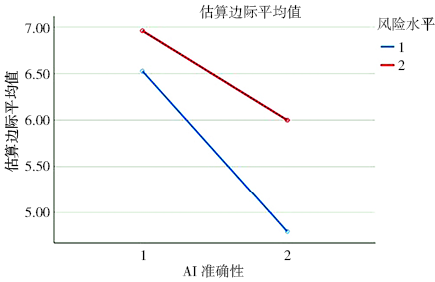
图 1 风险水平与AI建议准确率对建议采纳行为的交互作用
Figure 1 Interaction effect of risk level and AI recommendation accuracy on recommendation adoption
由图1可知,两条线段(或其延长线)发生相交,从图形角度验证了前面方差分析的交互效应的检验显著。
同时为了了解高低分组是否调节了风险水平与AI准确率对采纳行为的影响,以高低分组(高/低)为被试间变量,风险水平(高/低)和AI准确率(高/低)为被试内变量,AI建议采纳率为因变量,进行2×2×2混合设计方差分析。
主要统计结果如下:风险水平的主效应显著,
F(1,51)=12.855,p=0.001;AI准确率的主效应显著,F(1,51)=17.240,p<0.001;风险水平与AI准确率的交互效应显著,F(1,51)=5.606,p=0.022,进一步验证了情境因素之间的协同作用。
涉及高低分组的各交互效应均未达到显著水平:风险水平与高低分组的交互效应不显著,F(1,51)=
1.241,p=0.271;AI准确率与高低分组的交互效应不显著,F(1,51)=2.029,p=0.160;风险水平、AI准确率与高低分组的三重交互效应不显著,F(1,51)=1.042,p=0.312。上述结果表明,在本实验条件下,基于量表测量的信任/依赖高低分组并未显著改变情境因素(风险与准确率)对建议采纳行为的影响路径。
3.3 大五人格特质的调节效应分析
为检验大五人格特质是否在“AI信任→建议采纳”这一关系中发挥调节作用,采用分层回归分析进行检验。为避免多元共线性问题,所有涉及交互项的变量均在进行乘积运算前进行了中心化处理。
总的来说,通过分层回归分析发现,在控制了AI信任与依赖的主效应后,大五人格中的开放性与神经质与信任的交互项均未达到显著水平(p > 0.05)。这表明,在本实验样本中,人格特质并未显著改变AI信任对建议采纳行为的影响强度。
表 2 大五人格分层回归结果汇总
Table 2 Summary of hierarchical regression analyses for the moderating effects of big five personality traits
| 调节变量 | 因变量 | 交互项β | t值 | p值 | 结论 |
| 开放性 | 总采纳率 | 0.068 | 0.472 | 0.639 | 不显著 |
| 神经质 | 总采纳率 | 0.187 | 1.242 | 0.220 | 不显著 |
| 神经质 | 高风险采纳率 | 0.200 | 1.331 | 0.189 | 不显著 |
| 神经质 | 低风险采纳率 | 0.125 | 0.825 | 0.413 | 不显著 |
4 讨论
4.1 风险水平与AI建议准确率对建议采纳行为的影响
研究发现,风险水平和AI建议准确率均对建议采纳率产生显著影响,且二者存在显著交互作用。具体而言,高风险情境下AI建议准确率对建议采纳行为的影响显著强于低风险情境,表明风险水平增强了个体对AI建议质量的敏感性。该结果与研究假设一致,也与已有研究结论基本相符。
首先,AI建议准确率的显著主效应表明,系统性能仍然是影响建议采纳行为的重要决定因素。自动化信任理论认为,用户会依据系统的能力、可靠性和可预测性形成信任判断,并据此决定是否依赖系统建议(Lee & See,2004)。Hancock等(2011)的元分析进一步发现,系统性能是影响人机信任最稳定的预测因素之一。Dzindolet等(2003)指出,即使自动化系统整体准确率较高,用户仍会根据其实际表现动态调整依赖程度。Merritt和Ilgen(2008)的研究同样表明,相较于个体态度变量,系统能力往往更能直接预测自动化依赖行为。本研究中,高准确率AI获得更高的建议采纳率,说明被试能够依据系统表现调整自身决策策略,这与上述研究结论保持一致。
其次,风险水平的显著主效应说明决策情境会影响个体对外部建议的利用程度。前景理论指出,个体在风险决策过程中表现出明显的损失规避倾向,对潜在损失的敏感性通常高于潜在收益(Kahneman & Tversky,1979)。Slovic(1987)进一步提出,风险知觉会影响个体的信息加工方式和决策策略。当决策后果可能带来较大损失时,个体倾向于投入更多认知资源评估决策信息。因此,在高风险情境下,被试更愿意参考AI提供的信息,从而表现出更高的建议采纳水平。
更重要的是,本研究发现风险水平与AI建议准确率存在显著交互作用。该结果支持了人机信任三因素模型关于系统因素与环境因素共同影响行为结果的观点(Hancock et al.,2011)。Castelo等(2019)发现,个体对算法建议的接受程度并非固定不变,而会随着任务风险和任务性质的变化而发生改变。本研究进一步表明,在高风险情境下,个体更加关注AI建议的准确程度,而在低风险情境下,准确率差异对建议采纳行为的影响有所减弱。这说明用户并非简单地依赖AI,而是在结合任务后果的基础上对AI建议进行选择性采纳。
4.2 AI信任水平未产生显著作用的原因
与研究假设不同,本研究未发现AI信任水平对建议采纳行为具有显著影响。这一结果并不意味着信任在人机协同决策中不重要,而可能反映出不同类型信任在线索权重上的差异。Lee和See(2004)指出,信任并非固定不变的个体特质,而是随着系统表现不断调整的动态心理状态。Glikson和Woolley(2020)在对AI信任研究进行系统综述后指出,用户对AI的信任会持续受到系统实际表现的修正。
本研究中的AI信任来源于问卷测量,反映的是个体对生成式AI的总体态度;而实验中呈现的AI建议准确率属于与当前任务直接相关的即时绩效信息。根据信任校准(Trust Calibration)观点,当用户能够直接观察系统表现时,实时绩效信息往往比既有态度更能影响实际行为(Lee & See,2004;Schaefer et al.,2016)。因此,在本研究中,被试更可能依据AI建议的实际准确率而非先验信任水平作出决策。
此外,本研究采用的是短时实验任务。已有研究发现,在人机交互初期阶段,系统性能和任务特征往往比用户个体特征更能预测行为结果(Hancock et al.,2011;Hoff & Bashir,2015)。随着交互时间增加,用户才会逐渐形成稳定的人机信任关系。因此,本研究中AI信任效应未达到显著水平,可能与交互时间较短以及系统绩效线索较强有关。
4.3 开放性与神经质人格未表现出显著调节作用
本研究进一步检验了开放性和神经质人格在AI信任与建议采纳行为关系中的调节作用,但结果均未达到显著水平。根据大五人格理论,开放性较高的个体通常具有更强的新奇体验倾向和认知灵活性,而神经质较高的个体则更容易感知风险和不确定性(McCrae & Costa,1999)。已有研究发现,人格特质能够影响个体对技术的接受态度和使用行为(Devaraj et al.,2008)。因此,本研究原本预期人格特质可能影响AI建议采纳行为。
然而,本研究结果并未支持上述假设。一种可能的解释是,人格特质属于相对稳定的远端变量,而风险水平和AI建议准确率属于直接作用于当前任务的近端情境变量。Hoff和Bashir(2015)指出,在自动化信任形成过程中,系统因素通常比人格等个体差异变量更容易直接影响行为结果。Körber(2018)同样认为,人格变量对自动化依赖行为的解释效应往往弱于系统性能和任务特征。
此外,本研究样本量相对有限,且被试均为大学生群体,样本同质性较高,可能降低了人格变量的变异程度和统计检验力。未来研究可扩大样本规模,并纳入更多人格维度,以进一步检验人格因素在人机协同决策中的作用机制。
4.4 研究局限与未来展望
尽管本研究获得了一些有价值的发现,但仍存在一定局限。首先,本研究样本量相对较小,且样本主要来源于大学生群体,限制了研究结果的外部效度。未来研究可扩大样本规模,并纳入不同年龄、职业背景和AI使用经验的人群,以提高研究结论的普适性。
其次,本研究采用一次性实验任务测量建议采纳行为,而现实生活中的人机交互通常具有持续性和动态性。Lee和See(2004)以及Schaefer等(2016)均指出,人机信任会随着交互经验不断发展和调整。未来研究可采用纵向研究设计或多轮交互实验,以考察AI信任和建议采纳行为的动态变化过程。
再次,本研究仅考察了开放性和神经质人格的作用,而责任心、宜人性、认知需求以及算法素养等变量也可能影响AI建议采纳行为。未来研究可进一步纳入更多个体差异因素,以构建更加完整的人机协同决策模型。
最后,本研究主要关注风险水平和AI建议准确率的影响,而生成式AI情境中的透明性、可解释性、拟人化程度以及建议呈现方式等因素同样值得关注(Glikson & Woolley,2020;Bach et al.,2024)。未来研究可进一步考察这些变量与风险水平之间的交互作用,以更全面地揭示生成式AI背景下建议采纳行为的形成机制。
5 结论
本研究以大学生为研究对象,采用问卷测量与行为实验相结合的方法,考察了生成式AI辅助决策情境下建议采纳行为的影响因素。研究发现,AI建议准确率和任务风险水平显著影响个体的建议采纳行为,且二者存在显著交互作用。高风险情境下,个体对AI建议准确率更加敏感,准确率对建议采纳行为的影响更强。总体而言,在生成式AI辅助决策的初期交互阶段,建议采纳行为主要受到情境因素的影响。
参考文献
[1] Glikson E & Woolley A W. (2020). Human trust in artificial intelligence: Review of empirical research. Academy of Management Annals, 14(2), 627-660.
[2] Lee J D & See K A. (2004). Trust in automation: Designing for appropriate reliance. Human Factors, 46(1), 50-80.
[3] Dzindolet M T, Peterson S A, Pomranky R A, Pierce L G & Beck H P. (2003). The role of trust in automation reliance. International Journal of Human-Computer Studies, 58(6), 697-718.
[4] Hancock P A, Billings D R, Schaefer K E, Chen J Y C, de Visser E J & Parasuraman R. (2011). A meta-analysis of factors affecting trust in human-robot interaction. Human Factors, 53(5), 517-527.
[5] Merritt S M & Ilgen D R. (2008). Not all trust is created equal: Dispositional and history-based trust in human-automation interactions. Human Factors, 50(2), 194-210.
[6] Logg J M, Minson J A & Moore D A. (2019). Algorithm appreciation: People prefer algorithmic to human judgment. Organizational Behavior and Human Decision Processes, 151, 90-103.
[7] Kahneman D & Tversky A. (1979). Prospect theory: An analysis of decision under risk. Econometrica, 47(2), 263-291.
[8] Slovic P. (1987). Perception of risk. Science, 236(4799), 280-285.
[9] Weber E U, Blais A R & Betz N E. (2002). A domain-specific risk-attitude scale: Measuring risk perceptions and risk behaviors. Journal of Personality and Social Psychology, 82(4), 663-677.
[10] Castelo N, Bos M W & Lehmann D R. (2019). Task-dependent algorithm aversion. Journal of Marketing Research, 56(5), 809-825.
[11] Hoff K A & Bashir M. (2015). Trust in automation: Integrating empirical evidence on factors that influence trust. International Journal of Human-Computer Studies, 81, 1-11.
[12] McCrae R R & Costa P T Jr. (1999). A five-factor theory of personality. In L A Pervin & O P John (Eds.), Handbook of personality: Theory and research (2nd ed., pp. 139–153). Guilford Press.
[13] Devaraj S, Easley R F & Crant J M. (2008). How does personality matter? Relating the five-factor model to technology acceptance and use. Information Systems Research, 19(1), 93-105.
[14] Sun G. (2025). The dependence of generative artificial intelligence: Scale development, validation, and its motivational, behavioral, and psychological correlates. Computers in Human Behavior Reports.
[15] Nunnally J C & Bernstein I H. (1994). Psychometric theory (3rd ed.). McGraw-Hill.
[16] Wang M, Dai X & Yao S. (2011). Preliminary development of the Chinese Big Five Personality Inventory Ⅲ: Development of the short form and its reliability and validity. Chinese Journal of Clinical Psychology, 19(4), 454-457.
[17] Cureton E E. (1957). The upper and lower twenty-seven percent rule. Psychometrika, 22, 293-296.
[18] Feldt L S. (1961). The use of extreme groups to test for the presence of a relationship. Psychometrika, 26, 307-316.
[19] Schaefer K E, Chen J Y C, Szalma J L & Hancock P A. (2016). A meta-analysis of factors influencing the development of trust in automation. Human Factors, 58(3), 377-400.
[20] Körber M. (2018). Theoretical considerations and development of a questionnaire to measure trust in automation. Applied Ergonomics, 70, 136-147.
[21] Bach T A, Khan A, Hallock H, Beltrão G & Sousa S. (2024). A systematic literature review of user trust in AI-enabled systems: An HCI perspective. International Journal of Human-Computer Interaction, 40(5), 1251-1266.