Current Views: 2653747
 Current Downloads: 1656654
Psychology of China
ISSN Print:2664-1798
ISSN Online:2664-1801
Contact Editorial Office



Subscribe to the latest published information from SCISCAN
父母低头行为对初中生社交焦虑的影响:自尊的中介作用
The Impact of Parents’ Head-down Behavior on Junior High School Students’ Social Anxiety: The Mediating Role of Selfesteem


-
Information:
广西师范大学教育学部心理学系,桂林
-
Keywords:
Parental phubbing; Social anxiety; Self-esteem; Junior high school students; Mediating effect父母低头行为; 社交焦虑; 自尊; 初中生; 中介作用
- Abstract: The present study aimed to examine the relationship between parental phubbing and social anxiety among junior high school students, as well as the mediating role of self-esteem in this association. For this purpose, we employed the Parental Phubbing Scale, the Social Anxiety Scale, and the Self-Esteem Scale as research instruments, and conducted a questionnaire survey and analysis among 390 junior high school students from Wuming District of Guangxi, Chengdu, and Mianyang in Sichuan Province. The results showed that parental phubbing was significantly positively correlated with junior high school students’ social anxiety, significantly negatively correlated with self-esteem, and self-esteem was significantly negatively correlated with social anxiety. Furthermore, mediation analysis indicated that self-esteem partially mediated the relationship between parental phubbing and junior high school students’ social anxiety, with the mediation effect accounting for 33.33% of the total effect. These findings suggest that Parental phubbing not only positively predicts junior high school students’ social anxiety, but also significantly negatively predicts their self‑esteem, thereby indirectly exacerbating their social anxiety. 本研究旨在考察父母低头行为与初中生社交焦虑之间的关系,并检验自尊在二者之间所起的作用。为此,我们选用了父母低头行为量表、社交焦虑量表和自尊量表作为研究工具,对来自广西武鸣、四川成都以及绵阳地区的390名初中生进行了问卷调查与分析。研究发现,父母低头行为与初中生社交焦虑呈显著正相关,与自尊呈显著负相关,自尊与社交焦虑呈显著负相关。同时,中介效应分析显示,自尊在父母低头行为与初中生社交焦虑之间起部分中介作用,中介效应占总效应的33.33%。结果表明,父母低头行为不仅能够正向预测初中生的社交焦虑,也能显著负向预测初中生自尊水平,间接地加剧其社交焦虑。
- DOI: 10.35534/pc.0807164
- Cite: 吴承宇. (2026). 父母低头行为对初中生社交焦虑的影响: 自尊的中介作用. 中国心理学前沿, 8 (7), 1114-1119.
1 问题提出
当前,智能手机已经全面渗透到人们日常生活的方方面面。然而,这一科技进步也带来了一种值得关注的社会现象——“低头行为”(Phubbing),即个体在社交环境中过度专注于手机屏幕,从而忽视或疏离周边人群与情境的行为模式(龚艳萍 等,2019)。当这一行为或情形发生在家庭中时,便构成了“父母低头行为”,即父母在与子女共处时,因沉迷手机而忽视或冷落子女的现象(丁倩 等,2018)。这种现象在当下的家庭互动中越来越普遍,对正处于身心发展关键期的青少年产生了极大的影响。
家庭是儿童社会化的首要场所,也是其成长过程中接触时间最早、最长的社会环境,对初中生的心理发展具有不可替代的影响(姜倩云 等,2021)。从依恋理论的视角来看,孩子跟父母之间建立起来的稳固、安全的情感纽带,是他们将来拥有健康人格和良好社交能力的基础。然而,如果父母在亲子互动中过度沉溺于手机,这将会降低他们对孩子需求的敏感性,削弱亲子间的情感联结,间接阻碍孩子建立安全依恋(姜倩云 等,2021;Mcdaniel & Radesky,2018)。同时,这种低质量的父母陪伴不仅可能会导致孩子感到被忽视,从而产生孤独感和不安全感,更可能会对其自我认知和社交技能的发展造成严重的负面影响。
社交焦虑是初中生群体里较为常见的心理问题之一,它是指个体在社交情境中对他人的负面评价产生恐惧,并伴随显著的忧虑、不安及回避行为(郭晓薇,2000;李波 等,2003)。研究表明,有15%的初中生经常面临各种焦虑问题,其中社交焦虑、强迫障碍和担心身体受伤三类焦虑问题最为普遍(王建平 等,2006)。家庭环境是影响初中生社交焦虑的重要因素之一,家庭成员间的亲密程度、支持水平与冲突状况均与初中生的社交焦虑水平显著相关(郑金香 等,2000;谭亚菲,2015)。而父母低头行为作为一种新型的、消极的亲子互动模式,可能会通过减少亲子沟通、传递拒绝信号,加剧初中生对人际交往的恐惧和不安(刘幸娟,2022;张永欣 等,2022)。
此外,自尊作为个体对自我价值的基本判断和感受,在青少年心理健康中扮演着极其重要的角色(Mruk,2013)。青春期是个体自尊发展的关键且极不稳定的时期(Trzesniewski et al.,2003)。积极的亲子关系有助于青少年形成高自尊;相反,父母的忽视与拒绝则会损害青少年的自尊水平(高玲 等,2023)。更重要的是,大量研究证实,自尊是预测社交焦虑的关键变量,低自尊的个体往往会表现出更高水平的社交焦虑(张亚利 等,2019;刘广增 等,2017)。已有研究表明,父母低头行为会通过削弱青少年的自我评价或自尊,进而引发抑郁、攻击行为等内外部问题(刘子凡,2022;高玲 等,2023)。
尽管已有研究分别探讨了父母低头行为与青少年社交焦虑间的关系(张永欣 等,2022),以及自尊与社交焦虑的关系(刘广增 等,2017),但较少研究探讨自尊作为中介变量在其中的作用,这一中介路径尚缺乏实证支持。因此,本研究旨在构建一个中介模型,探讨父母低头行为对初中生社交焦虑的影响机制,考察自尊在其中的中介作用。
基于上述理论与实证基础,本研究提出以下假设:
假设一:父母低头行为对初中生社交焦虑具有显著的正向预测作用;
假设二:父母低头行为对初中生自尊具有显著的负向预测作用;
假设三:初中生自尊对社交焦虑具有显著的负向预测作用;
假设四:自尊在父母低头行为与初中生社交焦虑间起中介作用。
本研究的理论意义在于,尝试在父母低头行为、自尊与初中生社交焦虑三者之间建立新的理论模型,为相关理论建构提供依据,从而揭示父母低头行为对于初中生社交焦虑的影响机制。实践意义则在于,通过验证该模型,不仅能够帮助父母深刻认识到低头行为所引发的消极影响,同时也有助于深入探究低头行为对初中生身心发展可能产生的负面作用,从而促使父母更加重视并纠正这一行为,促进初中生的身心发展,进而维护社会的稳定和发展。
2 研究方法
2.1 研究对象
采用简单随机抽样的方式,以班级为单位,通过纸质填写、互联网填写两种方法,调查广西武鸣地区、四川成都及绵阳地区的初中学生,其中线上收集61份,线下纸质收集402份,共计463份。通过对463份问卷的严格筛选,剔除作答内容不全、规律性作答、答题时长过短的问卷后,最终得到390份有效问卷,有效回收率为84.23%。以下为研究对象人口学变量的描述性统计详情,具体数据如表1所示。
表 1 研究对象构成
Table 1 Study subject composition
| 项目 | 类别 | 人数 | 所占比例 |
| 性别 | 男 | 201 | 51.5% |
| 女 | 189 | 48.5% | |
| 年龄 | 13 | 155 | 39.7% |
| 14 | 174 | 44.6% | |
| 15 | 61 | 15.6% | |
| 年级 | 初一 | 174 | 44.6% |
| 初二 | 218 | 55.6% | |
| 生源地 | 农村 | 327 | 83.8% |
| 城镇 | 63 | 16.2% | |
| 父母是否在外务工 | 父母都在外务工 | 105 | 26.9% |
| 父母都在家中 | 174 | 44.6% | |
| 父亲在外务工 | 56 | 14.4% | |
| 母亲在外务工 | 55 | 14.1% |
2.2 研究工具
2.2.1 父母低头行为量表
采用丁倩等(2018)翻译并修订的父母低头行为量表。该量表为单维度结构,包含9个条目,如“我与父母交谈时,他们不会使用手机”等。问卷采用5点计分(1=“从不”至5=“总是”),总分越高,表示父母在亲子互动中的低头行为越频繁。本研究中,该量表的Cronbach’s α 为0.947。
2.2.2 社交焦虑量表
采用朱海东等修订的青少年社交焦虑量表(SAS-A)。该量表共13个题项,分为三个维度:害怕否定评价、陌生情境下的社交回避与苦恼、一般情境下的社交回避与苦恼。问卷采用5点计分(1=“完全不符合”至5=“完全符合”),得分越高,表示社交焦虑程度越严重。本研究中,该量表的Cronbach’s α为0.884。
2.2.3 自尊量表
采用Rosenberg 设计的自尊量表(SES),该量表共10个条目,采用4点计分(1=“非常不同意”至4=“非常同意”),总分越高,表示个体的自尊水平越高。本研究中,该量表的Cronbach’s α为0.926。
2.3 施测程序与数据处理
以班级为单位进行团体施测。由经过培训的心理学专业研究生担任主试,使用统一指导语向被试说明问卷填写要求和保密原则,被试当场填写并回收问卷。数据收集完成后,本研究借助SPSS 26.0软件对收集到的数据开展描述性统计分析、人口统计学差异性检验及相关分析。同时,运用SPSS插件PROCESS宏程序(Model 4)检验自尊在父母低头行为与初中生社交焦虑间的中介效应。
3 研究结果
3.1 父母低头行为、初中生社交焦虑、自尊的现状
如表2所示,采用描述统计对各变量维度及总体情况展开分析,得到以下数据。
表 2 父母低头行为、初中生社交焦虑、自尊的现状
Table 2 Parental phubbing, social anxiety among middle school students, and the current state of self-esteem
| Min | Max | M | SD | |
| 害怕否定评价 | 6 | 30 | 19.00 | 5.67 |
| 陌生情境下 | 4 | 20 | 12.60 | 3.82 |
| 一般情境下 | 3 | 15 | 9.37 | 2.81 |
| 社交焦虑总分 | 17 | 64 | 40.97 | 9.36 |
| 父母低头行为总分 | 9 | 45 | 28.34 | 8.71 |
| 自尊总分 | 10 | 40 | 23.37 | 7.49 |
3.2 父母低头行为、初中生社交焦虑、初中生自尊的人口学特征
3.2.1 性别差异
如表3所示,总体而言,父母低头行为、初中生社交焦虑、自尊在性别上不存在显著性差异。
表 3 各变量上的性别差异
Table 3 Gender differences across variables
| 男(n=201) | 女(n=189) | t | p | |||
| 均值 | 标准差 | 均值 | 标准差 | |||
| 父母低头行为 | 28.57 | 8.45 | 28.09 | 8.99 | 0.55 | 0.59 |
| 初中生社会焦虑 | 40.77 | 9.31 | 41.18 | 9.44 | -0.44 | 0.66 |
| 自尊 | 23.81 | 7.45 | 22.92 | 7.52 | 1.17 | 0.24 |
3.2.2 年级差异
如表4所示,总体而言,父母低头行为、初中生社交焦虑、自尊在年级上不存在显著性差异。
表 4 各变量上的年级差异
Table 4 Grade differences across variables
| 初一(n=174) | 初二(n=218) | t | p | |||
| 均值 | 标准差 | 均值 | 标准差 | |||
| 父母低头行为 | 28.13 | 8.44 | 28.50 | 8.94 | -0.42 | 0.67 |
| 初中生社会焦虑 | 40.39 | 9.17 | 41.44 | 9.51 | -1.1 | 0.27 |
| 自尊 | 23.66 | 7.76 | 23.15 | 7.27 | 0.66 | 0.51 |
3.3 父母低头行为、初中生社交焦虑、初中生自尊之间的关系
为了深入探究父母低头行为、初中生自尊与社交焦虑之间的关系,本研究开展Pearson相关分析,结果如表5所示。
表 5 父母低头行为、初中生社交焦虑、初中生自尊之间的关系
Table 5 The relationship between parental phubbing, junior high school students’ social anxiety, and junior high school students’ self-esteem
| 父母低头行为 | 初中生社交焦虑 | 初中生自尊 | |
| 父母低头行为 | 1 | ||
| 初中生社交焦虑 | 0.45*** | 1 | |
| 初中生自尊 | -0.42*** | -0.48*** | 1 |
注:***在0.001 水平(双侧)上显著相关。
结果表明,父母低头行为和初中生社交焦虑之间存在显著正相关,父母低头行为与初中生自尊存在显著负相关,初中生自尊和社交焦虑之间也存在显著负相关。
3.4 父母低头行为影响初中生社交焦虑的中介模型检验
本研究采用Hayes(2021)开发的PROCESS宏程序中的Model 4(简单中介模型)检验自尊在父母低头行为与初中生社交焦虑间的中介效应,具体回归分析结果如表6所示。
表 6 回归系数表
Table 6 Regression coefficient table
| 结果变量 | 预测变量 | β | t |
| 初中生社会焦虑 | 父母低头行为 | 0.48 | 9.79*** |
| 初中生自尊 | 父母低头行为 | -0.36 | -9.10*** |
| 初中生社会焦虑 | 初中生自尊 | -0.45 | -7.57*** |
| 父母低头行为 | 0.32 | 6.33*** |
注:***在0.001 水平(双侧)上显著相关。
采用Bias-Corrected Bootstrap(重复取样5000次)对自尊的中介效应进行检验,检验结果如表7所示。
表 7 中介效应检验结果
Table 7 Mediation effect test results
| 效应值 | Boot SE |
Boot CI 下限 |
Boot CI 上限 |
相对 效应值 |
|
| 总效应 | 0.48 | 0.05 | 0.38 | 0.57 | |
| 直接效应 | 0.32 | 0.05 | 0.22 | 0.42 | 66.67% |
| 自尊的中介效应 | 0.16 | 0.03 | 0.11 | 0.22 | 33.33% |
研究结果显示,父母低头行为对初中生社交焦虑具有显著的正向预测作用(β=0.48,p<0.001)。在引入中介变量——自尊后,父母低头行为对初中生社交焦虑的直接预测作用依然显著(β=0.32,p<0.001)。此外,父母低头行为对初中生自尊水平存在显著的负向预测作用(β=-0.36,p<0.001),初中生自尊水平则对其社交焦虑具有显著的负向预测作用(β=-0.45,p<0.001)。这一关系模式如图1所示。
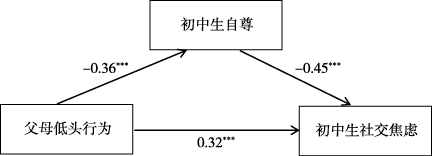
图 1 自尊的中介作用模型估计结果
Figure 1 Estimated results of the mediating model of self-esteem
根据表7可知,总效应(Total Effect)为0.48,其中直接效应(Direct Effect)为0.32,占总效应的66.67%;中介效应(Indirect Effect)为0.16,占总效应的33.33%。Bootstrap 95% CI为(0.1077,0.2198),区间内不包含0,因此本研究证实存在中介效应,且为部分中介效应。即,父母低头行为不仅能够直接预测初中生社交焦虑,还可以通过初中生自尊水平这一中介变量预测初中生社交焦虑。
4 讨论
4.1 父母低头行为对初中生社交焦虑的直接影响
本研究结果表明,父母低头行为对初中生社交焦虑具有显著的正向预测作用,这一结果与以往研究结论一致(张永欣 等,2022;刘幸娟,2022),即父母在亲子互动中使用手机越频繁,初中生的社交焦虑水平越高。
首先,父母低头行为越频繁,对子女产生的负面影响越大。青春期通常被视为孤独感滋生和加剧的时期。在此阶段,如果父母因过度沉溺手机而减少对子女的陪伴时间,孩子的情感需求得不到应有回应,易产生强烈的被忽视的体验。风险家庭模型指出,当家庭存在攻击性养育、教养缺失、忽视、情感支持匮乏等特征时,会损害子女的情绪调节能力与社交技能(Repetti et al.,2002),进而诱发社交焦虑。
其次,家庭是初中生生活时长最长、接触最频繁的场所,家庭成员结构、相处方式,以及对初中生的态度和教养方式,在很大程度上塑造孩子对社会关系的认知。儿童最早接触的人际互动方式与关系范本来自父母间的互动,这种互动的亲密程度将成为初中生人际交往学习的典范。如果家庭关系冷淡、家庭氛围冷漠,初中生长期处于这种环境中,就会很容易对人际交往产生消极的预期,担心与他人建立关系会带来不可知的伤害,从而表现出社交焦虑等心理障碍(谭亚菲,2015)。
4.2 自尊对初中生社交焦虑的影响
本研究发现,初中生自尊水平与社交焦虑之间存在显著负相关,即自尊水平越低,社交焦虑程度越高。
首先,高自尊个体通常对自我持有积极的认知,更愿意主动参与人际交往;而低自尊个体多存在自我否定倾向,在社交场景中易放大自身的不足,对他人评价过度敏感,这也使得低自尊初中生更容易产生社交焦虑(刘广增 等,2017)。
其次,青春期是个体自我意识快速发展、社交关系发生结构性转变的阶段,这一时期极易引发一些人际交往方面的问题,例如社交焦虑(金晓雨 等,2013)。自尊较高的个体能够借助积极的自我评价和反馈机制,有效减轻社交焦虑情绪。反之,由于缺乏足够的自我肯定,更容易在人际互动中感受到威胁,从而陷入社交焦虑之中(闫秀峰 等,2012)。
最后,根据依恋理论,缺乏自尊的个体通常表现出不安全型依恋,这使得他们难以信任他人,并表现出较高的敏感性。研究显示,自尊对个体的社会适应有显著影响,低自尊者往往缺乏人际信任,伴随更高水平的社交焦虑水平(孙晓玲,吴明证,2011)。
4.3 自尊在父母低头行为与初中生社交焦虑之间的中介作用
本研究的核心发现在于,自尊在父母低头行为与初中生社交焦虑间起部分中介作用,中介效应占总效应的33.33%。这一结果意味着,父母低头行为对初中生社交焦虑的影响并非完全是直接的,其中一部分通过降低初中生自尊水平实现。
首先,研究发现父母低头行为显著负向预测初中生的自尊。这与前人研究一致(高玲 等,2023)。根据社会镜像自我理论,个体对自我的认识在很大程度上是通过感知他人(尤其是重要他人)对自己的态度和评价而形成的。父母是初中生自我评价形成过程中的重要参照对象,当孩子感知到父母在互动中总是对自己缺乏关注、心不在焉时,很容易将此理解为一种“被拒绝”的信号,进而形成“我不够好”“我不值得被关注”的消极自我认知,从而导致自尊水平的下降(周飞,2020)。
其次,本研究发现自尊显著负向预测社交焦虑,验证了该领域一个稳定的结论(张亚利 等,2019;刘广增 等,2017)。自尊水平较高的个体倾向于对自己持有积极的评价,相信自己有能力来应对社交情境,因此在人际交往中更自信主动。相反,低自尊的个体对自我持负面看法,怀疑自身的社交能力,并过度关注外界可能的负面评价,这种高度自我警觉和消极预期使其在社交情境中体验到强烈的紧张、不安和回避行为(肖崇好,黄希庭,2011)。
本研究结果将上述两个关系串联起来,证实了自尊的中介路径。父母低头行为作为一种消极的亲子互动方式,首先损害了初中生的自我价值感,使其自尊水平降低;随后,受损的自尊成为个体应对社交情境时的一种脆弱性因素,使其更易于对人际互动产生恐惧和回避,从而表现出更高的社交焦虑。
4.4 研究意义与局限
本研究的理论意义在于,将父母低头行为的研究视角从成人亲密关系拓展至亲子关系,并深入到青少年心理健康领域,回应了数字时代家庭教育面临的新挑战。通过检验自尊的中介作用,本研究揭示了父母低头行为影响初中生社交焦虑的一条重要内在路径,丰富了对社交焦虑形成机制的理解,也为家庭因素如何通过个体自我系统影响心理健康提供了实证依据。
本研究的实践意义同样显著。研究结果对家庭教育指导和青少年心理健康干预具有启示作用。第一,研究提醒家长应深刻认识到低头行为的潜在危害,增强与孩子互动时的“在场”意识,将有质量的陪伴落到实处。第二,研究结果表明,提升初中生的自尊水平可能是预防和缓解社交焦虑的有效切入点,家长和教育者应当多给予青少年积极关注和肯定,帮助他们建立更为客观和积极的自我认知。第三,未来的干预项目可以考虑将“减少父母低头行为”与“提升青少年自尊”相结合,制定综合性的家庭干预方案,以期达到事半功倍的效果。
本研究也存在一些局限性。第一,横断研究的设计使得我们无法对变量之间的因果关系做出确切的推断,未来研究可以通过纵向追踪或实验设计来进一步检验因果方向。第二,数据均来自被试的自我报告,可能受到社会赞许性等因素的干扰,后续研究可以考虑引入观察法或多方报告(如教师评定、同伴提名)来增强数据的客观性。第三,本研究样本主要来自广西和四川两地,且初三学生样本缺失,限制了结论的代表性和推广性。未来研究应当努力扩大取样的地域范围和年级覆盖面。最后,本研究仅考察了自尊的中介作用,但父母低头行为对初中生社交焦虑的影响可能还存在其他中介变量(如自我效能感)或调节变量(如人格特质、同伴关系),后续研究可以在此基础上进一步拓展和深化。
5 结论
本研究通过对390名初中生开展问卷调查与数据分析,得出以下结论:
(1)父母低头行为对初中生社交焦虑具有显著的正向预测作用;
(2)父母低头行为对初中生自尊具有显著的负向预测作用;
(3)初中生自尊对社交焦虑具有显著的负向预测作用;
(4)自尊在父母低头行为与初中生社交焦虑之间起部分中介作用。
参考文献
[1] 丁倩, 孔令龙, 张永欣, 等. (2018). 父母 “低头族” 与初中生手机成瘾的交叉滞后分析. 中国临床心理学杂志, 26(5), 952-955.
[2] 高玲, 孟文慧, 刘介地, 等. (2023). 父母低头行为与青少年网络欺负行为: 自尊和基本共情的作用. 心理发展与教育,39(3), 439-448.
[3] 龚艳萍, 陈卓, 谢菊兰, 等. (2019). 手机冷落行为的前因、后果与作用机制.心理科学进展, 27(7), 1258-1267.
[4] 郭晓薇. (2000). 大学生社交焦虑成因的研究. 心理学探新, (1), 55-58.
[5] 姜倩云, 王兴超, 刘兵, 等. (2021) .父母低头行为对儿童青少年心理发展的影响. 心理发展与教育, 37 (1) , 137-145.
[6] 金晓雨, 肖晶, 崔丽霞. (2013) .大学生情绪调节的认知策略、外显自尊、人格特质与社交焦虑的关系. 中国健康心理学杂志, 21 (4) , 609-612.
[7] 李波, 钟杰, 钱铭怡. (2003) .大学生社交焦虑易感性的回归分析. 中国心理卫生杂志, (2) , 109-112.
[8] 刘广增, 潘彦谷, 李卫卫, 等. (2017) .自尊对青少年社交焦虑的影响: 自我概念清晰性的中介作用. 中国临床心理学杂志, 25 (1) , 151-154.
[9] 刘幸娟. (2022) .父母低头行为对儿童心理健康的消极影响及教育对策. 嘉应学院学报, 40 (4) , 97-101.
[10] 刘子凡. (2022) .父母低头行为对青少年发展的影响及机制. 中小学心理健康教育, (3) , 4-8.
[11] 孙晓玲, 吴明证. (2011) .大学生自尊、拒绝敏感性、人际信任与社会焦虑的关系. 中国临床心理学杂志, 19 (4) , 537-539.
[12] 谭亚菲. (2015) .家庭环境与青少年自尊、社交焦虑等问题的关系研究. 高教学刊, (14) , 175-176.
[13] 王建平, 杨智辉, 王玉龙, 等. (2006) .1506名初中生焦虑状况分析. 中国健康心理学杂志, (6) , 604-607.
[14] 肖崇好, 黄希庭. (2011) .社交焦虑个体外显与内隐自尊的研究. 心理科学, 34 (2) , 289-292.
[15] 闫秀峰, 冯淑丹, 李艳霞, 等. (2012) .青少年自我效能、自尊与社交焦虑的关系研究. 教育测量与评价 (理论版) , (7) , 41-44.
[16] 张亚利, 李森, 俞国良. (2019) .自尊与社交焦虑的关系: 基于中国学生群体的元分析. 心理科学进展, 27 (6) , 1005-1018.
[17] 张永欣, 董思唯, 丁倩, 等. (2022) .父母低头行为与青少年攻击行为: 一个双路径模型. 中国临床心理学杂志, 30 (1) , 129-133.
[18] 郑金香, 张剑, 张洪英. (2000) .女大学生的社交焦虑与家庭功能关系研究. 中华女子学院山东分院学报, (2) , 28-30.
[19] 周飞. (2020) . 父母手机冷落行为与青少年外化问题行为的关系 (硕士学位论文) .信阳师范学院.
[20] Mcdaniel B T & Coyne S M. (2016). Technology interference in the parenting of young children: Implications for mothers’ perceptions of coparenting. Social Science Journal, 53(4), 435-443.
[21] Mcdaniel B T & Radesky J S. (2018). Technoference: Parent distraction with technology and associations with child behavior problems. Child Development, 89(1), 100-109.
[22] Mruk C J. (2013). Self-esteem and positive psychology: Research, theory, and practice(4th ed.). Springer.
[23] Repetti R L, Taylor S E & Seeman T E. (2002). Risky families: Family social environments and the mental and physical health of offspring. Psychological Bulletin, 128(2), 330-366.
[24] Trzesniewski K H, Donnellan M B & Robins R W. (2003). Stability of self-esteem across the life span. Journal of Personality and Social Psychology, 84(1), 205-220.