Current Views: 2576899
 Current Downloads: 1600238
Psychology of China
ISSN Print:2664-1798
ISSN Online:2664-1801
Contact Editorial Office



Subscribe to the latest published information from SCISCAN
大学生社交媒体使用与在线社交焦虑的关系:人际交往效能感的作用
Social Media Use and Online Social Anxiety Among College Students: The Mediating Role of Interpersonal Self-efficacy


-
Information:
1.肇庆学院教育科学学院,肇庆;
2.佛山职业技术学院马克思主义学院,佛山
-
Keywords:
College students; Social media engagement; Online social anxiety; Interpersonal self-efficacy大学生; 社交媒体使用; 在线社交焦虑; 人际交往效能感
- Abstract: This study examined the mediating role of interpersonal self-efficacy in the relationship between social media use and online social anxiety among college students. Using validated scales including the Problematic Social Media Use Questionnaire for Adolescents, the Online Social Anxiety Scale for Social Media Users, and the Interpersonal Self- Efficacy Scale for College Students, data were collected from 864 participants. Key findings revealed: (1) Social media use intensity significantly predicted online social anxiety; (2) Interpersonal self-efficacy partially mediated this relationship, accounting for 42% of the total effect. These results align with previous findings on social skills and anxiety pathways, suggesting that targeted interventions enhancing interpersonal efficacy could mitigate anxiety risks associated with social media engagement. 为考察大学生社交媒体使用与在线社交焦虑的关系,并考察人际交往效能感的中介作用,本研究采用青少年问题性移动社交媒体使用评估问卷、社交媒体用户社交焦虑量表、大学生人际交往效能感问卷对粤港澳大湾区864名大学生进行问卷调查。研究发现:(1)社交媒体使用与在线社交焦虑呈显著正相关,人际交往效能感与社交媒体使用、在线社交焦虑均呈显著负相关。(2)社交媒体使用正向预测在线社交焦虑。(3)人际交往效能感在社交媒体使用与在线社交焦虑之间起部分中介作用。社交媒体使用不仅可以直接影响大学生的在线社交焦虑,还能通过降低人际交往效能感间接影响大学生的在线社交焦虑。
- DOI: 10.35534/pc.0802024 (registering DOI)
- Cite: 罗云, 黄悦霖, 毛玉梅. (2026). 大学生社交媒体使用与在线社交焦虑的关系: 人际交往效能感的作用. 中国心理学前沿, 8 (2), 154-158.
随着我国数字经济的不断发展,人们对社交媒体使用的频率也逐渐增加。根据《人民日报》提供的数据,2024年中国社交媒体用户数量已超过10亿,其中大学生是用户群体的主力军(李华锡,2024)。据调查显示,超过80%的大学生频繁在网络平台开展社交活动,超过50%的大学生每日在网络上花费的时长在3小时以上,而超过60%的大学生觉得网络社交会耗费大量时间。其中,有29.35%的用户感知到网络社交可能导致精神内耗和社交焦虑(杨晴,2023)。大学生正处于社交能力发展的关键期,其自我认同的建构、人际关系的维护很大程度上都依赖于社交互动,而青年期身心发育尚未成熟,过度使用社交媒体极易使其迷失自我,从而产生在线社交焦虑。
在线社交焦虑指个体在通过社交媒体平台等网络渠道进行社交互动时,所感受到的紧张、焦虑等消极情绪(陈晓光 等,2024)。该概念也被表述为“线上社交焦虑”,特指个体在社交媒体互动场景中体会到的诸如紧绷、忧惧之类的负面人际感受(陈必忠等,2020)。这种情绪状态不仅会降低个体的线上社交体验质量,还可能对其心理健康产生负面影响。有研究表明,线上社交焦虑不仅会使用户产生社交媒体倦怠等消极心理体验(Liu et al.,2020),还会导致用户出现抑郁或焦虑的情绪(刘如婧,2022),也会对用户的网络行为产生消极影响(Weidman et al.,2015)。
社交媒体使用指大学生在日常生活中通过微信、微博等平台参与互动、发布内容和浏览信息的综合行为(崔晶晶,2024)。社会置换理论认为过度沉迷社交媒体,会让人们无暇参与现实中的面对面社交互动,对现实社会支持的依赖和利用也随之减少(Kraut et al.,1998),这提高了个体的忧郁感和疏离感,从而产生社交焦虑等消极后果。研究表明,问题性社交媒体使用显著正向影响线上社交焦虑(陈晓光 等,2024)。当代年轻人害怕会错过他人的正性经历,容易过度使用社交媒体,这导致他们感受到与社交网络相关的压力,增加线上社交焦虑(Beyens et al.,2016;陈必忠 等,2023)。
自我效能感指的是人们对自身完成既定的行为目标所需的行动过程的组织和执行能力的判断(班杜拉 A,2001)。在人际交往的具体情形下,存在着相应的自我效能感,即人际交往效能感,指个体在与他人进行交往活动之前对自己能够在什么水平上完成该交往活动的判断(谢晶 等,2009)。自我效能感理论聚焦于个体对自身完成特定任务能力的信念,基于该理论,以往的失败经验会降低个体的自我效能感,进而使其产生消极的情感反应,如焦虑、抑郁等(Bandura A,1997)。有研究表明,社交自我效能感与社交焦虑显著负相关(许磊 等,2021)。社交自我效能感高的人越愿意主动与其他人交往,社交焦虑较少;而社交自我效能感低的人倾向于回避社交情境,焦虑感强(顾佳旎 等,2014)。
因此,人际交往效能感有可能是在线社交焦虑的影响因素。而以往研究表明,社交媒体使用是人际交往效能感的预测因素。如有研究表明,问题性社交网站使用与社会自我效能感的负相关关系显著(孙柳琦 等,2024),被动性社交网站使用能直接负向预测社会自我效能感(陈必忠,2020)。此外,有研究发现,社交自我效能感是大学生社交网站自我呈现和网络社交动机的中介变量(宋娇 等,2022),社交自我效能感在主动性社交网站使用对大学生友谊质量的影响过程中起中介作用(李笑燃,2024),而友谊关系质量与社交焦虑显著相关(钟萍 等,2017)。因此,社交自我效能感很可能是社交媒体使用与在线社交焦虑间的重要中介变量。
综上所述,本研究假设:社交媒体使用能显著正向预测大学生的在线社交焦虑(H1),且人际交往效能感在其中起中介作用(H2)。中介假设模型如图1所示。
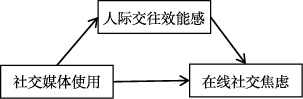
图 1 社交媒体使用影响在线社交焦虑的中介假设模型
Figure 1 Mediation hypothesis model of the influence of social media use on online social anxiety
1 对象与方法
1.1 研究对象
本研究通过问卷网平台制作调查问卷,以线上调研的形式,向粤港澳大湾区内多所大学展开调查。问卷内设测谎题2道,预计完成时间为5分钟以上,测谎题填写有误、问卷填写时间较为极端或有明显规律的问卷均视为无效问卷。正式施测阶段共发放 1015份问卷,有效回收864份问卷,有效率 85.1%。其中男生 299人(34.6%),女生 565人(65.4%);大一325人,大二105人,大三333人,大四101人。
1.2 研究工具
1.2.1 青少年问题性移动社交媒体使用评估问卷
采用姜永志编制的青少年问题性移动社交媒体使用评估问卷(姜永志,2018)。该问卷共有20个条目,包括五个维度:黏性增加、错失焦虑、认知失败、负罪感,采用Likert五点计分法,即从1(“完全不符合”)到5(“完全符合”)。分数越高,说明问题性社交媒体使用行为越严重。该量表在本次研究中的α系数为0.95。
1.2.2 社交媒体用户社交焦虑量表
采用Alkis等人开发的社交媒体用户社交焦虑量表,由国内学者对其进行汉化(罗谭媛,2023)。该量表共有21个条目,包含四个维度:内容分享焦虑、隐私关注焦虑、互动焦虑、自我评价焦虑,采用Likert五点计分方法,即从1(“非常不同意”)到5(“非常同意”)。该量表在本次研究中的α系数为0.95。
1.2.3 大学生人际交往效能感问卷
采用谢晶、张厚粲编制的大学生人际交往效能感问卷。该问卷共有36个条目,包含六个维度:亲和效能、印象管理效能、利他效能、沟通效能、情绪控制效能、自我价值感,采用Likert六点计分法,即从1(“完全不符合”)到6(“完全符合”)(谢晶 等,2009)。分数越高,表示人际交往效能感越高。该量表在本次研究中的α系数为0.94。
1.3 数据处理与统计方法
本研究选用统计软件 SPSS 24.0、Amos 24.0展开数据分析。
2 研究结果
2.1 共同方法偏差检验
利用Harman单因子检验法,将社交媒体使用、在线社交焦虑、人际交往效能感三个变量纳入分析框架,同步进行共同方法偏差检验。结果表明,共有8个因子的特征值大于1,第一个因子解释的变异量为32.49%(<40%)。由此可见,共同方法偏差对本研究结果并未造成太大影响。
2.2 描述统计及相关分析
对被试在社交媒体使用、在线社交焦虑以及人际交往效能感方面的得分展开相关分析,所得结果如表1所示。其中,社交媒体使用和在线社交焦虑之间呈显著正相关(r=0.72),与人际交往效能感呈显著负相关
(r=-0.52)。人际交往效能感和在线社交焦虑呈显著负相关(r= -0.55)。
表 1 描述性统计及相关分析表
Table 1 Descriptive analysis and correlation analysis
| 变量 | M | SD | 1 | 2 | 3 |
| 1社交媒体使用 | 2.96 | 0.82 | 1 | ||
| 2在线社交焦虑 | 2.93 | 0.82 | 0.72*** | 1 | |
| 3人际交往效能感 | 4.14 | 0.86 | -0.52*** | -0.55*** | 1 |
注:***p<0.001。
2.3 人际交往效能感的中介效应检验
本研究使用Amos构建模型,分析人际交往效能感在社交媒体使用与在线社交焦虑之间的中介效应,将性别、户籍、专业作为控制变量。
对模型进行MI值调整后的结果如表2所示,CMIN/DF=5.01,RMSEA=0.07, IFI=0.96,TLI=0.95,CFI=0.97,模型各项指标良好。
表 2 模型适配度检验
Table 2 Model fit test
| 指标 | 参考标准 | 实测结果 |
| CMIN/DF | 1~3为优秀,3~5为良好 | 5.01 |
| RMSEA | <0.05为优秀,<0.08为良好 | 0.07 |
| IFI | >0.9为优秀,>0.8为良好 | 0.96 |
| TLI | >0.9为优秀,>0.8为良好 | 0.95 |
| CFI | >0.9为优秀,>0.8为良好 | 0.97 |
从图2可以看出,社交媒体使用显著正向预测在线社交焦虑(β=0.67,p<0.001),假设1成立。社交媒体使用显著负向预测人际交往效能感(β= - 0.54,p<0.001),人际交往效能感对在线社交焦虑的负向预测作用显著(β= - 0.24,p< 0.001)。由此可见,社交媒体使用可以直接正向预测在线社交焦虑,也可以通过人际交往效能感预测在线社交焦虑,该中介模型成立。
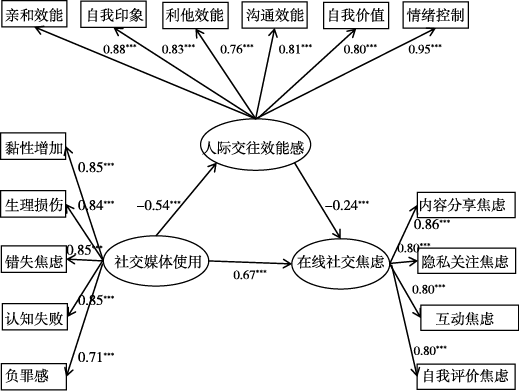
图 2 人际交往效能感在社交媒体使用与在线社交焦虑的中介模型
Figure 2 Mediation model of interpersonal self-efficacy between social media use and online social anxiety
随后,运用 Bootstrap 技术开展重复抽样,共进行 5000 次,以检验中介效应,检验结果如表3所示。经检验可知,直接效应的95%CI=[0.61,0.82]与间接效应的95%CI=[0.10,0.18]的置信区间均未包含0,表明中介效应显著。即社交媒体使用能够显著正向直接预测在线社交焦虑;同时,社交媒体使用会致使人际交往效能感降低,进而间接加重在线社交焦虑。这说明大学生的人际交往效能感在社交媒体使用对在线社交焦虑的影响中发挥部分中介作用,假设2成立。
表 3 Bootstrap中介效应检验结果
Table 3 Bootstrap mediation effect test results
| Parameter | Estimate | Lower | Upper | p |
| 间接效应 | 0.14 | 0.10 | 0.18 | 0.00 |
| 直接效应 | 0.71 | 0.61 | 0.82 | 0.00 |
| 总效应 | 0.85 | 0.76 | 0.94 | 0.00 |
3 讨论
本研究考察了社交媒体使用对粤港澳大湾区大学生在线社交焦虑的影响,并检验了人际交往效能感的中介作用。结果表明,社交媒体使用能显著正向预测大学生的在线社交焦虑,且人际交往效能感在其中起部分中介作用,支持了本研究假设。
首先,本研究发现社交媒体使用显著正向预测大学生的在线社交焦虑,这与以往研究结果基本一致(陈晓光 等,2024;陈必忠,2023),说明社交媒体使用是在线社交焦虑的重要影响因素。根据社会置换理论(Kraut et al.,1998),当大学生过度使用社交媒体开展社交互动,很可能导致其现实生活中的人际交往能力逐渐退化。这种退化会使得他们在面对真实的社交场景时,更容易感到紧张和不安,进而加剧在线社交焦虑(陈必忠 等,2023;文湘漓 等,2019)。此外,社交媒体用户常常有选择地呈现自我的积极方面(Shaw et al.,2008),大学生频繁接触这些积极化偏向的信息时,易与自身进行比较,进而产生线上社交焦虑(文湘漓 等,2019;祝阳 等,2017)。
其次,本研究结果显示人际交往效能感在社交媒体使用与大学生在线社交焦虑的关系中起中介作用,这表明社交媒体使用不仅会直接增加大学生的在线社交焦虑,还会通过减少人际交往效能感间接增加其在线社交焦虑。这与以往研究结果基本一致(宋娇 等,2022;李笑燃,2024)。当过度使用社交媒体时,个体容易放大社交媒体中的负面体验,如自身发布的内容受到不友好的评价与攻击,会产生“现实社交同样也是如此”的固化预期,进一步降低效能感(Wang et al.,2024)。而基于自我效能感理论,个体的失败经验会降低个体的自我效能感,进而使其产生焦虑、抑郁等情感体验(Bandura A,1977)。即当个体过度使用社交媒体时,不好的体验会使个体对自己能否正常社交缺少信心,使其人际自我效能感降低,从而无法有效的控制自己的人际交往行为,进而引发在线社交焦虑。此外,当社交媒体上复杂的人际信息超出个体的信息处理能力时,这会削弱个体的社交控制感,从而可能导致个体回避网络社交(Maier et al.,2015)。当个体接触的社交媒体用户增多时,他们也会面临来自不同社交群体过多的要求和期望,这可能使个体产生无力应付感,并最终导致在线社交焦虑(Davidson et al.,2014)。
4 研究不足和展望
第一,本研究未对三个变量进行多维度的比较分析,未细分社交媒体使用的类型,比如主动型与被动型等。因此本研究的广度和深度都有所欠缺。未来可以将三个变量按照多个维度细分,进行相关分析,得到更加清晰的作用机制。
第二,本研究样本具有局限性,数据仅仅覆盖广东省内的部分高校,且样本分布不均,多样性有所欠缺。未来可以更多地利用互联网平台得到更多样本,使得研究更具有普遍性和代表性。
第三,本研究在探究变量关系时,主要采用定量分析手段,这一局限性可能对研究结论的稳健性产生较大影响。为弥补这一不足,后续研究可综合运用质性研究、纵向追踪研究以及元分析等方法,更深入地剖析这些变量间的相互关系与内在影响机制。
5 结论
(1)社交媒体使用显著正向影响在线社交焦虑;
(2)社交媒体使用不仅能直接影响在线社交焦虑,还可通过人际交往效能感间接影响在线社交焦虑。
参考文献
[1] 李华锡. (2024). 中国社交媒体用户已超 10 亿. 取自 https://edu.youth.cn/wzlb/202401/t20240122_15036181.htm.
[2] 杨晴. (2023). 大学生网络社交调查: 超五成大学生每天网络社交 3 小时以上. 取自 https://txs.youth.cn/yc/202309/t20230901_14758499.htm.
[3] 陈晓光, 彭傲. (2024). 大学生社交媒体使用对在线社交焦虑的影响研究——上行社会比较和网络社会支持的中介与调节. 四川轻化工大学学报 (社会科学版), 39 (4), 52-64.
[4] 陈必忠, 张绮琳, 张瑞敏, 等. (2020). 线上社交焦虑: 社交媒体中的人际负性体验. 应用心理学, 26 (2), 180-192.
[5] Liu C & Ma J L. (2020). Social media addiction and burnout: The mediating roles of envy and social media use anxiety. Current Psychology, 39(6), 1883-1891.
[6] 刘如婧. (2022). 社交焦虑个体注意偏向研究综述. 心理月刊, 17(23), 231-233.
[7] Weidman A C & Levinson C A. (2015). I’m still socially anxious online: Offline relationship impairment characterizing social anxiety manifests and is accurately perceived in online social networking profiles. Computers in Human Behavior, 49, 12-19.
[8] 崔晶晶, 汪洋, 李笑, 等. (2024). 问题性社交媒体使用大学生注意抑制受损的特异性. 心理与行为研究, 22 (2), 258-265.
[9] Kraut R, Patterson M, Lundmark V, et al. (1998). Internet paradox: A social technology that reduces social involvement and psychological well-being. The American Psychologist, 53(9), 1017-1031.
[10] Beyens I, Frison E & Eggermont S. (2016). “I don’t want to miss a thing”: Adolescents’ fear of missing out and its relationship to adolescents’ social needs, Facebook use, and Facebook related stress. Computers in Human Behavior, 64, 1-8.
[11] 陈必忠, 郑雪, 孙晓军. (2023). 问题性社交媒体使用与线上社交焦虑: 社交媒体认知超载和特质正念的作用. 心理发展与教育, 39(5), 743-751.
[12] Bandura A. (2001). 思想和行动的社会基础——社会认知论 (林颖 等译) . 上海: 华东师范大学出版社.
[13] 谢晶, 张厚粲. (2009). 大学生人际交往效能感的理论构念与测量. 中国临床心理学杂志, 17 (3), 330-332.
[14] Bandura A. (1977). Self-efficacy: Toward a unifying theory of behavioral change. Psychological Review, 84(2), 191-215.
[15] 许磊, 张晴晴, 牛更枫, 等. (2021). 社会排斥对手机依赖的影响: 社会自我效能感和社交焦虑的中介作用. 中国临床心理学杂志, 29 (2), 323-327.
[16] 顾佳旎, 孟慧, 范津砚. (2014). 社会自我效能感的结构、测量及其作用机制. 心理科学进展, 22 (11), 1791-1800.
[17] 孙柳琦, 张晨婧, 张志云, 等. (2024). 大学生孤独感与问题性社交网站使用: 社交焦虑、社会自我效能感的链式中介作用. 心理研究, 17 (1), 61-68.
[18] 陈必忠. (2020). 被动性社交网站使用与社会自我效能感: 有调节的中介模型. 心理技术与应用, 8 (5), 291-297.
[19] 宋娇, 张一帆, 张英杰, 等. (2022). 大学生社交网站自我呈现与网络社交动机的关系: 社交自我效能感的中介作用. 心理月刊, 17 (10), 99-101.
[20] 李笑燃. (2024). 大学生主动性社交网站使用与友谊质量的关系: 线上积极反馈和社交自我效能感的中介作用. 中国临床心理学杂志, 32 (2), 446-450+456.
[21] 钟萍, 邓慧华, 张光珍, 等. (2017). 青少年友谊关系质量与社交焦虑的相互影响: 一项交叉滞后分析. 心理发展与教育, 33 (6), 727-733.
[22] 姜永志. (2018). 青少年问题性移动社交媒体使用评估问卷编制. 心理技术与应用, 6 (10), 613-621.
[23] 罗谭媛. (2023). 大学生线上社交焦虑对微信朋友圈自我呈现的影响研究. 上海: 上海外国语大学.
[24] 文湘漓, 刘耀中, 倪亚琨, 王赫. (2019). 被动性社交网络使用与在线社交焦虑: 有调节的中介模型. 中国临床心理学杂志, 27(4), 754-757.
[25] Shaw M & Black D W. (2008). Internet addiction: Definition, assessment, epidemiology and clinical management. CNS Drugs, 22(5), 353-365.
[26] 祝阳, 方国阳, 王苏君. (2017). 微信社交依赖对大学生社交焦虑的影响研究. 北京邮电大学学报 (社会科学版), 19(4), 9-16.
[27] Wang L, Zhang X & Xie A. (2024). Exploring the link between social media engagement, social anxiety, and environmental preferences in university students. Buildings, 14, 3284.
[28] Maier C, Laumer S, Eckhardt A, et al. (2015). Giving too much social support: Social overload on social networking sites. European Journal of Information Systems, 24(5), 447-464.
[29] Davidson T & Farquhar L K. (2014). Correlates of social anxiety, religion, and Facebook. Journal of Media and Religion, 13(4), 208-225.