Current Views: 2562418
 Current Downloads: 1592443
Psychology of China
ISSN Print:2664-1798
ISSN Online:2664-1801
Contact Editorial Office



Subscribe to the latest published information from SCISCAN
巴林特小组干预对退役复学大学生校园再适应的效果评估研究
A Research on the Impact of Balint Group Intervention on the Re - adaptation of College Students Returning to Campus after Military Service


-
Information:
西南民族大学教育学与心理学学院,成都
-
Keywords:
Retired and re-enrolled college students; Balint group; Campus re-adaptation; Perceived social support; Empathy退役复学大学生; 巴林特小组; 校园再适应; 领悟社会支持; 共情
- Abstract: This study focused on college students returning to campus after military service to examine the relationships among perceived social support, campus re-adaptation, and empathy, and to test the intervention effect of Balint groups on empathy. The study employed the Perceived Social Support Scale, the Chinese College Student Adjustment Scale, and the Interpersonal Reactivity Index to conduct a questionnaire survey among 306 retired military students from multiple universities in Chengdu who had been discharged within the past year. Subsequently, 60 students with poor campus readaptation were selected for an eight-week Balint group intervention experiment. The results showed that: (1) Empathy played a moderating role in the relationship between perceived social support and campus re-adaptation; (2) Balint groups, as an effective means of enhancing empathy, helped retired military students achieve successful campus readaptation. 本研究以退役复学大学生为对象,考察其领悟社会支持、校园再适应与共情之间的关系,并检验巴林特小组对共情能力的干预效果。研究采用领悟社会支持量表、中国大学生适应量表、人际反应指数量表,对成都市多所高校306名近一年内退伍的退役复学大学生进行问卷调研,随后筛选60名校园再适应不良者进行八周巴林特小组干预实验。结果显示:(1)共情在领悟社会支持与校园再适应之间起调节作用;(2)巴林特小组作为提升共情的有效手段,能够帮助退役复学大学生实现良好的校园再适应。
- DOI: 10.35534/pc.0803047
- Cite: 韩晓雪, 程科. (2026). 巴林特小组干预对退役复学大学生校园再适应的效果评估研究. 中国心理学前沿, 8 (3), 304-308.
1 引言
近年来,大学生应征入伍热潮迅速兴起,报名人数连年突破百万。随着大学生成为征兵主要对象,退役复学大学生数量也持续增加。国家相继出台《退役军人保障法》《关于促进新时代退役军人就业创业工作的意见》等政策,明确要求高校完善支持体系,保障其顺利完成学业并融入社会。
军旅生涯在提升大学生综合素质的同时,长期的封闭式管理也使退役复学大学生重返校园后普遍面临融入困难、心理困扰、学业压力等问题,休学、退学、学业预警等现象时有发生。然而,当前高校对这一群体的心理适应关注度不足,再适应困难问题亟待解决。
校园再适应是指退役复学大学生从军人身份重新适应学生生活的动态过程,涉及学业适应、人际适应、情绪适应等多个维度(方晓义 等,2005;Denneson et al.,2020)。领悟社会支持是个体感知到的被尊重、支持和理解的主观体验,研究表明其对心理健康的预测效应显著高于实际社会支持(Zimet et al.,1988;叶俊杰,2006),能够有效促进个体的社会适应水平(董增云,2010)。共情包含认知共情与情绪共情两个成分,既直接影响人际关系质量(Zaki & Cikara,2015),也调节个体对社会支持的感知和利用方式(程虹娟,郭锦蒙,2021)。社会支持的缓冲作用模型指出,支持的有效性取决于个体对支持的感知和利用,而共情作为一种人际特质,可能通过改变个体对社会支持的加工过程,影响支持对适应的效果。已有研究发现,共情在社会支持与心理健康之间发挥着调节作用,高共情者的社会支持保护效应更加突出(郭晓栋 等,2023;Chen et al.,2021)。
巴林特小组起源于20世纪50年代,最初用于帮助医务人员理解医患关系中的情感动力。该小组以团体动力学、精神分析、萨提亚家庭治疗等为理论基础,通过案例呈报、多元视角探索和雕塑技术,促进成员对人际关系的深度理解。大量研究证实,巴林特小组能够有效提升个体的共情能力(Lemogne et al.,2020;盛鑫 等,2015)并且在促进人际适应上也极为有效(庞娇艳 等,2015)。近年来其应用已从医学教育拓展至高校教育、社区服务等领域。退役复学大学生在重返校园过程中面临复杂的人际关系重建和身份整合需求(Elliott et al.,2021;孙启武 等,2022),而巴林特小组聚焦于关系理解和情感共鸣的特点,恰好与该群体的心理适应需求高度契合。
综上所述,本研究旨在检验共情在领悟社会支持与校园再适应之间的调节作用,并在此基础上设计巴林特小组干预方案,验证其对提升共情能力、促进校园再适应的有效性,为高校构建精准心理支持体系提供理论依据和实践路径。
2 方法
2.1 被试
本研究通过问卷星对成都市高校2024年秋季、2025年春季退役复学大学生进行线上调查,回收有效问卷306份,有效率95.92%。研究对象中男生181人(59.15%),女生125人(40.85%);大一新生110人(35.95%),非大一新生196人(64.05%);服役2年者占90.85%;转专业者占49.35%;降级者占28.76%;挂科者达83.33%。随后,从校园再适应低分组中招募60名志愿者,随机分为干预组与对照组各30人,按巴林特小组每组8~12人的要求分为6个小组开展活动。研究过程中出现被试脱落,最终纳入分析的被试为52人。
2.2 工具
(1)领悟社会支持量表
姜乾金(2001)基于齐梅特(Zimet,1998)编制的领悟社会支持量表进行修订,用以体现领悟社会支持的程度。本量表共12个条目三个维度,分别是家庭支持、朋友支持和其他支持。本研究中,量表总Cronbach’s α系数为 0.89。
(2)中国大学生适应量表
方晓义等(2005)编制了中国大学生适应量表,用以体现校园适应的程度。本量表共60个条目7个维度,分别是情绪适应、自我适应、校园生活适应、人际关系适应、学习适应、满意度和择业适应。本研究中,量表总Cronbach’s α系数为0.91。
(3)人际反应指数量表
张凤凤等人(2010)修订的中文版人际反应指数量表,用以体现共情水平。本量表包括22个条目四个维度,分别为观点采择、想象力、共情关注、个人忧伤。本研究中,量表总Cronbach’s α系数为 0.90。
(4)巴林特小组团体活动方案
巴林特小组团体活动方案共六步骤,历时约90分钟。第一步,案例呈报者讲述退役复学后遇到的困境;第二步,成员提问澄清细节;第三步,案例呈报者退场倾听,成员以“我”视角自由表达感受;第四步,呈报者选取成员扮演案例角色进行雕塑,从旁观者视角观察;第五步,呈报者根据讨论收获重塑雕塑,重新表达对案例的理解;第六步,组长总结并选取下期呈报者。
2.3 统计处理
使用SPSS 26.0工具对数据展开描述性统计、相关分析及分层回归分析检验调节效应。干预研究采用独立样本t检验进行同质性检验,采用重复测量方差分析及简单效应分析检验干预效果。
3 结果
3.1 共同方法偏差检验
研究采用Harman单因子法进行共同方法偏差检验,结果提取特征根 > 1的因子共18个,最大因子的方差解释量为23.93%,低于40%的临界标准,表明本研究不存在显著的共同方法偏差。
3.2 描述统计及相关分析
退役复学大学生领悟社会支持、校园再适应、共情的总体描述性统计及相关分析结果如表1所示。退役复学大学生的领悟社会支持平均得分为45.24分,低于理论中值48分;校园再适应均值为179.14分,与中值180分基本持平,处于中等水平;共情均值为69.91分,略高于理论中值66分。相关分析显示,三个变量两两之间均呈显著正相关:领悟社会支持与校园再适应(r = 0.52,p< 0.001)、领悟社会支持与共情(r= 0.40,p< 0.001)、校园再适应与共情(r = 0.39,p< 0.001)均存在显著相关。这一结果为进一步进行回归分析提供了基础。
表 1 各变量间的描述性统计与相关分析(N=306)
Table 1 Descriptive statistics and correlation analysis among variables (N=306)
| 变量 | M±SD | 1 | 2 | 3 |
| 1.领悟社会支持 | 45.24±15.51 | 1 | ||
| 2.校园再适应 | 179.14±44.12 | 0.52*** | 1 | |
| 3.共情 | 69.91±16.11 | 0.40*** | 0.39*** | 1 |
注:*p<0.05,**p<0.01,***p<0.001,下同。
3.3 调节效应检验
本研究调节模型的具体结果如表2所示。多元线性回归显示,领悟社会支持和共情均直接预测退役复学大学生校园再适应水平,且领悟社会支持和共情的交互作用也可以有效预测退役复学大学生的校园再适应
水平。
表 2 线性回归分析表
Table 2 Linear regression analysis table
| 变量名称 | 校园再适应 | |||||||
| M1 | M2 | M3 | M4 | |||||
| β | t | β | t | β | t | β | t | |
| 领悟社会支持 | 0.46 | 9.25*** | 0.40 | 7.61*** | 0.37 | 7.19*** | ||
| 共情 | 0.19 | 3.73*** | 0.22 | 4.31*** | ||||
| 领悟社会支持×共情 | 0.20 | 4.39*** | ||||||
| R2 | 0.16 | 0.35 | 0.38 | 0.42 | ||||
| ΔR2 | 0.16 | 0.19 | 0.03 | 0.04 | ||||
| F | 8.16*** | 19.86*** | 20.03*** | 21.00*** | ||||
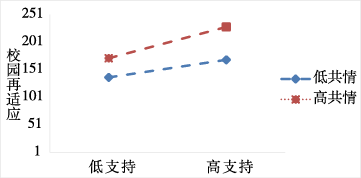
图 1 简单调节效应斜率图
Figure 1 Simple moderation effect slope plot
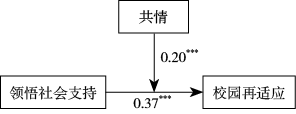
图 2 调节模型图
Figure 2 Moderation model diagram
具体来说,领悟社会支持可以显著正向预测被试的校园再适应(β = 0.46,p < 0.001),说明领悟社会支持水平越高的个体,其校园再适应能力越强。领悟社会支持和共情的交互作用可以显著正向预测被试的校园再适应(β = 0.20,p < 0.001)。如图1所示,简单斜率分析表明,共情能力较低时,领悟社会支持对校园再适应具有正向影响;共情能力较高时,领悟社会支持对校园再适应仍具有正向影响,且影响作用
变大。
3.4 重复测量方差分析
在实施巴林特小组干预前,采用独立样本t检验对实验组(n=30)和对照组(n=30)的基线数据进行同质性检验。两组在领悟社会支持、校园再适应及共情上均未呈现显著差异(p> 0.05),表明两组在干预前的各项指标具有同质性,满足实验设计的等组前提
假设。
表 3 校园再适应和共情的时间主效应和时间×分组交互效应检验
Table 3 Tests of time main effects and time×group interaction effects on campus re-adaptation and empathy
| 变量 | 时间点 | 干预组(n = 27) | 对照组(n = 25) | 时间 | 时间×组别 | ||||
| M±SD | M±SD | F | p | η2 | F | p | η2 | ||
| 校园再适应 | T1 | 125.56±8.08 | 127.16±6.61 | 22.78 | < 0.001 | 0.31 | 18.83 | < 0.001 | 0.27 |
| T2 | 139.74±10.86 | 127.52±7.01 | |||||||
| T3 | 139.37±6.99 | 128.16±8.14 | |||||||
| 共情 | T1 | 63.22±13.99 | 58.56±13.28 | 4.67 | 0.011 | 0.09 | 3.02 | 0.048 | 0.07 |
| T2 | 74.89±14.22 | 58.84±14.11 | |||||||
| T3 | 73.67±11.12 | 61.76±11.04 | |||||||
注:T1代表干预前,T2代表干预结束时,T3代表干预后3个月。
为检验巴林特小组干预效果,研究采用重复测量方差分析对两组被试在三个时间点的数据进行比较。结果显示,共情的组别主效应显著(F=24.48,p< 0.001),时间主效应显著(F = 4.67,p < 0.05),组别与时间交互作用显著(F = 3.02,p < 0.05)。简单效应分析表明,干预组后测及追踪测共情水平均显著高于前测(p< 0.01),而对照组三个时间点无显著变化;组间比较显示,两组前测无显著差异(p > 0.05),后测及追踪测干预组均显著高于对照组(p < 0.01)。校园再适应分析结果显示,组别主效应显著(F =20.08,p<0.001),时间主效应显著(F = 22.78,p<0.001),交互作用显著(F =18.83,p<0.01)。干预组后测及追踪测校园再适应水平均显著高于前测(p < 0.001),对照组无显著变化;两组前测无显著差异(p>0.05),后测及追踪测干预组均显著高于对照组(p < 0.001)。结果表明,巴林特小组干预能够显著提升退役复学大学生的共情能力和校园再适应水平,且效果具有持续性。
4 讨论
4.1 共情在领悟社会支持与校园再适应之间的调节作用
退役复学大学生心理适应呈现出“支持感知不足、适应中等、共情稍强”的复合特征。其中,共情在领悟社会支持与校园再适应关系中发挥调节作用。无论共情水平高低,领悟社会支持均能正向预测校园再适应,但高共情组中这一预测作用更强。换言之,共情能力越强者,越能从感知到的社会支持中获得适应能量,使同样的支持资源发挥更大效益(史素娟,潘光花,2022)。这一发现揭示了适应差异的关键可能不在于支持资源的多少,而在于个体感知和利用支持的内在能力,并提示我们干预工作需同步提升学生感知支持的心理资源。
4.2 巴林特小组干预的有效性
第一,巴林特小组通过多元视角采择训练认知共情。在案例讨论中,成员需要轮流站在案例中不同人物的立场表达感受,这种结构化练习直接强化了观点采择能力,这正是调节模型中高共情者能够更有效利用社会支持的认知基础(Jing et al.,2013)。第二,雕塑技术通过具身化体验激活情感共情,成员在角色扮演中切身感受他人的情绪状态,这种情感共鸣能力的提升有助于他们在现实校园中建立更深层的人际联结。第三,小组提供的安全港湾环境创造了矫正性情感体验,成员在表达适应困境时获得的是理解而非评判,这种积极体验能够消解因学业受挫、人际疏离而产生的羞耻与孤独,而从调节模型中可以看出这些负性处境正是削弱领悟社会支持的关键因素。
巴林特小组的干预机制与本研究的调节模型形成了较为紧密的逻辑闭环,通过系统提升共情这一调节变量,使成员能够更充分地感知和利用校园中的支持资源,从而促进校园再适应。
4.3 教育建议
高校应构建“外部支持与内在能力协同发展”的精准支持体系。一方面,高校应在完善奖助学金、学业帮扶、心理咨询等客观支持的基础上,通过入学教育、专题宣讲、朋辈结对等方式,让已退伍或有意愿入伍的学生充分了解并相信这些资源是可获得的。辅导员、专业课教师应主动关注退役学生心理状态,及时传递关怀信号,将潜在支持转化为可感知支持。另一方面,系统开展共情能力训练。建议高校引入巴林特小组等结构化团体干预项目,围绕退役复学大学生常见的人际冲突、学业压力、身份适应等议题开展小组活动,通过案例呈报、多元视角探索、雕塑技术等环节,系统训练观点采择与情感共鸣能力。此类干预不仅可直接提升共情水平,更能激活支持资源的心理效益,形成良性循环。
参考文献
[1] 程虹娟, 郭锦蒙. (2021). 大学生共情与社会支持的关系:人际信任的中介作用. 中国健康心理学杂志, 29(6), 912-916.
[2] 董增云. (2010). 大学生社会支持、应对方式与学校适应的关系研究. 中国健康心理学杂志, 18(5), 572-574.
[3] 方晓义, 沃建中, 蔺秀云. (2005). 中国大学生适应量表的编制. 心理与行为研究, 3(2), 95-101.
[4] 郭晓栋, 胡丁鼎, 阮盾. (2023). 共情与心理健康的关系:基于调节效应的元分析. 心理科学进展, 31(2), 1-18.
[5] 庞娇艳, 柏涌海, 唐晓晨. (2015). 巴林特小组对医护人员沟通能力的影响. 中国健康心理学杂志, 23(8), 1185-1188.
[6] 盛鑫, 张宁, 李箕君. (2015). 巴林特小组对大学生共情能力的干预研究. 中国学校卫生, 36(9), 1358-1360.
[7] 史素娟, 潘光花. (2022). 共情对心理应激的影响:希望感和领悟社会支持的中介调节作用. 教育生物学杂志, 10(1), 52-57.
[8] 孙启武, 任志洪, 赵春晓. (2022). 退役复学大学生士兵学校适应现状及影响因素. 心理与行为研究, 20(3), 389-395.
[9] 叶俊杰. (2006). 大学生领悟社会支持的影响因素研究. 心理科学, 29(6), 1460-1463.
[10] Chen C, Yang X & Wang Y. (2021). The moderating role of empathy in the relationship between perceived social support and life satisfaction among college students. Current Psychology, 40(8), 3897-3905.
[11] Denneson L M, Teo A R & Dobscha S K. (2020). Student veterans’ reintegration into college: A qualitative analysis. Journal of American College Health, 68(3), 272-279.
[12] Elliott M, Gonzalez C & Larsen S. (2021). Social support and academic success among student veterans. Journal of Veterans Studies, 7(1), 45-58.
[13] Jing W, Otten H & Sulman J. (2013). Balint groups: An effective intervention for medical students’ psychological well-being. Medical Teacher, 35(5), 398-403.
[14] Lemogne C, Buffel du Vaure C & Hoertel N. (2020). Balint groups and narrative medicine training to enhance medical students’ empathy: A randomized controlled trial. Journal of Psychosomatic Research, 129(1), 109-118.
[15] Zaki J & Cikara M. (2015). Addressing empathic failures. Current Directions in Psychological Science, 24(6), 471-476.
[16] Zimet G D, Dahlem N W & Zimet S G. (1988). The Multidimensional Scale of Perceived Social Support. Journal of Personality Assessment, 52(1), 30-41.