Current Views: 2544180
 Current Downloads: 1584119
Psychology of China
ISSN Print:2664-1798
ISSN Online:2664-1801
Contact Editorial Office



Subscribe to the latest published information from SCISCAN
识别风险亚群:基于短视频成瘾、自主支持和 基本心理需求联合潜剖面与抑郁预测研究
Identifying Risk Subgroups: A Study on the Joint Latent Profile Analysis of Short Video Addiction, Autonomy Support, and Basic Psychological Needs in Predicting Depression


-
Information:
西南民族大学教育学与心理学学院,成都
-
Keywords:
Short video addiction; Parental autonomy support; Basic psychological needs; Latent profile analysis; Depression短视频成瘾; 父母自主支持; 基本心理需求; 潜剖面分析; 抑郁
- Abstract: With the rapid popularization of short video platforms, adolescent short video addiction has become an important issue that affects mental health. Based on self-determination theory, this study aimed to explore the latent profile types of adolescents in short video addiction, parental autonomy support and basic psychological needs, and their predictive effects on depression. A total of 515 adolescents from a senior high school in Shandong Province were selected as subjects and assessed with the Short Video Addiction Scale, Parental Autonomy Support Scale, Basic Psychological Needs Satisfaction Scale, and Center for Epidemiologic Studies Depression Scale (Short Form). Latent profile analysis, ANOVA and regression analysis were used for data processing. The results showed that: (1) Three latent profiles were identified, namely healthy adaptation type (12.8%), general balance type (81.7%), and high-resource addiction type (5.4%); (2) There were significant gradient differences in depression scores among the three groups, with the healthy adaptation type having the lowest score and the high-resource addiction type having the highest; (3) Latent profile types could significantly predict adolescent depression. Compared with the general balance type, the healthy adaptation type had significantly lower depression level, while the high-resource addiction type had significantly higher depression level. The findings reveal the heterogeneous combination model of adolescent psychological resources and short video addiction risk, and provide empirical evidence for precise intervention of adolescent short video addiction and depression. 本研究旨在探讨青少年短视频成瘾、父母自主支持与基本心理需求的联合潜剖面类型,及其对抑郁症状的预测作用。以山东省某高中515名青少年为被试,采用短视频成瘾量表、父母自主支持量表、基本心理需求满足量表、流调中心用抑郁量表(简版)进行测查,运用潜剖面分析、方差分析及回归分析进行数据处理。结果显示:(1)青少年在短视频成瘾、父母自主支持、基本心理需求上可划分为健康适应型(12.8%)、一般平衡型(81.7%)、高资源成瘾型(5.4%)三种潜剖面类型;(2)三组被试抑郁水平呈显著梯度差异,健康适应型抑郁得分最低,高资源成瘾型最高;(3)潜剖面类型可显著预测青少年抑郁水平,相较于一般平衡型,健康适应型抑郁水平显著更低,高资源成瘾型显著更高。研究揭示了青少年心理资源与短视频成瘾风险的异质性组合模式,为青少年短视频成瘾与抑郁的精准化干预提供实证依据。
- DOI: 10.35534/pc.0803064
- Cite: 张晨慧. (2026). 识别风险亚群: 基于短视频成瘾、自主支持和基本心理需求联合潜剖面与抑郁预测研究. 中国心理学前沿, 8 (3), 411-417.
1 引言
随着移动互联网技术的飞速发展和智能终端的普及,短视频平台迅速崛起并深刻改变了人们的娱乐方式和信息获取习惯。短视频应用凭借其短小精悍、内容丰富、算法精准推送等特点,吸引了大量用户,尤其是青少年群体。然而,短视频的过度使用所引发的青少年成瘾问题日益凸显,引起了社会的广泛关注(康亚通,2019)。短视频成瘾不仅干扰青少年的学习生活和人际交往,还对其心理健康构成严重威胁,特别是与抑郁症状的发生发展密切相关(代宝 等,2025)。与此同时,自我决定理论(Self-determination Theory,SDT)(Ryan & Deci,2000)为理解青少年行为问题与心理健康提供了重要的理论框架,不难看出基本心理需求的满足是个体心理健康的基础,而父母自主支持则是满足这些需求的关键社会环境因素。因此,系统梳理短视频成瘾、自主支持、基本心理需求与抑郁的关系,对于深入理解青少年心理健康的保护性与风险因素具有重要意义。
短视频成瘾是指个体因过度依赖短视频平台而产生的强迫性、失控性的使用行为模式,表现为对短视频使用的强烈渴求、耐受性增加、戒断反应以及社会功能受损(李霞 等,2021)。作为一种新兴的行为成瘾,短视频成瘾与传统的网络成瘾、社交媒体成瘾既有联系又有区别。短视频的碎片化内容、即时反馈机制和无限滚动设计,使其比传统社交媒体更容易引发成瘾行为(方佳楠 等,2025)。根据《中国互联网络发展状况统计报告》第56次报告显示,截至2025年6月,我国网民规模达11.23亿人,互联网普及率达79.7%。青少年作为数字原住民,其短视频使用率和使用时长均处于较高水平。
大量研究证实,短视频成瘾与多种心理健康问题密切相关。具体而言,短视频成瘾者往往表现出更高的抑郁水平(陈海亮 等,2025)、更低的自尊和主观幸福感(Ye et al.,2022)。其作用机制可能涉及多个方面:过度使用短视频挤占了现实社交和学习时间,导致社会支持减少;短视频中呈现的理想化生活可能引发社会比较,损害自我评价;夜间使用短视频干扰睡眠节律,进而影响情绪调节(Malheiros et al.,2024)。
父母自主支持被认为是父母能够提供一个自主的家庭环境,避免使用控制性的语言,尊重孩子的选择和决定,并在他们需要时提供有价值的信息和情感支持(李伟君,2025)。与控制和强迫相对,自主支持能够满足青少年的自主需求,促进其内化社会价值观和行为规范。大量实证研究揭示了父母自主支持对青少年心理社会适应的重要作用(刘桂荣 等,2025)。高自主支持的青少年表现出更高的学业投入、更强的内在动机、更好的情绪调节能力和更少的心理健康问题(张凌和李新影,2022)。相反,父母控制或过度干预则可能导致青少年内化和外化问题增加。在数字媒体使用领域,父母自主支持同样发挥着重要作用。高自主支持的父母更倾向于采用主动引导和开放式沟通的方式,这与子女建立健康的数字媒体使用习惯相关。这种教养方式能够促进青少年的自主调节能力和心理复原力(林海兰,2023),使其在面对网络诱惑时具备更强的自我控制力。
自我决定理论提出,人类具有三种与生俱来的基本心理需求:自主需求(Autonomy)、能力需求(Competence)和关系需求(Relatedness)(Ryan & Deci,2000)。自主需求指个体体验到行为是自我选择和自我认可的;能力需求指个体体验到能够有效应对环境挑战;归属需求指个体体验到与他人的亲密联结和相互关怀。这三种需求的满足是个体心理健康和幸福感的必要条件,而需求受挫则会导致心理适应不良(尹霞云 等,2023)。大量研究证实,基本心理需求受挫与多种问题行为相关。网络成瘾行为常被视为个体在现实中心理需求得不到满足时的补偿性替代行为(魏萍,2024)。当青少年在现实生活中难以获得自主感、能力感和归属感时,可能会转向虚拟世界寻求满足。网络空间的匿名性、即时反馈和社交功能,恰好为满足这些需求提供了替代性途径。因此,理解基本心理需求在数字媒体使用中的作用机制,对于预防和干预成瘾行为具有重要意义。
短视频成瘾与抑郁之间的关系已得到较多实证研究的支持。横断面研究显示,短视频成瘾得分与抑郁症状呈显著正相关(Sha & Dong,2021)。父母自主支持作为保护性因素,使得感知到父母自主支持的青少年,其短视频成瘾倾向较低。其原因在于:自主支持有助于青少年发展自我调节能力,使其能够更理性地控制网络使用行为;自主支持满足青少年的自主需求,减少其通过虚拟空间寻求替代满足的动机;自主支持促进开放的亲子沟通,使父母能够更有效地引导子女的健康网络使用。基本心理需求满足与抑郁之间的负向关联已得到充分证实(尹霞云 等,2024)。需求受挫理论指出,当个体长期无法满足基本心理需求时,易产生无望感、低自我价值感和人际关系疏离,这些正是抑郁的重要因素(Costa et al.,2016)。在青少年群体中,需求满足对抑郁的保护作用尤为突出,因为青少年期正是心理需求敏感且易受环境影响的阶段。
综合上述文献回顾可见,短视频成瘾、父母自主支持、基本心理需求与抑郁之间的关系已分别得到较多研究关注,但仍存在以下研究空白:第一,现有研究多采用变量中心视角,探讨变量间的线性关系,忽视了青少年群体内部可能存在异质性组合模式。即不同类型的青少年可能在短视频成瘾水平、自主支持感知和需求满足程度上呈现出不同的组合特征。第二,较少研究同时考察风险因素(短视频成瘾)和保护性因素(自主支持、需求满足)的联合作用,难以揭示资源与风险的交互模式如何影响心理健康。第三,个体中心视角的研究方法,如潜剖面分析(Latent Profile Analysis,LPA),能够识别出具有不同特征组合的亚群体,为精准干预提供依据,但目前在短视频成瘾领域应用有限。
基于自我决定理论和上述文献分析,本研究提出以下假设:
H1:青少年在短视频成瘾、父母自主支持和基本心理需求上存在异质性的潜在剖面类型。
H2:不同潜在剖面类型在抑郁水平上存在显著差异。
H3:不同潜在剖面类型对青少年抑郁水平具有显著的预测作用。
2 方法
2.1 被试
本研究采用方便抽样法,从中国山东某高中招募被试,共收集有效问卷525份,剔除无效答题问卷,最终保留515份。被试平均年龄为13.75±1.34岁,其中男生291人(56.5%),女性224人(43.5%)。父母受教育水平方面,父亲初中及以下学历者189人(36.7%),高中及大专学历151人(29.3%),大学本科以上学历175人(34%);母亲初中及以下学历者183人(35.5%),高中及大专学历152人(29.5%),大学本科以上学历180人(35%)。主观家庭经济水平,较差的(1~4分)93人(18.1%),中等的(5~7分)166人(32.2%),较好的(8~10分)256人(49.7%)。
2.2 研究工具
2.2.1 短视频成瘾
采用张星(2019)改编的手机和网络成瘾问卷的短视频成瘾量表,该量表由6个项目组成,要求被试直接报告这些描述是否符合自己,用以测量被试的短视频成瘾状态。采用李克特7点计分,从1(“非常不同意”)到7(“非常同意”),得分越高,表明个体的短视频成瘾程度越高;得分越低,表明被试的短视频成瘾程度越低。本研究中总问卷的 Cronbach α系数为0.65。
2.2.2 基本心理需求
采用Sheldon和Niemiec(2006)编制,杜健等人(2020)翻译的基本心理需求满足量表,该量表由9个项目组成,包括自主需要(如“在我的生活中,我的选择是基于我的真实的兴趣和价值观”)、能力需要(如“在我的生活中,我曾经成功地完成困难的任务和计划”)、关系需要(如“在我的生活中,我有一种联系着关心我的人们,以及我关心的人们的感觉”)三个维度。自主需要(第1、2、3题)能力需要(第4、5、6题)和关系需要(第7、8、9题),无反向计分。采用李克特7点计分,1表示“完全不符合”,7表示“完全符合”,分数越高表明基本心理需求满足水平越高。本研究中总问卷的 Cronbach α系数为0.74。
2.2.3 父母自主支持
采用Bai & Gu(2022)编制的父母自主支持量表,该量表由4个项目组成。采用5点计分,从1(“完全不同意”)到5(“完全同意”),分数越高则表示个体感知的父母自主支持水平越高。本研究中总问卷的 Cronbach α系数为0.75。
2.2.4 抑郁
采用何津等(2013)修订的流调中心用抑郁量表的中文简版,该量表由9个项目组成。采用4点计分,从1(“没有”)到4(“总是”),得分越高表示抑郁症状越严重,第5题、第7题为反向计分。本研究中总问卷的 Cronbach α系数为0.73。
2.3 研究程序
本研究采用问卷调查法,以班级为单位进行团体施测。调查前,研究团队征得学校、班主任及学生本人的知情同意,并说明调查目的、匿名性、数据保密原则及自愿参与权利。数据整理后,采用SPSS 27.0和Mplus 8.1进行统计分析。具体分析方法包括:Harman单因子检验评估共同方法偏差;描述性统计与皮尔逊相关分析考察变量间关系;潜剖面分析(LPA)识别短视频成瘾、自主支持与基本心理需求的联合模式;方差分析(ANOVA)和回归分析检验不同剖面类型在抑郁上的差异。
3 研究结果
3.1 共同方法偏差检验
采用Harman单因子检验对共同方法偏差进行评估,结果显示未旋转的探索性因子分析中,第一个因子解释的变异量为14.16%,低于40%的临界值,表明本研究不存在严重的共同方法偏差。
3.2 研究变量的概况与相关分析
描述性统计与相关分析结果显示(表1),短视频成瘾与抑郁呈显著正相关(r=0.247,p<0.001),与基本心理需求(r=-0.037,p>0.05)和自主支持(r=0.024,p>0.05)相关不显著。基本心理需求与自主支持呈显著正相关(r=0.258,p<0.001),与抑郁呈负相关但不显著(r=-0.069,p>0.05)。自主支持与抑郁呈显著负相关但不显著(r=-0.070,p>0.05)。
表 1 描述性统计与相关分析
Table 1 Descriptive statistics and correlation analysis
| 1 | 2 | 3 | 4 | 5 | 6 | 7 | 8 | 9 | |
| 1性别 | 1 | ||||||||
| 2年龄 | -0.006 | 1 | |||||||
| 3父亲学历 | -0.064 | 0.018 | 1 | ||||||
| 4 母亲学历 | -0.059 | -0.031 | 0.753** | 1 | |||||
| 5主观经济 | -0.024 | -0.048 | 0.405*** | 0.451*** | 1 | ||||
| 6短视频成瘾 | -0.079 | -0.019 | 0.046 | 0.112* | 0.010 | 1 | |||
| 7心理需求 | 0.060 | 0.013 | -0.093* | -0.109* | 0.020 | -0.037 | 1 | ||
| 8自主支持 | 0.068 | 0.109* | 0.080 | 0.100* | 0.158*** | -0.024 | 0.258*** | 1 | |
| 9抑郁 | -.098* | 0.096* | 0.124** | 0.156*** | 0.061 | 0.247*** | -0.069 | -0.070 | 1 |
| M | 1.43 | 13.78 | 3.57 | 3.57 | 6.93 | 22.51 | 37.10 | 13.25 | 21.76 |
| SD | 0.50 | 1.22 | 1.72 | 1.73 | 2.74 | 6.21 | 8.41 | 3.53 | 4.71 |
3.3 自主支持、短视频成瘾与基本心理需求联合剖面
为识别青少年在短视频成瘾、自主支持与基本心理需求上的异质性组合,采用潜剖面分析(LPA)对数据进行拟合。模型拟合指标显示(表2),三类别模型在AIC、BIC、ABIC上均优于二类别模型,Entropy值为0.89,表明分类质量良好。LMR与BLRT均支持三类别模型(p<0.05),因此确定三类别为最优模型。
表 2 数据拟合指标
Table 2 Model fit indices
| Classes | AIC | BIC | ABIC | Entropy | LMR p value | BLRT p value | Class N |
| 2 | 24529.20 | 24673.50 | 24565.58 | 0.85 | 0.54 | 0.54 | 71/444 |
| 3 | 24320.77 | 24516.00 | 24369.99 | 0.90 | <0.05 | <0.05 | 66/421/28 |
| 4 | 24167.05 | 24413.22 | 24229.11 | 0.89 | 0.51 | 0.52 | 36/63/399/17 |
图1展示了三个潜在类别在自主支持、短视频成瘾与基本心理需求上的标准化得分。第一类别(n= 66,12.8%)在自主支持与基本心理需求上得分高,而短视频成瘾得分最低,心理资源充沛且行为适应良好,故命名为健康适应型。第二类别(n= 421,81.7%)在三个变量上得分均接近平均水平,但自主支持与基本心理需求略低而短视频成瘾略高,呈现资源与风险的平衡状态,故命名为一般平衡型。第三类别(n=28,5.4%)在自主支持与基本心理需求上得分高,但短视频成瘾得分极高,呈现心理资源丰富与行为成瘾风险并存的特征,故命名为高资源成瘾型。
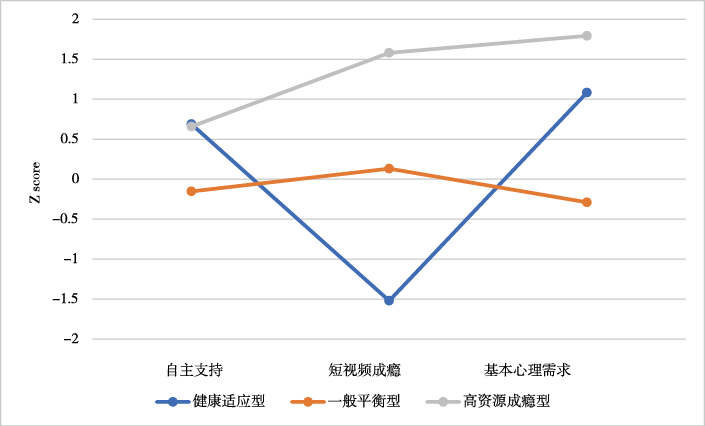
图 1 自主支持、短视频成瘾与基本心理需求联合剖面图
Figure 1 Combined profile plot of autonomy support, short video addiction, and basic psychological needs
3.4 不同剖面类型与抑郁的关系
ANOVA分析结果显示(表3),不同心理社会资源剖面类型在抑郁水平上存在显著差异(F(2,515)=
23.12,p<0.001)。Bonferroni事后检验表明,健康适应型(18.65±5.33)的抑郁程度显著低于一般平衡型(22.03±4.09),而 一般平衡型 又显著低于 高资源成瘾型(24.89±4.71),即抑郁水平呈现显著梯度:健康适应型<一般平衡型<高资源成瘾型。这表明心理资源—行为模型对抑郁症状具有重要影响,资源与行为适应性越好,抑郁水平越低,心理资源与行为适应的组合模式对抑郁具有显著的区分效应。
表 3 ANOVA分析
Table 3 ANOVA results
| 健康适应型 | 一般平衡型 | 高资源成瘾型 | F | Bonferroni | |
| 抑郁 | 18.65±5.33 | 22.03±4.09 | 24.89±4.71 | F(2,515)=23.12,p<0.001 | 1<2<3 |
3.5 不同剖面类型对抑郁的预测
根据回归分析结果(表4),三个潜在剖面组在抑郁水平上存在显著差异:以第二类别为参照组,第一类别的抑郁得分显著降低(B=-0.24,p< 0.001),第三类别的抑郁得分显著提高(B=0.14,p< 0.001)。这表明三类群体的抑郁程度呈现明确梯度,由低到高分别为:第一类别、第二类别、第三类别。
表 4 回归分析
Table 4 Regression analysis
| B | p | |
| 健康适应型 | -0.24 | <0.001 |
| 高资源成瘾型 | 0.14 | <0.001 |
注:因变量为抑郁。
4 讨论
本研究采用个体中心视角,通过潜剖面分析识别出青少年在短视频成瘾、父母自主支持与基本心理需求上的三种异质性组合类型:健康适应型(12.8%)、一般平衡型(81.7%)和高资源成瘾型(5.4%)。结果表明,青少年心理健康资源的配置与行为风险并非单一线性关系,而是存在多样化的组合模式,支持了自我决定理论(SDT)在解释青少年行为与心理健康异质性方面的适用性。
健康适应型青少年在自主支持与基本心理需求上得分最高,短视频成瘾最低,抑郁水平也最低,表明良好的社会支持与心理满足有助于抵御成瘾行为(代宝 等,2025),维护心理健康。这一结果与已有研究一致,强调了父母自主支持在满足青少年基本心理需求、促进其积极发展中的重要作用。
一般平衡型作为主要群体,表现出中等水平的资源与风险,抑郁水平居中,提示大多数青少年处于资源与行为的动态平衡中,可能具有一定程度的心理韧性,但也存在潜在风险。
值得关注的是高资源成瘾型,该群体尽管拥有较高的自主支持和基本心理需求满足,却表现出极高的短视频成瘾水平,且抑郁水平最高。这类“资源—行为悖论”现象挑战了传统SDT的线性假设,提示高资源个体仍可能因其他因素(如同伴影响、情绪调节困难、成瘾的自动化加工)陷入行为成瘾。这一结果也反映出短视频成瘾的复杂性,可能涉及神经机制、冲动控制障碍等非社会性因素。
进一步分析显示,三个剖面在抑郁水平上呈现显著梯度,说明心理资源与行为适应性的组合模式对青少年情绪健康具有重要预测作用。回归分析也证实,相较于一般平衡型,健康适应型抑郁显著降低,高资源成瘾型抑郁显著升高,进一步验证了剖面分类的效度。
本研究为青少年短视频成瘾干预提供了精准化思路:对于一般平衡型,可通过提升自主支持与心理需求满足进行预防;对于高资源成瘾型,则需关注行为控制与情绪调节能力的干预,避免“资源错配”。
本研究也存在一定局限:首先,样本仅来自山东省某高中,代表性有限;其次,横断面设计无法推断因果关系;未来研究可结合纵向设计,探讨不同剖面类型的稳定性与演变机制,并引入多源数据(如父母报告、行为日志)以增强研究的生态效度。除此以外,本研究部分数据的结果在解释时需加以注意。首先,短视频成瘾量表的内部一致性信度(Cronbach α= 0.65)略低于惯用的0.70临界标准。这一结果可能受多重因素影响:其一,短视频成瘾量表仅包含6个项目,而信度系数对量表长度较为敏感,项目数量较少时容易导致α估计偏低;其二,该量表为近年来基于手机和网络成瘾问卷改编的新编工具,在我国青少年群体中的跨样本稳定性仍有待进一步验证,本研究中信度波动可能反映了量表在不同人群中应用时的情境依赖性;其三,短视频成瘾作为新兴行为成瘾构念,其表现维度尚处于探索阶段,项目间的异质性可能在所难免。尽管如此,在探索性研究中,0.65仍被视为可接受的信度下限,且本研究主要关注剖面分类而非个体精确测量,对整体结论的影响相对有限。未来研究建议结合验证性因子分析进一步检验量表结构,或通过增加项目、优化表述等方式提升其信度水平。
5 结论
本研究通过潜剖面分析,成功识别出青少年在短视频成瘾、父母自主支持与基本心理需求上的三类异质性潜剖面,分别为健康适应型、一般平衡型与高资源成瘾型,证实青少年群体在心理资源与行为风险的组合上并非单一线性模式,丰富了自我决定理论在青少年短视频成瘾领域的应用。三类潜剖面的抑郁水平存在显著梯度差异,高资源成瘾型青少年抑郁水平最高,呈现心理资源充足但成瘾风险高、抑郁症状突出的悖论特征,提示短视频成瘾并非单纯由心理资源匮乏导致,情绪调节、行为控制等因素同样发挥关键作用。同时,青少年短视频成瘾、父母自主支持与基本心理需求的联合剖面类型可显著预测抑郁症状,表明心理资源与成瘾行为的组合模式是影响青少年情绪健康的重要因素。
该研究结果为青少年心理健康精准干预提供方向:对健康适应型以巩固保护因素为主;对一般平衡型以提升心理需求满足、强化父母自主支持为核心;对高资源成瘾型需重点聚焦成瘾行为控制与情绪调节干预,从而实现针对性的风险防控与心理健康促进。
参考文献
[1] 康亚通. (2019). 青少年网络沉迷研究综述. 中国青年社会科学, 38(6),130-135.
[2] 代宝, 郑怡晴, 杨利英. (2025). 大学生短视频成瘾影响因素及其健康损害研究进展. 中国学校卫生, 46(2), 290-294.
[3] Ryan R M & Deci E L. (2000). Self-determination theory and the facilitation of intrinsic motivation, social development, and well-being. American psychologist, 55(1), 68.
[4] 李霞, 秦浩轩, 曾美红, 何玉雪, 马梦珍. (2021). 大学生短视频成瘾症状与人格的关系. 中国心理卫生杂志, 35(11), 925-928.
[5] 方佳楠, 于增艳, 胡玉乐, 马镛麒, 周羽吉, 赵慧童. (2025).大学生短视频成瘾对学业拖延的影响: 睡眠质量的中介作用以及数字化认知行为疗法的干预效果. 心理月刊, 20(20), 112-115.
[6] 陈海亮, 王丹, 张琳淼, 周晖, 廖艳辉, 胡玉正. (2025). 短视频沉迷量表的编制和信效度检验. 中国临床心理学杂志, 33(6), 1158-1166.
[7] Ye J H, Wu Y T, Wu Y F, Chen M Y & Ye J N. (2022). Effects of short video addiction on the motivation and well-being of Chinese vocational college students. Frontiers in Public Health, 10, 847672.
[8] Malheiros L E, da Costa B G, Lopes M V, Martins da Costa R, Chaput J P & Silva K S. (2024). Association of sleep timing and sleep variability with health-related outcomes in a sample of Brazilian adolescents. Behavioral Sleep Medicine, 22(2), 129-139.
[9] 李伟君. (2025). 父母自主支持对大学生主观幸福感的影响及干预研究 (硕士学位论文). 江西师范大学.
[10] 刘桂荣,张梦云,张晓梅, 陈晓霖.(2025).父母自主支持对高中生基本心理需要满足的预测及作用机制.沈阳大学学报(社会科学版),27(6),62-69.
[11] 张凌, 李新影. (2022). 父母自主支持、教师自主支持对青少年心理健康的影响: 心理灵活性的中介作用. 教育理论与实践, 42(17), 12-16.
[12] 林海兰. (2023). 高中生父母自主支持与心理复原力的关系 (硕士学位论文). 福建师范大学.
[13] 尹霞云, 娄梦程, 余彬杨. (2023). 家庭累积风险对青少年网络游戏成瘾的影响: 有调节的中介模型. 当代教育理论与实践, 15(1), 45-52.
[14] 魏萍. (2024). 正念对手机依赖的影响: 心理机制与理论解释. 甘肃开放大学学报, 34(5), 65-70.
[15] Sha P & Dong X. (2021). Research on adolescents regarding the indirect effect of depression, anxiety, and stress between TikTok use disorder and memory loss. International journal of environmental research and public health, 18(16), 8820.
[16] 尹霞云, 杨筱璇, 黎志华. (2024).父母情感投入、青少年基本心理需求与青少年抑郁的关系: 一项交叉滞后分析. 中国临床心理学杂志, 32(5), 969-976.
[17] Costa S, Cuzzocrea F, Gugliandolo M C & Larcan R. (2016). Associations between parental psychological control and autonomy support, and psychological outcomes in adolescents: The mediating role of need satisfaction and need frustration. Child Indicators Research, 9(4), 1059-1076.
[18] 代宝, 郑怡晴, 杨利英. (2025). 大学生短视频成瘾影响因素及其健康损害研究进展. 中国学校卫生, 46(2), 290-294.