Current Views: 2621061
 Current Downloads: 1631185
Psychology of China
ISSN Print:2664-1798
ISSN Online:2664-1801
Contact Editorial Office



Subscribe to the latest published information from SCISCAN
孤独感对初中生学业拖延的影响:手机成瘾的中介作用
The Impact of Loneliness on Academic Procrastination among Middle School Students: The Mediating Role of Mobile Phone Addiction


-
Information:
1.新疆心智发展与学习科学重点实验室,乌鲁木齐;
2.新疆师范大学心理学院,乌鲁木齐
-
Keywords:
Middle school students; Loneliness; Smartphone addiction; Academic procrastination初中生; 孤独感; 手机成瘾; 学业拖延
- Abstract: Objective: This study aimed to investigate the relationships among loneliness, smartphone addiction, and academic procrastination in middle school students, and to examine the mediating role of smartphone addiction in the association between loneliness and academic procrastination. Methods: A sample of 474 middle school students in Kashgar, Xinjiang completed questionnaires including the Adolescent Loneliness Scale, the Academic Procrastination Questionnaire for Middle School Students, and the Smartphone Addiction Scale for College Students. Data were analyzed using SPSS 26.0 for descriptive statistics, correlation analysis, and Bootstrap mediation analysis. Results: (1) Loneliness was significantly and positively correlated with smartphone addiction; (2) Smartphone addiction was significantly and positively correlated with academic procrastination; (3) Loneliness was significantly and positively correlated with academic procrastination; (4) Smartphone addiction partially mediated the relationship between loneliness and academic procrastination. Conclusion: Loneliness not only directly predicts academic procrastination but also indirectly influences academic procrastination through smartphone addiction. Intervention strategies should focus on loneliness emotion management and smartphone usage behavior among middle school students. 目的:探讨初中生孤独感、手机成瘾与学业拖延之间的关系,验证手机成瘾在孤独感与学业拖延之间的中介作用。方法:采用青少年孤独感量表、中学生学业拖延问卷和大学生智能手机成瘾量表,对新疆喀什某中学474名初中生进行问卷调查,运用SPSS26.0进行描述统计、相关分析和Bootstrap中介效应检验。结果:(1)孤独感与手机成瘾呈显著正相关;(2)手机成瘾与学业拖延呈显著正相关;(3)孤独感与学业拖延呈显著正相关;(4)手机成瘾在孤独感与学业拖延间起部分中介作用。结论:孤独感可显著正向预测学业拖延,还可通过手机成瘾间接影响学业拖延。干预建议应重点关注初中生的孤独情绪管理与手机使用行为。
- DOI: 10.35534/pc.0804068
- Cite: 李淳坤, 祖丽皮耶·马木提, 杨河山. (2026). 孤独感对初中生学业拖延的影响:手机成瘾的中介作用. 中国心理学前沿, 8 (4), 438-442.
1 引言
学业拖延作为影响学生学业成就的重要行为问题,在初中阶段表现得尤为突出。这一阶段学生面临升学压力增大、学科难度提升等多重挑战,而学业拖延不仅直接导致学习成绩下降,更可能引发焦虑、自我效能感降低等连锁反应,形成恶性循环。因此,探究初中生学业拖延的形成机制具有重要的现实意义。
从个体心理特质角度来看,孤独感可能是影响学业拖延的重要因素之一。孤独感是个体对社交关系未满足需求时产生的主观负性体验(Peplau & Perlman,1982)。初中阶段正处于埃里克森人格发展理论中的“自我同一性对角色混乱”时期,青少年自我意识增强但社交技能尚不成熟,对同伴接纳和归属感的需求急剧增加,一旦现实人际关系出现缺口,便容易产生强烈的孤独感(刘俊升,2015)。这种负性情绪体验会消耗个体的认知资源和自我控制能力,使其难以集中精力完成学业任务,进而推迟学业目标的达成(Yang et al.,2023)。
然而,孤独感影响学业拖延的路径可能并非直接作用。近年来,随着移动互联网技术的普及,我国未成年网民规模已达1.93亿,其中初中生互联网普及率高达97.3%。最新研究表明,过度使用手机不仅影响青少年的身心健康,还可能导致学业表现下降(Alhajri et al.,2025;Liu et al.,2026)。这一发现提示我们,手机成瘾可能是连接孤独感与学业拖延的关键桥梁。基于补偿性互联网使用理论(Compensatory Internet Use Theory;Kardefelt-Winther,2014),当个体的现实社交需求无法得到满足时,会转向虚拟世界寻求替代性满足。孤独感水平较高的初中生可能将手机作为寻求社交补偿和情感慰藉的主要工具,以弥补现实人际关系的缺失。但与此同时,手机成瘾者往往将大量时间投入虚拟世界,挤占本应用于学习的认知资源,进而推迟学业任务的完成(Liu et al.,2022)。因此,手机成瘾在孤独感与学业拖延之间可能发挥着中介作用。
尽管已有研究分别探讨了孤独感与手机成瘾、手机成瘾与学业拖延的关系,但将三者整合考察的实证研究仍较为匮乏,特别是手机成瘾在孤独感与学业拖延之间的中介机制尚未得到充分验证。基于此,本研究以初中生为被试,旨在探讨孤独感对学业拖延的影响及手机成瘾的中介作用。研究假设如下:(1)孤独感显著正向预测学业拖延;(2)手机成瘾在孤独感与学业拖延之间起中介作用。
2 方法
2.1 研究对象
采用分层整群抽样,选取新疆喀什某中学七至九年级学生为研究对象。共发放问卷485份,剔除无效问卷后获得有效问卷474份,有效率97.7%。其中男生200人(42.2%),女生274人(57.8%);七年级127人(26.8%),八年级146人(30.8%),九年级201人(42.4%)。被试年龄11~16岁。
2.2 研究工具
(1)孤独感量表
采用邹泓(2003)修订的青少年孤独感量表,共21题,四个维度(纯孤独感、社交能力知觉、社交关系未满足感、同伴关系评价),5点计分。本研究中Cronbach’s α=0.86。
(2)手机成瘾量表
采用苏双等(2014)编制的大学生智能手机成瘾量表,共22题,六个维度,5点计分。本研究中Cronbach’s α=0.91。
(3)学业拖延量表
采用左艳梅(2010)编制的中学生学业拖延问卷,共17题,四个维度,5点计分。本研究中Cronbach’s α=0.88。
2.3 数据处理
采用SPSS 26.0进行描述统计和Pearson相关分析。使用Hayes(2018)的PROCESS宏(Model 4)进行Bootstrap中介效应检验,抽样5000次,置信区间95%。
3 结果
3.1 共同方法偏差检验
由于本研究采用被试自我报告法进行测量,因此可能存在共同方法偏差问题。采用Harman单因子检验方法进行检验,分析结果表明,最大因子可解释的变异量为8.6%,低于40%的临界标准(周浩,龙立荣,2004)。因此,可以认为本研究不存在显著的共同方法偏差
问题。
3.2 描述统计与相关分析
表1呈现了各变量的描述统计与相关系数。孤独感与手机成瘾呈显著正相关(r=0.28,p<0.01);手机成瘾与学业拖延呈显著正相关(r=0.40,p<0.01);孤独感与学业拖延呈显著正相关(r=0.13,p<0.01)。相关分析结果支持进一步检验中介
效应。
表 1 孤独感、手机成瘾和学业拖延的描述统计与相关矩阵
Table 1 Descriptive statistics and correlation matrix of loneliness, smartphone addiction, and academic procrastination
| 变量 | M±SD | 孤独感 | 手机成瘾 | 学业拖延 |
| 孤独感 | 22.70±10.56 | 1 | ||
| 手机成瘾 | 65.45±11.85 | 0.28** | 1 | |
| 学业拖延 | 50.11±8.85 | 0.13** | 0.40** | 1 |
| 年龄 | 13.52±1.28 |
注:** 在 0.01 级别(双尾),相关性显著。
3.3 中介效应检验
采用PROCESS宏Model 4检验手机成瘾的中介作用。结果如表2所示,孤独感显著正向预测手机成瘾(β=0.32,p<0.01);手机成瘾显著正向预测学业拖延(β=0.09,p<0.01);孤独感对学业拖延的总效应显著(β=0.13,p<0.01),控制中介变量后,直接效应仍显著(β=0.10,p<0.01)。Bootstrap检验表明,中介效应值为0.03,其95%置信区间为[0.0030,0.0703],不包含0,说明手机成瘾在孤独感与学业拖延间起部分中介作用,中介效应占总效应的23.76%。
表 2 中介效应表
Table 2 Mediation effect table
| 效应值 | SE | 95%置信区间 | 效应量 | ||
| LLCI | ULCI | ||||
| 总效应 | 0.1271 | 0.0393 | 0.0499 | 0.2044 | |
| 直接效应 | 0.0969 | 0.0375 | 0.0234 | 0.1704 | 76.24% |
| 中介效应 | 0.0302 | 0.0170 | 0.0030 | 0.0703 | 23.76% |
由检验结果可知,所有的路径都显著,中介路径如图1所示。
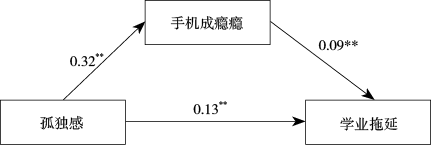
图 1 手机成瘾在孤独感和学业拖延之间的中介路径图
Figure 1 Mediating pathway between mobile phone addiction and loneliness and academic procrastination
4 讨论
本研究基于补偿性互联网使用理论,考察了初中生孤独感、手机成瘾与学业拖延的关系。结果发现,孤独感与手机成瘾、学业拖延均呈显著正相关;手机成瘾在孤独感与学业拖延间起部分中介作用,中介效应占总效应的23.76%。这些发现拓展了我们对青少年学业拖延形成机制的理解,并为干预实践提供了实证依据。
本研究结果还表明孤独感能显著正向预测学业拖延,这与已有研究结果一致(黄明明,2018;李衡,2022)。从心理机制来看,孤独感作为一种负性情绪体验,会消耗个体的认知资源和自我控制能力(Fumagalli et al.,2022)。根据情绪—认知资源理论,长期处于孤独状态的个体往往伴随更高的情绪困扰和注意力分散,导致其难以集中精力完成学业任务(Wong et al.,2022;Rosenstreich & Margalit,2015;Zawadzki et al.,2013)。此外,初中生正处于埃里克森人格发展理论中的“自我同一性对角色混乱”阶段,研究表明孤独感与学业拖延存在显著正相关(Anam & Hitipeuw,2022)。此外,当个体面临学业压力时,消极的应对策略(如逃避行为)会加剧拖延行为(Xue et al.,2025),这提示孤独感可能通过相似的应对机制影响学习行为。
本研究的核心发现是手机成瘾在孤独感与学业拖延之间起部分中介作用,这一结果验证了补偿性互联网使用理论(Kardefelt-Winther,2014)在初中生群体中的适用性。该理论认为,当个体的现实社交需求未得到满足时,会转向虚拟世界寻求补偿性满足。本研究中,孤独感水平较高的初中生可能将手机作为寻求社交连接和情感慰藉的主要工具,以弥补现实人际关系的缺失(Chen et al.,2023)。然而,这种补偿性行为具有“双刃剑”效应:虽然短期内缓解了孤独感,但长期过度依赖手机形成了成瘾性行为模式。
进一步地,手机成瘾导致学业拖延的机制可由“时间置换假说”(Time Displacement Hypothesis)解释(Liu et al.,2022;Neuman,1988)。手机成瘾者将大量时间和认知资源投入虚拟世界,直接挤占了本应用于学习的时间和精力。此外,手机使用带来的即时满足感可能削弱初中生的延迟满足能力和自我调节功能,使其难以坚持完成需要长期投入的学业任务(Schulz van Endert,2021)。值得注意的是,中介效应占总效应的23.76%,表明手机成瘾是孤独感影响学业拖延的重要但非唯一路径,孤独感也可能通过降低学习动机、增加情绪困扰等直接途径影响学业表现(Troncone et al.,2025)。
本研究存在以下局限:首先,横断面设计无法确立因果关系,未来可采用纵向追踪设计以验证变量间的时间先后顺序。其次,样本取自新疆喀什单一地区,且城乡分布和住宿情况不均衡,代表性有限,未来应在更广泛地区验证本研究结论。再次,自我报告数据可能存在社会期望偏差,未来研究可结合客观行为数据(如手机使用时长记录、学业任务完成时间的客观测量)以提高测量的生态效度。最后,本研究仅采用问卷调查法探讨了孤独感在手机成瘾与学业拖延之间的关联。未来研究可整合自我调节、心理韧性等相关变量,以进行更深入的探究。
5 结论
本研究得出以下结论:(1)初中生孤独感、手机成瘾与学业拖延两两呈显著正相关;(2)手机成瘾在孤独感与学业拖延间起部分中介作用。
参考文献
[1] 黄明明,金童林, 赵守盈. (2018). 孤独感对大学生拖延行为的影响: 手机成瘾的中介作用. 贵州师范学院学报, 34(9), 5.
[2] 李衡. (2022). 孤独感在初一年级学生手机依赖与学习适应中的中介效应. 校园心理, 20 (3), 193-197.
[3] 刘俊升, 周颖, 李丹, 陈欣银. (2015). 儿童中期和青春期早期独处偏好与心理适应之关系:有调节的中介效应. 心理学报, 47 (8), 1004-1012.
[4] 苏双, 潘婷婷, 刘勤学, 陈潇雯, 王宇静, 李明月. (2014). 大学生智能手机成瘾量表的初步编制. 中国心理卫生杂志, 28(5), 392-397.
[5] 王丽君, 陈嫄, 王丹娜, 张澜, 华小燕, 宋丽娟. (2021). 手机成瘾与大学生学业拖延: 有调节的中介模型. 教育生物学杂志, 9(5), 358-365.
[6] 周浩, 龙立荣. (2004). 共同方法偏差的统计检验与控制方法. 心理科学进展, (6), 942-950.
[7] 邹泓. (2003). 青少年的同伴关系发展特点、功能及其影响因素. 北京师范大学出版社.
[8] 左艳梅. (2010). 中学生学业拖延的问卷编制及其与父母教养方式的关系研究 (硕士学位论文). 西南大学.
[9] Alhajri S, AlRashidi M, Alomirah A & Alhazmi R. (2025). Smartphone usage in young adults: Cross-sectional associations with physical activity, sleep, social isolation, academic achievement, and anxiety. Frontiers in Psychiatry, 16, Article 1722523.
[10] Anam M K & Hitipeuw I. (2022). The correlation between loneliness and academic procrastination among psychology students at State University of Malang. KnE Social Sciences, 323-332.
[11] Chen Y, Li R & Liu X. (2023). Problematic smartphone usage among Chinese adolescents: Role of social/non-social loneliness, use motivations, and grade difference. Current Psychology, 42(14), 11529-11538.
[12] Fumagalli E, Shrum L J & Lowrey T M. (2022). Consuming in response to loneliness: Bright side and dark side effects. Current Opinion in Psychology, 46, 101329.
[13] Hayes A F. (2018). Partial, conditional, and moderated moderated mediation: Quantification, inference, and interpretation. Communication monographs, 85(1), 4-40.
[14] Kardefelt-Winther D. (2014). A conceptual and methodological critique of internet addiction research: Towards a model of compensatory internet use. Computers in human behavior, 31, 351-354.
[15] Liu F, Xu Y, Yang T, Li Z, Dong Y, Chen L & Sun X. (2022). The mediating roles of time management and learning strategic approach in the relationship between smartphone addiction and academic procrastination. Psychology Research and Behavior Management, 2639-2648.
[16] Liu Y, Lin Y, Zhao S, Wang F, Yuan Q & Tong Y. (2026). Mobile phone addiction and academic procrastination in adolescents: The serial mediating roles of self-regulation and psychological resilience and the moderating role of the parent-child relationship. Brain and Behavior, 16(1), e71169.
[17] Neuman S B. (1988). The displacement effect: Assessing the relation between television viewing and reading performance. Reading research quarterly, 414-440.
[18] Peplau L A & Perlman D. (Eds.). (1982). Loneliness: A sourcebook of current theory, research and therapy. New York: Wiley-Interscience.
[19] Rosenstreich E & Margalit M. (2015). Loneliness, mindfulness, and academic achievements: A moderation effect among first-year college students. The Open Psychology Journal, 8(1), 138145.
[20] Schulz van Endert T. (2021). Addictive use of digital devices in young children: Associations with delay discounting, self-control and academic performance. Plos one, 16(6), e0253058-e0253058.
[21] Troncone A, Caldarelli G, Cosenza M, Affuso G, Sacco M, Ciccarelli M & Pizzini B. (2025). Psychological problems and academic motivation in university students: A cross-sectional study one year after the COVID-19 lockdown in Italy. Psychiatric Quarterly, 96(3), 683-704.
[22] Wong N M L, Mabel-Kenzie S T S T, Lin C, et al. (2022). Meta-analytic evidence for the cognitive control model of loneliness in emotion processing. Neuroscience & Biobehavioral Reviews, 139, 104745.
[23] Xue C, Helian Z & Li Y. (2025). Academic pressure and academic procrastination: The mediating role of negative coping strategies. Plos one, 20(12), e0338956.
[24] Yang X, Liu R D, Ding Y, Hong W & Ding Z. (2023). Interpersonal relationships moderate the relation between academic stress and mobile phone addiction via depression among Chinese adolescents: A three-wave longitudinal study. Current Psychology, 42(22), 19076-19086.
[25] Zawadzki M J, Graham J E & Gerin W. (2013). Rumination and anxiety mediate the effect of loneliness on depressed mood and sleep quality in college students. Health Psychology, 32(2), 212222.