Current Views: 2605891
 Current Downloads: 1619707
Psychology of China
ISSN Print:2664-1798
ISSN Online:2664-1801
Contact Editorial Office



Subscribe to the latest published information from SCISCAN
团体音乐疗法对大学生心理弹性的干预研究
An Intervention Study of Group Music Therapy on Psychological Resilience Among College Students


-
Information:
1.桂林信息工程职业学院,桂林;
2.桂林师范学院,桂林
-
Keywords:
Music therapy; Psychological resilience; College students; Group counseling; Intervention study音乐疗法; 心理弹性; 大学生; 团体辅导; 干预研究
- Abstract: Investigate the effect of group music therapy on college students’ psychological resilience and its underlying mechanism, this study employed a 2 (experimental group vs. control group) × 2 (pre-test vs. post-test) mixed experimental design. 20 vocational college students were recruited and randomly assigned to either an experimental group (n = 10) or a control group (n = 10). The experimental group received an 8-week group music therapy intervention, 90 minutes per week, no intervention in the control group during the same period. The Chinese revised version of the Connor-Davidson Resilience Scale (CD-RISC) was used to assess participants’ psychological resilience before and after the intervention, and data were analyzed using SPSS 27.0. The results revealed that: (1) prior to the intervention, there was no significant difference in psychological resilience between the experimental and control groups t = -0.34, p = 0.74, 95% CI = [-0.81, 0.59], indicating homogeneity between the two groups; (2) a 2 × 2 mixeddesign ANOVA showed a significant interaction between intervention condition and time of measurement, F (1,18) = 29.62, p<0.001, suggesting significant differences in the trend of change between the two groups. Simple effects analysis revealed that the experimental group scored significantly higher on psychological resilience at post-test M = 3.92, SD = 0.62 compared to the control group M = 2.96, SD = 0.87, t = 2.82, p < 0.05, 95% CI = [0.24, 1.66]; (3) no significant change was observed in the control group from pre-test to post-test. 为探讨团体音乐疗法对大学生心理弹性的干预效果及其作用机制,本研究采用2(实验组vs.控制组)×2(前测vs.后测)混合实验设计,以某高职院校20名在校大学生为研究对象,随机分为实验组(n=10)与控制组(n=10)。实验组接受为期8周、每周1次、每次90分钟的团体音乐疗法干预,控制组在此时间段不接受任何干预。采用Connor-Davidson心理弹性量表(CD-RISC)中文修订版于干预前后对两组被试进行测量,并使用SPSS27.0进行数据分析。研究结果发现:(1)干预前,实验组与控制组心理弹性水平无显著差异t=-0.34,p=0.74,95%CI=[-0.81,0.59](2)2×2混合设计方差分析显示,干预条件和测量时间的交互作用显著,F(1,18)=29.62,p<0.001,两组前后测存在显著差异。简单效应分析表明,实验组后测心理弹性得分M=3.92,SD=0.62显著高于控制组M=2.96,SD=0.87,t=2.82,p<0.05,95%CI=[0.24,1.66](3)控制组前后测得分无显著变化。
- DOI: 10.35534/pc.0804082
- Cite: 蒋燕, 刘雁霞. (2026). 团体音乐疗法对大学生心理弹性的干预研究. 中国心理学前沿, 8 (4), 534-539.
1 问题提出
在《黄帝内经》中,已有关于“宫、商、角、徵、羽”五音的记载,五音在韵律、节拍与声调上各具特征,这些音律分别对应人体“脾、肺、肝、心、肾”五脏的疾病治疗(包金金,2022)。近年来,心理学、神经科学、教育学等学科领域聚焦于音乐的作用机制开展了大量的实证研究。有学者按随机数字表法将80位抑郁症患者分为实验组和控制组开展音乐疗法干预研究,每组被试各40人,研究结果显示,实验组抑郁自评量表得分显著低于控制组,实验组的治疗有效率和治疗依从性均显著高于控制组(周田芬 等,2023)。有学者从“生理—心理—社会”框架出发,探讨音乐在人际同步活动中的作用机制,研究发现音乐在人际同步活动中提供节奏和情感框架,不同形式的音乐活动在促进社会联结的过程中发挥的作用与效果也不同(于喆 等,2025)。有学者发现催产素、内源性阿片系统、多巴胺奖赏系统以及听觉-运动耦合可能是音乐亲社会效应的潜在神经生物学基础,音乐节奏产生的夹带作用能够促进人际同步,音乐通过情绪感染提升个体的共情和积极情绪体验,节奏夹带和情绪感染的相互作用进一步增强音乐的亲社会效应(李俊朋 等,2024)。有学者从生理、认知神经和社会沟通三个方面提出假说,试图揭示音乐疗法干预焦虑的作用机制,研究发现音乐疗法可以有效缓解焦虑,不同的音乐材料与治疗方式对焦虑干预效果有不同的影响(周子涵 等,2024)。音乐作为人类文化中普遍存在的艺术形式,不仅承载着审美与情感表达的功能,也在个体行为塑造与社会关系建构中发挥着重要作用。国外对音乐疗法的研究最早可以追溯到第一次世界大战期间,现在已与临床医学、神经科学、行为科学、护理学与音乐治疗等学科结合。Epstein等人的研究发现音乐疗法对严重脑损伤的早产儿生理指标如自主神经系统稳定性、心率、呼吸频率、氧饱和度和行为状态等,具有良好的干预效果(Epstein et al.,2020)。Patricia等人的研究发现音乐疗法能缓解肿瘤血液病患者的情绪、焦虑、抑郁和身体不适水平(Patricia et al.,2023)。Ruiyan的研究发现团体音乐疗法可降低大学生焦虑水平和抑郁水平,通过缓解大学生的身心压力让他们更有力量面对学业压力和社交压力(Ruiyan.,2022)。
心理弹性(Resilience)是指个体身处逆境时能有效应对和适应协调生活上的压力、挫折等负面事件的能力,也被称为心理韧性、复原力、压弹、抗逆力等。心理弹性对个体的社会适应水平和心理健康水平有着重要的影响。有学者采用整群抽样法以1137名大学生为研究对象,探讨大学生早期创伤与抑郁症状的关系,研究发现大学生的心理弹性水平越高,其抑郁症状得分越低(陈乐程 等,2023)。心理弹性作为个体应对逆境、压力与创伤的关键心理资源,近年来在心理学与教育学研究中备受关注。个体在面对挫折或困境时,使自己在逆境中不断适应社会的变化,逐步恢复和成长,与其心理弹性和心理健康有着紧密联系(黄莲琼 等,2024)。随着近年来社会压力与心理健康问题逐步走进人们的视野,探讨心理弹性的形成机制及其在心理健康中的作用有着重要的意义。有研究发现,思维方式与心理健康相关,个体的思维联系性越高,心理健康水平越高,思维的矛盾性越高,个体的心理健康水平越低,心理弹性在思维方式与心理健康间起中介作用(黄莲琼 等,2024)。
综上所述,音乐疗法在抑郁症患者、早产儿、肿瘤血液病患者以及大学生等多类群体中均显示出良好的干预效果,在人际同步、亲社会行为、社会联结及缓解焦虑等方面有促进作用,能够有效改善个体的生理指标、情绪状态、社会适应能力及整体生活质量。然而,音乐疗法现有研究对象多集中于抑郁症患者、肿瘤血液病患者等特定人群,针对大学生群体中心理弹性的相关研究较为有限。本研究拟运用团体音乐疗法模式,以高职大学生为研究对象,考察团体音乐疗法对其心理弹性的干预效果。
2 研究方法
2.1 研究目的
本研究旨在探讨团体音乐疗法对大学生心理弹性的干预效果。借鉴以往干预研究的范式(邓林园 等,2016),设计为期8周的结构化音乐团体辅导方案,通过对实验组与控制组的比较,验证团体音乐疗法对心理弹性的提升作用,并初步探讨其作用机制,为高校心理健康教育提供实证经验。
2.2 研究对象
本研究以某高职院校在读大学生为研究对象,通过校园网络平台发布招募信息,筛选自愿参与且无严重躯体疾病或精神障碍史的学生。将20人被试随机分为实验组与控制组,每组各10人。实验组中女生4人,男生6人,平均年龄19.68 ± 0.79岁;控制组中女生4人,男生6人,平均年龄19.73 ± 0.89岁。
2.3 干预内容与方法
采用2(实验组vs.控制组)×2(前测T1 vs.后测T2)混合实验设计。实验组接受为期8周的团体音乐疗法干预,每周1次,每次90分钟。控制组在此时间段不接受任何系统性干预。在干预前后测量两组被试的心理弹性水平。
干预内容围绕建立安全感、增强信任、情绪觉察、资源识别、压力应对、支持建构、意义生成、巩固迁移的结构展开,具体内容如表1所示。其中第1、2、4、6次团体辅导关注个体内在资源与社会支持系统的建立与强化,第3、5次则提升情绪觉察与压力应对能力,第7、8次旨在调适个体积极心理状态。
表 1 音乐疗法团体辅导设计框架
Table 1 Framework of music therapy group counseling
| 次数 | 主题 | 团体目标 | 团体主要活动 |
| 第1次 | 遇见音乐 | 建立团体安全感,明确目标与规则 | 自我介绍、团体契约制定、团体即兴演奏 |
| 第2次 | 信任之声 | 建立成员间的信任感与归属感 | 节奏镜像、团体信任合奏 |
| 第3次 | 情绪图谱 | 提升情绪觉察与接纳能力 | 感受情绪音乐、绘制情绪图谱、即兴表达情绪 |
| 第4次 | 内在资源 | 识别并强化个人优势与资源 | 优势合奏、建立资源联结 |
| 第5次 | 压力转化 | 学习运用音乐调适情绪与压力 | 敲击训练与压力表达、探索调节策略、音乐放松训练 |
| 第6次 | 支持网络 | 增强成员间的社会支持与团体凝聚力 | 支持性合奏、音乐对话训练 |
| 第7次 | 希望之声 | 促进积极心理建构 | 创作团体音乐、表达和分享希望 |
| 第8次 | 未来之歌 | 巩固干预效果,展望未来成长 | 历程回顾、互赠祝福音乐、集体创作与总结 |
2.4 研究工具
(1)心理弹性量表
采用Connor-Davidson心理弹性量表(CD-RISC)的中文修订版(张建新、余肖楠等,2007),本量表有25条题目,包含三个维度,分别是坚韧性维度、力量性维度和乐观性维度。采用Likert 5点计分,“从来不”计1 分,“一直如此”计5 分,得分越高表示个体的心理弹性水平越高。本研究中,该量表的Cronbach's α系数为0.96。
(2)研究场地与设备
本研究场地设在某高职院校多媒体教室。研究设备包括多媒体音响、三角铁、碰铃、吉他、沙蛋、沙锤、空灵鼓、海浪鼓、颂钵、手鼓、响板等多种团体音乐疗法所需乐器,符合团体音乐辅导活动需求。
(3)数据处理
采用SPSS 27.0对实验组与对照组前后测进行描述性统计、独立样本T检验,简单效应分析,并对实验组的前测、后测进行方差分析。
3 研究结果
3.1 实验组与控制组前测同质性检验
为检验实验组与控制组在干预前是否具有同质性,采用独立样本T检验对两组被试的心理弹性前测得分进行比较。结果显示,实验组M = ٢.٧٥,SD = 0.81与控制组M = ٢.٨٦,SD = ٠.٦٧在心理弹性水平上差异不显著前测数据在统计学上不存在显著差异 t = -0.34,p = 0.74,95% CI = [-0.81,0.59],结果表明,两组被试在干预前心理弹性水平无显著差异,具备同质性,满足后续实验比较的前提条件,如表2所示。
表 2 心理弹性前测独立样本t检验(M±SD)
Table 2 Independent samples T-test for psychological resilience pretest (M ± SD)
| 实验组 | 控制组 | t | p | 95% 置信区间 | ||
| 下限 | 上限 | |||||
| 心理弹性 | 2.75 ± 0.81 | 2.86 ± 0.67 | -0.34 | 0.74 | -0.81 | 0.59 |
3.2 实验组与控制组干预效应检验
为检验团体音乐疗法对心理弹性的干预效果,采用 2(干预条件:实验组 vs. 控制组)× ٢(测量时间:前测T1 vs. 后测T2)双因素混合设计方差分析,其中干预条件为被试间变量,测量时间为被试内变量。方差分析结果显示:干预条件的主效应显著,F(1,18) = 41.75,
p < 0.001,表明实验组与控制组在心理弹性水平上存在显著差异;干预条件和测量时间的交互作用显著,
F(1,18)= 29.62,p < 0.001,说明两组在前后测变化趋势上存在显著差异。进一步进行简单效应分析发现:在前测阶段,实验组与控制组的心理弹性水平差异不显著,
F(1,18)= 0.79,t = -0.34,p > 0.05,进一步验证了两组干预前的同质性;在后测阶段,实验组的心理弹性水平
M = 3.92,SD = 0.62显著高于控制组M = ٢.٩٦,SD = ٠.٨٧,
t = 2.82,p < 0.05,95% CI = [0.24,1.66],如表3所示。
表 3 不同条件下心理弹性分析(M±SD)
Table 3 Analysis of psychological resilience across different conditions (M±SD)
| 实验组 | 控制组 | |||
| 前测 | 后测 | 前测 | 后测 | |
| 心理弹性 | 2.75 ± 0.81 | 3.92 ± 0.62 | 2.86 ± 0.67 | 2.96 ± 0.87 |
上述结果表明,经过8次团体音乐疗法干预,实验组被试的心理弹性水平显著提高,而控制组无显著变化。干预效果在图1轮廓图中得到直观呈现,图1呈现了实验组与控制组在心理弹性前测与后测得分上的变化趋势。横轴表示测量时间,纵轴表示心理弹性得分均值。图1呈现了实验组与控制组在干预前后的效果,图中可见实验组得分后测T2显著高于前测T1,控制组前、后测得分基本趋于稳定。
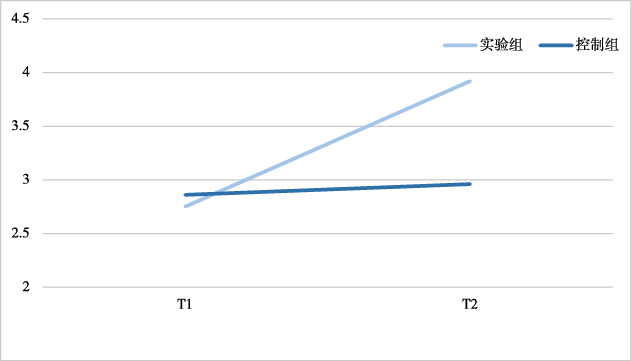
图 1 实验组与控制组测试前后轮廓图
Figure 1 Profile of experimental group and control group
4 分析与讨论
4.1 团体音乐疗法对大学生心理弹性的干预效果
本研究通过为期8周的团体音乐疗法干预,发现实验组大学生的心理弹性水平显著高于控制组,且干预前后差异显著,验证了团体音乐疗法在提升大学生心理弹性方面的有效性,进一步支持了音乐疗法作为心理干预手段的可行性。
从理论机制上看,团体音乐疗法可能通过多条路径促进心理弹性的提升。团体音乐活动中的节奏同步、合奏互动等环节,有助于增强成员间的社会联结与信任感,构建支持性人际关系网络,从而提升个体的社会支持感知力与群体归属感(于喆 等,2025)。音乐作为一种非语言的表达方式,能够帮助个体在安全、支持性的团体氛围中识别和表达自己的情绪状态,增强情绪觉察与调节能力,与本研究中团体辅导设计框架“情绪图谱”“内在资源”等主题相契合。设计框架里的“希望之声”和“未来之歌”等主题活动,通过音乐的创造性表达与意义建构,帮助个体形成积极的自我认知与自我意象,增强心理资本。
4.2 整合视角下心理弹性的机制分析
心理弹性并非单一特质,而是个体在与环境互动过程中动态发展的心理资源系统(黄莲琼 等,2024)。本研究通过团体音乐疗法的结构化设计,在多个层面探讨心理弹性的提升机制。在安全与信任的团体氛围内,音乐作为个体情绪表达的媒介,可增强其情绪调节能力。团体互动中的信任构建与支持性合奏等活动,有助于增强个体对社会支持的感知并提升其适应社会的能力。成员间通过“优势合奏”“资源联结”等活动的联结,提升了个体的主体性,个体得以重新识别及整合自身优势,增强其自我效能感与意义感。个体在音乐团体中获得了情感体验与社会资源,可能增强了其应对压力与逆境的整体水平。
4.3 研究结果实践意义
音乐作为一种综合性艺术形式,不仅作用于个体的认知与情感,还能促进其社会功能发展。团体音乐疗法的结构化设计,丰富了心理健康教育的实践经验,它作为一种可操作的干预形式,适合在学校心理健康教育中推广及应用。
4.4 研究局限与未来展望
尽管本研究初步验证了团体音乐疗法对大学生心理弹性的干预效果,但仍存在以下局限:样本量偏小,实验组与控制组各10人,可能影响结果的统计效力;缺乏追踪研究,干预效果的持续性与可迁移性尚不明确,本研究仅考察了干预前后的即时效果,未在干预结束后设置追踪检验,也就无法判断干预效果是否能够维持,以及个体是否能够将其迁移至学业表现、社会适应等实际生活情境;本土音乐资源的整合尚不充足,干预活动框架的设计借鉴了国内外音乐治疗经验,对中国传统文化资源如《黄帝内经》中的五音疗疾、民族乐器等应用场景尚不能充分开发。
基于当前研究进展与本研究的局限性,未来可从以下几个方向深入推进团体音乐疗法的研究:未来研究可尝试扩大样本量,拓展研究对象与群体,不同群体如留守儿童、学前儿童、青少年焦虑群体、处境不利青少年等的心理弹性发展轨迹与作用机制存在差异,未来可开展不同群体之间的对比研究,探讨团体音乐疗法的适用边界与差异化效果;设计追踪研究,当前音乐疗法研究多集中于横断面或短期纵向设计,缺乏对干预效果的长期追踪,未来研究可考虑在团体结束后进行3个月或6个月的追踪检验;未来可更多地尝试使用民族乐器或具有地域特色的乐器或音乐,提升团体音乐辅导干预的文化适应性,探索音乐疗法本土化。
5 结论
本研究通过为期8周的团体音乐疗法干预,系统考察了其对大学生心理弹性的影响。研究结果表明:(1)团体音乐疗法能够显著提升大学生的心理弹性水平。实验组在接受干预后心理弹性得分显著高于对照组,验证了团体音乐疗法作为心理健康干预手段的有效性。(2)团体音乐疗法通过社会支持建构、情绪觉察、认知体验等多重影响,促进个体心理资源的积累与整合,从而提升其心理弹性水平。(3)本研究构建的结构化团体音乐疗法干预方案具有良好的可操作性,为高校心理健康教育提供了可参考的操作路径。
参考文献
[1] Martí Patricia, Fontanals Irene, Funtané Joel, Canaletas Cristina, Sierra Jorge, Rodés Mariona…& Novelli Silvana. (2023). Preliminary Results of the Effect of Music Therapy Treatment on Anxiety, Sadness, Physical Discomfort, Mood, and Quality of Life in Hospitalized Onco-haematological Patients. Bmc Psychology, 11(1), null.
[2] Shulamit Epstein, Sofia Bauer, Orly Levkovitz Stern, Ita Litmanovitz, Cochavit Elefant, Dana Yakobson & Shmuel Arnon. (2020). Preterm Infants with Severe Brain Injury Demonstrate Unstable Physiological Responses During Maternal Singing with Music Therapy: a Randomized Controlled Study. European Journal of Pediatrics, 180(prepublish), null.
[3] Tang Ruiyan. (2022). The Possibility of Using Music Therapy to Treat Depression and Anxiety Among University Students(Eds.). 2021 4th International Conference on Humanities Education and Social Sciences (ichess 2021). Atlantis Press.
[4] 包金金. (2022). 表达性艺术疗法研究综述. 现代职业教育, (38), 72-75.
[5] 陈乐程, 龚玉莎, 阎玉娇, 吴贤华, 朱冬梅, 韦霁珊, 蒋晓娟, 韩娟. (2023). 武汉市大学生抑郁症状与早期创伤、亲子依恋及心理弹性的关系. 华中科技大学学报(医学版), 52(1), 54-59.
[6] 邓林园, 李蓓蕾, 赵鑫钰. (2016). 音乐治疗对青少年羞怯的干预效果和机制研究. 心理技术与应用, 4(11), 663-668.
[7] 黄莲琼, 罗曦, 侯玉波. (2024). 中国人的思维方式与心理健康: 心理弹性与自尊的作用. 心理科学, 47(2), 458-466.
[8] 李俊朋, 周临舒, 江俊, 王丹妮, 蒋存梅. (2024). 音乐对亲社会行为的影响及其作用机制. 心理科学进展, 32(7), 1179-1194.
[9] 于喆, 陆清岚, 乌哲丽坤, 李晶. (2025). 音乐人际同步活动促进社会联结的机制. 心理科学, 48(1), 118-128.
[10] 周田芬, 鲁梦, 袁雪娇. (2023). 探讨对抑郁症患者实施音乐疗法的效果. 心理月刊, 18(15), 149-151.
[11] 周子涵, 潘文谊, 邱依雯, 李红, 雷怡. (2024). 音乐疗法干预焦虑的作用机制. 中国临床心理学杂志, 32(3), 711-716.