Current Views: 2565083
 Current Downloads: 1593583
Psychology of China
ISSN Print:2664-1798
ISSN Online:2664-1801
Contact Editorial Office



Subscribe to the latest published information from SCISCAN
大学生心理素质与心理健康的关系:自尊的中介作用
The Relationship between Psychological Suzhi and Mental Health in College Students: The Mediating Role of Selfesteem


-
Information:
1.新疆心智发展与学习科学重点实验室,乌鲁木齐;
2.新疆师范大学心理学院,乌鲁木齐;
3.上海师范大学心理学院,上海
-
Keywords:
College students; Psychological Suzhi; Self-esteem; Mental health大学生; 心理素质; 自尊; 心理健康
- Abstract: To explore the influence of psychological SuZhi on the mental health level of college students and its internal mechanism, this study conducted a survey among 325 college students using the Concise College Student Psychological Quality Scale (Health Edition), the Self-Esteem Scale (SES), and the General Health Questionnaire (GHQ-20). Data were analyzed using SPSS 23.0. The results showed that: (1) The psychological quality and mental health level of college students were above average; (2) Male students scored significantly higher than female students in psychological quality, self-esteem, and mental health; (3) Psychological quality was significantly positively correlated with both mental health and self-esteem, and self-esteem was significantly positively correlated with mental health; (4) Self-esteem played a partial mediating role between psychological quality and mental health level. The findings reveal that psychological quality not only directly affects mental health but also indirectly influences it by enhancing individuals’ self-esteem. 为探讨心理素质对大学生心理健康水平的影响及内在作用机制,采用简明大学生心理素质量表(健康版)、自尊量表(SES)、和一般心理健康问卷(GHQ-20),对325名大学生进行调查,采用SPSS23.0对数据进行分析。结果表明:(1)大学生心理素质和心理健康水平处于中等偏上水平;(2)男生的心理素质、自尊、心理健康分数显著高于女生。(2)心理素质分别与心理健康、自尊呈显著正相关,自尊与心理健康呈显著正相关。(4)自尊在心理素质与心理健康水平中起部分中介作用。研究结果揭示,心理素质不仅能直接影响心理健康水平,还会通过提升个体的自尊水平间接影响心理健康水平。
- DOI: 10.35534/pc.0804084
- Cite: 考赛尔·玉苏甫江, 李冰冰, 伊力扎提·麦麦提. (2026). 大学生心理素质与心理健康的关系: 自尊的中介作用. 中国心理学前沿, 8 (4), 547-552.
1 引言
大学生是世界观、人生观和价值观形成的重要时期,也是青年群体中的中坚力量(陈雨濛 等,2022)。然而其情绪波动频繁、缺乏社会锻炼以及心理承受能力比较薄弱,是面临各种挑战从而产生更多心理问题的易感人群。中国科学院发布的2022版《心理健康蓝皮书》显示,在成年人群体中,18~24岁年龄组的抑郁风险率高达24.1%,显著高于其他年龄组;另一项研究表明,与一般群体相比,大学生的抑郁和焦虑率较高(Gao et al.,2020);此外,在一项以3800名大学生为对象的心理健康调查中就发现15.8%的学生成长发展出现问题,有13.3%的大学生人际和谐出现问题(林磊 等,2015)。由此可见,目前大学生的心理健康风险相对突出。心理健康是指个体有较强的自我效能感,对自己的行为和生活的满意度较高的一种幸福的状态(唐辉一 等,2024)。健康的心理是大学生成长成才的重要前提、是发挥大学生潜能的重要因素、是适应社会和成就事业的重要基础(郦炜,2019)。因此,提升大学生的心理健康水平具有重要的实践价值。心理健康水平会受到很多因素的影响,其中心理素质作为个体稳定的心理因素,是很大程度上预测和影响心理健康的内源性因素(张大均,2012),但是以现有研究来看,心理素质如何影响心理健康的心理机制尚不清晰。
1.1 心理素质与心理健康
心理素质是以生理条件为基础,将外在获得的刺激内化为基本、稳定、内隐的,具有基础、衍生和发展功能的,与人的适应性行为和创造行为具有密切的联系的心理品质(张大均 等,2000)。根据张大均等的观点,心理素质包括了认知特性、个性品质和适应能力三个成分(张大均,2012)。其中,认知成分主要表示个体主动参与对外界事物的认知;个性品质是指个体在心理和行为中表现出来的独特特征,如自我控制、自我调节,为个体的认知提供了动力;适应能力是指个体与环境的交互作用过程中,控制和调整内部心理过程,适应、改变环境的能力(Nie et al.,2020; Nie et al.,2012)。心理健康则是个体拥有能够妥善处理自身积极和消极感受的能力,并达到内部和外部的平衡协调,从而表现出的一种个体适应状态(高爽 等,2015)。王鑫强和张大均(2012)认为,心理素质从本质上来说是一种相对稳定的心理品质,而心理健康则是一种积极的心理状态,就二者的关系来说,心理素质是影响心理健康的内源性因素(张阳阳,佐斌,2006)。研究表明,心理素质较低的个体,在面对生活中的负性事件时,其适应能力较差,容易产生抑郁、焦虑等负性情绪(王鑫强,张大均,2012),从而降低心理健康水平;具有良好心理素质的个体可以更容易克服挫折,具有良好的心理弹性,而这些因素又是个体维持心理健康的保护性因子,增加个体的心理健康水平。据此,本研究提出假设H1:心理素质能正向预测心理健康
水平。
1.2 自尊的中介作用
恐惧管理理论(Terror Management Theory,TMT)指出,人类之所以有自尊需求是因为自尊的自我调节机制能够提供弹性空间,能够帮助我们缓解焦虑,即自尊作为个体适应社会文化环境的心理机制,具有焦虑缓冲剂的作用(张阳阳,佐斌,2006)。高自尊的个体能够更好地减少焦虑以及其他问题对自身的伤害,从而有助于个体维持心理健康。相反,低自尊水平的个体不能够较好地缓解焦虑,从而呈现出较低的心理健康水平。根据自我决定理论(Self-determination Theory,SDT)可知个体有自主、能力、归属三种基本心理需求,当这些需求得到满足时,个体的自尊水平也会有所提升(Ryan et al.,2017)。心理素质作为个体稳定的心理品质,在帮助个体调节外在的风险因素的同时还能增益保护因素(王鑫强 等,2017),让个体具有更高的适应能力、归属感,更好地满足基本心理需求,从而提升自尊水平。综上可以推测心理素质会对自尊产生一定的影响,而自尊进一步影响个体的心理健康水平。据此,本研究提出假设H2:自尊在心理素质与心理健康水平中起中介
作用。
综上,本研究拟探讨心理素质与心理健康水平的关系,并假设自尊在这两者之间有中介作用。研究试图检验:(1)心理素质能够正向预测心理健康水平;
(2)自尊在心理素质与心理健康水平中起中介作用。
2 研究方法
2.1 研究对象
采取随机抽样的方法,从上海、新疆、重庆、湖北、等多个省市中选取大学生为调查对象,共发放并回收412份问卷,剔除无效个案后,得到有效问卷325份,其中男生有121人,女生有204人,被试的平均年龄为21.04(SD=1.92)。
2.2 研究工具
(1)简明大学生心理素质量表(健康版)
简明大学生心理素质量表(健康版)是由王鑫强等人修订度(王鑫强,2012)。问卷共36个项目,三个维度分别是认知、个性品质以及适应能力,采用了5点计分,选项1到5表示从非常不符合到非常符合的程度。总分越高就说明个体心理素质越好。该量表在本研究中的α系数为0.90。
(2)自尊量表(SES)
该量表是由Rosenberg学者编写,并由王萍等修订(王萍 等,1998)。该量表包含了10个项目,并在个体的自尊测试中得到了广泛的应用,具有良好的信效度。采用从“非常符合”到“很不符合”1~4级评分。总分较高,意味着个体的自尊心相对较强。该量表在本研究中的α系数为0.74。
(3)一般心理健康问卷(GHQ-20)
GHQ-20量表是由学者Goldberg提出,李虹等人修订(李虹,梅锦荣,2002),共有20个问题,包括焦虑、忧郁和自我肯定三个不同的维度。该量表采用“是”和“否”记分。计算总分需要将忧郁和焦虑量表得分反向记分后与自我肯定分数相加,总分越高,说明心理健康水平越高。在本研究中该量表的α系数为0.74。
2.3 统计分析
采用SPSS23.0软件对数据进行处理与分析,借助SPSS的Process组件,对数据进行了中介作用的分析与检验以及偏差校正非参数百分比BootStrap分析。
3 研究结果
3.1 共同方法偏差检验
根据Harman单因子检验的方法进行共同方法偏差检验(周浩,龙立荣,2004),根据检验结果,发现共有12个因子的特征根超过了1,其中最大的因子解释变异量达到了30.12%,并未超过临界值40%,不存在明显的共同方法偏差。
3.2 大学生心理素质与心理健康水平的总体状况
本研究通过描述统计得到了大学生心理素质、心理健康总体以及心理素质各维度的平均分,标准差以及其他统计指标,如表1所示。结果显示,大学生心理素质的整体得分近似正态分布;从分维度来看,认知品质、个性品质呈现负偏态分布,适应能力近似正态分布,这表明大学生心理素质整体水平中等偏上,认知品质和个性品质相较于适应能力发展得更好;心理健康的整体得分同样呈现中等偏上,呈现出负偏态分布,表明绝大部分学生的心理健康分数向高分区
趋近。
表 1 大学生心理素质与心理健康的总体状况(N=325)
Table 1 Overall status of college students’ psychological suzhi and mental health (N=325)
| 统计指标 | 认知品质 | 个性品质 | 适应能力 | 心理素质 | 心理健康 |
| 平均数 | 36.22 | 34.37 | 64.73 | 135.32 | 15.71 |
| 标准差 | 5.02 | 6.08 | 12.14 | 21.05 | 4.64 |
| 中位数 | 36 | 35 | 63 | 133 | 17 |
| 众数 | 36 | 41 | 53 | 159 | 20 |
| 偏度 | -0.29 | -0.27 | 0.17 | 0.03 | -1.13 |
| 峰度 | -0.42 | -0.77 | -0.83 | -0.90 | 0.60 |
3.3 各变量的性别差异
如表2所示,男生和女生在不同变量得分的独立样本t检验显示,在心理素质、自尊、心理健康四个变量上男生的分数均显著高于女生(ps<0.05),但是在消极应对上的分数没有呈现出显著的性别差异。
表 2 各变量的性别差异
Table 2 Gender differences of each variable
| 变量 | 总体(M+SD) | 男生(M ± SD) | 女生(M ± SD) | t | d |
| 心理素质 | 135±21.05 | 142.64±19.82 | 130.98±20.59 | 5.00*** | 0.58 |
| 自尊 | 30.33±5.57 | 31.54±4.68 | 29.61±5.93 | 3.06*** | 0.36 |
| 心理健康 | 15.71±4.64 | 17.04±4.26 | 14.92±4.69 | 4.08*** | 0.47 |
注:* p<0.05,** p<0.01,*** p<0.001,同下。
3.4 各变量的相关性
表3为本研究中所用变量的平均数、标准差以及变量之间的相关性,相关分析表明,心理素质与自尊呈显著正相关,自尊与心理健康呈显著正相关,如表3所示。
表 3 各变量的平均数、标准差及相关性(N=325)
Table 3 Means, standard deviations and correlations of all variables (N=325)
| 变量 | M ± SD | 1 | 2 |
| 1.心理素质 | 135.32±21.05 | 1 | |
| 2.自尊 | 30.33±5.57 | 0.76*** | 1 |
| 3.心理健康 | 15.71±٤.٦٤ | 0.73*** | 0.73*** |
3.5 自尊中介效应检验
使用SPSS插件PROCESSv4.2的模型4,考察自尊在心理素质与心理健康中的中介作用以及链式中介作用,路径系数结果如表4所示(标准化结果)。由于性别在心理素质、自尊等变量上存在差异,因此将性别作为控制变量。结果显示,心理素质显著正向预测心理健康、自尊;自尊显著正向预测心理健康。在中介变量没有进入模型时,心理素质对心理健康的预测作用显著(M2);加入中介变量后,心理素质对心理健康的预测作用依然显著(M5),故心理素质不仅可以直接预测心理健康,还可以通过中介变量的部分中介作用间接预测心理健康。
用Bootstrap抽样的方法对中介效应进行检验(Bootstrap=5000),结果显示(标准化系数),以自尊为中介变量的路径间接效应为0.31(95%CI=[0.24,0.39])区间不包含0;具体效应的占比如表5所示。综上表明,自尊的中介作用显著,自尊的中介效应占总效应的44%。如图1所示,自尊和应对方式在心理素质和心理健康中的中介作用。
表 4 心理素质与心理健康间的中介模型标准化结果(N=325)
Table 4 Standardized results of the mediating model between psychological suzhi and mental health (N=325)
| M1:自尊 | M2:心理健康 | M5:心理健康 | |
| 心理素质 | 0.76*** | 0.73*** | 0.42*** |
| 自尊 | 0.41*** | ||
| R2 | 0.58 | 0.54 | 0.60 |
| F | 449.16*** | 371.14*** | 245.92*** |
表 5 中介效应Bootstrap检验和效应值
Table 5 Mediating effect bootstrap test and effect size
| 效应类型 | 效应值 | Boot SE | Bootstrap 95% CI | 相对效应占比 | |
| 下限 | 上限 | ||||
| 总效应 | 0.16 | 0.01 | 0.14 | 0.18 | 100% |
| 直接效应 | 0.09 | 0.01 | 0.06 | 0.12 | 56% |
| 间接效应 | 0.07 | 0.01 | 0.05 | 0.09 | 44% |
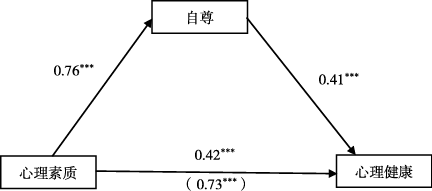
图 1 自尊在心理素质与心理健康中的中介模型图
Figure 1 Mediation model diagram of self-esteem in the relationship between psychological Suzhi and mental health
4 讨论
4.1 大学生心理素质和心理健康水平处于中等偏上水平
研究显示,大学生心理素质与心理健康的整体水平均处于中等偏上水平,这与张大均等的结果相一致(张大均,朱政光,2022)。这是由于近年来,我国高等学校学生的心理健康教育不断地加强,教育部先后颁布《高等学生心理健康教育指导纲要》(2018)、《关于加强学生心理健康管理工作的通知》(2021)、《全面加强和改进新时代学生心理健康工作专项计划(2023—2025年)》(2023)等一系列文件,推动了新时代学生心理健康教育工作的开展,从而促进了学生的心理素质和心理健康水平。此外,本研究结果还显示大学生适应能力的发展相较于认知品质和个性品质的发展弱一些。认知品质通常跟个体对外界事物的认知息息相关,个性品质主要涉及个体的自我意识层面,适应能力则是个体适应、改变环境的能力(朱政光,2020)。从认知品质方面来看,大学生的认知品质表现出独立性、敏锐性等特点(李祥飞,赵明奇,2017),他们能够对所接触的新事物有很强的接受能力,且认知事物的独立性增强。从个性品质方面来看,埃里克森的人格发展理论指出,青春期的主要矛盾是自我统一性的建立(2005),而大学生是从青春期转向成年期的重要发展阶段,该阶段的个体自我意识品格趋于成熟和相对稳定(林崇德,李庆安,2005)。从适应能力方面来看,与中学相比,大学在生活、教育、人际交往等环境发生了变化,这就意味着进入大学后学生会面临更多方面适应问题,特别是对于新生而言,学习适应、人际适应、生活适应方面较为突出(魏爽,2012)。综上,虽然大学生在认知品质和个性水平上表现出较高的水平,但在适应能力方面,会面临更多的挑战和困难。
4.2 男生在各变量的总体水平显著高于女生
研究显示,心理素质、自尊、积极应对、心理健康存在显著的性别差异。男生的心理素质要显著高于女生,该结果与王滔等的结果相一致[7]。其原因是影响个体心理的因素很多,其中社会适应,人际交往以及专业能力是决定个体心理素质的因素;而在王滔等(2003)的研究中发现在这些因素上,男生的优势比较高,因此他们的心理素质会比女生高一些(张大均 等,2000)。而心理素质会直接影响个体的心理健康水平,因此,男生的心理要比女生的心理要健康。本研究发现男生自尊心显著高于女生,这与已有的研究结果一致(闫艳 等,2019),性别差异的形成可能受到社会文化期待、归因风格、人际环境等多重因素的影响,具体机制尚需进一步探究。该结果提示,心理健康教育应重视不同性别学生的自尊发展特点,开展差异化、针对性的心理素质提升与自尊培育工作。
4.3 心理素质、自尊、心理健康的关系分析
研究结果发现,心理素质正向预测心理健康,即心理素质高,心理健康得分高,心理越健康,该结果与前人的研究结果相一致(朱政光,2020)。这是由于心理素质高的个体,心理品质高,发展得也越健全,加之,他们有良好的负性情绪调节能力(潘朝霞,李冰冰,2019)。因此,他们在面对生活中的事件时,心理素质的内在调控程度也要比心理素质低的人高,从而更好地发挥对心理健康的保护作用,减少个体的不良情绪。
本研究还发现自尊在心理素质与心理健康之间起重要的部分中介作用。心理素质高的个体不仅有积极的认知、个性品质以及良好的适应能力之外,他们还会更加尊重自己与他人,进而获得同伴的喜爱与欢迎(刘广增 等,2016;刘广增 等,2025)。此外,他们往往会对自己做出一些积极的评价,且在与他人交往的过程中会表现出更多的主动性(Pan et al.,2018),因此他们在人际、学业等多方面中要比心理素质低、对自己持有较多的消极看法的个体要好,所以心理健康水平要更高。落实到本研究,心理素质越高,自尊越高,心理更健康。
5 结论
(1)心理素质能够正向预测大学生心理健康水平;
(2)自尊在心理素质与心理健康之间起中介作用,即心理素质对心理健康水平既有直接影响,又可通过提高自尊水平来改善心理健康水平。
6 教育建议与研究不足
本研究揭示了心理素质通过自尊对大学生的心理健康水平产生影响。这一结论对大学生心理健康水平的干预提供了参考依据。
随着社会竞争的加剧,大学生的心理健康问题也越来越突出。由于心理素质水平不高导致他们焦虑、抑郁、非自杀性自伤行为等现象频频出现(谢春芳 等,2024)。本研究发现,心理素质不仅可以直接影响心理健康水平,还通过自尊的提升来间接影响个体的心理健康水平,因此可以以心理素质和自尊为抓手提高大学生的心理健康水平。未来学校心理健康教育应通过个性化的丰富多彩的活动开展大学生心理素质训练,同时还应该多关注大学生的自尊水平。具体可以从以下几个方面进行开展:(1)学校层面:营造良好的、积极向上的校园文化氛围,加强校园的自尊教育,可以通过策划组织丰富多彩的校园心理健康活动,例如心理健康月主题活动、心理健康主题班会、团体辅导等形式鼓励学生展示自己的特长和兴趣。(2)教育者层面:教师在课堂中应该尊重学生的个性和差异,多关注存在心理问题的同学,为这些学生提供更多的积极反馈和认可,鼓励并引导其积极参与班上的活动和体育锻炼,并帮助他们找到自己的优势,从而帮助他们提高心理素质与自尊水平。(3)家庭层面:用鼓励式教育替换打压式教育,多给孩子自由选择和表现的机会,少将自己的孩子与“别人家的孩子”进行比较。家校联合共同提高学生的心理素质与自尊水平。
同时本研究还有一些局限,研究仅采用问卷调查的方法进行横断研究探讨变量之间的关系,方法比较单一,日后可以将纵向研究和其他方法相结合,对心理健康进行更深入的了解。其次,本研究的被试只选取了大学生,因此研究得出的结论能否运用到其他群体还需要进一步调查。
参考文献
[1] 陈雨濛, 张亚利, 俞国良. (2022). 2010—2020中国内地大学生心理健康问题检出率的元分析. 心理科学进展, 30(5), 991-1004.
[2] 高爽, 张向葵, 徐晓林. (2015). 大学生自尊与心理健康的元分析——以中国大学生为样本. 心理科学进展, 23(9), 1499-1507.
[3] 林崇德,李庆安. (2005). 青少年期身心发展特点. 北京师范大学学报(社会科学版), (1), 48-56.
[4] 刘广增, 张大均, 潘彦谷,等. (2016). 中学生心理素质与同伴关系的研究:自尊的中介作用. 心理科学, 39(6), 1290-1295.
[5] 刘广增, 王晓刚, 程科, 朱政光. (2025). 高中生心理素质的类别转变对问题行为的影响: 一项潜在转变分析. 中国心理学前沿, 7 (6), 740-745.
[6] 李虹, 梅锦荣. (2002). 测量大学生的心理问题:GHQ-20的结构及其信度和效度. 心理发展与教育, (1), 75-79.
[7] 林磊, 陶思亮, 王群. (2015). 大学生心理健康状况调查与分析——以上海高校为例. 思想理论教育, (5), 89-92.
[8] 郦炜. (2019). 高校对当代大学生心理健康教育的重要性. 当代教育实践与教学研究, (16), 194-195.
[9] 李祥飞, 赵明奇. (2017). 基于大学生认知特点视角的大学新生入学教育探究. 学周刊, (35), 14-17.
[10] 潘朝霞, 李冰冰. (2019). 大学生负性情绪调节效力的差异:心理素质与性别的作用. 西南大学学报(社会科学版), 45(1), 113-119.
[11] 唐辉一, 杨丽娟, 吴俊华, 金欢欢, 罗超, 杨娟. (2024). 大学生错失焦虑对心理健康的影响: 认知失败的中介作用和消极完美主义的调节作用. 中国健康心理学杂志, 32(1), 143-149.
[12] 王萍, 高华, 许家玉,等. (1998). 自尊量表信度效度研究. 山东精神医学, (4), 31-32+22.
[13] 魏爽. (2012). 大学新生适应不良的原因分析及调适对策. 湖北广播电视大学学报, 32(6), 44.
[14] 王鑫强, 张大均. (2012). 心理素质与心理健康关系模型构建:对PTH和DFM的超越. 西南大学学报(社会科学版), 8(6), 67-74+174.
[15] 王鑫强, 张大均, 张雪琪. (2017). 简明大学生心理素质量表(健康版)的修编及信效度检验. 西南大学学报(自然科学版), 39(8), 126-132.
[16] 谢春芳, 江洋, 唐新龙, 张俊, 陈磊, 童庆好. (2024). 中学生心理素质与非自杀性自伤行为的关系: 应对方式的作用路径. 四川精神卫生, 37(2), 162-167.
[17] 闫艳, 谢笑春, 盖笑松, 等. (2021). 中国大中学生的罗森伯格自尊量表测评结果. 中国心理卫生杂志, 35(10), 863-868.
[18] 张大均. (2012). 青少年心理健康与心理素质培养的整合研究. 心理科学, 35(3), 530-536.
[19] 张大均, 冯正直, 郭成, 陈旭. (2000). 关于学生心理素质研究的几个问题. 西南师范大学学报(哲学社会科学版), (3), 56-62.
[20] 张大均, 朱政光. (2022). 大学生心理素质的特点和影响因素——基于对大学生线上调查数据的分析. 教育研究, 43(7), 126-139.
[21] 周浩, 龙立荣. 共同方法偏差的统计检验与控制方法. (2004). 心理科学进展, (6), 942-950.
[22] 张阳阳, 佐斌. (2006). 自尊的恐惧管理理论研究述评. 心理科学进展, (2), 273-280.
[23] 朱政光. (2020). 大学生心理素质的现状及其与心理健康、社会适应和学业发展的关系研究. 西南大学, 重庆.
[24] Gao L, Xie Y, Jia C, Wang W. (2020). Prevalence of depression among Chinese university students: a systematic review and meta-analysis. Sci Rep, 10(1), 15897.
[25] Nie Q, Yang C, Teng Z, et al. (2020). Longitudinal association between school climate and depressive symptoms: The mediating role of psychological suzhi. Sch Psychol. 35(4). 267-276.
[26] Nie Q, Teng Z, Yang C, et al. (2021). Psychological suzhi and academic achievement in Chinese adolescents: A 2-year longitudinal study. Br J Educ Psychol. 91(2), 638-657.
[27] Pan Z, Zhang D, Hu T, Pan Y. (2018). The relationship between psychological Suzhi and social anxiety among Chinese adolescents: the mediating role of self-esteem and sense of security. Child Adolesc Psychiatry Ment Health. 12, 50.
[28] Ryan, Richard M. and Edward L. Deci. (2017). “Self-Determination Theory: Basic Psychological Needs in Motivation, Development, and Wellness.”