Current Views: 2562406
 Current Downloads: 1592443
Psychology of China
ISSN Print:2664-1798
ISSN Online:2664-1801
Contact Editorial Office



Subscribe to the latest published information from SCISCAN
童年创伤对大学生创伤后成长与负性情绪的影响:自我同情的中介作用
The Impact of Childhood Trauma on Post-traumatic Growth and Negative Emotions in College Students: The Mediating Role of Self-compassion


-
Information:
西安欧亚学院人文教育学院,西安
-
Keywords:
Childhood trauma; Post-traumatic growth; Negative emotions; Self-compassion童年创伤; 创伤后成长; 负性情绪; 自我同情
- Abstract: Objective: This study aimed to examine the impact of childhood trauma on post-traumatic growth (PTG) and negative emotions among college students, with a focus on the mediating role of self-compassion. Methods: A sample of 307 university students completed the Childhood Trauma Questionnaire (CTQ), Post-traumatic Growth Inventory (PTGI), Self-Compassion Scale (SCS), and Depression-Anxiety-Stress Scale (DASS). Bootstrap analysis was employed to test the mediation effects. Results: Childhood trauma significantly negatively predicted PTG (β=-0.24) and selfcompassion (β=-0.24), while positively predicting negative emotions (β=0.41). Self-compassion significantly positively predicted PTG (β=0.69) and negatively predicted negative emotions (β=-0.50). Mediation analysis revealed that selfcompassion fully mediated the relationship between childhood trauma and PTG (β=-0.17, 95% CI=-0.26 ~ -0.09), accounting for 70.83% of the total effect. Additionally, self-compassion partially mediated the link between childhood trauma and negative emotions (β=0.12, 95% CI=0.07 ~ 0.18), explaining 29.27% of the variance. Conclusion: Childhood trauma may hinder post-traumatic growth and exacerbate negative emotions by impairing self-compassion. These findings highlight self-compassion as a critical psychological mechanism underlying these associations. 目的:探讨童年创伤对大学生创伤后成长和负性情绪的影响,聚焦自我同情在其中的中介作用。方法:选取307名大学生,采用童年创伤问卷(CTQ)、创伤后成长问卷(PTGI)、自我同情量表(SCS)和抑郁-焦虑-压力量表(DASS)进行调查,使用Bootstrap法检验中介效应。结果:童年创伤显著负向预测创伤后成长和自我同情(β=-0.24、-0.24)、正向预测负性情绪(β=0.41),自我同情显著正向预测创伤后成长(β=0.69)、负向预测负性情绪(β=-0.50)。中介效应分析显示,自我同情在童年创伤和创伤后成长间起完全中介效应(β=-0.17,95%CI=-0.26~-0.09),中介效应占比70.83%;在童年创伤和负性情绪间起部分中介效应(β=0.12,95%CI=0.07~0.18),中介效应占比29.27%。结论:童年创伤可以通过削弱自我同情阻碍创伤后成长,并加剧负性情绪的发生。
- DOI: 10.35534/pc.0804089
- Cite: 佀建锋, 吴婧. (2026). 童年创伤对大学生创伤后成长与负性情绪的影响: 自我同情的中介作用. 中国心理学前沿, 8 (4), 584-591.
童年创伤(Childhood Trauma)是指个体在18岁前经历的情感虐待、身体虐待、性虐待、情感忽视和身体忽视等创伤事件(Bernstein et al.,2003)。作为个体早期发展的重大逆境事件,童年创伤对大学生的心理健康有着深远的影响,近年来研究显示,我国大学生童年创伤发生率高达64.7%~79.1%(Fu et al.,2018;杨文敏 等,2021),这一高发率凸显了大学生童年创伤干预的重要性。
大量研究证实童年创伤对负性情绪有显著预测作用。Meta分析表明,童年创伤会使个体抑郁风险提升2.66~3.73倍,且与发病早、慢性化及治疗抵抗性相关(Nelson et al.,2017)。在大学生群体中,童年创伤通过激活负性认知图式正向预测抑郁、焦虑及压力症状(丁语恬 等,2025;张春阳,徐慰,2022)。另外,童年创伤通过加剧情绪调节困难间接加剧心理病理症状,这一机制在人际依赖、物质滥用等共病中尤为显著(ÇAKMAK TOLAN & TIMER,2023;Dvir et al.,2014)。这种关联具有跨文化一致性,土耳其研究发现童年创伤大学生的抑郁、焦虑量表得分显著高于无创伤群体(Bahar,2023),而神经机制研究进一步揭示其与边缘系统结构损伤、HPA轴失调及恐惧学习异常相关(Giotakos,2020)。
值得关注的是,创伤经历并非仅导致消极影响,也可能出现积极的改变。Tedeschi与Calhoun提出创伤后成长理论(Posttraumatic Growth,PTG),指个体在与创伤抗争后可能产生人际关系、生命意义感等维度的积极心理转变(Tedeschi & Calhoun,2004)。然而,创伤与PTG的关系存在不一致的结果:一方面,研究发现童年创伤直接负向预测大学生PTG(Cheng & Zhang,2023;郝羽,2024);另一方面,创伤的严重程度和PTG之间可能呈曲线关系(涂阳军,郭永玉,2010),如丧子父母的创伤与创伤后成长之间没有直接关联(Khursheed & Shahnawaz,2020),这表明过度严重的创伤可能彻底抑制成长所需的心理资源(Tomich & Helgeson,2004)。
自我同情(Self-Compassion)包含自我友善、普遍人性及正念接纳等成分,能有效缓冲创伤的负面影响(Neff,2003)。自我同情在童年创伤病理化和创伤后成长的双路径中起着关键的作用。在病理化路径中,童年创伤通过降低自我同情水平,间接加剧焦虑抑郁症状(任凌雪 等,2022;陈超男 等,2025;Chi et al.,2023),因此,本研究提出假设1:自我同情在童年创伤和负性情绪间起中介作用。在PTG路径中,自我同情可能通过促进接纳与积极再评估驱动成长:Zhang与Chen证实自我同情可以促使个体接纳创伤经历,重构生命意义(Zhang & Chen,2016);Quan等发现接纳在童年创伤与PTG间起部分中介作用,且积极再评估可强化该路径(Quan et al.,2022)。类似地,依恋安全感也可转化为自我同情,进而促进PTG(Cheng & Zhang,2023),印证了“创伤→自我同情→适应性认知→成长”的链式机制(Wong & Yeung,2017)。因此,本研究提出假设2:自我同情在童年创伤和负性情绪间起中介作用。
综上,当前研究存在以下局限:多数研究聚焦童年创伤的单一后果(病理化或成长),缺乏双路径整合模型,且自我同情在“创伤-PTG”路径的中介机制需在中国文化背景下进一步验证。本研究拟通过结构方程模型,同时检验童年创伤对大学生负性情绪与PTG的双重作用,并重点分析自我同情在两条路径中的中介效应。研究成果将为创伤干预提供新方向:通过培育自我同情能力,既缓解创伤后情绪障碍,又激活成长潜能,实现“减害”与“增效”的双重目标。
1 对象与方法
1.1 研究对象
于2024年10月至12月期间,采取方便取样原则,以大学生为研究对象,使用问卷星线上匿名收集数据。所有受试均自愿参与研究,阅读并签署书面知情同意书,充分知悉研究目的、调查内容及数据使用规范,全程保障受试者隐私与合法权益。本研究方案已通过西安欧亚学院伦理审查委员会审核批准,研究过程严格遵循心理学伦理规范及科研伦理要求。共回收数据324份,排除作答时间过短、无效作答等问卷,最终回收有效数据307份。其中,男生53名,女生254名;独生子女111名,非独生子女196名;家庭经济水平贫困38名,中等193名,良好76名。
1.2 研究工具
1.2.1 童年创伤问卷(Chilehood Trauma Question-naire,CTQ)
该问卷由Bernstein和Fink(1994)编制,傅文青等人(2005)修订,共28个条目,其中25个为临床条目,3个为效度条目,用于评估个体在18岁以前经历的虐待与忽视经历,童年期不良经历包括5个维度:情感虐待、躯体虐待、性虐待、情感忽视和躯体忽视。采用5点评分(1“从不”,5“总是”),分数越高,表明创伤程度越严重。各个维度创伤严重程度评分标准如表1所示,童年创伤整体严重程度按照以下标准进行划分:所有维度中得分都为无则童年创伤为无,至少有一个维度得分为轻度且所有维度未达到中度则童年创伤为轻度,至少有一个维度得分为中度且所有维度未达到重度则童年创伤为中度,至少有一个维度得分为重度则童年创伤为重度(Jones et al.,2022)。本研究中该量表的Cronbach α系数为0.85。
表 1 童年创伤各维度严重程度划分标准
Table 1 Criteria for classifying the severity of each dimension of childhood trauma
| 维度 | 无 | 轻度 | 中度 | 重度 |
| 情感虐待 | ≤8 | 9~12 | 13~15 | ≥16 |
| 身体虐待 | ≤7 | 8~9 | 10~12 | ≥13 |
| 性虐待 | ≤5 | 6~7 | 8~12 | ≥13 |
| 情感忽视 | ≤9 | 10~14 | 15~17 | ≥18 |
| 身体忽视 | ≤7 | 8~9 | 10~12 | ≥13 |
1.2.2 创伤后成长问卷(Post-traumatic Growth Inventory,PTGI)
该问卷由Tedeschi和Calhoun(1996)编制,张月娟等人( 2013)修订,共21题,包含五个维度:与他人关系、新可能性、个人力量、欣赏生活、精神成长。采用6点计分(0“完全没有变化”,5“变化非常大”),分数越高,表示个体的创伤后成长水平越高。本研究中该量表的Cronbach α系数为0.97。
1.2.3 自我同情量表(Self-Compassion Scale,SCS)
该问卷由Neff(2003)编制,陈健等人(2011)修订,共26题,包含6个分量表:自我友善、自我评判、普遍人性、孤立感、正念、过度认同。采用5点计分(1“完全不符合”,5“完全符合”),分数越高,说明自我同情水平越高。本研究中该量表总分及分量表的Cronbach α系数分别为0.84、0.86、0.74、0.7、0.71、0.8、0.73。
1.2.4 抑郁-焦虑-压力量表(The Depression Anxiety StressScale,DASS)
该量表由Lovibond等人(1995)编制,龚栩等人(2010)修订,共21个条目,包含抑郁、焦虑、压力3个分量表,采用4点计分(0不符合,3完全符合)。得分越高,其抑郁、焦虑、压力水平越高。本研究中将三个分量表的分数相加作为负性情绪总分,该量表总分及分量表的Cronbach α系数分别为0.96、0.9、
0.89、0.9。
1.3 统计方法
采用SPSS 22.0软件进行数据统计分析。采用独立样本t检验和单因素方差分析比较人口学变量在各量表间的得分差异。使用Pearson相关分析探讨童年创伤、创伤后成长、自我同情和负性情绪间的相关性。采用Hayes(2013)编制的PROCESS宏程序中的Model 4进行中介模型检验(Hayes,2013),采用Bootstrap法(重复抽样5000次),置信区间(95% CI)不包含0即为效应模型有统计学意义。以p<0.05为差异具有统计学
意义。
采用Harman单因素检验法进行共同方法偏差检验,结果显示,有16个特征根大于1的因子,其中第一个因子解释变异量为21.59%,小于40%的临界值,表明本研究不存在严重的共同方法偏差(周浩,龙立荣,2004)。
3 结果
3.1 描述性结果
童年创伤各维度发生率由高到低依次是,情感忽视66.12%、身体忽视62.21%、情感虐待37.13%、性虐待22.80%、身体虐待22.15%。整体来看,在本研究样本中,童年创伤发生率为80.78%,如表2所示。
表 2 童年创伤按严重程度分布情况[人数(%)]
Table 2 Distribution of childhood trauma by severity [Number (Percentage)]
| 维度 | 无 | 轻度 | 中度 | 重度 | 发生率 |
| 情感虐待 | 193(62.87%) | 74(24.10%) | 24(7.82%) | 16(5.21%) | 37.13% |
| 身体虐待 | 239(77.85%) | 24(7.82%) | 22(7.17%) | 22(7.17%) | 22.15% |
| 性虐待 | 237(77.20%) | 29(9.45%) | 26(8.47%) | 15(4.89%) | 22.80% |
| 情感忽视 | 104(33.88%) | 120(39.09%) | 47(15.31%) | 36(11.73%) | 66.12% |
| 身体忽视 | 116(37.79%) | 68(22.15%) | 56(18.24%) | 67(21.82%) | 62.21% |
| 童年创伤 | 59(19.22%) | 90(29.32%) | 69(22.48%) | 89(28.99%) | 80.78% |
3.2 人口学变量在各量表上的差异比较
3.2.1 性别差异
以性别为分组变量进行独立样本t检验,结果如表3所示。男生在身体虐待和身体忽视上均显著高于女生;男生在抑郁分量表和负性情绪总分上显著高于
女生。
表 3 各变量在性别及是否独生上的差异(平均数±标准差)
Table 3 Differences of each variable by gender and whether it is an only child (M± SD)
| 变量 | 男(n=53) | 女(n=254) | t值 | 独生(n=111) | 非独生(n=196) | t值 |
| 自我友善 | 17.45±3.36 | 17.30±3.80 | 0.273 | 17.33±4.10 | 17.32±3.50 | 0.026 |
| 自我评判 | 14.89±3.26 | 15.20±3.53 | -0.596 | 14.70±3.97 | 15.4±3.16 | -1.582 |
| 普遍人性 | 13.06±3.08 | 13.45±2.63 | -0.967 | 13.74±2.95 | 13.18±2.55 | 1.661 |
| 孤立感 | 11.26±2.57 | 11.57±2.95 | -0.704 | 11.18±3.15 | 11.71±2.71 | -1.548 |
| 正念 | 14.09±2.78 | 13.99±2.81 | 0.251 | 14.29±3.01 | 13.85±2.66 | 1.331 |
| 过度认同 | 11.38±2.80 | 11.14±3.04 | 0.529 | 10.94±3.34 | 11.32±2.78 | -1.066 |
| SCS总分 | 82.13±10.54 | 82.65±12.76 | -0.276 | 82.18±14.54 | 82.78±11.02 | -0.375 |
| 压力 | 7.45±4.27 | 6.28±4.87 | 1.634 | 7.42±5.19 | 5.94±4.47 | 2.628** |
| 焦虑 | 6.58±4.14 | 5.28±4.65 | 1.886 | 6.23±4.99 | 5.10±4.30 | 2.071* |
| 抑郁 | 6.13±4.39 | 4.66±4.42 | 2.204* | 5.70±4.80 | 4.47±4.18 | 2.352* |
| DASS总分 | 20.17±11.97 | 16.22±13.26 | 2.005* | 19.35±14.23 | 15.52±12.25 | 2.484* |
| 情感虐待 | 8.79±3.75 | 8.07±3.66 | 1.301 | 8.72±4.02 | 7.90±3.44 | 1.892 |
| 身体虐待 | 7.72±3.44 | 6.44±3.01 | 2.517* | 7.05±3.38 | 6.44±2.94 | 1.581 |
| 性虐待 | 6.60±3.11 | 5.96±2.57 | 1.418 | 6.16±2.87 | 6.02±2.56 | 0.462 |
| 情感忽视 | 12.17±5.20 | 11.76±4.51 | 0.538 | 11.94±4.94 | 11.77±4.46 | 0.303 |
| 身体忽视 | 10.21±3.83 | 9.13±3.34 | 2.087* | 8.95±3.38 | 9.52±3.48 | -1.404 |
| CTQ总分 | 45.49±15.84 | 41.35±12.51 | 1.792 | 42.81±14.25 | 41.64±12.6 | 0.747 |
| 人际关系 | 19.09±9.23 | 17.85±8.63 | 0.946 | 18.91±9.42 | 17.58±8.31 | 1.238 |
| 新可能性 | 13.75±7.31 | 13.38±6.14 | 0.347 | 14.18±6.76 | 13.03±6.08 | 1.528 |
| 个人力量 | 11.17±5.59 | 11.24±4.97 | -0.087 | 12.08±5.27 | 10.74±4.90 | 2.241* |
| 精神改变 | 4.40±2.50 | 4.23±2.38 | 0.463 | 4.33±2.68 | 4.21±2.23 | 0.396 |
| 欣赏生活 | 8.94±4.49 | 8.02±3.63 | 1.41 | 8.54±4.11 | 7.97±3.61 | 1.265 |
| PTG总分 | 57.36±27.22 | 54.71±23.69 | 0.721 | 58.05±26.05 | 53.54±23.17 | 1.565 |
注:SCS=自我同情,DASS=负性情绪,CTQ=童年创伤,PTG=创伤后成长;**p<0.01,*p<0.05。
3.2.2 是否独生差异
以是否独生为分组变量进行独立样本t检验,结果如表3所示。独生子女在个人力量上显著高于非独生;独生子女在抑郁、焦虑、压力分量表及负性情绪总分上均显著高于非独生。
3.2.3 家庭经济水平差异
以家庭经济水平为分组变量进行单因素方差分析,结果如表4所示。家庭经济水平良好的大学生在自我友善、普遍人性和自我同情总分上均显著高于经济水平贫困的大学生;经济水平中等的大学生在情感虐待和童年创伤总分上显著高于良好的大学生,经济水平贫困和中等的大学生在情感忽视上均显著高于良好的大学生。
表 4 各变量在家庭经济水平上的差异
Table 4 Differences of each variable in terms of family economic level
| 变量 | 贫困(n=38) | 中等(n=193) | 良好(n=76) | F值 |
| 自我友善 | 16.05±3.12 | 17.32±3.58 | 17.99±4.19 | 3.481* |
| 自我评判 | 14.82±2.63 | 15.20±3.54 | 15.18±3.73 | 0.195 |
| 普遍人性 | 12.63±2.21 | 13.32±2.68 | 13.93±2.94 | 3.13* |
| 孤立感 | 11.13±2.32 | 11.39±2.87 | 12.03±3.13 | 1.709 |
| 正念 | 13.39±2.28 | 13.92±2.75 | 14.53±3.07 | 2.331 |
| 过度认同 | 10.95±2.44 | 11.16±2.94 | 11.34±3.39 | 0.229 |
| SCS总分 | 78.97±10.2 | 82.31±11.33 | 85.00±15.28 | 3.15* |
| 压力 | 6.74±4.11 | 6.87±4.86 | 5.36±4.78 | 2.83 |
| 焦虑 | 5.68±3.89 | 5.84±4.71 | 4.58±4.54 | 2.104 |
| 抑郁 | 5.26±3.53 | 5.24±4.59 | 3.92±4.40 | 2.551 |
| DASS总分 | 17.68±10.84 | 17.95±13.37 | 13.86±13.17 | 2.766 |
| 情感虐待 | 7.74±2.73 | 8.66±4.04 | 7.24±2.86 | 4.544* |
| 身体虐待 | 6.63±2.70 | 6.82±3.41 | 6.25±2.45 | 0.926 |
| 性虐待 | 5.68±1.83 | 6.25±2.98 | 5.79±2.13 | 1.273 |
| 情感忽视 | 12.61±4.05 | 12.19±4.59 | 10.51±4.81 | 4.283* |
| 身体忽视 | 10.24±3.44 | 9.32±3.49 | 8.83±3.31 | 2.125 |
| CTQ总分 | 42.89±11.25 | 43.25±13.86 | 38.62±11.91 | 3.498* |
| 人际关系 | 17.37±8.64 | 17.69±8.39 | 19.34±9.60 | 1.108 |
| 新可能性 | 12.76±6.20 | 13.22±6.27 | 14.36±6.59 | 1.121 |
| 个人力量 | 10.5±4.78 | 10.98±5.10 | 12.20±5.08 | 2.015 |
| 精神改变 | 4.24±2.37 | 4.13±2.34 | 4.58±2.56 | 0.935 |
| 欣赏生活 | 8.08±3.80 | 7.89±3.60 | 8.96±4.24 | 2.207 |
| PTG总分 | 52.95±24.17 | 53.92±23.71 | 59.43±25.66 | 1.589 |
3.3 各量表之间的相关分析
将大学生童年创伤、创伤后成长、自我同情和负性情绪进行相关分析,结果如表5所示。自我同情与童年创伤和负性情绪均显著负相关,与创伤后成长显著正相关;童年创伤与负性情绪显著正相关,与创伤后成长显著负相关;创伤后成长与负性情绪显著负相关。
表 5 各变量之间的相关性(r)
Table 5 Correlation coefficients (r) among variables
| 变量 | 1 | 2 | 3 | 4 |
| 1自我同情 | 1 | |||
| 2负性情绪 | -0.56*** | 1 | ||
| 3童年创伤 | -0.27*** | 0.44*** | 1 | |
| 4创伤后成长 | 0.36*** | -0.21*** | -0.13* | 1 |
注:***p<0.001。
3.4 中介效应检验
3.4.1 自我同情在童年创伤和创伤后成长中的中介效应
以性别、是否独生和家庭经济水平为控制变量,童年创伤为自变量,创伤后成长为因变量,使用Hayes编制的SPSS宏程序PROCESS 4.0中的Model 4进行简单中介效应检验,结果如表6所示。童年创伤对创伤后成长的总效应显著(β=-0.24,p<0.05)。加入自我同情中介变量后,童年创伤显著负向预测自我同情(β=
-0.24,p<0.001),自我同情显著正向预测创伤后成长(β=0.69,p<0.001),而童年创伤对创伤后成长的直接效应不显著(β=-0.07,p=0.495)。Bootstrap检验表明,自我同情的中介效应显著(β=-0.17,95% CI[-0.26,
-0.09],不包含0),且中介效应占总效应的70.83%。
表 6 各变量的多元回归分析
Table 6 Multivariate regression analysis of each variable
| 变量 | 整体拟合指数 | 回归方程显著性 | ||||||
| 因变量 | 自变量 | R | R2 | F | β | LLCI | ULCI | t值 |
| 自我 同情 | 童年创伤 | 0.30 | 0.09 | 7.30 | -0.24 | -0.35 | -0.14 | -4.66*** |
| 性别 | -0.76 | -4.33 | 2.81 | -0.42 | ||||
| 独生 | 0.88 | -1.96 | 3.72 | 0.61 | ||||
| 经济 | 2.45 | 0.15 | 4.76 | 2.09* | ||||
| 创伤后成长 | 童年创伤 | 0.38 | 0.14 | 10.13 | -0.07 | -0.27 | 0.13 | -0.68 |
| 自我同情 | 0.69 | 0.47 | 0.90 | 6.27*** | ||||
| 性别 | -3.31 | -10.11 | 3.49 | -0.96 | ||||
| 独生 | -4.74 | -10.15 | 0.67 | -1.72 | ||||
| 经济 | 0.96 | -3.46 | 5.38 | 0.43 | ||||
| 负性 情绪 | 童年创伤 | 0.65 | 0.42 | 43.80 | 0.29 | 0.20 | 0.38 | 6.37*** |
| 自我同情 | -0.50 | -0.60 | -0.40 | -10.30*** | ||||
| 性别 | -2.37 | -5.38 | 0.65 | -1.54 | ||||
| 独生 | -3.29 | -5.69 | -0.89 | -2.70** | ||||
| 经济 | -0.53 | -2.49 | 1.43 | -0.53 | ||||
综上,自我同情在童年创伤和创伤后成长之间起完全中介效应,即童年创伤并非直接促进或抑制个体的创伤后成长,而是通过削弱自我同情能力间接阻碍创伤后成长的发生。中介效应模型图如图1所示。
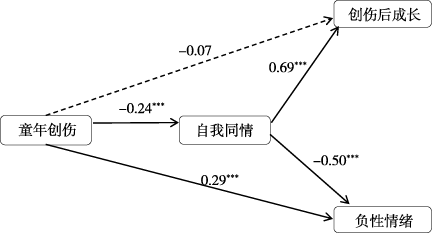
图 1 童年创伤、自我同情、创伤后成长与负性情绪间的中介模型图
Figure 1 The mediation model between childhood trauma, self-compassion, post-traumatic growth and negative emotions
3.4.2 自我同情在童年创伤和负性情绪中的中介效应
以性别、是否独生和家庭经济水平为控制变量,童年创伤为自变量,负性情绪为因变量,使用Hayes编制的SPSS宏程序PROCESS 4.0中的Model 4进行简单中介效应检验,结果如表5所示。童年创伤对负性情绪的总效应显著(β=0.41,p<0.001)。加入自我同情中介变量后,童年创伤显著负向预测自我同情(β=-0.24,p<0.001),自我同情显著负向预测负性情绪(β=-0.50,p<0.001),并且童年创伤对负性情绪的直接效应显著(β=0.29,p<0.001)。Bootstrap检验表明,自我同情在童年创伤和负性情绪中的中介效应显著(β=0.12,95% CI[0.07,0.18],不包含0),且中介效应占总效应
的29.27%。
综上,自我同情在童年创伤和负性情绪之间起部分中介作用,童年创伤不仅能够直接增加负性情绪,还可通过削弱自我同情间接加剧负性情绪。
4 讨论
研究发现,大学生童年创伤经历中,忽视发生率较高,虐待发生率较低,且情感忽视和虐待高于身体忽视和虐待,这与多项研究结果一致。忽视发生率较高,因其不造成明显后果,家长和教育者可能未意识到其危害,而虐待因留下身体痕迹或法律界定明确更易被识别和发现。
男生在身体虐待、身体忽视、抑郁分量表及总分上均显著高于女生,表现出男生在部分创伤维度与负性情绪得分上显著更高,这与以往研究部分一致(Wang et al.,2022;Prachason et al.,2024),这可能是由于社会对性别角色期待不同,对男性赋予更多的“坚强、隐忍”,男孩更可能被鼓励参加高风险活动,增加遭受身体虐待、身体忽视的机会(Machisa et al.,2016),如体罚文化对男孩的容忍度较高,同时童年创伤的增加加剧了抑郁风险的上升(Norman et al.,2012)。
独生子女在负性情绪上显著高于非独生子女,这与多项研究结果一致。Cheng等发现大学生独生子女的焦虑症状患病率(33.4%)显著高于非独生子女(17.4%),抑郁症状患病率及共病率也更高(Cheng et al.,2020)。原因可能是独生子女面临更少的同伴支持和更高的社会期待压力,同时因缺乏兄弟姐妹的情感缓冲更易出现负性情绪(Wikle et al.,2019)。
经济水平良好的大学生出现更高的自我友善、普遍人性及自我同情,更少的情感忽视、情感虐待及童年创伤,这与以往多项研究结果一致。经济优势可以为个体提供更多的教育发展、社会服务和人际支持等资源,促进个体积极的自我认知,提升自我效能及社会共情能力的发展(Huang & Wang,2023)。另外,高经济地位家庭更易提供安全稳定的情感支持环境,降低童年创伤的风险。
本研究发现,自我同情在童年创伤与PTG间起完全中介作用,表明童年创伤能否实现PTG,关键在于其能否发展出自我同情能力。这一发现与Neff提出的自我同情理论高度一致,自我同情能够帮助个体以接纳的态度,而非批评的态度处理痛苦体验,从而为创伤后的积极转化提供心理基础。完全中介效应的发现支持了“创伤后成长的双过程模型”,即创伤暴露本身并不直接导致成长,而是通过激发个体认知情绪调节策略间接实现。童年创伤常引发自我批评和羞耻感,而自我同情可以通过自我友善、普遍人性、正念觉察这三重路径促进心理成长,自我友善将自我敌对转化为同理心,普遍人性将自我孤立转化为正常化,正念觉察将过度认同转化为接纳,自我同情带来的内在变化,会让个体以更加平和、现实的心态考虑生命的意义及与他人的关系,这些为后续的创伤后成长提供了力量和新方向。这一结果拓展了国内相关研究,如Chi等发现中国大学生的童年家庭暴力通过自我同情间接影响PTG,且直接效应不显著,支持完全中介模型(Chi et al.,2021)。本研究进一步证实,自我同情不仅是“缓冲器”,更是“转化器”,即使在高童年创伤群体中,通过培养自我同情仍可能实现心理成长。
本研究显示,自我同情在童年创伤和负性情绪间起部分中介作用,表明童年创伤不仅直接引发负性情绪,还会通过削弱自我同情间接导致负性情绪,这与以往多项研究结果一致,且在不同群体中均得到了验证。童年创伤会形成情绪记忆存储于潜意识中,当成年后生活中遭遇相似刺激情境时,会自动激活焦虑、恐惧、愤怒等负性情绪;同时童年创伤可能与负性自我认知相关,如低自我价值感、人际安全感不足等,成为后续负性情绪产生的持续温床。自我同情用正念提升对负性情绪的耐受力和觉察力,缓冲个体潜意识的自动化情绪反应,以接纳的态度让负性情绪自然的发展变化;用自我友善替代自我批评,减少威胁系统的激活,用普遍人性培养内在的安全感,促进与他人之间的联接,强化安抚系统,从而减少负性情绪的恶性循环(Wekerle et al.,2022)。
综上所述,本研究揭示了童年创伤可通过自我同情间接影响创伤后成长和负性情绪两个不同的路径。该研究对于预防和干预大学生童年创伤具有一定的启示作用。政策方面可通过强化儿童虐待预防体系,从国家干预打破创伤代际传递;另外,还可以通过提升大学生的自我同情能力促进创伤后成长和减少负性情绪,并且可以根据创伤的不同维度设置不同的干预方式,为后续干预研究提供了依据。本研究可能存在以下不足:样本量较少,可能限制了样本的代表性和结论的推广性;童年创伤发生时间较早,在成年后进行回忆可能存在主观偏差,难以确定童年创伤、自我同情、创伤后成长和负性情绪之间的因果关系。
参考文献
[1] Bernstein D, Stein J & Newcomb M. (2003). Development and validation of a brief screening version of the Childhood Trauma Questionnaire. Child Abuse and Neglect, 27(2), 169-190.
[2] Fu H L, Feng T J & Qin J B. (2018). Reported prevalence of childhood maltreatment among Chinese college students: A systematic review and meta-analysis. PLOS ONE, 13(10), Article e0205808.
[3] 杨文敏, 鲁嘉晨, 谭欣, 等. (2021). 大学生主观童年创伤症状对抑郁的影响: 抗挫折能力和外向性的多重中介效应. 心理发展与教育, 37(1), 128-136.
[4] Nelson J, Klumparendt A & Doebler P. (2017). Childhood maltreatment and characteristics of adult depression: Meta-analysis. The British Journal of Psychiatry, 210(2), 96-104.
[5] 丁语恬, 刘楷, 苏蕴烨, 等. (2025). 注意控制和偏向对大学生抑郁症状与童年创伤关系的作用. 中国心理卫生杂志, 39(7), 643-648.
[6] 张春阳, 徐慰. (2022). 儿童期创伤与有留守经历大学生负性情绪: 心理韧性的调节作用. 心理发展与教育, 38(4), 584-591.
[7] Çakmak Tolan Ö & Timer S B. (2023). Difficulty in emotion regulation as a mediator between childhood traumas and interpersonal dependency. E-International Journal of Educational Research, 14(2), 31-49.
[8] Dvir Y, Ford J D & Hill M. (2014). Childhood maltreatment, emotional dysregulation, and psychiatric comorbidities. Harvard Review of Psychiatry, 22(3), 149-161.
[9] Bahar A. (2023). The relationship of university students’ childhood mental trauma with depression, anxiety and stress. The European Research Journal, 9(4), 785-791.
[10] Giotakos O. (2020). Neurobiology of emotional trauma. Psychiatriki, 31(2), 162-171.
[11] Tedeschi R G & Calhoun L G. (2004). Posttraumatic growth: Conceptual foundations and empirical evidence. Psychological Inquiry, 15(1), 1-18.
[12] Cheng H & Zhang Y. (2023). Effect of childhood trauma on PTSD and PTG among college students: The mediating role of attachment. In Proceedings of the 7th International Conference on Medical and Health Informatics (ICMHI 2023) (pp. 332–336). ACM.
[13] 郝羽. (2024). 海南省男性未成年服刑人员心理韧性和创伤后成长的发展关系及童年期创伤的影响(硕士学位论文). 海南医科大学.
[14] 涂阳军, 郭永玉. (2010). 创伤后成长: 概念、影响因素、与心理健康的关系. 心理科学进展, 18(1), 114-122.
[15] Khursheed M & Shahnawaz M G. (2020). Trauma and post-traumatic growth: Spirituality and self-compassion as mediators among parents who lost their young children in a protracted conflict. Journal of Religion and Health, 59(6), 3149-3167.
[16] Tomich P L & Helgeson V S. (2004). Is finding something good in the bad always good? Benefit finding among women with breast cancer. Health Psychology, 23(1), 16-23.
[17] Neff K D. (2003). The development and validation of a scale to measure self-compassion. Self and Identity, 2(3), 223-250.
[18] 任凌雪, 杨洋, 张绍波, 等. (2022). 童年期虐待与初中生抑郁的关系: 述情障碍与自我怜悯的链式中介. 中国健康心理学杂志, 30(11), 1734-1740.
[19] 陈超男, 肖崇好, 金艳. (2025). 儿童期虐待对负性情绪的影响: 心理灵活性和自我关怀的链式中介作用. 石家庄学院学报, 27(3), 99-105.
[20] Chi X, Jiang W & Guo T. (2023). Relationship between adverse childhood experiences and anxiety symptoms among Chinese adolescents: The role of self-compassion and social support. Current Psychology, 42, 12822-12834.
[21] Zhang J W & Chen S. (2016). Self-compassion promotes personal improvement from regret experiences via acceptance. Personality and Social Psychology Bulletin, 42(2), 244-258.
[22] Quan L, Lü B & Sun J. (2022). The relationship between childhood trauma and post-traumatic growth among college students: The role of acceptance and positive reappraisal. Frontiers in Psychology, 13, Article 921362.
[23] Wong C C Y & Yeung N C Y. (2017). Self-compassion and posttraumatic growth: The mediating role of mindfulness. Mindfulness, 8(4), 1078-1087.
[24] 傅文青, 姚树桥, 李茹, 等. (2005). 儿童期创伤问卷在中国高校大学生中应用的信效度研究. 中国临床心理学杂志, 13(1), 40-43.
[25] Jones J S, Goldstein S J & Wang J. (2022). Evaluation of brain structure and metabolism in currently depressed adults with a history of childhood trauma. Translational Psychiatry, 12, Article 392.
[26] 张月娟, 王进礼, 周喻, 等. (2013). 创伤后成长量表在军校学员中的初步修订. 中国临床心理学杂志, 21(3), 389-392.
[27] 陈健, 燕良轼, 周丽华. (2011). 中文版自悯量表的信效度研究. 中国临床心理学杂志, 19(6), 734-736.
[28] 龚栩, 谢熹瑶, 徐蕊, 等. (2010). 抑郁—焦虑—压力量表简体中文版 (DASS-21) 在中国大学生中的测试报告. 中国临床心理学杂志, 18(4), 443-446.
[29] Hayes A F. (2013). Introduction to mediation, moderation, and conditional process analysis: A regression-based approach. Guilford Press.
[30] 周浩, 龙立荣. (2004). 共同方法偏差的统计检验与控制方法. 心理科学进展, 6, 942-950.
[31] Wang X, Ding F & Cheng C. (2022). Psychometric properties and measurement invariance of the Childhood Trauma Questionnaire (Short Form) across genders, time points and presence of major depressive disorder among Chinese adolescents. Frontiers in Psychology, 13, Article 816051.
[32] Prachason T, Mutlu I & Fusar-Poli L. (2024). Gender differences in the associations between childhood adversity and psychopathology in the general population. Social Psychiatry and Psychiatric Epidemiology, 59, 847-858.
[33] Machisa M T, Christofides N & Jewkes R. (2016). Structural pathways between child abuse, poor mental health outcomes and male-perpetrated intimate partner violence (IPV). PLOS ONE, 11(3), Article e0150986.
[34] Norman R E, Byambaa M & De R. (2012). The long-term health consequences of child physical abuse, emotional abuse, and neglect: A systematic review and meta-analysis. PLOS Medicine, 9(11), Article e1001349.
[35] Cheng S, Jia C & Wang Y. (2020). Only children were associated with anxiety and depressive symptoms among college students in China. International Journal of Environmental Research and Public Health, 17(4), Article 35.
[36] Wikle J S, Ackert E & Jensen A C. (2019). Companionship patterns and emotional states during social interactions for adolescents with and without siblings. Journal of Youth and Adolescence, 48(11), 2190-2206.
[37] Huang L & Wang D S. (2023). Socioeconomic status and students’ mental health during the COVID-19 university closure: Mediating roles of perceived social support and self-efficacy. Behavioral Sciences, 13(8), Article 71.
[38] Chi X L, Huang Q M & Liu X F. (2021). Self-compassion and resilience mediate the relationship between childhood exposure to domestic violence and posttraumatic growth/stress disorder during COVID-19 pandemic. World Journal of Psychiatry, 11(11), 1106–1115.
[39] Wekerle C, Kim K & Wong N. (2022). Child sexual abuse victimization: Focus on self-compassion. Frontiers in Psychiatry, 13, Article 818774.