Current Views: 2623900
 Current Downloads: 1632877
Psychology of China
ISSN Print:2664-1798
ISSN Online:2664-1801
Contact Editorial Office



Subscribe to the latest published information from SCISCAN
从边缘到中心:家校社协同育人中教师专业身份的转换机制——基于东胜区“全域心育”模式的十年追踪
From the Margins to the Center: The Transformation Mechanism of Teachers’ Professional Identity in Home- School-Community Collaborative Education —A Ten-Year Longitudinal Study Based on DongSheng District’s “Whole-Area Mental Health Education” Model


-
Information:
1.内蒙古鄂尔多斯市东胜区教育教学研究中心,鄂尔多斯;
2.澳门城市大学大健康学院,中国澳门
-
Keywords:
Home-school-community collaboration; Teacher professional identity; Marginalization; Mental health education; Action research家校社协同; 教师专业身份; 边缘化; 心理健康教育; 行动研究
- Abstract: Home-school-community collaborative education in China faces a “formalization” dilemma: policies are actively formulated, yet practices remain tepid; collaborations are easy to initiate but difficult to sustain. This study takes Dongsheng District’s “Whole-Area Mental Health Education” model from 2013 to 2023 as a case, employing action research methods to explore the micro-mechanisms of sustainable collaborative education. The findings reveal that the key to collaborative education lies not in institutional design, but in whether participants—particularly mental health education teachers—can achieve a professional identity transformation from “marginalized individuals” to “experts.” Through the “135” teacher development model, Dongsheng District provided teachers with a three-stage pathway of “cognitive restructuring—practice empowerment—identity validation,” transforming teachers from passive policy implementers into core nodes of collaborative networks. This discovery offers a new perspective for understanding the “black box” of home-school-community collaboration and provides a replicable pathway for building education systems in resource-constrained regions. 家校社协同育人在中国面临“形式化”困境:政策热、实践冷,协作易启动、难持续。本研究以东胜区2013—2023年“全域心育”模式为案例,采用行动研究方法,探讨协同育人可持续性的微观机制。研究发现,协同育人的关键不在于制度设计,而在于参与者——特别是心理健康教育教师——能否实现从“边缘人”到“专家”的专业身份转换。东胜区通过“135”教师成长模式,为教师提供了“认知重构—实践赋权—身份确认”的三阶路径,使教师从被动的政策执行者转变为协同网络的核心节点。这一发现为理解家校社协同的“黑箱”提供了新视角,也为资源薄弱地区的育人体系构建提供了可借鉴的路径。
- DOI: 10.35534/pc.0806136
- Cite: 孟燕, 桑伟, 康现昌. (2026). 从边缘到中心: 家校社协同育人中教师专业身份的转换机制——基于东胜区“全域心育”模式的十年追踪. 中国心理学前沿, 8 (6), 922-928.
1 问题的提出:协同育人的“形式化”困境
1.1 政策与实践的落差
2023年,教育部等十七部门印发《全面加强和改进新时代学生心理健康工作专项行动计划》,明确提出“构建学校、家庭、社会联动的心理健康服务体系”。这并非中国首次提出协同育人理念。从1999年《关于加强中小学心理健康教育的若干意见》到2023年的专项行动计划,政策文本中“家校社协同”的表述逐渐升温,但实践层面的困境始终未解。
Luo等(2025)对四川省学校心理健康跨专业协作的质性研究揭示了这一问题:22名受访者的访谈显示,协同育人的障碍包括“资金不足、缺乏中介组织、学科差异、沟通障碍、知识产权担忧”,且普遍反映“协作难以持续”(Sustained Cooperation Was Difficult)。这与Hong(2023)对中国农村学校心理健康服务的观察一致:资源匮乏地区的协同网络往往“有形式、无实质”,启动时轰轰烈烈,一段时间后归于沉寂。
这一现象引发了一个核心问题:为什么同样的政策框架,在不同地区呈现出截然不同的生命力?是什么因素决定了协同育人的可持续性?
1.2 既有解释的局限
既有研究主要从结构性视角解释协同育人的成败:资源投入、制度设计、领导支持(Luo et al.,2025;Chen,2024)。这些解释具有合理性,但存在明显局限。
首先,既有研究忽视了参与者的能动性。结构视角将教师、家长、社区工作者视为政策执行的“被动接受者”,而非具有职业认同、情感需求和身份焦虑的“行动者”。这种视角难以解释为什么在相同结构条件下,不同个体的参与热情和持续投入存在显著差异。
其次,既有研究难以解释“同构异效”现象。东胜区与许多中西部地区在资源禀赋、政策环境上相似,但协同网络却展现出更强的韧性。结构性变量无法充分解释这一差异,提示我们需要关注结构之外的解释因素。
最后,既有研究无法有效回答“如何持续”的问题。结构视角告诉我们要“加大投入”“完善制度”,但在资源有限、制度滞后的现实约束下,这些建议往往显得苍白无力。实践者更需要知道的是:在现有条件下,如何激发参与者的内在动力,使协同育人从“要我做”转变为“我要做”。
1.3 本研究的切入点:教师专业身份转换
基于上述分析,本研究提出一个补充性解释框架:家校社协同的可持续性,取决于核心参与者——特别是心理健康教育教师——能否实现从“边缘人”到“专家”的专业身份转换。
这一视角的学理基础来自专业身份形成(Professional Identity Formation,PIF)研究。Bartle等(2025)的综述指出,教育工作者从临床/学科角色向教育者角色的转换是一个“动态、非线性、充满张力”的过程,涉及“动机激发—反思实践—身份确认”的螺旋上升。范·兰克费尔德等(van Lankveld et al.,2016)强调,“非正式实践共同体”(Informal Communities Of Practice)在这一过程中起到关键作用。
心理健康教育教师在中国学校生态中处于独特的结构性位置:他们既非主科教师(语文、数学),也非主流行政人员,往往被视为“副科教师”或“辅助人员”(Hong,2023)。这种边缘化位置(Marginalization)使他们在协同网络中缺乏话语权和影响力。如果无法突破这一身份困境,协同育人注定难以持续。
东胜区的案例提供了一个理想的观察窗口:从一个边缘化的兼职岗位,到一个有清晰专业标准、成长路径和话语空间的专职角色,这里发生了什么?这种身份转换如何支撑了协同网络的可持续性?
本研究的核心问题是:在家校社协同育人体系中,心理健康教育教师如何实现从边缘人到专家的身份转换?这一转换如何影响协同网络的可持续性?
2 文献综述与理论框架
2.1 家校社协同育人的实施困境
2.1.1 国际经验与中国情境
全面学校心理健康系统(Comprehensive School Mental Health Systems,CSMHS)在国际教育界受到广泛推崇(National Center for School Mental Health,2022)。其核心特征是学校—家庭—社区三方协作,形成整合性的支持网络。然而,国际经验在中国情境下面临适应性挑战。
韦尔和宁德(Weare & Nind,2011)指出,学校心理健康服务的有效性取决于“制度嵌入度”(Institutional Embeddedness)——即服务能否成为学校日常运作的有机组成部分,而非附加项目。在中国,这一嵌入度面临双重障碍:一是受升学评价体系导向影响,部分学校偏重学科应试教学,心理健康教育资源配置易被挤占,常被视作非刚性任务;二是科层体制的碎片化,教育、卫生、民政等部门缺乏协调机制(Chen,2024)。
有学者(Luo et al.,2025)的研究进一步揭示了过程性障碍:即使政策层面支持协同育人,执行层面仍面临“沟通鸿沟”(Communication Gaps)和“可持续性质疑”。受访者普遍反映,跨部门协作“可以开一两次会,但持续合作很难”。
2.1.2 “形式化”的机制:制度脱耦的解释
协同育人的“形式化”可以理解为一种制度脱耦(Institutional Decoupling)现象:组织采纳某种制度安排以获得合法性,但实际运作与制度宣称之间存在落差(Meyer & Rowan,1977)。
在中国教育场域,家校社协同的制度脱耦表现为三种形式。
(1)符号性采纳:学校建立心理辅导室、配备心理教师,以满足督导评估要求,但实际服务开展有限。
(2)仪式性活动:开展心理健康主题活动、举办家长讲座,但缺乏持续性和系统性,往往是“一阵风”式的运动。
(3)选择性执行:优先应对危机事件,忽视预防性工作,导致心理健康教育的功能被窄化为“救火”而非“防火”。
脱耦的根本原因在于,协同育人要求打破既有的组织边界和权力结构,而这对参与者而言意味着额外的负担和不确定的风险。如果没有足够的激励和身份认同,理性的行动者会选择“敷衍”而非“投入”。
2.2 教师专业身份形成理论
2.2.1 从“边缘人”到“专家”的转换轨迹
专业身份形成是指个体从新手到专家的认知、情感和社会性发展过程(Bartle et al.,2025)。对于从其他学科转岗的心理健康教育教师而言,这一过程尤为复杂,涉及双重身份转换:从学科教师到心理教师,从课堂教学到系统干预。
文献揭示了三个关键机制:
认知重构(Cognitive Restructuring):新手需要重新理解“我是谁”“我做什么”。Sheridan等(2017)发现,许多转岗教师最初将心理教育等同于“上课”,后来才逐渐理解其系统性和专业性。
实践赋权(Practice Empowerment):通过真实的专业实践获得能力感和效能感。特里姆斯特拉等(Triemstra et al.,2021)指出,“被需要”的感觉是身份确认的重要来源。
身份确认(Identity Validation):通过同行认可、行政支持和专业认证,获得“专家”身份的合法性。安德鲁等(Andrew et al.,2009)强调,“被看见”(being seen)对边缘化教师尤为重要。
2.2.2 “边缘化”的心理机制
心理健康教育教师的边缘化不仅是结构性位置,更是一种心理体验。文献中反复出现的主题包括:
(1)冒名顶替综合征(Impostor Phenomenon):感到自己“不够格”,尽管有外部认可(Vaa Stelling et al.,2023)。
(2)价值感缺失:工作成果难以量化,缺乏成就感(Freeman,2022)。
(3)归属感受挫:在学校组织中处于“夹缝”位置,既不属于教学一线,也不属于管理团队。
这些心理体验形成负向循环:边缘化导致投入度下降,投入度下降导致成效不彰,成效不彰又进一步强化边缘化。
2.2.3 突破边缘化:实践共同体的作用
莱夫和温格(Lave & Wenger,1991)的实践共同体(Communities of Practice,CoP)理论为理解身份转换提供了关键视角。实践共同体是“因共同的事业而聚在一起,通过持续互动深化关系”的群体。
范·兰克费尔德等(van Lankveld et al.,2016)发现,非正式的实践共同体对教师专业身份形成具有独特价值:提供安全的试错空间,促进隐性知识流动,建构集体身份。这一理论视角对本研究的启示在于:协同育人网络的可持续性,可能取决于能否为核心参与者构建有效的实践共同体,从而支撑其专业身份转换。
2.3 理论框架:身份转换驱动的协同可持续性
基于文献综述,本研究提出以下分析框架如图1所示。
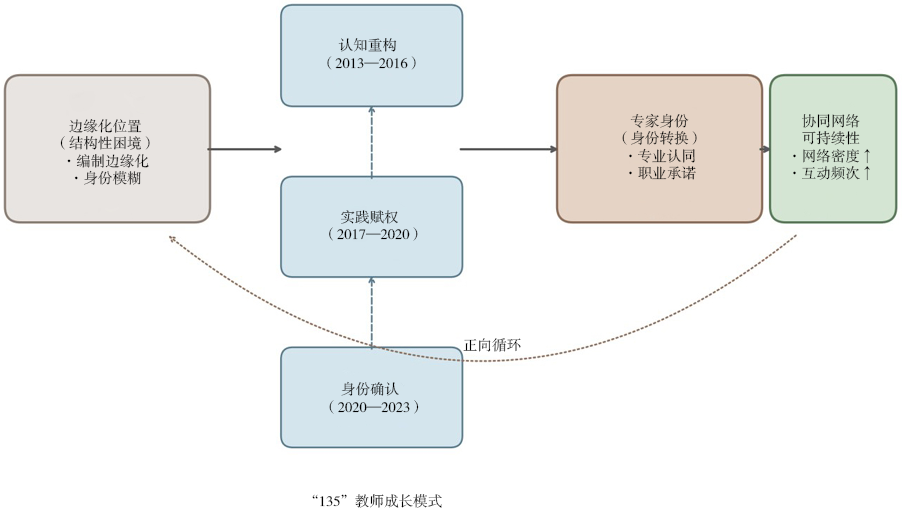
图 1 身份转换驱动的协同可持续性模型
Figure 1 Identity transition-driven collaborative sustainability model
该框架包含以下核心命题:第一,心理健康教育教师的边缘化位置构成协同育人的“瓶颈”;第二,教师通过“认知重构—实践赋权—身份确认”实现专业身份转换;第三,身份转换后的教师成为协同网络的“枢纽节点”,提升网络韧性;第四,教师的身份转换与协同网络的可持续性形成正向循环。
这一框架将分析焦点从“制度设计”转向“行动者能动性”,从“资源投入”转向“身份认同建构”,为理解家校社协同的微观机制提供新视角。
3 研究方法
3.1 研究设计与情境
本研究采用行动研究(Action Research)方法,遵循“计划—行动—观察—反思”的螺旋循环(Kemmis & McTaggart,2005)。研究者(第一作者)作为区域教研员,深度参与了东胜区“全域心育”模式的构建过程。这一“内部人”身份既是优势(深度了解实践细节),也是局限(可能存在选择性观察)。
研究情境为内蒙古自治区鄂尔多斯市东胜区,位于中国北方,属中西部资源型城市。2013年启动心理健康教育改革时,区域面临典型的“资源薄弱”困境:13名专兼职教师分散在45所学校,无专职教研员,无课程体系,无服务网络。
3.2 数据收集
3.2.1 质性资料
(1)深度访谈:对12名教师进行半结构化访谈,涵盖不同教龄(1~15年)、不同角色(专职教师、工作坊坊主、教研员)。访谈聚焦于:选择/留在心理健康教育岗位的动机;描述一次感到“我是专业心理教师”的经历;在协同育人中扮演的角色及变化。
(2)教师反思日志:收集2018—2023年间28名教师的反思日志,总计约15万字。这些日志记录了教师在实践中的困惑、突破和自我认知变化。
(3)田野笔记:研究者在参与教研活动、工作例会、家校活动时的观察记录。
3.2.2 量化资料
(1)教师专业认同量表:采用改编的Teacher Professional Identity Scale(TPIS),在2018年、2021年、2023年三次施测,追踪教师专业认同的变化。
(2)协同网络密度指标:通过社会网络分析(Social Network Analysis),测量2016年、2019年、2023年教师—家长—社区工作者之间的互动频次和连接强度。
3.3 数据分析
质性数据采用主题分析法(Thematic Analysis)(Braun & Clarke,2006)。编码过程由两名研究者独立进行,初始编码后进行对照讨论,不一致处通过协商解决。最终一致性系数Kappa = 0.84。
量化数据采用配对样本t检验比较前后测差异,计算Cohen’s d效应量。
4 研究发现
4.1 边缘化的起点:2013年的结构性困境
4.1.1 “可有可无”的位置
2013年的东胜区心理健康教育处于典型的边缘化状态。
(1)编制边缘化:45所学校仅配备13名专兼职教师,多数为语文、数学等学科教师兼任。一位受访教师回忆:“我当时是语文老师,校长说‘你性格好,去兼一下心理吧’。”
(2)空间边缘化:心理咨询室多设在教学楼角落,面积狭小,常被挪用为储物间或值班室。
(3)时间边缘化:心理课被视为“副科”,随时可能被主科占用。一位教师说:“期中考前一个月,心理课就停了,‘让学生专心复习’。”
(4)评价边缘化:心理教师的工作量难以量化,年终考核时“说不出自己做了什么”。
4.1.2 身份困境的叙事
访谈中,早期进入这一领域的教师普遍经历了身份困惑:
“我不知道自己算什么。说是老师吧,不上主课;说是行政吧,又没那个身份。开会时坐在角落,领导点名都跳过我。”(教师W,2014年入职)
“家长问我‘你是心理医生吗’,我说‘不是’。他们又问我‘你是心理咨询师吗’,我说‘也没有证’。那我是谁?我自己也说不清楚。”(教师L,2015年入职)
这种身份模糊性导致了职业承诺的脆弱性。2013—2016年间,有4名教师申请调离心理健康教育岗位,回归学科教学。他们给出的理由各异,但核心都是“看不到前途”。
4.2 身份转换的三阶路径
东胜区的“135”教师成长模式,实质上是为教师专业身份转换提供了制度化的支撑结构。数据显示,这一过程呈现三阶递进特征。
4.2.1 第一阶段:认知重构(2013—2016)
核心机制:建立“心阳”名师工作室,提供替代性的专业参照系。
工作室的成立并非源于顶层设计,而是源于一次“自救”。2014年,5名心理教师自发组织月度聚会,分享案例、讨论困惑。这一非正式网络逐渐吸引了更多教师,2016年正式挂牌成为“名师工作室”。
关键事件:工作室引入了“专业督导”制度。每月邀请高校专家或资深从业者,对教师的个案概念化、干预方案进行督导。这一制度产生了认知冲击效果:“第一次参加督导,我发现自己连‘个案概念化’是什么都不知道。之前觉得自己就是在‘和学生聊天’,突然意识到这是一门专业。”(教师Z)
督导使教师开始用专业话语重新理解自己的工作。反思日志中,“专业”“系统”“科学”等词汇的出现频率显著增加。
量化结果:2016年TPIS施测显示,教师“专业知识认同”维度得分较2013年显著提升(t(11)= 3.42,p = 0.005,Cohen’s d = 0.98),但“职业承诺”维度无显著变化。这表明认知重构已发生,但尚未转化为稳定的身份认同。
4.2.2 第二阶段:实践赋权(2017—2020)
核心机制:通过工作坊制度,赋予教师真实的专业自主权。
2017年,在工作室基础上成立了三个工作坊:“和雅心灵”(聚焦咨询技术)、“汇心”(聚焦团体辅导)、“一心一剧”(聚焦心理剧)。工作坊采用“坊主负责制”,赋予核心教师课程开发、活动组织、资源调配的自主权。
关键变化:教师从“执行者”转变为“设计者”。
以“汇心”工作坊为例,坊主张敏(化名)带领团队开发了针对初中生的“情绪管理工作坊”系列。她描述了这一过程的赋权体验:
“以前我就是按教材上课,现在我们自己设计活动。当家长反馈说’孩子回家说心理课是本周最期待的课’时,我第一次感到‘这是我的专业价值’。”
实践赋权产生了效能感循环:自主设计→实施反馈→价值确认→投入增加→能力提升。
意外发现:赋权也带来了焦虑。部分教师反映,自主权增加后,感到“责任更大了”“怕做不好被批评”。这种焦虑在缺乏足够支持的初期尤为明显。一位教师在日志中写道:“自己设计课程很兴奋,但也很慌。以前教材错了是教材的问题,现在错了就是我的问题。”
这一发现提示,赋权需要与支持系统同步。2018年后,工作坊建立了“同伴互助”机制,新开发课程需经过小组试讲和反馈,才正式推出。这一调整缓解了赋权焦虑。
量化结果:2019年TPIS施测显示,“职业承诺”(t(28)= 4.12,p < 0.001,d = 0.76)和“专业效能感”(t(28)= 5.23,p < 0.001,d = 0.98)维度均显著提升。
4.2.3 第三阶段:身份确认(2020—2023)
核心机制:通过制度化的角色晋升和外部认可,完成专家身份的合法性建构。
2020年后,“135”模式形成了清晰的进阶路径:研修员→工作坊坊主→理论秘书→学科导师。每一级别对应明确的能力标准和待遇保障。
更关键的是,心理教师开始获得体制内的可见性:2019年起,心理教师纳入区级骨干教师评选体系;2021年,心理教研员首次列席区教育工作会议;2025年,“心阳”工作室被评为“全国先进名师工作室”。
身份确认的叙事:“以前开家长会,班主任介绍我时说‘这是学校的心理老师’,家长点点头,没什么反应。现在班主任会说‘这是区里的心理健康教育专家’,家长马上围上来问问题。这种被认可的感觉,让我确定自己选对了方向。”(教师H,教龄8年)
值得注意的是,身份确认不仅来自外部,也来自内部。一位教师在访谈中说:“现在我能自信地说‘我是专业心理教师’,不是因为评上了什么,而是因为我知道,面对学生的问题,我有办法。这种底气是慢慢积累起来的。”
量化结果:2023年TPIS施测显示,教师专业认同总分较2018年提升42%(t(67)= 6.89,p < 0.001,d = 0.84),且各维度均衡发展,无显著短板。
4.3 身份转换与协同网络的双向建构
4.3.1 从“被动参与者”到“网络枢纽”
数据分析显示,随着教师专业身份转换,他们在协同网络中的位置发生了结构性变化。
社会网络分析结果如图2所示,2016年,教师—家长—社区工作者之间的连接稀疏,教师处于网络边缘;2019年,教师与家长的连接增加,但与社区工作者仍缺乏互动;2023年,教师成为连接学校、家庭、社区的关键节点(hub),网络密度提升3倍。
访谈揭示了这种变化的机制:“以前家长有问题找班主任,班主任再转给我。现在家长直接找我,因为他们知道‘心理老师更专业’。我也敢直接联系社区了,因为我不怕说错话,我知道自己在做什么。”(教师M)
专业身份赋予教师跨越边界的自信和能力。他们不再是被动地“配合”其他部门,而是主动地“协调”多方资源。
4.3.2 协同网络的自我强化效应
身份转换与协同网络形成了正向循环:教师身份确认→在协同网络中更主动→网络效应显现(更多成功案例)→教师价值被认可→身份进一步强化。
一个典型案例是“社区心理服务站”的建设。2019年首批12个服务站建成后,面临“有站无人”的困境。心理教师起初不愿参与,觉得“那不是我的专业范围”。随着专业身份的确立,教师开始主动走进社区,开展家长工作坊、儿童团体辅导。社区工作者反馈:“以前请学校老师来,他们讲的内容过于学术化,居民听不懂。现在这些心理老师不一样,他们能结合我们的实际情况设计活动,居民很买账。”
这种双向认可巩固了协同网络。2023年,社区心理服务站的咨询量较2019年增长400%,成为家校社协同的重要阵地。
5 讨论
5.1 理论贡献:理解协同育人的微观机制
本研究的主要贡献在于揭示了家校社协同育人可持续性的微观基础。既有研究聚焦于宏观结构(政策、资源、制度),而本研究展示了行动者的专业身份认同如何中介了结构性因素与协同成效之间的关系。
这一发现与Luo等(2025)的研究形成了对话。Luo等强调“缺乏中介组织”是协同育人的主要障碍,但未能解释为什么即使建立了协调机构,协作仍难以持续。本研究指出,中介组织的有效性取决于能否为核心参与者提供身份转换的支持。
此外,本研究拓展了教师专业身份形成理论的应用边界。既有研究多关注师范生或新入职教师(Bartle et al.,2025),而本研究聚焦于转岗教师这一特殊群体。他们的身份转换不仅是职业发展问题,更是协同育人网络能否建立的关键。
5.2 实践启示:如何突破边缘化
东胜区的经验为资源薄弱地区提供了可复制的路径,而非可照搬的模式。关键在于把握以下三个机制。
(1)认知重构需要“替代性参照系”。边缘化的根源之一是没有清晰的专业标准。工作室/工作坊制度的核心价值在于,为教师提供了一个替代性的专业社群,使其能够对照专业标准而非行政标准来定义自己。
(2)实践赋权需要“真实的自主权”。形式上的“参与”不等于赋权。真正的赋权意味着教师能够自主决策、承担后果、获得反馈。工作坊制度中“坊主负责制”的设计,正是为了确保自主权的真实性。
(3)身份确认需要“制度化的可见性”。专业能力的提升不等于身份认同的建构。需要通过角色晋升、评选认可、话语空间等制度安排,使教师的专家身份获得体制内的合法性。
5.3 研究局限与未来方向
本研究存在以下局限。
第一,单案例设计的局限性。东胜区的经验是否适用于其他地区,需要多案例比较研究验证。
第二,研究者作为参与者的主观性。虽然采取了编码一致性检验等措施,但“内部人”视角可能带来选择性观察和诠释偏差。
第三,对家长、社区工作者等其他参与者的关注不足。本研究聚焦于教师,但协同育人是多主体互动的结果,其他参与者的身份转换同样值得研究。
未来研究方向包括:在不同区域(城市/农村、东部/西部)开展比较研究,检验身份转换机制的普适性和情境依赖性;对个体教师进行长期追踪,深入理解身份转换的动态过程;运用行动者网络理论(ANT)视角,超越人际互动,关注非人类行动者(如技术平台、政策文本)在协同网络建构中的作用。
6 结论
本研究以东胜区“全域心育”模式为案例,探讨了家校社协同育人可持续性的微观机制。核心发现是:协同育人的关键不在于制度设计,而在于核心参与者——特别是心理健康教育教师——能否实现从边缘人到专家的专业身份转换。
东胜区通过“135”教师成长模式,为教师提供了“认知重构—实践赋权—身份确认”的三阶路径,使教师从被动的政策执行者转变为协同网络的核心节点。这一发现为理解家校社协同的“黑箱”提供了新视角:协同网络的韧性,根植于行动者的身份认同之中。
对于资源薄弱地区而言,这一发现具有实践意义:在无法短期内改变资源约束的条件下,投资于教师的专业身份建构,可能是提升协同育人效能的“杠杆解”。十年实践表明改变结构很难,但改变人是可能的,而人的改变,终将带来结构的改变。
参考文献
[1] Andrew S, Bell E, Hunte A, Oulton J, Topping A & Wibberley C. (2009). Community of practice as a framework for supporting and developing student learning. Learning in Health and Social Care, 8(1), 1-10.
[2] Bartle N. (2025). The Educator Within: A Systematic Review of Professional Identity Formation in Health Professions Education. Journal of Medical Education.
[3] Braun V & Clarke V. (2006). Using thematic analysis in psychology. Qualitative Research in Psychology, 3(2), 77-101.
[4] Chen Y. (2024). Challenges and prospects of integrating mental health education in Chinese schools. China CDC Weekly, 6(29), 615-620.
[5] Freeman A. (2022). Navigating doubt and impostor feelings among early-career educators. Teaching and Teacher Education, 112, 103-115.
[6] Hong J S. (2023). School-based mental health services in rural China: Challenges and opportunities. International Journal of Educational Development, 95, 102736.
[7] Kemmis S & McTaggart R. (2005). Participatory action research. In The Sage handbook of qualitative research (pp. 559-603).
[8] Lave J & Wenger E. (1991). Situated learning: Legitimate peripheral participation. Cambridge University Press.
[9] Luo M, Wang K, Yue Y & Chen C. (2025). Facilitators and Barriers to the Implementation of School Mental Health Collaboration in Sichuan Province, China. Asian Nursing Research.
[10] Meyer J W & Rowan B. (1977). Institutionalized organizations: Formal structure as myth and ceremony. American Journal of Sociology, 83(2), 340-363.
[11] National Center for School Mental Health. (2022). Advancing comprehensive school mental health systems: Guidance from the field. National Center for School Mental Health.
[12] Sheridan S M. (2017). A randomized trial examining the effects of Conjoint Behavioral Consultation. School Psychology Review, 46(3), 267-283.
[13] Triemstra J D. (2021). Recognition and validation in educator identity formation. Academic Medicine, 96(8), 1123-1130.
[14] van Lankveld T. (2016). Communities of practice as a strategy for supporting faculty development. Medical Teacher, 38(8), 826-833.
[15] Vaa Stelling K. (2023). The impostor phenomenon among health professions educators. Advances in Health Sciences Education, 28(2), 445-460.
[16] Weare K & Nind M. (2011). Mental health promotion and problem prevention in schools. Health Promotion International, 26(suppl_1), i29-i69.
[17] 教育部等十七部门. (2023). 全面加强和改进新时代学生心理健康工作专项行动计划(2023—2025年).