Current Views: 31162
 Current Downloads: 20516
Guide to Education Innovation
ISSN Print:2789-0732
ISSN Online:2789-0740
Contact Editorial Office



Subscribe to the latest published information from SCISCAN
From Scenarios to Solutions: A Development Path for Philosophy and Social Sciences Laboratories in Industry-Characteristic Universities under the “Dual Carbon” Goals


-
Information:
1. School of Economics and Management, China University of Geosciences, Beijing, Beijing;
2. MOE Social Science Laboratory of Mineral Resources Security Governance, China University of Geosciences, Beijing, Beijing;
3. School of Foreign Languages, China University of Geosciences, Beijing, Beijing
-
Keywords:
“Dual carbon” goals; Philosophy and Social Sciences Laboratories; Industry-education integration; Data governance; Scenario-Driven
- Abstract: Against the macro-background of the “dual carbon” goals, the energy revolution, and digital transformation, universities with dominant disciplines in geology, mining, and petroleum (hereafter “industrycharacteristic universities”) must not only respond to national strategic demands for energy resource security and green, low-carbon transition but also address multiple challenges such as updating talent cultivation paradigms, fostering industrial chain collaborative innovation, and modernizing university governance. The Philosophy and Social Sciences Laboratories should address forward-looking, comprehensive, and complex issues in economic and social development, rely on data resources and information technology, promote interdisciplinary collaboration, and form a high-quality innovation platform integrating teaching, research, and policy consultation. However, industry-characteristic universities still face significant bottlenecks, including a mismatch between investment and reputation structures, high costs in organizing practical teaching, weak interdisciplinary collaboration, and insufficient data asset governance capabilities. Based on theories of organized research and industry-education integration, this paper constructs a development path model termed “Scenario-Driven — Data Foundation — Collaborative Education — Transformation” (SDCT model). It reveals how the “dual carbon” goals, digital and intelligent technologies, and green governance needs influence the evolution of philosophy and social sciences laboratories through the mechanism of “problem scenario-based — data asset-based — organization platform-based — outcome product-based”. Furthermore, it proposes a phased development roadmap, governance structure, and evaluation system. The study argues that the key to achieving high-quality, sustainable, and assessable development for these laboratories in industry-characteristic universities lies in: using real and complex industry carbon governance scenarios as the driving force; establishing authoritative data and toolchains as core assets; adopting multi-stakeholder collaboration among universities, government, and enterprises as the organizational mode; and utilizing policy advisory, standard tools, and talent supply as transformation outputs. This paper provides an explanatory framework and policy recommendations from the perspective of educational governance and organizational innovation for “industry-education integration-driven green education innovation and the energy technology industry”.
- DOI: 10.35534/gei.0601004
- Cite: Jiang, Y., Lei, Y. L., & Sun, T. T. (2026). From Scenarios to Solutions: A Development Path for Philosophy and Social Sciences Laboratories in Industry-Characteristic Universities under the “Dual Carbon” Goals. Guide to Education Innovation, 6(1), 28-41.
1 Introduction
The convergence of global carbon neutrality imperatives, profound energy system transitions, and pervasive digital transformation presents a formidable yet pivotal challenge for higher education institutions worldwide. For universities with traditional strengths in geology, mining, and petroleum (GMP sectors), this triad of forces demands a fundamental re-evaluation of their societal role and operational paradigm. Their mandate has expanded beyond the established mission of securing energy resources and providing technological expertise; it now critically encompasses leading the complex socio-technical transition towards a green, low-carbon future. This systemic shift involves multidimensional issues — from industrial restructuring and regional development pathways to corporate governance innovation and societal behavioral change. Challenges such as balancing mineral extraction with ecological preservation, managing carbon assets in oil and gas corporations, and aligning carbon market mechanisms with regional policies are inherently interdisciplinary, context-dependent, data-intensive, and policy-sensitive. However, the long-standing engineering-technology-application competency model prevalent in these industry-characteristic universities proves inadequate for addressing problems that require coupled technology-economics-policy-society designs. Consequently, there is an urgent need to transform talent cultivation from a focus on singular technical skills towards fostering composite capabilities in carbon accounting, policy evaluation, and risk governance.
Within this context, the Philosophy and Social Sciences Laboratory (PSSL) emerges as a strategic institutional innovation with transformative potential. It is no longer a conventional “humanities lab” but evolves into a data-driven, scenario-oriented, and collaboratively-organized critical platform. Its purpose is to drive industry governance reform and policy innovation, signifying a profound evolution in how universities respond to grand national strategic demands. This transformation is further reinforced by explicit policy guidance, such as China’s Measures for the Construction and Management of Philosophy and Social Sciences Laboratories (Trial). These policies reposition PSSLs as interdisciplinary innovation platforms tasked with addressing forward-looking and complex societal issues. They emphasize the integration of data resources and information technology, advocating for a synthesis of teaching, research, and policy advisory functions. This shift essentially propels academic research in philosophy and social sciences from a project-based logic — centered on scattered topics and paper output — towards a platform-based logic focused on sustained capacity building and systematic knowledge supply.
Nevertheless, a significant tension exists between this policy vision and the on-the-ground reality for industry-characteristic universities. The development of PSSLs is hampered by multiple structural bottlenecks, including a misalignment between investment and reputation structures, prohibitively high costs for accessing authentic practical teaching scenarios, superficial “potluck-style” interdisciplinary collaboration, deficient data asset governance capabilities, and fractured pathways for translating research into impact. These constraints severely limit the potential comparative advantages these universities hold, such as their deep-rooted industry connections and access to niche operational data. Therefore, this study aims to construct a systematic framework to diagnose these challenges and guide the high-quality development of PSSLs within industry-characteristic universities under the “Dual Carbon” agenda.
2 Literature Review
The concept of the Philosophy and Social Sciences Laboratory (PSSL) represents a significant evolution within the humanities and social sciences, marking a departure from traditionally solitary, text-based scholarship towards more empirical, collaborative, and experimental modes of inquiry. Existing literature primarily elucidates the conceptual foundation and pedagogical value of such laboratories. Scholars define PSSLs as interdisciplinary frameworks designed to foster innovative research, enhance teaching methodologies, and tackle complex societal challenges by creating collaborative environments where philosophical inquiry converges with social science methods (Rempala et al., 2021; Barefield, 2023; Petrovich & Viola, 2024). This model addresses the limitations of traditional educational settings, which often lack dedicated spaces for the experimental and applied aspects of social science and philosophical education (Mentari, 2021). The core utility of PSSLs is seen in their ability to move beyond pure academic pursuit, serving as vital infrastructure for skill development. For instance, they are posited as crucial for prospective social science teachers to improve pedagogical skills and manage learning environments effectively (Purwanto, 2024), and for students to engage in active learning and critical development of material through experimentation (Mentari, 2021).
Building on this conceptual groundwork, a second stream of research delves into the operational models, methodological innovations, and diverse manifestations of PSSLs. The literature documents various incarnations, such as Philosophy Labs that bridge pedagogy and research through group collaboration (Rempala et al., 2021), and Social Labs that serve as methods for participatory research and responsible innovation (Marschalek et al., 2022). These labs often employ experiential learning cycles and design-thinking approaches to facilitate engagement (Castillo & Carrasco, 2022; Marschalek et al., 2022). Specialized laboratories like the LAPEF (Busacchi, 2022) or LABELS (Děchtěrenko, 2021) demonstrate deep interdisciplinary fusion — between philosophy, psychoanalysis, and psychiatry, or between linguistics and cognitive science — highlighting a commitment to holistic understanding. Furthermore, the model extends to “Public and Social Innovation Laboratories” and “Citizen Laboratories”, which function as collaborative ecosystems for ideating and testing solutions to real-world social and urban governance problems (Benavides, 2024; Gutiérrez et al., 2023). This body of work illustrates the adaptability of the laboratory model to various research foci, from behavioral economics (Vranka, 2021) to digital competence in social education (Gutiérrez-Pequeño et al., 2022).
A third, more integrative line of inquiry examines the broader rationale and impact of this “new humanities turn”. Scholars argue that PSSLs are essential for cultivating critical thinking, strengthening interdisciplinary connections, and developing practical solutions to contemporary challenges (Barefield, 2023). Their relevance is heightened in an era where scientific endeavors are increasingly scrutinized for their social responsibility (Sikora, 2022), and where fields like life sciences are actively seeking insights from social sciences to navigate public controversies (Zhou et al., 2024). The establishment of PSSLs in vocational colleges has also been proposed as a countermeasure to weak research awareness and low research levels in philosophy and social sciences within those institutions (Jing, 2022). Collectively, this literature portrays PSSLs as transformative infrastructures that integrate philosophical rigor with social scientific empiricism, enabling a more comprehensive and engaged form of knowledge production.
Despite this growing body of work, significant gaps remain, particularly in contextualizing PSSLs within specific, urgent macro-strategic frameworks and tailored institutional settings. First, existing literature offers broad models and case studies but lacks a coherent and actionable developmental pathway for establishing and sustaining PSSLs, especially in resource-constrained or traditionally technical-university environments. Second, while the importance of interdisciplinarity and real-world engagement is emphasized, there is insufficient exploration of the precise mechanisms — such as data governance, industry-education fusion, and product-oriented transformation — that can systematically translate academic activity into tangible policy, industrial, and educational impact. Third, little scholarly attention has been paid to the unique opportunities and acute challenges facing industry-characteristic universities — particularly in carbon-intensive sectors like geology, mining, and petroleum — in leveraging their niche assets (e.g., industry scenarios, proprietary data) to build influential PSSLs aligned with global sustainability goals like the “Dual Carbon” targets.
This study aims to address these gaps by developing a targeted, integrated framework. Based on the current status, pain points, and emerging challenges within industry-characteristic universities under the “Dual Carbon” agenda, this research constructs and theoretically grounds the “Scenario-Driven, Data-Foundation, Collaborative Education, Transformation” development model to elucidate its evolutionary mechanism, and subsequently proposes a concrete, actionable implementation pathway comprising a phased construction roadmap, a collaborative governance framework, and a multidimensional evaluation system.
3 Current Status of PSSL Development, Pain Points, and New Challenges
3.1 The General Trend of PSSL Development
In recent years, the landscape of philosophy and social sciences in higher education has undergone a profound paradigm shift, evolving from traditional, library-based textual research toward a modern, tripartite model characterized by Data-Platform-Policy. This transformation is first evidenced by the digitalization and democratization of research methodologies; while qualitative analysis and case studies remain foundational, data-driven inquiries — leveraging big data, artificial intelligence, and computational social science — have become mainstream tools for exploring complex socio-economic phenomena. By mining massive datasets, researchers can bridge the gap between macro-level descriptions and micro-level insights, shifting from historical explanation to predictive modeling, thereby enhancing the scientific rigor and reproducibility of the social sciences. Furthermore, the organizational structure of these disciplines is moving toward “platformization” and collaborative “Big Science” models. To address national strategic imperatives that cross-cut traditional disciplinary boundaries, the old model of solitary scholars or fragmented departments is being replaced by integrated laboratory platforms. These entities emphasize stable team building, long-term task commitment, and the continuous accumulation of data assets, mimicking the infrastructure of the natural sciences to improve collective efficiency. Finally, the value proposition of social science research has expanded beyond academic publications; the efficacy of a laboratory is now increasingly measured by its policy impact — its ability to produce high-quality consultancy reports, industry standards, and knowledge products that directly serve national decision-making and local governance. This shift represents a transition from a project-based logic to a platform-based logic, where the goal is to build a new disciplinary infrastructure capable of responding to the urgent demands of the “Dual Carbon” era.
3.2 Typical Pain Points of Industry-Characteristic Universities
A systemic imbalance between investment structures and academic reputation frameworks severely hinders the formation of stable platform-based capabilities within industry-characteristic laboratories. In these institutions, resource allocation logic has historically revolved around engineering and technical disciplines, creating a closed loop of investment and output centered on major infrastructure projects, patent commercialization, and high-value industrial contracts. Within this environment, philosophy and social science laboratories are often perceived as soft supplements rather than essential infrastructure for strategic transition, leading to unstable and short-term funding patterns. Essential long-term costs — such as database maintenance, specialized tool development, and data procurement — often lack dedicated budget lines and must rely on competitive, short-term research grants, forcing laboratories into a reactive cycle of “seeking data for projects” rather than “building capacity through data”. Furthermore, the lack of institutional authority for lab directors makes it difficult to coordinate resources across different colleges, resulting in a failure to establish unified task scheduling or shared output mechanisms. Most critically, the academic “reputation economy” remains misaligned; existing evaluation systems prioritize traditional SCI/SSCI journals, while the lab’s most valuable outputs — such as policy briefs, industry standards, or decision-support tools — are often undervalued in tenure and promotion reviews. This misalignment creates a “high effort, low reward” environment, dampening internal motivation and leaving the laboratory’s foundation for sustainable development structurally fragile.
High costs associated with practical teaching and stringent barriers to entry for industrial scenarios lead to superficial industry-education integration and a failure of collaborative talent cultivation. The core operational scenarios of the “mining, geology, and petroleum” sectors — such as remote oil fields, high-risk mining sites, and complex chemical parks — possess extremely high safety thresholds, professional requirements, and geographic dispersion. For faculty and students, entering these sites involves lengthy approval processes and safety training, which represents a low return on investment for short-term internships, often placing an undue burden of supervision and risk on the host enterprises. Beyond physical access, the sensitivity of data sharing presents a fundamental obstacle; core industrial process data, supply chain information, and government energy emissions inventories are often classified as trade secrets or matters of national security. In the absence of a high-trust legal and technical framework for data governance, enterprises are frequently unwilling and unable to share the very data that would make social science research impactful. This disconnect creates a dual-trac dilemma where internships become mere observational tours, and classroom case studies rely on outdated secondary data, completely detached from the dynamic realities of the industry. Consequently, the training of composite governance talent occurs in a vacuum, resulting in a significant gap between student skill sets and actual industry needs, as high transaction costs prevent the formation of a deep, institutionalized collaborative education model.
Interdisciplinary collaboration in these labs often falls into the trap of patchwork integration, failing to achieve a qualitative chemical fusion due to the lack of overarching common tasks and compatible incentive mechanisms. While the primary goal of the PSSL is to dismantle the barriers between technology, economics, policy, and society, the reality is that engineering and social science disciplines operate under deeply divergent paradigms, goals, and output forms. Engineers focus on technical parameters and project delivery, producing patents and technical packages, while social scientists focus on institutions, behaviors, and values, producing papers and policy reports. When collaborating on “Dual Carbon” issues without a meta-problem to unify these disparate concerns, the collaboration often devolves into a mere joint meeting where individual reports are compiled rather than integrated into a comprehensive governance solution. This centrifugal force is exacerbated by university incentive systems; engineering faculty are rewarded for SCI publications and large-scale technical funding, while social science faculty prioritize SSCI journals and high-level political citations. Integrated products, such as policy simulation tools or industry green standards, may carry little weight in the formal evaluation of either side. Without a defined common task group that holds recognized value within the existing evaluation hierarchy, cross-disciplinary efforts remain temporary alliances or voluntary favors, preventing the emergence of a stable academic community capable of accumulating incremental, integrated knowledge.
3.3 New Challenges for PSSL Development
As the work towards carbon goals moves into the tougher, more challenging phase, the focus of research must shift from project-based emission reduction to the systemic reconstruction of the socio-technical landscape. The initial phase of carbon neutrality, focused on top-level design and discrete energy-saving projects, has evolved into a period of systemic challenge where carbon markets, green finance, and climate investment tools must synergize with mandatory “Dual Control” policies and supply chain transparency requirements. For enterprises, the challenge is no longer a simple technical choice but a complex system of strategic planning, financial management, and legal compliance; for local governments, the requirement is to balance economic growth with energy security and social equity. This shift demands that philosophy and social science laboratories move beyond macro-level trend analysis toward providing computable policy evaluations and operable governance tools. Researchers must now be capable of quantifying the cost impact of different carbon quota allocation schemes on diverse industrial sectors and simulating the ripple effects of green finance on technological innovation. The systemic, quantitative, and dynamic nature of these problems requires labs to enhance their predictive modeling and engineering capabilities, transforming academic insights into robust products that can withstand the complexities of real-world policy implementation.
The acceleration of digitalization and intelligence has made data-intensive governance the new norm, requiring laboratories to integrate advanced algorithmic capabilities with traditional social science rigor. The pervasive wave of technologies such as the Internet of Things (IoT), Big Data, and Generative AI (AIGC) is reshaping the form of “Dual Carbon” governance by enabling real-time emission monitoring, life-cycle carbon footprint tracking, and automated ESG data verification. These technologies offer PSSLs unprecedented opportunities for efficiency gains, allowing for the rapid synthesis of policy literature and the automation of multi-scenario simulations. However, this technological empowerment also introduces profound challenges; researchers must now possess data engineering skills and the ability to navigate complex machine-learning frameworks, moving beyond theoretical modeling to understand data pipelines and algorithmic biases. Moreover, the deep application of AI introduces ethical and governance risks, such as the interpretability of black box policy recommendations and the necessity of ensuring academic integrity in automated analysis. Laboratories must therefore establish a “Technology Governance” framework to ensure that digital tools enhance, rather than undermine, the scientific validity and social responsibility of their research, avoiding the trap of “Technological Determinism” while embracing the digital frontier.
Rising compliance and security constraints have placed data governance at the strategic forefront, making data safety a prerequisite for the survival and credibility of social science laboratories. In the sensitive sectors of geology, mining, and oil, data is not only a commercial asset but a matter of national energy security and public safety. With the implementation of stringent legal frameworks — such as the Data Security Law and the Personal Information Protection Law — the boundaries for data sharing and cross-border flow have become clearly defined and strictly enforced. For PSSLs, obtaining research data through industry-education integration is no longer just a matter of institutional “Willingness”, but a complex legal hurdle involving data classification, security assessments, and minimal necessity principles. Without a professional compliance team and a robust system for data desensitization and auditing, laboratories will find it impossible to build the necessary trust with government and corporate partners. The inability to manage these risks not only prevents the acquisition of high-value data but also exposes the institution to significant legal liabilities. Therefore, modern laboratories must internalize a culture of security by design, ensuring that every stage of the data life cycle — from collection to publication — is legally sound, thereby creating a secure foundation for sustainable cooperation and data-driven innovation.
4 Evolutionary Mechanism Analysis
4.1 Theoretical Foundations
The construction and evolution of PSSLs under the “Dual Carbon” framework are rooted in the convergence of organized research and industry-education integration. Organized research provides the internal structural logic, distinguishing these laboratories from traditional, fragmented humanities research models characterized by individual scholar interests. Traditional social science often operates as a handicraft workshop, which is insufficient for addressing the system-of-systems challenges posed by carbon neutrality — a problem set involving energy systems, economic structures, and legal frameworks. Organized research instead emphasizes a task-oriented, team-based, and platform-centric approach. Its essence lies in upgrading knowledge production into a modern production line, establishing common problem frameworks, standardized data protocols, and iterative output cycles. For PSSLs, this signifies a paradigm shift from speculative analysis toward a computable, experimental, and verifiable research mode that utilizes data-driven simulations and policy intervention assessments to address national strategic goals.
Complementing this internal structure, industry-education integration serves as the laboratory’s circulatory system, anchoring its external relationships and value realization channels. Table 1 shows the S-D-C-T Component. In the context of industry-characteristic universities, this integration transcends simple internship placements, evolving into a model of synergistic governance. It requires universities, government bodies, and industrial giants to dismantle organizational silos and form strategic innovation communities focused on specific carbon governance dilemmas, such as carbon accounting or green supply chain management. Within this “Triple Helix” framework, the industry provides real-world scenarios and raw data, the government offers policy demand and institutional interfaces, and the laboratory acts as the central hub that translates industrial pain points into scientific inquiries. This interaction ensures that the laboratory’s research agenda remains tethered to the pulse of the era, producing solutions that possess high practical feasibility and direct policy relevance.
Table 1 The S-D-C-T Component
|
Component |
Driving Mechanism |
Evolutionary Logic: From Platform to Ecosystem |
Target Outcome |
|
S: Scenario Traction |
Problematization & Anchor |
Shifts from academic topic-seeking to Industrial Taskization. It transforms macro “Dual Carbon” goals into specific, high-stakes industrial bottlenecks (e.g., methane leaks) |
Scenario-Problem Fit: High-relevance research tasks |
|
D: Database |
Assetization & Intelligence |
Evolves from a passive database to a “Digital Engine”. It focuses on the standardization of heterogeneous data and the automation of toolchains for predictive modeling |
Data Productivity: Verifiable, data-driven insights |
|
C: Collaborative Education |
Competency & Trust |
Moves from guest lectures to a “Competency Production Line”. It institutionalizes the dual-mentor system to create a steady flow of talent back into the industry ecosystem |
Talent Synergy: “Combat-ready” green governance professionals |
|
T: Result Transformation |
Productization & Feedback |
Transcends paper publishing into “Value Exit” creation. It builds a “Pilot-Iteration-Diffusion” loop where academic theory is hardened into industry standards and software |
Social/Market Value: Influence spillover and resource backflow |
4.2 The S-D-C-T Development Path Model
The Scenario Traction (S) serves as the logical starting point of the model, transforming grand “Dual Carbon” strategies into concrete, operable task clusters within specific industrial contexts. Given the vast and often abstract nature of carbon peak and neutrality goals, the core mechanism of scenario traction is problematization — anchoring national strategies to the real-world complexities of the geology, mining, and oil industries. These scenarios, such as ecological compensation in mining life cycles or methane leakage monitoring in oil fields, represent high-stakes real-world slices where technology, economics, and policy collide. The focal effect of a scenario acts as a gravitational field for interdisciplinary talent; it forces researchers to move from discipline-oriented to problem-oriented work, significantly lowering the communication barriers between engineers and social scientists. Moreover, by aligning research with the specific pain points of enterprises and the regulatory concerns of the government, scenario traction ensures data accessibility. It defines the ultimate users of the lab’s output, preventing research from becoming disconnected from practice.
The Database (D) constitutes the core strategic asset and sustainable competitive advantage of the laboratory, evolving from mere supplementary material into the primary means of production. In the digital era, building a database involves more than just assembling a database; it is a systematic engineering feat encompassing high-quality resource integration, standardized governance, and intelligent toolchains. This asset’s value is derived not from static possession but from dynamic data capacity — the ability to continuously harvest, clean, and fuse multi-source heterogeneous data, ranging from micro-level corporate emissions to macro-level regional energy statistics. This platform empowers researchers to conduct quantitative “War Games” for policy evaluation, elevating traditional social science to the level of computational social science. Crucially, the database serves as a carrier of knowledge capital that remains within the institution regardless of staff turnover, allowing the laboratory to transition from a project-based respondent to a platform-based provider of industry-wide knowledge infrastructure.
Collaborative Education (C) functions as the competency production line, bridging the gap between scientific innovation and social demand through a knowledge-action integration mechanism. The pedagogical mission of the PSSL is not a secondary supplement to classroom learning but a core mechanism to institutionalize the fruits of industry-education integration. By constructing a competency community involving universities, government, and enterprises, the laboratory injects real-world industrial problems and data into the curriculum, producing combat-ready graduates who understand both social science methodology and industrial logic. This process involves project-based curriculum restructuring and the dual-mentor system, where students tackle real tasks — such as designing a carbon-peaking roadmap for an industrial park — under the guidance of both academic and industry experts. This model solves the fundamental contradiction between theory and practice, creating a reciprocal cycle where enterprises gain early access to high-quality talent and laboratories gain the reputation and industrial feedback necessary for long-term sustainability.
Result Transformation (T) represents the final mile of the laboratory’s value chain, creating diversified value exits that drive a self-reinforcing loop of sustainable development. Unlike traditional humanities research focused solely on publications, the transformation mechanism for PSSLs must be product-oriented, encompassing policy products, standardized tools, and talent supply. The core logic here is that the lab’s value is measured by its capacity to change the world rather than just interpret it; therefore, outcomes must undergo small-scale testing in real industrial scenarios before wider promotion. For instance, a new carbon sink accounting method must be piloted at a cooperative mine site to be refined into an industry standard. Successful transformation creates a feedback effect: adopted policy briefs enhance decision-making influence, widely used software tools build technical branding, and sought-after talent programs strengthen alumni networks. These outcomes attract new resources and talent, propelling the S-D-C-T model into a spiraling, self-enhancing trajectory of growth and institutional prestige. The S-D-C-T Development Path Model is shown in Figure 1.
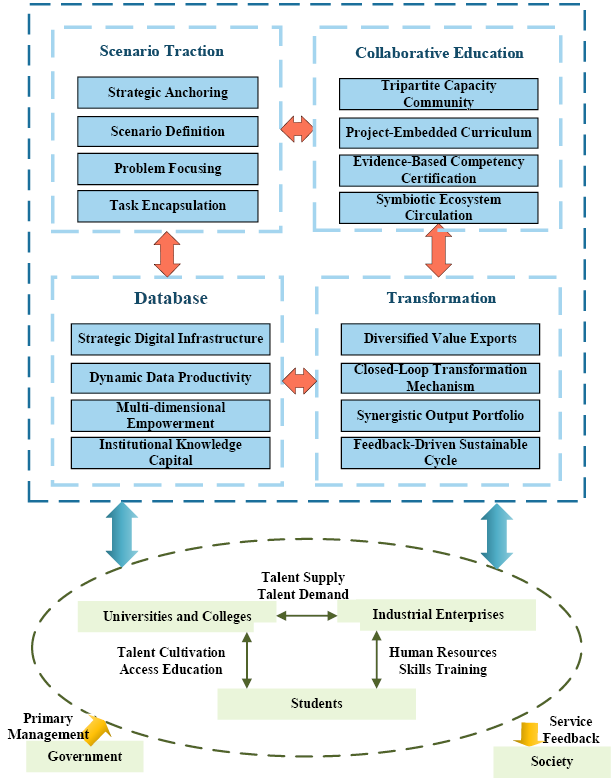
Figure 1 S-D-C-T Development Path Model
4.3 Influencing Factors and Action Paths
The institutional pressure and demand pull generated by national “Dual Carbon” goals constitute the fundamental strategic driver for the laboratory’s evolution. China’s commitment to carbon neutrality is not merely a technical target but a systemic socio-economic transformation that exerts rigid top-down pressure on local governments and market actors through policy frameworks like the “1+N” system. This pressure translates into an urgent demand for green governance knowledge and composite talent, effectively activating the core components of the S-D-C-T model. Specifically, it defines the Scenarios (S) that require investigation, creates the massive Data (D) requirements for MRV (Monitoring, Reporting, Verification) systems, and mandates new Competencies (C) for the workforce. Consequently, the “Dual Carbon” strategy acts as a directional flow that both dictates the laboratory’s strategic orientation and provides the necessary momentum for its Transformation (T) into the policy and market arenas.
Furthermore, the fusion of digital and intelligent technologies provides a revolutionary methodological empowerment that reshapes the laboratory’s research paradigm. Technologies such as the Internet of Things (IoT), Big Data, and AI have fundamentally altered the experimental nature of the social sciences by providing high-granularity data and powerful analytical engines. These technologies enable the modeling of non-linear, dynamic, and complex systems, shifting research from static description to predictive simulation and intervention experiments. The action path of this technological driver is twofold: It directly enhances the Database (D) through automated collection and AI-driven cleaning, and it expands the boundaries of Scenarios (S) by introducing new research topics, such as algorithmic fairness in carbon quota allocation. However, this empowerment necessitates the internalization of technological governance within the laboratory to manage risks associated with data security and algorithmic bias, ensuring that the embrace of digital dividends does not compromise the scientific integrity of the institution.
4.4 Evolutionary Stages
The development of PSSLs in industry-characteristic universities is a gradual process of capacity building, moving from an initial startup phase to a mature ecosystem. In the first phase — the “Issue Focusing and Scenario Locking” stage — the goal is to achieve a “0 to 1” validation of the model. During this period, the laboratory must refine a small number of core industrial scenarios based on its disciplinary strengths and establish deep pilot partnerships with benchmark enterprises. Success in this stage is not defined by the scale of output but by the ability to complete a full “Scenario-Data-Research-Output” loop, demonstrating the micro-level feasibility of the S-D-C-T model and building the initial credibility and knowledge assets required for future expansion.
As the laboratory enters the “Systematization and Model Consolidation” phase, the focus shifts toward a “1 to N” scaling and institutionalization. Here, the Database (D) is transformed from fragmented data points into a robust infrastructure with standardized governance and sustainable update mechanisms, while Collaborative Education (C) becomes a standardized production line of talent with a stable network of mentors and practice bases. Finally, in the “Impact Spillover and Ecosystem Construction” phase, the laboratory transcends its role as a service provider to become a rule advocate and a hub for industrial innovation. Its outputs evolve into industry-wide standards and white papers, and its role becomes that of a central node connecting government, industry, academia, and finance. At this terminal stage of evolution, the laboratory is deeply embedded in the national carbon governance system, functioning as a sustainable innovation micro-ecosystem whose influence extends far beyond the university itself.
5 Implementation Pathways of PSSL
5.1 Constructing a Cross-Organizational Ecosystem and “Industry-Education Community”
Constructing an integrated cross-organizational ecosystem and a robust “Industry-Education Community” is essential to dismantle high scenario entry barriers and the current patchwork fragmentation of interdisciplinary efforts. This path operationalizes Scenario Traction (S) by establishing a formal “Strategic Governance Board” comprising university leaders, industrial executives, and policy experts who define a shared meta-problem framework. By aligning the laboratory’s research agenda with the high-stakes operational realities of mining and energy enterprises, the laboratory transforms isolated departmental projects into a unified “Industry-Education Community”. This ecosystem approach provides a stable, low-friction channel for researchers and students to access sensitive industrial sites and real-world datasets, effectively solving the separation between engineering practice and social science inquiry through a shared mission of systemic carbon reconstruction.
5.2 Cultivating a “Digital-Green” Synergy Culture and Intelligent Data Infrastructure
Fostering a dual-synergy culture of digitalization and greening within an intelligent platform framework serves as the fundamental engineering required to build a high-performance Database (D). This implementation path addresses the pain point of weak data governance by internalizing a security-by-design ethos, where digital proficiency and environmental stewardship are fused into the laboratory’s organizational DNA. By developing a standardized data lifecycle management system — encompassing automated collection via IoT, AI-driven cleaning, and blockchain-based audit trails — the laboratory converts raw scattered ore data into refined, computable assets. This intelligent infrastructure allows the PSSL to move beyond descriptive analysis toward predictive modeling, ensuring that the laboratory possesses the digital engine necessary to simulate the complex socio-technical interactions of the “Dual Carbon” transition with scientific rigor.
5.3 Developing Multi-Level and Multi-Dimensional Digital Learning Systems
Developing a multi-level and multi-dimensional digitalized learning system is critical for institutionalizing Collaborative Education (C) and bridging the gap between theoretical knowledge and industrial demand. This path targets the high costs of practical teaching by utilizing Virtual Reality (VR) and Digital Twin technology to create immersive Simulated Industrial Scenarios, allowing for large-scale talent cultivation without the safety risks or geographic constraints of oil fields or mines. The learning system is designed as a competency production line that serves multiple dimensions: from project-based undergraduate modules to executive-level Green Governance certifications. By integrating real-time data from the Database (D) into these learning modules, the laboratory ensures that students are not merely learning static theories but are engaging in active, evidence-based problem solving, thereby producing a steady stream of combat-ready talent for the green economy.
5.4 Strengthening Ecosystem Partnerships and Expanding Edge-Area Innovation
Strengthening synergistic collaboration among platform ecosystem partners and expanding into edge-area innovations are the primary drivers for achieving Transformation (T) and securing sustainable value spillover. This implementation path addresses the short transformation chain by establishing a dedicated “Transformation & Productization Office” that actively manages the transition from academic insight to deployable product. By collaborating with ecosystem partners — such as green finance institutions and carbon auditing firms — the laboratory can explore edge innovations where philosophy, ethics, and digital technology intersect, such as “Algorithmic Justice in Carbon Quota Allocation” or “ESG Ethical Auditing Tools”. This product-oriented approach ensures that the lab’s outputs are not limited to papers but are embedded in the software, standards, and policy workflows of the industry, creating a self-reinforcing loop where commercial and social success refuels the laboratory’s research and reputation. Implementation Path is shown in Table 2.
Table 2 Implementation Path
|
Implementation Path |
Year 1: Startup & Anchoring |
Year 2: Growth & Systematization |
Year 3: Maturity & Ecosystem Hub |
|
1. Cross-Organizational Ecosystem (S) |
Establish a Strategic Governance Board; finalize 3 priority “Dual Carbon” industrial scenarios |
Sign formal “Strategic Innovation Community” agreements with 5 + industry giants and local gov |
Act as a Lead Node in national carbon governance networks; host a global industry-education summit |
|
2. Digital-Green Synergy Infrastructure (D) |
Launch the “Three Databases” project; implement basic data security and ethical review protocols |
Integrate AI-driven analysis toolchains; achieve “Data Assetization” for 80% of internal datasets |
Establish a Digital Twin Industry Lab; provide open-access “Governance-as-a-Service” (GaaS) platforms |
|
3. Multi-Dimensional Learning Systems (C) |
Launch 2 Project-Based Learning (PBL) pilot courses with dual-mentors from energy firms |
Roll out VR/Digital Twin simulated scenarios; establish a Green Governance micro-credential system |
Scale to a National Talent Cradle; 90% of graduates placed in strategic ESG / Carbon management roles |
|
4. Ecosystem Partnerships & Edge Innovation (T) |
Establish a Productization Office; publish the first “Industry Carbon Transition” Bluebook |
Release 2 Prototype Tools (e.g., ESG Auditing software) for small-scale pilot testing |
Drive Industry Standard-Setting; generate self-sustaining revenue through IP and professional certifications |
6 Conclusion and Policy Recommendations
6.1 Conclusion
This study systematically addresses the construction challenges of Philosophy and Social Science Laboratories (PSSL) in industry-characteristic universities under the “Dual Carbon” strategic framework, proposing and validating the Scenario-Data-Collaboration-Transformation (S-D-C-T) development model. The core findings suggest that Scenario Traction (S) serves as the indispensable logical anchor, transforming abstract national strategies into concrete industrial task clusters that effectively reduce interdisciplinary friction. Simultaneously, the Database(D) functions as the laboratory’s core strategic asset; in the digital age, a laboratory’s competitiveness is defined by its capacity for standardized data governance and integrated toolchain maintenance rather than the sheer volume of isolated research projects.
Furthermore, the research concludes that Collaborative Education (C) acts as a low-friction mechanism for deepening industry-education integration, converting high-cost industrial practices into reproducible talent production lines. This is complemented by a Result Transformation (T) loop that ensures social value through the productization of academic insights into policy briefs, industry standards, and professional tools. Ultimately, a modern governance framework characterized by multi-stakeholder decision-making and strict data compliance is the fundamental guarantee for systemic stability. By integrating these four pillars, industry-characteristic universities can successfully transition from traditional textual research to a platform-based logic, becoming vital nodes in the national carbon governance ecosystem.
6.2 Policy Recommendations
Universities must reposition Philosophy and Social Science Laboratories as governance infrastructure and radically overhaul internal evaluation systems to incentivize interdisciplinary, task-oriented outputs. Institutional leaders should integrate PSSLs into “Dual Carbon” key engineering initiatives, providing stable funding and professional technical positions — such as data engineers and product managers — commensurate with engineering platforms. To dismantle the mosaic style of collaboration, universities must prioritize the creation of substantive cross-disciplinary teams focused on scenario task clusters. Most importantly, the academic reputation economy needs a structural shift: high-quality datasets, software copyrights, and policy adoption evidence must be weighted equally with traditional SCI/SSCI publications in tenure and promotion tracks. Establishing a university-level data and model governance committee is also essential to enforce strict safety, compliance, and algorithmic ethics standards.
Government agencies and industrial actors should facilitate “Data Openness” and “Scenario Supply”, transforming laboratories into critical experimental grounds for public policy and industrial green transition. Government departments should spearhead the creation of unified carbon governance data interfaces, on the premise of ensuring national energy security, providing laboratories with regulated access to energy, economic, and emission statistics to lower research barriers. Policymakers should actively include qualified laboratories in pilot projects, such as zero-carbon industrial parks or carbon market simulations, to provide policy laboratories for real-world testing. On the industry side, enterprises should move from short-term project contracts to long-term strategic alliances, providing available standardized data and dispatching technical experts as dual mentors. This creates a low-carbon governance external brain that allows enterprises to reflect on their management practices while pre-training a pipeline of “Combat-ready” talent.
Educational authorities and management bodies must establish a platform-based evaluation paradigm that prioritizes systemic capacity, process quality, and diverse social impact over fragmented metrics. It is urgent to advocate for comprehensive evaluation frameworks, such as the Input-Process-Output-Impact (IPOI) model, which explicitly recognizes the value of decision-support reports, data products, and industry standards. Evaluation criteria should provide clear weighting for contributions to national and provincial policy-making or the drafting of industry-wide technical specifications. Furthermore, management departments should encourage the formation of inter-institutional and cross-regional laboratory networks. By supporting joint initiatives between industry-characteristic universities, comprehensive research institutes, and financial stakeholders, authorities can facilitate the complementarity of scenarios, data, and methods, ultimately constructing a robust philosophical and social science experimental system that serves the global sustainable development agenda.
Acknowledgments
The authors express their sincere thanks to the people who provided language help, writing assistance or proofreading the article.
References
[1] Rempala, K., Sifferd, K., & Vukov, J. (2021). Philosophy labs. Teaching Philosophy, 44(2), 187−206.
[2] Barefield, T. (2023). Emergence Studios: Bringing collaboration and iteration into the social sciences. International Journal of Lifelong Education, 42(2), 165−176.
[3] Busacchi, V. (2023). The LAPEF: An interdisciplinary laboratory of research. Natureza Humana, 25(1), 105−120.
[4] Purwanto, I. (2024). Desain laboratorium pembelajaran IPS pada program studi tadris IPS. Sosio-Didaktika: Social Science Education Journal, 10(2), 157−170.
[5] Mentari, N. (2021). The use of laboratory social studies as a learning resource in junior high school. International Journal Pedagogy of Social Studies, 6(2), 71−80.
[6] Marschalek, I., Blok, V., Bernstein, M., Braun, R., Cohen, J., Hofer, M., ... & Kumar Thapa, R. (2022). The social lab as a method for experimental engagement in participatory research. Journal of Responsible Innovation, 9(3), 419−442.
[7] Jing, C. (2022). Current research in philosophy and social science, and countermeasures in vocational colleges. In HCII 2022: Human-computer interaction (pp. 13−20). Springer.
[8] Gutiérrez-Pequeño, J. M., Anguita-Martínez, R., & Pradena-García, Y. P. (2022). Social media labs in the social education degree: Exploring digital competences of university students. Education Sciences, 13(1), 20.
[9] Zhou, H., Sun, B., Guns, R., Engels, T. C. E., Huang, Y., & Zhang, L. (2024). How do life sciences cite social sciences? Characterizing the volume and trajectory of citations. Journal of the Association for Information Science and Technology, 75(11), 1304−1319.
[10] Petrovich, E., & Viola, M. (2024). Mapping the philosophy and neuroscience nexus through citation analysis. European Journal for Philosophy of Science, 14(4).
[11] Vranka, M. (2021). Experimentální laboratoř PLESS. E-Psychologie, 15(4), 101.
[12] Děchtěrenko, F. (2021). LABELS: Laboratoř behaviorálních a lingvistických studií. E-Psychologie, 15(4), 102−103.
[13] Sikora, M. (2022). Problem of social responsibility of laboratory sciences. Ruch Filozoficzny, 77(4), 133−151.