Current Views: 32709
 Current Downloads: 21744
Guide to Education Innovation
ISSN Print:2789-0732
ISSN Online:2789-0740
Contact Editorial Office



Subscribe to the latest published information from SCISCAN
Empowering the Dimension Formula of Quotient Spaces Through Knowledge Rediscovery: Teaching Design and Multi-Scenario Application Practice


- Information:
-
Keywords:
Knowledge rediscovery; Quotient space; Dimension formula; Teaching design of advanced algebra; Core competencies
- Abstract: The dimension formula of quotient spaces is a core proposition in advanced algebra that describes the structure of vector spaces and the correlation between subspaces. Its high abstraction and rigorous logic often lead students to a learning misunderstanding of “mechanically memorizing formulas and blindly applying question types”, making it difficult for them to grasp the generative logic and application value of the formula. The concept of “knowledge rediscovery” emphasizes guiding students to revisit the trajectory of knowledge construction as “quasi-researchers” through a progressive process of “problem-driven guidance – concrete instantiation – conjecture and deduction – rigorous proof – multi-dimensional application”, which precisely adapts to the teaching characteristics of the dimension formula of quotient spaces. Based on this concept, this paper reconstructs the teaching framework of the dimension formula of quotient spaces: starting from the geometric intuition of Euclidean space, it guides students to independently analyze the essence of equivalence classes of quotient spaces, completes the strict proof of the formula through basis extension and conjecture of dimensional relationships, and then designs application tasks combining multiple scenarios such as the derivation of the dimension formula for the sum of subspaces and the verification of the rank-nullity theorem of linear transformations. The research aims to help students break through the learning barriers of abstract knowledge, deepen their essential understanding of the structure of vector spaces, and cultivate core competencies such as algebraic abstraction, logical reasoning, and knowledge transfer. Meanwhile, it provides a new practical path and theoretical reference for the teaching innovation of abstract formula modules in advanced algebra.
- DOI: 10.35534/gei.0601007
- Cite: Wang, Q. W (2026). Empowering the Dimension Formula of Quotient Spaces Through Knowledge Rediscovery: Teaching Design and Multi-Scenario Application Practice. Guide to Education Innovation, 6(1), 76-85.
1 Introduction
As a foundational course for mathematics majors in institutions of higher education, advanced algebra not only undertakes the mission of imparting linear mathematical tools but also shoulders the core task of cultivating students’ abstract thinking and logical reasoning abilities. As a high-level abstract module in the operation system of linear subspaces, the quotient space is a key link connecting the decomposition of vector spaces, the theory of linear transformations, and invariant subspaces of matrices, while the dimension formula of quotient spaces is a core tool for revealing the structural characteristics of quotient spaces. Behind its concise form lie profound algebraic ideas and geometric connotations.
The traditional teaching mode of the dimension formula of quotient spaces mostly adopts a linear process of “definition indoctrination – formula derivation – example imitation”. Teachers directly present the definition of equivalence classes and the dimension formula of quotient spaces, and then complete the proof through pure algebraic reasoning. Students are always in a passive receiving state, making it difficult for them to understand core questions such as “why quotient spaces exist” “why the dimensional relationship follows a subtraction rule”, and “what essential problems the formula can solve”. At the same time, the teaching process neglects the generative context of knowledge and the support of geometric intuition, isolating the formula from the entire knowledge system of advanced algebra. This leads to the fragmentation of students’ knowledge mastery, failure to integrate it with subspace operations, linear transformations, and other content, and difficulty in flexible knowledge transfer in subsequent applications.
Proposed by the author based on long-term teaching practice, the concept of “knowledge rediscovery” abandons the cramming teaching method and guides students to simulate the historical generative process of knowledge, conduct independent inquiry, conjecture and verification, and abstract construction under the drive of problems, thus realizing the identity transformation from “knowledge consumers” to “knowledge constructors” (Wang, 2026a). This concept emphasizes the teaching orientation of “process activation – content reconstruction – competency cultivation”, focuses on the relevance and inquiry of knowledge, and is highly consistent with the abstract and logical characteristics of the dimension formula of quotient spaces, providing a new idea for solving the predicament of traditional teaching.
Based on the concept of “knowledge rediscovery” (Wang, 2026b), this paper focuses on the teaching design and application innovation of the dimension formula of quotient spaces, restores the generative and developmental trajectory of the formula starting from specific geometric examples, and constructs a teaching process of “intuitive perception – conjecture and deduction – rigorous proof – multi-dimensional application”. It emphatically strengthens the innovative application of the formula in proving the dimension formula for the sum of subspaces, helps students deeply understand the essence and value of the formula, and provides practical reference for the teaching reform of abstract formula modules in advanced algebra.
2 Core Essentials and Teaching Adaptability of the Concept of Knowledge Rediscovery
2.1 Core Essentials
With the fundamental purpose of cultivating students’ innovative ability and the core path of “restoring the trajectory of knowledge generation”, the concept of “knowledge rediscovery” constructs a complete teaching chain of “problem-driven guidance – concrete instantiation – conjecture and deduction – rigorous proof – multi-dimensional application – reflection and sublimation”. Its core essentials can be summarized in three dimensions: in terms of teaching philosophy, it adheres to “student-centered and teacher-guided”, breaks the traditional pattern of “teachers lecture and students listen”, and highlights students’ subjectivity in inquiry; in terms of teaching process, it restores the generative process of knowledge from concrete to abstract, from intuitive to rigorous, and from scattered to systematic, enabling students to grasp the origin and internal correlation of knowledge through independent inquiry; in terms of teaching objectives, it realizes the trinity of “knowledge mastery – competency cultivation – thinking improvement”, which not only enables students to acquire core formulas and application skills but also focuses on cultivating their scientific inquiry thinking, algebraic abstraction ability, and logical reasoning ability, meeting the requirements of talent cultivation in basic disciplines in the new era (Wang et al., 2026).
2.2 Teaching Adaptability
The abstraction and logic of the dimension formula of quotient spaces determine that its teaching must break through the limitations of “mechanical memory and passive application”, and the application of the concept of “knowledge rediscovery” exactly meets this demand with significant teaching adaptability. First, it facilitates the understanding of essence: by restoring the generative process of the dimension formula, it guides students to independently explore the internal logic of dimensional relationships, avoids mechanical memory, and achieves an in-depth understanding of the formula. Second, it cultivates core competencies: in the whole process of inquiry, conjecture, proof, and application, students’ algebraic abstract thinking, logical reasoning ability, and equivalent transformation ability are systematically exercised, which is in line with the competency cultivation objectives of mathematics education in the new era. Third, it constructs a knowledge network: it guides students to associate the dimension formula of quotient spaces with the intersection and sum operations of subspaces, the theory of linear transformations, and other knowledge, forming a complete knowledge system of “vector space structure – subspace operations – linear transformations”. Fourth, it breaks down abstract barriers: with the help of geometric examples in Euclidean space, it transforms the abstract concept of quotient spaces and dimensional relationships into intuitive and perceptible geometric phenomena, effectively reducing the difficulty of understanding abstract knowledge.
3 Teaching Design Criteria for the Dimension Formula of Quotient Spaces Under the Guidance of Knowledge Rediscovery
Based on the core essentials of the concept of “knowledge rediscovery”, combined with the knowledge characteristics (abstraction, logic, relevance) of the dimension formula of quotient spaces and students’ cognitive laws (intuitive perception – concrete inquiry – conjecture and deduction – rigorous proof – application and transfer), the following five major teaching design criteria are constructed to provide clear guidance for teaching implementation.
3.1 Anchoring Criterion of Prerequisite Knowledge
Closely connect with the prerequisite knowledge that students have mastered, such as the definition of linear subspaces, basis and dimension, equivalence relations, and intersection and sum operations of subspaces. Design gradient inquiry questions starting from known knowledge, lower the threshold of inquiry, and lay a solid foundation for the exploration of quotient spaces.
3.2 Progressive Guidance Criterion of Problems
Follow the cognitive logic of “concrete examples – superficial inquiry – in-depth conjecture – rigorous proof – application expansion”, design a progressive question chain, and guide students to gradually break through the key and difficult points of teaching from “observation of geometric phenomena” to “conjecture of algebraic relationships” and then to “strict logical argumentation”.
3.3 Integration Criterion of Intuition and Abstraction
Taking the three-dimensional Euclidean space  as the carrier, transform the equivalence classes of quotient spaces into intuitive geometric figures such as straight lines and planes to help students establish perceptual cognition; then gradually guide students to rise from intuitive examples to abstract concepts, realizing the cognitive leap of “intuitive perception – abstract generalization”.
3.4 Equal Emphasis Criterion of Conjecture and Verification
Encourage students to boldly put forward conjectures about the dimensional relationship of quotient spaces based on specific examples and existing knowledge, and then improve the conjectures through logical reasoning, counterexample verification, or example corroboration, cultivating students’ scientific inquiry spirit and rigor.
3.5 Penetration Criterion of Competency Objectives
Integrate the cultivation of core mathematical competencies into the whole teaching process, clarify the orientation of competency cultivation in each teaching link, and realize the organic unity of “knowledge transfer – competency cultivation – thinking improvement” through inquiry tasks, thinking training, and application practice.
4 Teaching Implementation Process of the Dimension Formula of Quotient Spaces Under the Guidance of Knowledge Rediscovery
Based on the core links of the concept of “knowledge rediscovery”, this section takes the three-dimensional Euclidean space  as the intuitive carrier and the “exploration of the dimensional relationship of quotient spaces” as the core task, and carries out teaching in six links to guide students to independently complete the exploration of the essence of quotient spaces and the construction of the dimension formula. Each link follows the knowledge rediscovery logic of “problem-driven guidance – independent inquiry – verification and sublimation”.
4.1 Activation of Prerequisite Knowledge: Laying a Solid Foundation for Inquiry
Before exploring quotient spaces, students are first guided to systematically review four core pieces of prerequisite knowledge to pave the way for subsequent inquiry: the definition and judgment criteria of linear subspaces; the basis and dimension dim of the vector space
 ; the definition and properties of equivalence relations, with special attention to the fact that equivalence relations can partition a set into disjoint equivalence classes; the definition and basic characteristics of the sum of subspaces.
Inquiry leading question: Let  (three-dimensional Euclidean space) and
  be a two-dimensional subspace of
  (e.g., the
  plane). Can we reasonably classify all vectors in
  through
 ? What structural characteristics does the new set formed after classification have? What is the relationship between its dimension and the dimensions of
  and
and ? Can this relationship provide a new idea for us to prove the learned dimension formula for the sum of subspaces? With these questions, we start the exploration of the dimension formula of quotient spaces.
4.2 Concrete Instantiation and Inquiry: Perceiving the Essence of Quotient Spaces
This link guides students to intuitively perceive the characteristics of equivalence classes of quotient spaces through specific examples in three-dimensional Euclidean space, establish perceptual cognition of quotient spaces, and lay a foundation for the subsequent conjecture of dimensional relationships.
4.2.1 Problem Proposal
Let  and
and  (the
(the  plane,
 ), and define a relation
  on
on : for any
 ,
,
 . Does this relation satisfy the definition of an equivalence relation? If so, what geometric form does its equivalence class
  have?
have?
4.2.2 Independent Inquiry and Verification
Students are guided to independently complete the verification of the equivalence relation:
(1) Reflexivity: For any ,
,  , so
, so , satisfying reflexivity;
(2) Symmetry: If , then
 , and
, and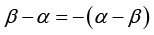 . Since
  is a subspace,
  , so
, so , satisfying symmetry;
(3) Transitivity: If  and
and , then
  and
and , so
, so , that is,
  , satisfying transitivity;
Further analyze the geometric characteristics of the equivalence class: Take any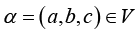 , then
  .This set is a straight line passing through the point
 and parallel to the
  plane. Through observation, students can find that all equivalence classes are straight lines parallel to
 ; these straight lines are disjoint and completely cover the entire three-dimensional space, thus intuitively perceiving that the quotient space
 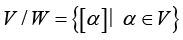 is a set composed of these parallel straight lines.
4.2.3 Expanded Inquiry
Change the dimension of the subspace : let
: let  be a one-dimensional subspace of
  (e.g., the
  -axis,
 ),
),
and guide students to independently analyze the geometric characteristics of the equivalence class . At this time,
  is a plane passing through the point
 and parallel to the
  -axis, and the quotient space
  is a set composed of these parallel planes.
4.3 Conjecture and Deduction: Exploring Dimensional Relationships
Based on the results of instantiation and inquiry, this link guides students to boldly conjecture the dimensional relationship of quotient spaces and verify the rationality of the conjecture through multi-scenario examples to strengthen the cognition of dimensional laws.
4.3.1 Problem Guidance
Combined with the above two types of examples,  (
( ). When
  is a two-dimensional subspace (
 ), the quotient space
  is composed of parallel straight lines; how should its dimension be defined? When
  is a one-dimensional subspace (
 ), the quotient space
  is composed of parallel planes; what is its dimension? Based on the above situations, is there a universal law between the dimension of the quotient space
  and the dimensions of the original space
  and the subspace
 ?
?
4.3.2 Conjecture Proposal
Based on geometric intuition and example analysis, students independently put forward the conjecture: the dimension of the quotient space is equal to the dimension of the original space minus the dimension of the subspace, that is, .
.
4.3.3 Multi-Example Verification
Example 1: Let  (plane,
 ) and
) and  be a one-dimensional subspace of
  (straight line,
 ). The quotient space
  is composed of straight lines parallel to
 , which is obviously a one-dimensional vector space, and
 , consistent with the conjecture.
Example 2: Let  (
( ) and
) and  be a three-dimensional subspace of
  (
( ). The quotient space
  is composed of straight lines parallel to
 , which is a one-dimensional vector space, and
 , in line with the conjecture.
Example 3: Let  be an
be an  -dimensional vector space over a number field
  and
and  (zero subspace,
 ). Then each equivalence class in
  contains only one element, so
  is isomorphic to
 , and
, and , verifying the validity of the conjecture.
Example 4: Let  be an
be an  -dimensional vector space over a number field
  and
and  (the space itself as a subspace,
 ). Then
  contains only one equivalence class (i.e.,
  itself), so
 , consistent with the conjecture.
Through the verification of multi-scenario examples, students further confirm the rationality of the conjecture and accumulate sufficient perceptual cognition and logical support for the subsequent abstract proof.
4.4 Abstract Construction: Rigorously Proving the Dimension Formula
This link guides students to rise from specific examples to the abstract level and complete the strict proof of the dimension formula of quotient spaces through basis extension and equivalence class analysis, realizing the cognitive advancement of “intuitive perception – abstract argumentation”.
4.4.1 Problem Proposal
Let  be an
be an  -dimensional vector space over a number field
  and
and  be an
be an  -dimensional subspace of
 . How to strictly prove
 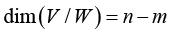 from the algebraic perspective?
4.4.2 Step-by-Step Proof and Inquiry
Students are guided to complete the proof in three steps, with an emphasis on independent inquiry and logical reasoning in each step.
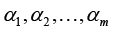
(1) Construction of basis extension: Since  is an
is an  -dimensional subspace of
 , there exists a basis
  of
of . According to the basis extension theorem of vector spaces, this basis can be extended to a basis
 of
of , which is the key premise of the proof.
(2) Proof of generators: For any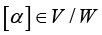 ,
,  can be expressed as
 . Since
  then
then , that is,
  can be linearly represented by
 . Therefore, this set is a generator set of
 .
.
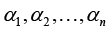
(3) Proof of linear independence: Let  (where
  is the zero element of
 , i.e.,
 ), then
 . Since
  is a basis of
  and linearly independent, then
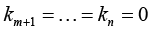 . Therefore,
  is linearly independent.
Combining the above three steps,  is a basis of
 , and the number of vectors it contains is
 . Thus,
  , and the dimension formula of quotient spaces is proved.
4.5 Deconstruction of the Formula’s Essence: Connecting Algebra and Geometry
This link guides students to deeply analyze the algebraic essence and geometric meaning of the dimension formula of quotient spaces, avoiding staying only on the surface of the formula and realizing an in-depth understanding of knowledge.
4.5.1 Algebraic Essence
The essence of the quotient space  is a vector space constructed with “classes” as new elements by classifying elements in
  that “differ by a vector in
 ” through an equivalence relation. The dimension formula essentially reflects the internal law of “the dimension of the original space minus the ‘thickness’ of the equivalence class (i.e., the dimension of the subspace
 )” and is an in-depth depiction of the structure of vector spaces.
4.5.2 Geometric Meaning
In the Euclidean space , the dimension formula of quotient spaces presents a clear geometric intuition — the geometric dimension of the original space minus the geometric dimension of the subspace is the geometric dimension of the quotient space, reflecting the idea of “dimensionality reduction and abstraction”: for example, the quotient space corresponding to a two-dimensional subspace in
  is one-dimensional (a space composed of straight lines), and the quotient space corresponding to a one-dimensional subspace is two-dimensional (a space composed of planes).
4.6 Multi-Dimensional Application Practice: Deepening the Cognition of Formula Value
This link designs multi-level and multi-scenario application tasks, guides students to deeply integrate the dimension formula of quotient spaces with the knowledge system of advanced algebra, emphatically strengthens the application of the formula in proving the dimension formula for the sum of subspaces, deepens the cognition of the formula’s value, and improves the ability of knowledge transfer.
4.6.1 Basic Application: Direct Calculation of the Dimension of Quotient Spaces
Example 1: Let  and
and  (
( ), find
 .
.
Analysis: Apply the dimension formula of quotient spaces directly: . The geometric meaning is that
  is a one-dimensional vector space composed of all straight lines parallel to
 , which is isomorphic to
 .
.
4.6.2 Core Application: Proving the Dimension Formula for the Sum of Subspaces
Example 2: Let  be two finite-dimensional linear subspaces of a vector space
  over a number field
 , prove that
  (the dimension formula for the sum of subspaces).
Analysis: Construct a new proof path with the help of the dimension formula of quotient spaces and guide students to conduct independent inquiry.
(1) Construction of Auxiliary Structure
Since  is a subspace of
 , consider the quotient space
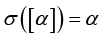
 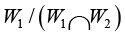 and construct a linear transformation
 ,
,
where 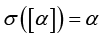 (
( ), that is,
  maps the equivalence class
  in the quotient space to the element
  in
in .
.
(2) Verification of Transformation Properties
Injectivity: If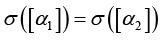 , then
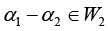 . Moreover,
 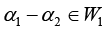 , so
, so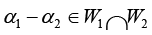 , that is,
 . Therefore,
  is injective.
Surjectivity: For any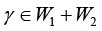 , there exist
  and
and  such that
 . Then
 , and
, and
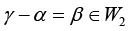 , that is,
  can be obtained by combining the image of
  with the elements of
 . Combined with the arbitrariness of
 ,
,  is surjective.
(3) Deduction of Dimensional Relationships
Since  is an isomorphism, we know that
 . Combined with the dimension formula of quotient spaces,
 .
.
In addition, since  and
and , and
, and , then
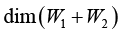 =
=
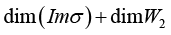 . Combining the above formulas, we have
 . Rearranging gives
 .
.
4.6.3 Expanded Application: Verifying the Rank-Nullity Theorem of Linear Transformations
Example 3: Let be a linear transformation of vector spaces over a number field
 ,
,  (kernel space) be a subspace of
 , and
, and (image space) be a subspace of
 . Prove that
  (the rank-nullity theorem).
Analysis: Guide students to construct a linear transformation , where
 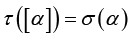 (
( ). First, verify that
  is well-defined (independent of the choice of representative elements of the equivalence class), then prove that
  is an isomorphism. Thus,
 . Combined with the dimension formula of quotient spaces,
 . Therefore,
 .
.
4.6.4 Advanced Application: Supporting the Direct Sum Decomposition of Vector Spaces
Example 4: Let  be linear subspaces of
 , and
, and 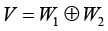 (direct sum). Prove that
 .
.
Analysis: From the properties of direct sum, we know that  and
and . According to the dimension formula of quotient spaces,
 . Substituting the dimensional relationship of the direct sum, we obtain
 . This conclusion reveals the internal correlation between quotient spaces and direct sum decomposition.
Inquiry Thinking Question: Let 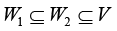 be a vector space chain over a number field
 . Try to use the dimension formula of quotient spaces to prove that
 , so as to further deepen the understanding and application of the formula.
5 Teaching Implementation Effects and Reflection
5.1 Teaching Implementation Effects
The teaching of the dimension formula of quotient spaces based on the concept of “knowledge rediscovery” has completely broken the limitations of traditional teaching and achieved remarkable results in teaching practice.
(1) Knowledge mastery has evolved from “mechanical memory” to “in-depth understanding”: Students no longer memorize formulas by rote but can independently restore the generative process of the formula, understand its algebraic essence and geometric meaning, and even deduce the formula independently and use it to prove relevant conclusions.
(2) Core competencies have been systematically cultivated: In the whole process of inquiry, conjecture, proof, and application, students’ algebraic abstract thinking, logical reasoning ability, equivalent transformation ability, and innovative thinking have been fully exercised, forming a rigorous mathematical thinking habit.
(3) The knowledge system has been integrated: Students can deeply associate the dimension formula of quotient spaces with subspace operations, linear transformations, vector space decomposition, and other knowledge, construct a systematic knowledge network of advanced algebra, and their knowledge transfer ability has been significantly improved.
(4) Learning initiative has been fully stimulated: The problem-driven inquiry mode, intuitive geometric examples, and diverse application scenarios have effectively stimulated students’ learning interest. Students have transformed from “passive listening” to “active inquiry”, and their classroom participation and depth of thinking have been significantly improved.
5.2 Teaching Reflection and Optimization Directions
In teaching practice, some problems that need continuous improvement have also been found, providing directions for subsequent teaching improvement.
(1) The inquiry rhythm needs to be accurately controlled: Due to differences in students’ abstract thinking levels, some students with weak foundations are prone to thinking stagnation in the links of abstract proof of the formula and derivation of the dimension formula for the sum of subspaces. In subsequent teaching, hierarchical inquiry tasks should be designed, providing more intuitive guidance and step-by-step disassembly for students with weak foundations, and setting extended inquiry content for students with spare capacity.
(2) The teaching duration needs to be reasonably allocated: Teaching guided by “knowledge rediscovery” focuses on process inquiry and takes a relatively long time, especially the formula proof and core application links, which require sufficient time. In subsequent teaching, the teaching links should be optimized, and non-core content should be streamlined to ensure that the inquiry process is sufficient and the teaching progress is controllable.
(3) Application cases need to be tailored to professional needs: In subsequent teaching, more targeted application cases can be designed according to the characteristics of different majors (such as graphic transformation in computer science, quantum state space decomposition in physics, and linear programming models in economics), enabling students to more intuitively feel the application value of the formula and improve the practical application ability of knowledge.
6 Conclusion
As a core abstract formula in advanced algebra, the teaching of the dimension formula of quotient spaces is not only a process of knowledge transfer but also a key carrier for cultivating students’ core mathematical competencies. By restoring the generative trajectory of the formula and guiding students to conduct independent inquiry, the concept of “knowledge rediscovery” effectively breaks the teaching barriers of abstract knowledge, enabling students to understand the essence of the formula, construct the knowledge system, and cultivate thinking abilities in the process of “simulating scientific research”, and provides an effective solution for solving the predicament of traditional teaching.
Based on the concept of “knowledge rediscovery”, this paper completes the teaching design and application innovation of the dimension formula of quotient spaces, constructs a teaching process of “intuitive perception – conjecture and deduction – rigorous proof – multi-dimensional application”, emphatically strengthens the innovative application of the formula in proving the dimension formula for the sum of subspaces, and clarifies the teaching criteria, implementation paths, and theoretical support. The effectiveness and rationality of the concept have been verified through teaching practice. In subsequent teaching, it is necessary to continuously optimize the teaching process, accurately control the inquiry rhythm, enrich application cases adapted to different majors, and realize teaching students in accordance with their aptitude, so that the concept of “knowledge rediscovery” can be fully implemented in the teaching of advanced algebra, helping students break through the bottleneck of learning abstract knowledge, improve the learning effect of advanced algebra, and lay a solid foundation for subsequent mathematics learning and professional research. At the same time, the teaching ideas of this study can also provide reference for the teaching reform of other abstract formula modules in advanced algebra (such as the matrix eigenvalue formula and the determinant expansion formula), promoting the in-depth transformation of advanced algebra teaching from “knowledge imparting” to “competency cultivation”.
References
[1] Wang, Q. W. (2026a). Construction and practice of the training paradigm for innovative talents in college mathematics based on knowledge rediscovery. College Mathematics, 42(1), 21−26.
[2] Wang, Q. W. (2026b). Knowledge rediscovery is driving a new paradigm of higher-level education in the linear algebra course. College Mathematics, in press.
[3] Wang, Q. W., He, Z. H., & Zhang, Y. (2026). A new proof of the inertia theorem for symmetric matrices from the perspective of knowledge rediscovery. Pure and Applied Mathematics, 2026(1).