Current Views: 2549907
 Current Downloads: 1587507
Psychology of China
ISSN Print:2664-1798
ISSN Online:2664-1801
Contact Editorial Office



Subscribe to the latest published information from SCISCAN
情绪表达与抑制对主观体验的阶段性影响
Stage-specific Effects of Emotional Expression and Suppression on Subjective Experience


-
Information:
苏州大学教育学院,苏州
-
Keywords:
Emotional expression; Expressive suppression; Subjective experience情绪表达; 表达抑制; 主观体验
- Abstract: This study induced negative emotions using video stimuli and implemented emotion regulation at two distinct time points: during the emotion induction phase and the emotion recovery phase. It aimed to examine the effects of emotional expression and expressive suppression on subjective experience across different regulatory stages. The results showed that emotional expression was more beneficial during the emotion induction phase, facilitating emotional release and allowing individuals to express and externalize their emotions naturally. In contrast, expressive suppression was more effective during the emotion recovery phase, helping to reduce negative emotional experience and promote emotional recovery. 本研究通过负性视频诱发情绪,并通过在情绪诱发阶段或在情绪恢复阶段两个时间进行情绪调节,探讨在不同的调节阶段,情绪表达与表达抑制对主观体验的影响。研究发现,情绪表达更有利于情绪诱发阶段的情绪释放,使个体能够自然表达和外化情绪;而表达抑制在情绪恢复阶段更有助于降低负性情绪体验,促进情绪状态的恢复。
- DOI: 10.35534/pc.0804081
- Cite: 闫艳, 杨双, 宁宁. (2026). 情绪表达与抑制对主观体验的阶段性影响. 中国心理学前沿, 8 (4), 527-533.
1 引言
负性情绪,如愤怒、悲伤和恐惧,是人们日常生活中不可避免的情绪体验。当这些负性情绪持续存在且缺乏有效调节时,会增加个体罹患情绪障碍的风险(Mennin et al.,2007;Nolen-Hoeksema et al.,2008)。在众多处理负性情绪的方法中,两种相互对立的方法经常被提到,即情绪表达和表达抑制。人们普遍认为情绪表达会让负性情绪在当前事件中集中爆发,但能够缓解个体的压力;而表达抑制能够阻碍个体对当下情绪事件的进一步加工,达到稳定情绪的目的。深入探讨情绪表达和表达抑制对主观体验的影响,将有助于合理使用这两种情绪调节技术。
情绪表达是指个体将内部情绪状态通过面部表情、语音语调、身体姿态或行为反应等方式表现出来,它强调情绪的积极展现和充分流露(Gross,2015;Ekman & Friesen,1975)。情绪表达的操作形式主要包括:通过语言命名当下情绪体验的情绪标记或情感标签(Lieberman,2007);或通过面部表情或身体姿势对情绪进行自然、夸大或受控的外显表达。从机制上看,这些表达方式的共同作用基础在于,将原本模糊、未分化的内感受信号转化为可被识别和处理的符号化输出(Ionescu et al.,2025)。大量心理健康领域与临床实践的研究一致表明,情绪表达有助于缓解负性情绪、减轻压力并促进心理恢复(Frattaroli,2006;Gross,2015;Lepore & Smyth,2002;Pennebaker,1997)。相应的干预手段,如表达性写作、暴露疗法和情感宣泄治疗,已被广泛应用于创伤后应激障碍、焦虑症与抑郁症的治疗中(Foa et al.,2007)。例如,Pennebaker 等人的研究发现,对创伤事件进行表达性书写能够改善个体的身心健康状况并增强免疫功能(Pennebaker & Beall,1986;Pennebaker & Seagal,1999)。
与情绪表达相反,表达抑制(Expressive Suppression)要求个体隐藏、减少或抑制情绪表达行为(Gross & Levenson,1993;Gross & John,2003)。有研究者提出,表达抑制是一种非适应性情绪调节策略,它虽然能够保证个体顺利处理当下事件,但会对后续生活产生负面影响,如:负性情绪体验增加以及抑郁和焦虑障碍风险升高(Gross & John,2003;Moore et al.,2008),压力水平升高、生活满意度降低(Haga et al.,2009)。更重要的是,尽管表达抑制能够有效减少负面情绪行为,但对内在情绪体验和生理反应的调节较弱,甚至可能伴随更高的生理唤醒水平(Richards & Gross,1999;Butler et al.,2003)但也有研究表明,抑制能在特定时间窗口内调节生理与情感状态。表达抑制在刺激呈现7.5秒后能有效降低心率及皮肤电导水平,促进机体恢复生理平衡(Trentini & Dan-Glauser,2023)。
因此,本研究分别针对情绪诱发的不同时间进行情绪表达或抑制,考察这两种情绪调节方式在不同阶段对主观体验的影响。我们推测情绪表达与表达抑制由于调节方式的不同,对主观体验的影响存在于不同的阶段。情绪表达作为一种强烈情绪释放手段,可能会更有利于情绪诱发阶段的情绪释放。相反,表达抑制作为一种抑制手段,可能更有利于情绪恢复。
2 实验一:情绪诱发阶段的情绪表达与抑制对主观体验的影响
2.1 被试
使用G*Power 3.1,事前功效分析表明,样本量为19名参与者足以在显著性水平α=0.05、检验效能1-β=0.80的情况下,检测出中等效应量(f=0.25)。为应对可能出现的脱落情况,我们通过海报广告招募了28名参与者。参与者的年龄范围为19至25岁(M=20.9,SD=2.2),其中女性13名,男性15名。所有参与者均为右利手,听力正常,视力正常或经矫正后达到正常水平,没有精神和脑神经病史。本实验程序已获苏州大学人体伦理委员会批准,实验结束后,向所有参与者提供了简短的情绪恢复指导,并告知如有需要可联系学校心理健康服务中心。所有参与者均签署了书面知情同意书,并因其参与研究获得了现金报酬。
2.2 实验材料
(1)情绪诱导视频
情绪刺激包括一段名为“如何给新电脑分区”的中性视频片段,以及两段负面视频片段——《唐山大地震》和《素媛》。每段视频时长均为180秒。为验证这些视频的有效性,30名未参与主实验的大学生使用自我评估表情量表(SAM)对每段视频进行了效价和唤醒度评分,评分采用9级量表,其中效价从1(“最愉悦”)到9(“最悲伤”),唤醒度从1(“非常平静”)到9(“非常强烈”)。评分结果证实,中性视频片段(“如何给新电脑分区”)所引发的效价和唤醒度得分接近量表的中点水平(效价:5.03±0.70;唤醒度:2.40±0.50)。相比之下,两段负面视频片段均被评定为极度不愉快。(《唐山大地震》:效价2.33±0.66,唤醒度6.43±0.97;《素媛》:效价2.47±0.73,唤醒度6.97±0.73)且显著比中性片段唤醒度更高(ps<0.001)。这两段负面片段在效价和唤醒度上均无显著差异(ps > 0.05),证实它们引发的负面情绪状态强度相当。
(2)自我报告情绪评定量表
情绪体验采用一种自评情绪量表进行评估,该量表改编自情绪调节研究中常用的电影诱导范式(Gross & Levenson,1995)。根据日常生活中常见的情绪类别,选取了六个负面情绪词(愤怒、恐惧、悲伤、厌恶、紧张和痛苦)以及两个积极情绪词(快乐和兴趣)。参与者使用五级李克特量表对每种情绪的强度进行评分,量表范围从1(“非常轻微或根本没有”)到5(“非常强烈”)。
2.3 实验程序
该实验采用被试内设计。参与者在隔音室内单独接受测试,坐姿距离电脑显示器约70厘米。每个参与者在三种条件下完成了情绪调节任务:基线条件(Emotion Neutral,EN)、情绪表达条件(Emotion Display,ED)和表达抑制条件(Expressive Suppression,ES)。所有参与者首先完成EN条件,该条件用作基线。随后,参与者被随机分配,先完成ED条件或ES条件。ED与ES条件的顺序,以及影片片段与各调节条件的对应关系,在不同参与者之间进行了平衡设计。每种条件之间设置了30分钟的休息时间,以帮助参与者恢复情绪。
在每种条件下,首先会播放一段视频片段。视频播放期间,每30秒,屏幕右上角就会出现一个红色三角形,提示参与者按照特定条件的指示进行操作。在EN条件下,参与者被要求专心观看视频,并监测自己的理解程度,无需做出任何外部反应。在ED条件下,参与者被要求关注自己的情绪反应;如果他们感受到负面情绪,就需要用力挤压手中握着的压力球,并通过面部表情表达相应的情绪。在ES条件下,参与者被要求抑制任何明显的表情和肢体动作。随后,参与者在每个实验条件结束后立即完成了自我报告情绪评定量表。
2.4 结果
统计分析采用SPSS(版本22.0;IBM 公司,纽约州阿蒙克市)。分别对八个情绪类别进行分析,采用重复测量方差分析(ANOVAs),其中条件(EN、ED、ES)作为被试内因素。条件主效应显著,F(1,27)=11.23,p=0.002,ηp²=0.294;EN条件下的评分显著低于ED和ES条件。情绪主效应显著,F(7,189)=5.77,p<0.001,ηp²=0.176。情绪与条件交互作用显著,F(1,27)=11.75,p=0.002,ηp²=0.303。证实了情绪诱导的有效性:与EN条件相比,两种调节条件(ED、ES)下积极情绪(如快乐和兴趣)的评分均有所下降,而消极情绪(如恐惧、愤怒、悲伤、厌恶、痛苦)的评分则有所上升。大多数情绪的评分在两种调节条件之间并无显著差异。不过值得注意的是,ES条件下的厌恶评分高于ED条件——这一效应经多重比较校正后未显著,初步提示抑制可能带来放大特定负面体验的风险,如图1所示。最后,各条件间的平均紧张度评分无显著差异,表明实验操纵并未改变整体的情绪唤醒水平,如表1所示。
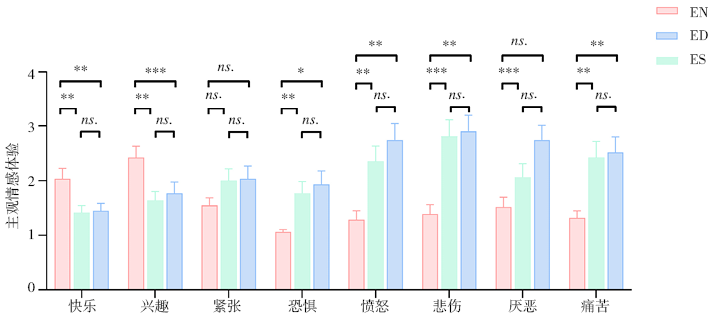
注:*p<0.05,**p<0.01,***p<0.001;ns.=不显著。
图 1 EN(基线条件)、ED(情绪表达)和ES(表达抑制)条件下的情绪评分
Figure 1 Emotion scores under the EN (emotion neutral), ED (emotion display), and ES (expressive suppression) conditions
表 1 三种条件下八种情绪的评分M(SD)
Table 1 Ratings of eight emotions under three conditions M (SD)
| EN | ED | ES | |
| 快乐 | 1.96(1.04) | 1.39(0.69) | 1.36(0.73) |
| 愤怒 | 1.32(0.94) | 2.50(1.58) | 2.93(1.65) |
| 恐惧 | 1.07(0.26) | 1.86(1.21) | 2.04(1.37) |
| 兴趣 | 2.46(1.20) | 1.64(0.87) | 1.82(1.16) |
| 悲伤 | 1.43(1.03) | 3.00(1.68) | 3.11(1.57) |
| 厌恶 | 1.57(1.07) | 2.18(1.39) | 2.93(1.46) |
| 紧张 | 1.61(0.79) | 2.07(1.25) | 2.14(1.33) |
| 痛苦 | 1.36(0.73) | 2.57(1.69) | 2.68(1.56) |
2.5 讨论
在情绪诱发阶段同时进行情绪表达与表达抑制,结果发现两种条件下积极情绪均有所下降,消极情绪上升。但表达条件下的厌恶评分低于抑制条件。结果证明了表达抑制会使负性情绪体验增加(Gross & John,2003;Moore et al.,2008),而情绪表达有助于情绪诱发阶段的情绪释放。因此实验二将继续探究在情绪恢复阶段,两种调节方式对主观体验的影响。
3 实验二:情绪恢复阶段的情绪表达与抑制对主观体验的影响
3.1 被试
使用G*Power 3.1,事前功效分析表明,样本量为54名参与者足以在显著性水平 α=0.05、检验效能 1−β=0.80 的情况下,检测出中等效应量(f=0.25)。为应对可能出现的脱落情况,本实验通过海报广告招募了87名参与者,参与者被随机分配至对照组、表达组与抑制组。其中对照组被试29人(男生13人,女生16人,年龄范围18~24),表达组29人(男生13人,女生16人,年龄范围18~24),抑制组29人(男生13人,女生16人,年龄范围18~24)。所有参与者均为右利手,听力正常,视力正常或经矫正后达到正常水平,且均自述无神经系统或运动功能障碍病史。本实验程序已获苏州大学人体伦理委员会批准,实验结束后,向所有参与者提供了简短的情绪恢复指导,并告知如有需要可联系学校心理健康服务中心。所有参与者均签署了书面知情同意书,并因其参与研究获得了现金报酬。
3.2 实验材料
(1)情绪诱导视频
情绪刺激包括一段负面视频片段——《素媛》。视频时长180秒。为验证视频的有效性,30名未参与主实验的大学生使用自我评估表情量表(SAM)对该视频进行了效价和唤醒度评分,评分采用9级量表,其中效价从1(“最愉悦”)到9(“最悲伤”),唤醒度从1(“非常平静”)到9(“非常强烈”)。评分结果证实,负面视频片段被评定为极度不愉快。(效价2.47±0.73,唤醒度6.97±0.73)。
(2)自我报告情绪评定量表
情绪体验采用自评情绪量表进行评估。国际正性与负性情感量表简版(I-PANAS-SF)由Thompson于2007年基于20项 PANAS 精简编制,包含积极情感(Positive Affect,PA)、消极情感(Negative Affect,NA)两个维度,原10个项目采用5点计分(1=从不~5=总是),适用于跨文化情感测量。我国学者Liu等人(2020)以中国香港4111名7-11年级青少年为样本,对其进行中文版修订与检验:删除文化适配性不佳的“alert(警觉)”项目后,形成9项版量表。信效度结果显示,PA与NA子量表的Cronbach’s α 系数分别为0.81和0.83,内部一致性优秀;效标关联效度良好,且量表在不同性别、不同年级群体中具备严格测量不变性,结构稳定。本研究采用该中文版9项I-PANAS-SF,用于测量社会比较前后阶段,被试的积极与消极情感水平。根据实验一,情绪调节对厌恶评分的影响较为明显,因此在该量表基础上加入“厌恶的”情绪评分。该量表可通过指导语要求被试选择近期或是当前的情绪状态,因此,实验要求被试根据“此时此刻”的情绪状态进行填写,分别记录被试积极和消极情绪的分数。
3.3 实验程序
为与实验一被试内设计互相补充,实验二采用被试间设计。参与者在隔音室内单独接受测试,坐姿距离电脑显示器约70厘米。将被试分为3组,无调节对照组(No-Regulation,NR)、情绪表达组(Emotion Display,ED)、表达抑制组(Expressive Suppression,ES)。参与者被随机分配至三组中,所有参与者分别完成NR、ED或ES实验任务。
在每种条件下,首先会播放一段视频片段。在NR和ED条件下,参与者被要求专心观看视频,期间允许被试有自然的表情或肢体动作。在ES条件下,参与者被要求抑制任何明显的表情和肢体动作。视频结束后,主试引导参与者执行对应的情绪调节操作。在NR条件下,参与者被要求休息两分钟。在ED条件下,主试引导被试从愤怒、悲伤和恐惧三种情绪维度表达自己的情绪并做出相应的发泄动作,时长大约两分钟。在ES条件下,参与者被要求抑制任何明显的表情以及肢体动作,持续两分钟。参与者在观看视频前、观看视频后以及情绪调节后,立即完成正负性情绪量表填写。
3.4 结果
将情绪分为正性情绪和负性情绪,分别对2个情绪类别在视频前、视频后以及情绪调节后三个时间点的测量结果进行分析,采用重复测量方差分析(ANOVAs),其中组别(NR、ED、ES)作为被试间因素,测量时间(视频前、视频后、情绪调节后)为被试内因素。
(1)积极情绪得分
测量时间的主效应显著,F(2,168)=15.76,p<0.001,ηp2=0.158,事后检验发现,观看视频后(M=3.259,SD=0.064)显著高于观看视频前(M=2.917,SD=0.057)和情绪调节后(M=3.057,SD=0.075),观看视频前与情绪调节后得分无显著差异。被试组别主效应不显著,F(2,84)=1.61,p=0.207,ηp2=0.037。测量时间与被试组别交互作用显著,F(4,168)=6.54,p<0.001,ηp2=0.135。简单效应分析发现,观看视频前,NR、ED和ES组积极情绪无差异F(2,84)=0.09,p=0.911,ηp2=0.002;观看视频后、ED和ES组三者积极情绪无差异F(2,84)=0.22,p=0.800,ηp2=0.005;情绪调节后,ED组的积极情绪显著高于NR组与ES组,NR组与ES组无差异F(2,87)=6.74,p=0.002,ηp2=0.138,如表2所示。综合分析发现,情绪表达组的积极情绪显著上升,对照组和抑制组的积极情绪显著回落。这表明,相较于对照组和抑制组,情绪表达能够提升积极情绪水平,如图2所示。
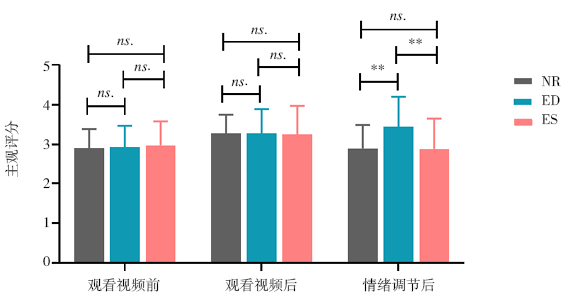
注:*p<0.05,**p<0.01,***p<0.001;ns.=不显著。
图 2 NR(对照组)、ED(表达组)和ES(抑制组)条件下的积极情绪评分
Figure 2 Positive emotion scores under NR (No-Regulation), ED (Emotion Display), and ES (Expressive Suppression) conditions
表 2 三种条件下积极情绪的评分M(SD)
Table 2 Scores for positive emotions under three conditions M(SD)
| 对照组 | 表达组 | 抑制组 | |
| 观看视频前 | 2.89(0.47) | 2.91(0.55) | 2.94(0.57) |
| 观看视频后 | 3.28(0.48) | 3.29(0.62) | 3.20(0.67) |
| 情绪调节后 | 2.87(0.58) | 3.45(0.77) | 2.85(0.75) |
(2)消极情绪得分
测量时间的主效应显著,F(2,168)=85.11,p<0.001,ηp2=0.503,事后检验发现,观看视频后(M=2.473,SD=0.086)显著高于观看视频前(M=1.567,SD=0.059)和情绪调节后(M=2.253,SD=0.086),观看视频前消极情绪水平显著低于情绪调节后(p<0.001)。被试组别主效应不显著,F(2,84)=
2.81,p=0.066,ηp2=0.063。测量时间与被试组别交互作用显著,F(4,168)=7.02,p<0.001,ηp2=0.143。简单效应分析发现,观看视频前,NR、ED和ES组三者消极情绪无差异F(2,84)=0.47,p=0.326,ηp2=0.011;观看视频后、ED和ES组消极情绪无差异F(2,84)=0.25,p=0.777,ηp2=0.006;情绪调节后,ED组的消极情绪显著高于NR组与ES组,NR组与ES组无差异F(2,84)=
9.39,p<0.001,ηp2=0.183。如表3所示,综合分析发现,表达组的消极情绪显著升高,对照组和抑制组无显著变化。这表明,相较于抑制组和对照组,情绪表达会放大消极情绪体验,如图3所示。
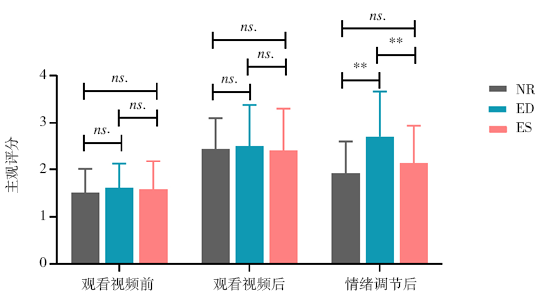
注:*p<0.05,**p<0.01,***p<0.001;ns.=不显著。
图 3 NR(对照组)、ED(表达组)和ES(抑制组)条件下的消极情绪评分
Figure 3 Negative emotion scores under NR (No-Regulation), ED (Emotion Display), and ES (Expressive Suppression) conditions
表 3 三种条件下消极情绪的评分M(SD)
Table 3 Scores for negative emotions under three conditions M(SD)
| 对照组 | 表达组 | 抑制组 | |
| 观看视频前 | 1.49(0.50) | 1.62(0.52) | 1.59(0.61) |
| 观看视频后 | 2.47(0.66) | 2.55(0.85) | 2.40(0.89) |
| 情绪调节后 | 1.88(0.67) | 2.76(0.91) | 2.11(0.82) |
3.5 讨论
在情绪恢复阶段进行情绪表达与表达抑制干预,结果发现,情绪表达条件下个体积极、消极情绪水平均上升,表达抑制条件下两类情绪水平均有所下降。研究结果支持表达抑制在情绪刺激结束后,能够帮助个体恢复生理平衡的观点(Trentini & Dan-Glauser,2023)。与研究假设一致,情绪表达会显著提升情绪恢复阶段的主观情绪体验强度。
4 综合讨论
本研究分别在情绪诱发阶段以及情绪恢复阶段,操控被试采用情绪表达或表达抑制策略,结果发现,两种情绪调节方式对主观情绪体验的影响,取决于调节所处阶段与调节方式类型。在情绪诱发阶段,表达抑制会增强负性情绪体验;情绪表达则可降低负性情绪体验。在情绪诱发结束后的恢复阶段,表达抑制有助于促进情绪恢复;情绪表达可能促进情绪体验的外化,使情绪体验升高。
在实验一中,被试在观看负性情绪视频的情绪诱发阶段,被要求抑制面部表情与肢体动作。结果显示,抑制条件下被试的负性情绪体验显著升高,其中厌恶情绪甚至略高于情绪表达条件。这与Gross提出的情绪调节过程模型一致:作为反应调节策略,表达抑制在情绪生成初期往往效率低,且可能增加个体认知负荷,从而增强主观情绪体验(Gross,1998)。相关实证研究也发现,抑制在情绪诱发阶段会提升生理唤醒和主观负性情绪水平(Butler et al.,2003;Schmeichel et al.,2008)。相较之下,实验二在负性情绪视频结束后增加了三分钟的持续抑制操作,结果显示被试的负性情绪体验相较于情绪表达出现下降。这一结果提示,在情绪诱发事件消失后,持续的表达抑制可能促进个体的情绪恢复。这可能由于,情绪诱发事件结束后,此时抑制策略的认知负荷相对较低,个体的情绪体验更多是前期唤醒的延续,持续抑制可能通过减少对情绪状态的强化,从而促进情绪恢复。这一结果与以往研究相符:抑制在事件结束后可通过阻断行为,降低负性情绪的延续(Richards & Gross,2000;John & Gross,2004)。
另外,从非言语的动作表达到言语与动作相结合的表达方式,两种不同的表达方式对主观体验产生了不一致的影响。实验一采用动作(捏球)作为情绪表达的非言语形式。结果显示,该种非言语表达形式未能即时降低个体的主观情绪体验。在后续实验二中,通过言语与动作相结合的表达方式,进一步强化情绪表达过程,使个体在充分加工并体验情绪的同时,通过行为发泄减少情绪在内部的累积。然而实验二的结果显示,这种方式反而增强了积极和消极的情绪体验。一个可能的解释是,强化的情绪表达方式使个体更加清晰地意识到自身的情绪成分,在当下提高了情绪唤醒水平,从而使情绪体验更为强烈。另外,可能与情绪表达产生的身体反馈机制有关,即面部和身体表达活动反过来能够影响情绪体验及其生理激活水平(Niedenthal,2007)。总体而言,这些结果表明,情绪表达并不必然降低当下主观情绪体验,其对情绪体验的影响在很大程度上取决于表达方式的形式及其对情绪加工的激活程度。
本研究仍存在一定局限性。本研究对情绪调节后效应持续时间的考察仍然有限。虽然能够较好地揭示情绪调节在短时间尺度上的影响,但仍无法明确这种调节后效应能够持续多长时间,也无法判断其是否能够在更长时间间隔内保持稳定。未来研究可以通过设置多个时间间隔,例如在不同时间点检验情绪调节对主观体验影响的持续性及其时间衰减特征。
参考文献
[1] Butler E A, Egloff B, Wilhelm F H, Smith N C, Erickson E A & Gross J J. (2003). The social consequences of expressive suppression. Emotion (Washington, D.C.), 3(1), 48-67.
[2] Ekman P & Friesen W V. (1975). Unmasking the face: A guide to recognizing emotions from facial clues (pp. xii, 212). Prentice-Hall.
[3] Foa E B, Hembree E A & Rothbaum B O. (2007). Prolonged exposure therapy for PTSD: Emotional processing of traumatic experiences: Therapist guide. Oxford University Press.
[4] Frattaroli J. (2006). Experimental disclosure and its moderators: A meta-analysis. Psychological Bulletin, 132(6), 823-865.
[5] Gross J J. (2015). Emotion regulation: Current status and future prospects. Psychological Inquiry, 26(1), 1-26.
[6] Gross J J & John O P. (2003). Individual differences in two emotion regulation processes: Implications for affect, relationships, and well-being. Journal of Personality and Social Psychology, 85(2), 348-362.
[7] Gross J J & Levenson R W. (1993). Emotional suppression: Physiology, self-report, and expressive behavior. Journal of Personality and Social Psychology, 64(6), 970-986.
[8] Gross J J & Levenson R W. (1995). Emotion elicitation using films. Cognition and Emotion, 9(1), 87-108.
[9] Haga M H, Kraft P & Corby E. (2009). Emotion regulation: Antecedents and well- being outcomes of cognitive reappraisal and expressive suppression in cross-cultural samples. Journal of Happiness Studies, 10, 271-291.
[10] Ionescu A, Pascual-Leone A & Vandekerckhove M. (2025). Embracing the bodily felt affective experience: Experiential emotion regulation, a systematic review. Neuroscience and Biobehavioral Reviews, 179, 106456.
[11] John O P & Gross J J. (2004). Healthy and unhealthy emotion regulation: Personality processes, individual differences, and life span development. Journal of Personality, 72(6), 1301-1334.
[12] Lepore S J & Smyth J M. (Eds.). (2002). The writing cure: How expressive writing promotes health and emotional well-being. American Psychological Association.
[13] Lieberman M D, Eisenberger N I, Crockett M J, Tom S M, Pfeifer J H & Way B M. (2007). Putting feelings into words: affect labeling disrupts amygdala activity in response to affective stimuli. Psychological science, 18(5), 421-428.
[14] Liu J D, You R H, Liu H & Chung P K. (2020). Chinese version of the international positive and negative affect schedule short form: Factor structure and measurement invariance. Health and Quality of Life Outcomes, 18(1), 285.
[15] Mennin D S, Holaway R M, Fresco D M, Moore M T & Heimberg R G. (2007). Delineating components of emotion and its dysregulation in anxiety and mood psychopathology. Behavior Therapy, 38(3), 284-302.
[16] Moore S A, Zoellner L A & Mollenholt N. (2008). Are expressive suppression and cognitive reappraisal associated with stress-related symptoms? Behaviour Research and Therapy, 46, 993-1000.
[17] Niedenthal P M. (2007). Embodying emotion. Science, 316(5827), 1002-1005.
[18] Nolen-Hoeksema S, Wisco B E & Lyubomirsky S. (2008). Rethinking rumination. Perspectives on Psychological Science, 3(5), 400-424.
[19] Pennebaker J W. (1997). Writing about emotional experiences as a therapeutic process. Psychological Science, 8(3), 162-166.
[20] Pennebaker J W & Beall S K. (1986). Confronting a traumatic event: toward an understanding of inhibition and disease. Journal of Abnormal Psychology, 95(3), 274-281.
[21] Pennebaker J W & Seagal J D. (1999). Forming a story: The health benefits of narrative. Journal of Clinical Psychology, 55(10), 1243-1254.
[22] Richards J M & Gross J J. (1999). Composure at any cost? The cognitive consequences of emotion suppression. Personality and Social Psychology Bulletin, 25(8), 1033-1044.
[23] Richards J M & Gross J J. (2000). Emotion regulation and memory: The cognitive costs of keeping one’s cool. Journal of Personality and Social Psychology, 79(3), 410-424.
[24] Schmeichel B J, Volokhov R N & Demaree H A. (2008). Working memory capacity and the self-regulation of emotional expression and experience. Journal of personality and social psychology, 95(6), 1526-1540.
[25] Trentini E & Dan-Glauser E. (2023). Use of a difference index approach to analyze the early dynamic efficiency of reappraisal and suppression. Methods in Psychology, 8, 100112.